DD
MM
YYYY

PAGES

DD
MM
YYYY

spot_img

PAGES

Home Blog Page 1149

Tekedia Crypto and Blockchain Weekend Roundup

0

The Saudi Central Bank reportedly disclosed an investment in MicroStrategy ($MSTR) stock, with posts on X claiming a purchase of 25,656 shares. Given MicroStrategy’s significant Bitcoin holdings, this move is widely interpreted as indirect exposure to Bitcoin. The investment aligns with growing institutional interest in crypto but has sparked debate, with some viewing it as a strategic diversification and others as a risky bet with public funds.

The Central Bank of Russia has reported Bitcoin as the top-performing investment asset in 2025, with a 38% return over the past 12 months, outperforming traditional assets like gold, stocks, and bonds. Since 2022, Bitcoin’s cumulative return has reached 121.3%. Its year-to-date performance in 2025 shows a 17.6% return, and in April 2025 alone, it gained 11.2%. This recognition marks a shift in Russia’s stance, as the Central Bank has also included Bitcoin in its financial overview and plans to launch a crypto exchange for qualified investors. However, Bitcoin’s volatility remains notable, with a reported 17.6% drop in Q1 2025.

The Economist published an article on May 17, 2025, titled “Crypto meets the swamp: Why it won’t end well,” labeling cryptocurrency as the “ultimate swamp asset.” It argues that the U.S. crypto industry has shifted from its decentralized ideals to a tool for rent-seeking, particularly benefiting political figures like Donald Trump and his associates. The piece criticizes crypto for facilitating fraud, money-laundering, and financial crime on a large scale, deviating from its original promise of financial freedom.

Abu Dhabi’s sovereign wealth fund, Mubadala Investment Company, disclosed a $408.5 million investment in BlackRock’s iShares Bitcoin Trust (IBIT) ETF, as per a 13F filing with the SEC. This stake, comprising 8.7 million shares as of March 31, 2025, positions Mubadala as one of the largest holders of IBIT, reflecting growing institutional adoption of cryptocurrency. Some reports suggest the investment may have increased to around $461 million, elevating Mubadala to the seventh-largest IBIT holder. This move signals a significant shift, as sovereign wealth funds rarely invest directly in crypto assets, potentially influencing broader market confidence.

The next FTX distribution of over $5 billion to eligible creditors is scheduled to begin on May 30, 2025. Payments will be processed through BitGo or Kraken, with funds expected to reach creditors within 1 to 3 business days. The Ethereum Foundation announced the “Trillion Dollar Security” (1TS) initiative on May 14, 2025, aiming to enhance Ethereum’s security infrastructure to support trillions in onchain assets. The initiative focuses on improving wallet safety, securing smart contracts, enhancing user experience (UX), and strengthening protocol layers.

Key features include smart accounts (ERC-4337), social recovery, spending limits, and advanced key management like MPC and biometrics. This ecosystem-wide effort seeks to boost trust and enable secure mass adoption for both individual and institutional users, positioning Ethereum as a robust global digital asset management platform.

JPMorgan Chase has completed its first public blockchain transaction, settling tokenized U.S. Treasuries outside its private network. The transaction, facilitated by Ondo Finance and leveraging Chainlink’s interoperability technology, marks a significant step for the bank, which has traditionally relied on its private blockchain, Kinexys Digital Payments (formerly JPM Coin). The settlement involved a cross-chain transfer of tokenized short-term Treasuries on Ondo’s public ledger, demonstrating JPMorgan’s move toward integrating with public blockchain infrastructure. This development is seen as a milestone in bridging traditional finance (TradFi) with decentralized finance (DeFi), with potential implications for tokenized real-world assets (RWAs).

Mastercard has partnered with MoonPay to launch stablecoin payment cards, enabling users to spend cryptocurrencies like USDC, USDT, and DAI at over 150 million merchants worldwide. The service converts stablecoins to fiat at the point of sale, powered by MoonPay’s Iron infrastructure.

This expands Mastercard’s crypto push, competing with Visa, despite regulatory uncertainties. The rollout follows Mastercard’s earlier stablecoin payment capabilities announced in April 2025, involving partners like Circle, Nuvei, and Paxos for merchant settlements.

Doodles, a next-generation entertainment company, launched Take Your Medicine, a London-based creative music studio and label, last week. The studio specializes in original music and sound for commercial recording, bridging the gap between commercial and artistic worlds. It has already worked with major brands like Coca-Cola, Samsung, Adidas, Disney, and TikTok, with an EP in development. This follows Doodles’ earlier launch of a namesake record label in July 2024, featuring artists like Lil Wayne and Lil Yachty.

The Infinite Node Foundation (NODE), a nonprofit focused on preserving digital art, acquired the intellectual property (IP) of the CryptoPunks NFT collection from Yuga Labs on May 13, 2025. Yuga Labs, which had purchased the IP from Larva Labs in 2022, transferred it to NODE for an estimated $20 million, though some sources note the amount was undisclosed.

NODE also received a $25 million fund to support its stewardship, which includes preserving the collection, engaging the community, and launching a museum-partnership program to integrate CryptoPunks into leading art institutions.

The acquisition led to a 40% surge in CryptoPunks NFT sales and a 170% increase in trading volume to $2.8 million within 24 hours. Yuga Labs described the transfer as a “full-circle moment” to ensure the collection’s permanence, with Larva Labs founders Matt Hall and John Watkinson returning as advisors.

The Uniswap DAO is currently voting on a proposal to fund the integration of Uniswap V4 on Ethereum and add Unichain support within the Oku platform. This initiative, proposed by GFX Labs, aims to enhance Uniswap’s reach and encourage liquidity migration to Uniswap V4, solidifying its position as a leading decentralized exchange. The proposal includes funding for GFX Labs to integrate these features, develop analytics, and build liquidity tools on Oku. Voting is ongoing and set to conclude on May 18, 2025.
Messari Releases Solana’s Q1 Performance Report, Showing Ecosystem Growth

0

Solana (SOL) is an integrated, open-source Layer-1 network with the goal of synchronizing global information at the speed of light. Solana optimizes for increasing bandwidth and reducing latency. It accomplishes this through features such as its novel timestamp mechanism called Proof-of-History (PoH), a block propagation protocol Turbine, and parallel transaction processing. Since mainnet launch in March 2020, several network upgrades have brought further network performance and resilience, including QUIC, stake-weighted Quality of Service (QoS), and local fee markets.

Development and growth of the network and its ecosystem are supported by the non-profit Solana Foundation, for-profit Solana Labs, and various third-party organizations, including Anza, Colosseum, Helius, and Superteam. Solana Labs has raised over $335 million in private and public token sales. Solana features a growing ecosystem of projects across many sectors, including DeFi, consumer, DePIN, and payments. To stay up-to-date with all things Solana, visit the Solana Portal.

Chain GDP is defined as the total application revenue generated on a network. In Q1 2025, Solana’s Chain GDP grew 20% QoQ from $971 million to $1.2 billion. January was the highest-earning month, bringing in $699 million in revenue to applications on the protocol. The leaders by application revenue in Q1’25 were as follows:

Pump.fun: $257 million (10% QoQ increase)

Phantom: $164 million (25% QoQ increase)

Photon: $122 million (13% QoQ decrease)

BullX: $87 million (19% QoQ increase)

Jupiter: $80 million (79% QoQ increase)

These applications’ revenue is directly correlated to increases in speculation as they facilitate the trading of assets. This was especially apparent when TRUMP and MELANIA launched. Average daily DEX volume (USD) in January grew to $8.3 billion, a 153.4% increase from the average in Q4’24.

App Revenue Capture Ratio (App RCR)

A network’s App Revenue Capture Ratio (RCR) is the ratio of revenue generated by its apps to its Real Economic Value (REV). REV is defined as the sum of base transaction fees, priority fees, and MEV tips paid to validators. App RCR reflects the efficiency with which applications capitalize on the economic activity taking place on the network. The higher the app RCR, the more effectively apps capture the economic activity being generated on the network, suggesting a mature ecosystem with monetizable applications. A low App RCR may signal untapped potential for app developers or inefficiencies in revenue capture. Alternatively, it may signal a nascent ecosystem not yet ready for monetization.

If App RCR equals 20%, this implies that for every $1 of REV generated by the network, $0.20 is captured as revenue by apps. In Q1 2025, App RCR on Solana was 142.8%, a 21% QoQ increase from 117.6% in Q4’24. This can be interpreted as when $100 is spent in transaction fees (and/or Jito tips) to interact with Solana, applications earn $142.80 in revenue.

A network’s App RCR can be greater than 1 when its applications are successful in monetizing activity, driving revenue streams for project teams and potentially, tokenholders. For example, DEXs charging swap fees or NFT marketplaces imposing marketplace fees in excess of transaction fees paid to Solana.

Stablecoin market cap expanded 145.2% QoQ to $12.5 billion. USDC grew 148.4% to $9.7 billion, and USDT grew 154.2% to $2.3 billion. Average Daily DEX volume grew by 40.8% QoQ to $4.6 billion, fueled by renewed memecoin speculation after the TRUMP token launch. Solana Foundation will host the Accelerate conference in May in New York City, featuring two events: Scale or Die, focused on developers, and Ship or Die, focused on product and application teams.

Development and growth of the network and its ecosystem are supported by the non-profit Solana Foundation, for-profit Solana Labs, and various third-party organizations, including Anza, Colosseum, Helius, and Superteam. Solana Labs has raised over $335 million in private and public token sales. Solana features a growing ecosystem of projects across many sectors, including DeFi, consumer, DePIN, and payments. To stay up-to-date with all things Solana, visit the Solana Portal.

DeFi

DeFi TVL (USD) on Solana fell 64% QoQ to $6.6 billion. Still, it ranked second among networks after surpassing TRON in November 2024. DeFi TVL (SOL) grew by 18% QoQ to 53 million SOL. Kamino: Took the lead in TVL, ending with $1.6 billion and a market share of 24% despite its TVL falling 13% QoQ. On Dec. 5, 2024, Kamino introduced Kamino Swap, an intents-based exchange platform that offers zero slippage, fees, and MEV. The beta version first launched with SOL and USDC as the first available tokens, but has since added support for all SPL tokens.

Jupiter Perps: Claimed the second spot, though its TVL decreased 18% QoQ, ending with $1.4 billion and a 21% market share. Raydium: Fell to the third spot with its TVL decreasing 46% QoQ, ending with $1.1 billion and a 17% market share.

DEXs

Average daily spot DEX volume (USD) grew 41% QoQ to $4.6 billion in Q1 2025. This growth can be attributed to the memecoin craze being reignited following the November 2024 U.S. presidential election and continuing into the launch of the TRUMP token in January 2025. On Jan. 18, Solana DEXs did $36 billion in volume, which puts it at about 10% of Nasdaq’s daily volume.

Raydium’s average daily volume increased by 5% QoQ to $2.0 billion with a 43% market share. Read more about Raydium’s recent developments in our State of Raydium Q4 2024 report. Orca saw a 45% increase ($904 million) QoQ in average daily volume, with a market share of 20%. Meteora became the DEX with the third-highest quarterly volume after increasing 3047% QoQ to $839 million and a 18% market share. This was mainly led by the TRUMP, MELANIA, and LIBRA tokens, which launched directly on Meteora.

PumpFun dropped to the fifth-largest DEX by quarterly volume on Solana after decreasing by 11% QoQ in Q1 to $187 million. On March 20, 2025, the team launched PumpSwap. PumpSwap replaced Raydium as the sole trading venue of PumpFun tokens that graduate past their bonding curve. In the last week of the quarter, Pump.fun and Pumpswap averaged $279 million in average daily volume, compared to Raydium at $334 million.

The Jupiter team acquired SonarWatch, Moonshot, Ape Pro, and Drip in Q1’25, aiming to become the Solana DeFi super app. However, Jupiter fell to being the secondary trade source by Q1 spot DEX volume on Solana, with 24% of Q1 spot DEX volume being initiated via the protocol. Raydium took over as the primary trade source on Solana, accounting for 31% of Q1 spot DEX volumes. In March, Titan unveiled its Meta DEX Aggregator which claimed their algorithm beats competitors 80% of the time. Titan’s private beta is now live.

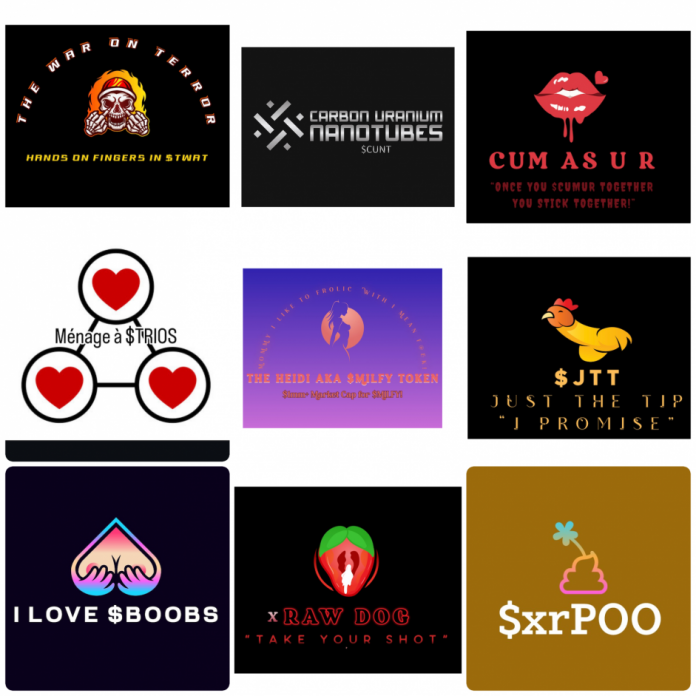
Collect and stack this altseasons 9 most controversial and offensive meme tokens while they are cheap!

0

OffensiveMemeTokens owns each of the tokens mentioned in this press release. This is not investment advice; this is entertainment information if childish, sarcastic, inappropriate and vile humor is your thing. If not, stop reading!

These tokens can be traded on XPMarket and Magnetic decentralized exchanges. All the mine tokens are on the XRPLedger. Token descriptions along with links to each token where additional information can be found:

$xrPOO– “Honoring, celebrating, worshiping and sharing the satisfaction of a nice complete emptying of one’s bowels. However, fleeting that $xrPOO can be! Also, how we feel about XRP currently. These are not mutually exclusive. ;-)”

$TWAT– “The War On Terror ($TWAT) is a global military campaign initiated by the United States following the September 11 attacks in 2001. If you are against terrorism and love freedom show it by owning your own $TWAT. Show off and share your $TWAT to your friends and family. Sell your $TWAT if things get tight buy more $TWAT when things loosen up…..financially. Just make sure you get your hands on fingers in some $TWAT.”

$CUNT– “Carbon Uranium Nanotubes ($CUNT) are hollow cylinders made of C with exceptional properties including high tensile strength and conductivity. U a heavy metal can be adsorbed onto $CUNTs and this interaction has various apps including water purification and electrode materials. Specifically, $CUNTs can act as a filter to remove U from water and can also be used in hybrid nanostructures for ultracapacitors. The $CUNT token utility will further enable develop off this technology and its deployment.”

$TRIOS– “Are you one of the lucky ones? You have had a Ménage à $TRIOS (devils Ménage à $TRIOS does not count!) or maybe you are not “allowed” to have a Ménage à $TRIOS, maybe you don’t have the baller game to pull it off. Whatever the case maybe it doesn’t matter anymore because we all can have a Ménage à $TRIOS now with the XRP Ledger, the $TRIOS token and yourself! What the hell might as well make it a foursome and buy $TRIOS with XRP!”

$MILFY– “The Heidi aka $MILFY Token is in honor of the Mommy I Like to Frolic with and when I say Frolic I mean F@&K! Let’s honor Heidi and make $MILFY explode starting today; Mommy Day 2025! She has asked for a Market Cap of over $1mm (100,000,000 $MILFY = only .01 USD per $MILFY); I believe we can do it. She gets what she wants so let’s PUMP $MILFY Up UP and Up!”

$JTT– “Just The Tip aka $JTT requires no description other than let’s penetrate with $JTT and pump this token up and deep into Altcoin season! Always, remember Just The Tip : “I Promise” ;-)”

$CUMUR– “The Cum As U R (“$CUMUR”) token is here to represent a cummunity that welcomes all. Our motto at the $CUMUR cummunity is “Once you $CUMUR together you stick together!” $CUMUR’s enjoy cumming together multiple times each gathering. We $CUMUR’s enjoy large and small cummunity events. The $CUMUR’s pass ion when cumming together is having a very deep and penetrating experience that only $CUMUR’s cumming together can have. This cummunity definitely is a sticky one; once you are in is hard to pull out!”

$xRAW– “$xRAW Dog live your best life and “Take Your Shot!!!”

$BOOBS– “The token name says it all. I Love $BOOBS!!! This token is for anyone and everyone who loves $BOOBS. Doesn’t matter what kind of $BOOBS because we do not discriminate! Big $BOOBS, tiny $BOOBS, firm $BOOBS, droopy $BOOBS, perky $BOOBS, heavy $BOOBS, side $BOOBS, bouncing $BOOBS, down blouse $BOOBS, natural $BOOBS, fake $BOOBS, lopsided $BOOBS, cold $BOOBS, sweaty $BOOBS, even the word $BOOBS on an upside down calculator!!!! We love and honor $BOOBS at I Love $BOOBS!”

Follow us @OffensiveTokens on X. Drop us a DM if you want us to add an offensive token to the list or to tell us what you think about these tokens.
OffensiveMemeTokens owns each of the tokens mentioned in this press release.

OpenAI Unveils Codex: A Multi-Tasking AI Coding Agent to Assist Developers With Software Engineering Tasks

0

OpenAI has launched a research preview of Codex, an advanced AI coding tool designed to assist developers with various software engineering tasks. The launch signals OpenAI’s deeper push into the competitive AI coding space, currently dominated by players like Amazon, Anthropic, and Google.

Trained with reinforcement learning on real-world coding tasks, the tool generates human-like code, adheres to instructions, and iteratively runs tests to ensure accuracy. Operating in cloud-based sandbox environments preloaded with a user’s repository, Codex supports parallel task execution.

Announcing the launch of the coding tool, OpenAI wrote,

“Today we’re launching a research preview of Codex: a cloud-based software engineering agent that can work on many tasks in parallel. Codex can perform tasks for you such as writing features, answering questions about your codebase, fixing bugs, and proposing pull requests for review; each task runs in its own cloud sandbox environment, preloaded with your repository.”

Codex is powered by codex-1, a version of OpenAI o3 optimized for software engineering. It was trained using reinforcement learning on real-world coding tasks in a variety of environments to generate code that closely mirrors human style and PR preferences, adheres precisely to instructions, and can iteratively run tests until it receives a passing result.

Codex can read and edit files, as well as run commands including test harnesses, linters, and type checkers. Task completion typically takes between 1 and 30 minutes, depending on complexity, and users can monitor Codex’s progress in real time. Once Codex completes a task, it commits its changes in its environment. Also, it provides verifiable evidence of its actions through citations of terminal logs and test outputs, allowing users to trace each step taken during task completion.

Lauding the tool, OpenAI CEO Sam Altman said, “it is amazing and exciting how much software one person is going to be able to create with tools like this. “you can just do things” is one of my favorite memes; i didn’t think it would apply to AI itself, and its users, in such an important way so soon”.

Codex is being gradually rolled out to ChatGPT Pro, Team, and Enterprise users, with availability for Plus and Edu users expected soon. Within OpenAI itself, engineering teams have already incorporated Codex into their daily workflows. It is particularly effective for offloading repetitive or well-defined tasks such as refactoring, renaming, test-writing, and bug fixing. The tool also assists in scaffolding new features, drafting documentation, and managing day-to-day development chores like triaging on-call issues and planning tasks.

By reducing the cognitive load of context-switching and surfacing overlooked to-dos, Codex allows developers to stay focused on more meaningful work. The AI acts as a collaborative partner, enabling engineers to ship code faster and more efficiently.

OpenAI envisions a future in which developers take ownership of high-priority tasks while delegating routine or time-consuming work to AI agents like Codex. To support this shift, the company is building a suite of Codex tools that accommodate both real-time collaboration and asynchronous task delegation.

OpenAI believes that while tools like Codex CLI have made real-time AI-assisted coding the industry standard, the multi-agent, asynchronous workflow introduced through Codex in ChatGPT will soon become the dominant method of producing high-quality software.

Looking ahead, OpenAI plans to introduce more interactive agent workflows that will allow developers to provide guidance mid-task, collaborate on implementation strategies, and receive real-time progress updates—bridging the gap between live coding assistance and autonomous task management.

Shiba Inu (SHIB) 2025 Bull Run Dreams Drift Further Away, But This SHIB Competitor Is Still Set for 15639% ROI

0

The Shiba Inu (SHIB) project lost significant momentum after its initial popularity but now faces even greater challenges to realize its anticipated 2025 bull run as the token continues to struggle for its previous success. Rexas Finance (RXS) stands as a new industry challenger offering investors the potential for a 15,639% return on investment while drawing attention from those searching for the next major crypto opportunity. The struggling SHIB price alongside declining community interest creates an opportunity for RXS to become a utility-focused dominant force by digitally transforming the way global stakeholders can access and trade real-world assets.

RXS: Redefining Asset Ownership and Utility

The Real World Asset (RWA) sector leader Rexas Finance (RXS) introduces blockchain technology to real-world applications while offering tangible assets to the market. The real-world assets tokenization focus of RXS creates a connection between traditional finance systems and decentralized environments that allows everyday investors to access the multi-trillion-dollar global asset market. Users can now conduct transactions involving real estate and commodities and financial instruments on this platform through an innovative system which provides cost-effective and transparent service. Users can access various token standards through RXS platform since it supports ERC-20, ERC-721 and ERC-1155 which enables users to engage with different asset classes.

Rexas Finance Utilities: Beyond the Meme Coin Hype

Rexas Finance differentiates itself from meme coins by creating an extensive practical ecosystem that provides functionalities superior to basic price speculation methods. The platform gives users access to the Rexas Token Builder and Rexas Launchpad tools along with other instruments that enable users and projects to build tokens and run fundraising initiatives easily. The platform’s useful features both promote innovation across the RXS system and draw diverse developers who want to utilize blockchain solutions for practical applications. The RXS platform establishes itself as the preferred solution for tokenized asset management through its institutional-grade security together with multiple blockchain connectors and regulatory compliance features.

Presale Momentum and Imminent Exchange Listing

The current stage of Rexas Finance presale is Stage 12 where each RXS token sells for $0.20. The presale has reached impressive success by completing 92.24% of its goals while raising $48,239,379 from a $56,000,000 target and selling 461,194,606 out of 500,000,000 available RXS tokens. The substantial market response represents increasing investor trust in RXS’s market-changing approach to traditional asset markets. The RXS team has created great anticipation among investors as they plan to list on exchanges at $0.25 on June 19, 2025. Public trading debut following the presale period will create substantial price movements that strengthens RXS’s position as the top crypto performer of 2025.

RXS: A 15,639% ROI Powerhouse

A 15,639% Return on Investment stands as more than a capture-attention headline because it represents the complete transformation power which RXS offers to crypto markets. The declining prospects of Shiba Inu combined with its fading dream of more price surges make RXS emerge as a leadership force in innovation and profitability. Early adopters of RXS can expect life-changing returns because its real-world tokenization capabilities merge with extensive utilities and its successful presale which positions the platform as a competitive strong force in the market. RXS is a project with genuine value and longevity as it already meets leading standards through listings on CoinMarketCap and CoinGecko and has undergone the security audit by Certik.

The Future of Asset Tokenization Belongs to RXS

Rexas Finance along with other projects are driving the crypto market toward utility-driven solutions combined with increased transparency and real-world benefits for investors beyond mere hype. The projected 15,639% ROI for RXS represents both the project’s strong development potential and a wider trend shift within crypto asset investments. The RXS presale remains in its last stages where completion exceeds 92% while an upcoming major exchange listing positions the project to become the digital asset investment leader of its time. Rexas Finance provides a dependable solution for individuals who want to shift away from meme coin risks and establish ownership in the emerging asset market.


Website: https://rexas.com

Whitepaper: https://rexas.com/rexas-whitepaper.pdf

Twitter/X: https://x.com/rexasfinance

Telegram: https://t.me/rexasfinance