DD
MM
YYYY

PAGES

DD
MM
YYYY

spot_img

PAGES

Home Blog Page 1164

NODE Acquisition of CryptoPunks IP Positions It As a Cornerstone for Digital Art Preservation

0

The Infinite Node Foundation (NODE), a nonprofit focused on preserving digital art, acquired the intellectual property (IP) of the CryptoPunks NFT collection from Yuga Labs on May 13, 2025. Yuga Labs, which had purchased the IP from Larva Labs in 2022, transferred it to NODE for an estimated $20 million, though some sources note the amount was undisclosed.

NODE also received a $25 million fund to support its stewardship, which includes preserving the collection, engaging the community, and launching a museum-partnership program to integrate CryptoPunks into leading art institutions. The acquisition led to a 40% surge in CryptoPunks NFT sales and a 170% increase in trading volume to $2.8 million within 24 hours.

Yuga Labs described the transfer as a “full-circle moment” to ensure the collection’s permanence, with Larva Labs founders Matt Hall and John Watkinson returning as advisors. Some X posts question whether the $20 million price was undervalued, reflecting mixed sentiment among holders.

The acquisition of the CryptoPunks IP by the Infinite Node Foundation (NODE) from Yuga Labs has significant implications for the NFT ecosystem, digital art preservation, and the CryptoPunks community, while also highlighting a divide in stakeholder perspectives. NODE’s nonprofit status and mission to preserve digital art position CryptoPunks as a cultural artifact rather than a speculative asset.

The planned museum-partnership program aims to integrate the collection into prestigious art institutions, potentially elevating its status in the traditional art world. The $25 million stewardship fund ensures long-term maintenance, including blockchain integrity and community engagement, reducing risks of neglect or mismanagement.

The acquisition triggered a 40% surge in CryptoPunks sales and a 170% increase in trading volume to $2.8 million within 24 hours, signaling renewed market interest. However, the NFT market’s volatility suggests this may not guarantee sustained value growth. Transferring IP to a nonprofit could stabilize the collection’s perceived value by removing it from purely commercial motives, but it may also limit future profit-driven initiatives that some investors expected from Yuga Labs.

The return of Larva Labs founders Matt Hall and John Watkinson as advisors strengthens NODE’s credibility and aligns with the collection’s origins, potentially fostering community trust. NODE’s community engagement plans, including potential decentralized governance models, could empower CryptoPunks holders, though details remain unclear.

This move sets a precedent for nonprofit stewardship of digital assets, which could inspire similar models for other iconic NFT collections, balancing commercialization with cultural preservation. It highlights the maturing NFT space, where projects transition from speculative hype to long-term cultural significance.

Many see NODE’s involvement as a win for digital art, ensuring CryptoPunks’ longevity beyond market cycles. The nonprofit model is praised for prioritizing cultural value over profit. Some holders and enthusiasts welcome the return of Larva Labs founders and NODE’s community-focused approach, expecting more inclusive governance and creative initiatives.

The immediate sales and volume spike fueled optimism among traders who view the acquisition as a catalyst for renewed interest and price appreciation. Some X posts question whether the $20 million price tag undervalues CryptoPunks, given their historical significance and prior sales (e.g., individual Punks sold for millions). Critics argue Yuga Labs may have offloaded the IP at a discount, potentially shortchanging holders expecting higher commercial exploitation.

Investors who anticipated Yuga Labs’ commercial strategies (e.g., media or metaverse integrations) worry that NODE’s nonprofit focus could cap financial upside, prioritizing art over profit. While NODE promises community engagement, lack of clarity on how holders will influence decisions has sparked skepticism. Some fear a disconnect between NODE’s vision and the community’s speculative interests.

Positive posts celebrate the “decentralized ethos” and cultural preservation, with users like NFTCollector praising NODE’s mission. Negative posts, such as those from CryptoSpeculator, express frustration over the “lowball” sale price and potential loss of commercial potential, reflecting a divide between art-focused and profit-driven holders.

The acquisition positions CryptoPunks as a cornerstone of digital art preservation, with NODE’s nonprofit model offering stability and cultural legitimacy. However, it also underscores a divide between those who value long-term legacy and those prioritizing financial returns. The success of NODE’s stewardship will depend on balancing these interests through transparent governance and effective community engagement, while navigating the broader NFT market’s evolution.

Trump Secures $243.5bn in Deals with Qatar, Eyes $1.2tn Economic Pact

0

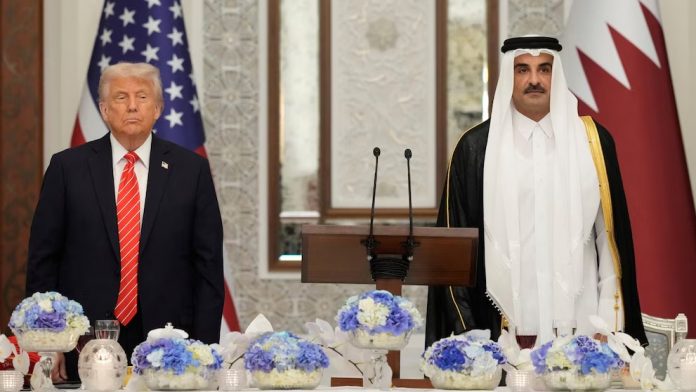
U.S. President Donald Trump’s visit to Qatar, according to the White House, has culminated in a cascade of deals worth more than $243.5 billion, a staggering package that combines defense, aviation, energy and tech partnerships — and sets the stage for an even more ambitious $1.2 trillion economic pledge with the Gulf nation.

While the final tally fell short of Trump’s earlier projections of locking down $1 trillion in Saudi pledges alone, the White House cast the Qatar leg as a critical win in the president’s broader campaign to steer Gulf wealth into the American economy and manufacturing base.

“The landmark deals celebrated today will drive innovation and prosperity for generations, bolster American manufacturing and technological leadership, and put America on the path to a new Golden Age,” the White House said in a statement, emphasizing how central foreign investment has become to Trump’s economic diplomacy.

Qatar’s contribution came just 24 hours after Trump touted $600 billion in investment commitments from Saudi Arabia, as part of a wider regional charm offensive aimed at reinforcing America’s strategic and commercial footprint in the Middle East.

The Boeing Coup: $96 Billion Dreamliner Deal

Among the biggest headlines was a $96 billion plan by Qatar Airways to acquire up to 210 Boeing aircraft, including the 787 Dreamliner and the next-generation 777X. The White House described it as the largest-ever widebody aircraft order and the single largest order of 787s in aviation history.

For Trump, it’s a political trophy. The deal is expected to support thousands of American aerospace jobs and inject momentum into Boeing’s commercial aviation division, which has faced recent turbulence amid production flaws and delivery delays.

$3 Billion in Defense Contracts

Qatar’s growing security alliance with Washington was further strengthened through two major defense deals:

  • A $1 billion agreement with Raytheon to supply counter-drone systems, making Qatar the first international buyer of the company’s Fixed Site-Low, Slow, Small Unmanned Aerial System Integrated Defeat System, which is tailored to counter emerging threats from small unmanned aircraft.
  • A $2 billion deal with General Atomics for the purchase of MQ-9B drones, an advanced surveillance and strike platform deployed widely by U.S. forces.

The two nations also signed a statement of intent for $28 billion in future security investments, which may span cyberwarfare, airspace monitoring, missile systems, and classified intelligence-sharing arrangements.

Al Udeid As a U.S. Anchor in the Gulf

Qatar’s value to U.S. defense planning has been cemented by its hosting of Al Udeid Air Base, the largest American military installation in the Middle East. It serves as the forward operating center for U.S. Central Command (CENTCOM).

An agreement signed last year ensures American troop presence at Al Udeid for at least another decade, making Qatar indispensable to U.S. power projection in the region.

In 2022, former President Joe Biden designated Qatar a major non-NATO ally, formally elevating its role in America’s global security framework.

Trump Also Secured Personal Business

Amid the flurry of official signings, the Trump Organization quietly scored its own deal. The family business has partnered with local developers to build a golf course, clubhouse, and beachfront villas along Qatar’s coast. The deal reflects a growing pattern of commercial entanglements that blur lines between Trump’s political leadership and private empire — a convergence that has drawn scrutiny from ethics watchdogs.

However, Gulf leaders appear undeterred. Trump’s reputation for transactional diplomacy has made him a preferred interlocutor among Arab monarchies eager to bypass the slow-moving Washington bureaucracy.

$8.5 Billion Energy Alliance and $97 Billion in Infrastructure Projects

Energy and infrastructure also featured heavily:

  • McDermott International and QatarEnergy signed an $8.5 billion energy infrastructure agreement, likely covering liquefied natural gas, petrochemical, and deepwater extraction projects.
  • U.S. engineering giant Parsons Corp. was linked to 30 Qatari projects worth up to $97 billion, covering urban design, smart city infrastructure, and transport modernization.

$1 Billion in U.S. Quantum Leap Tech

In a nod to next-generation technology, Qatar’s Al Rabban Capital will invest up to $1 billion in U.S.-based quantum computing firm Quantinuum. The deal covers not just R&D but also workforce development, signaling Doha’s ambitions to integrate into America’s high-tech sector at a foundational level.

A Pattern Emerges

Qatar’s investment surge mirrors similar moves by Saudi Arabia and the UAE, which Trump is expected to visit next. The deals are part of a wider Gulf strategy to buy deeper ties to Washington through direct investment, while securing defense equipment, economic diversification, and political backing amid regional rivalries and shifting alliances.

At the same time, these agreements reinforce Trump’s pitch at home: that his brand of diplomacy delivers tangible economic benefits, especially for American firms and workers. With Boeing, Raytheon, General Atomics, and McDermott all poised to benefit, the president is banking on these deals to paint a picture of job creation, even as broader concerns persist about automation and AI displacing workers in those same sectors.

Trump’s next stop is Abu Dhabi, where another wave of deals is expected. If Qatar’s haul is any indication, the president is likely to use his Gulf tour not just to shape foreign policy, but to sculpt a legacy of global economic influence.

Amazon Cuts 100 Jobs Amid Ongoing Cost-Cutting Efforts

0

E-commerce giant Amazon has on Wednesday confirmed that it is laying off approximately 100 employees in its devices and services division, amidst ongoing cost-cutting efforts.

The devices and services unit comprise many businesses, including the Alexa Voice assistant, Echo Hardware, Ring Video doorbells, and Zoox robotaxis.

Speaking on the layoff, Amazon spokesperson Kristy Schmidt said,

“As part of our ongoing work to make our teams and programs operate more efficiently, and to better align with our product roadmap, we’ve made the difficult decision to eliminate a small number of roles. We don’t make these decisions lightly, and we’re committed to supporting affected employees through their transitions.”

The company did not specify which units within the division were impacted; however, it noted that it will continue to hire within the devices and services division.

Amazon’s workforce saw rapid expansion during the pandemic, growing from 798,000 employees in 2019 to over 1.6 million by the end of 2021. However, as consumer demand stabilized, the company began recalibrating its staffing levels. Over the past two years, Amazon has already laid off 27,000 employees, primarily in corporate roles, as part of a cost-cutting effort. By late 2024, its global workforce stood at approximately 1.5 million, including 350,000 corporate employees and over a million frontline workers in warehouse and delivery operations.

In recent months Amazon has faced significant scrutiny over its return-to-office policy, particularly as it unfolds in tandem with a series of large-scale layoffs. The mandate requires employees to work from the office five days a week, a directive that has been met with resistance from many within the workforce.

Jassy set a target to increase the ratio of individual contributors to managers by at least 15% by the end of Q1 2025. The rationale behind Amazon’s firm stance on returning to office likely intersects with its broader business strategy, particularly as it relates to layoffs and restructuring efforts. With a focus on “conscious unbossing,” Amazon aims to flatten its hierarchical structure, purportedly to increase speed and efficiency in decision-making.

The recent job cuts of 100 workers, is coming after the company in March this year, laid off 14,000 managerial employees, as part of a sweeping restructuring plan aimed at increasing efficiency and reducing costs. The move, which represented a 13% reduction in the company’s global management workforce, is expected to save Amazon between $2.1 billion and $3.6 billion annually. 

By the first quarter of 2025, Amazon plans to increase the ratio of individual contributors to managers by at least 15%, a strategy designed to accelerate decision-making and enhance operational efficiency. A Morgan Stanley report released in October 2024 also projected that Amazon’s restructuring might cut nearly 13,834 managerial roles by early this year.

The financial services company also estimated that the cost per manager at Amazon ranged between $200,000 and $350,000 a year. According to sources, Jassy has been vocal about reducing bureaucratic layers that slow down processes, reinforcing his vision of making Amazon function more like a nimble startup.

Jassy’s move to trim the organization comes at a time when Amazon, like many tech companies, is contending with economic challenges. Other tech giants are also downsizing. On Tuesday, Microsoft announced it would cut approximately 6,000 jobs to reduce management layers. These layoffs are part of a broader trend in the tech industry, where companies are grappling with slowing revenue growth and rising costs after years of rapid expansion.

Uniswap DAO Voting to Add Support and Integrate Unichain on Oku Platform

0

The Uniswap DAO is currently voting on a proposal to fund the integration of Uniswap V4 on Ethereum and add Unichain support within the Oku platform. This initiative, proposed by GFX Labs, aims to enhance Uniswap’s reach and encourage liquidity migration to Uniswap V4, solidifying its position as a leading decentralized exchange.

The proposal includes funding for GFX Labs to integrate these features, develop analytics, and build liquidity tools on Oku. Voting is ongoing and set to conclude on May 18, 2025. The Uniswap DAO’s vote to fund the integration of Uniswap V4 on Ethereum and Unichain support on Oku, proposed by GFX Labs, carries significant implications for the Uniswap ecosystem, decentralized finance (DeFi), and the broader crypto landscape.

Integrating Uniswap V4 into Oku, a DeFi interface developed by GFX Labs, aims to expand Uniswap’s accessibility across Ethereum and Unichain, a layer-2 network. This could drive liquidity migration to V4, which introduces customizable liquidity pools via “hooks” for advanced trading strategies.

By supporting Unichain, Uniswap strengthens its presence on a high-throughput, low-cost network, potentially attracting users and developers seeking scalable DeFi solutions. This aligns with Uniswap’s goal to remain the leading decentralized exchange (DEX) amid competition from rivals like Sushiswap or Curve.

The proposal includes funding for analytics and liquidity tools on Oku, which could improve user experience and provide data-driven insights, further incentivizing adoption. Unichain, supported by over 80 apps including Circle and Coinbase, is positioned as a key layer-2 solution for DeFi. Funding its integration on Oku could accelerate its adoption, drawing more projects and liquidity to the network. Unichain is already capturing significant Uniswap V4 volume (75%, with Ethereum below 20%), indicating a potential shift in DEX activity from Ethereum’s mainnet to layer-2 solutions.

DAO’s Strategic Investment and Governance

The proposed $250,000 allocation to GFX Labs, alongside a blanket license exemption for future V4 integrations, reflects the DAO’s willingness to invest in third-party platforms to extend Uniswap’s reach. This move could set a precedent for similar partnerships, decentralizing Uniswap’s growth strategy. Previous DAO votes, such as the $165M funding plan for Unichain and V4 growth, indicate a broader commitment to scaling Uniswap’s infrastructure.

This proposal builds on that momentum, potentially increasing the DAO’s influence over DeFi innovation. Uniswap V4 and Unichain are seen as transformative for the DEX space, with V4’s hooks enabling tailored liquidity solutions and Unichain offering scalability. Successful integration on Oku could reinforce Uniswap’s market leadership, especially as competitors adopt similar layer-2 strategies.

However, the focus on Unichain raises questions about Ethereum’s long-term role in Uniswap’s ecosystem, potentially fragmenting liquidity across networks if not managed carefully. Integrating V4’s complex hooks into Oku requires robust development to avoid vulnerabilities. Inadequately designed hooks could harm users or the protocol, as noted in prior Uniswap Foundation grants studying hook-related risks.

The $250,000 allocation, while modest compared to the DAO’s $50M token incentives or $113M treasury delegation, must deliver measurable outcomes to justify the cost. Critics may question the ROI if liquidity migration underperforms. Granting GFX Labs a blanket license exemption could spark debate about favoritism or reduced oversight, potentially alienating other developers seeking similar exemptions.

The proposal has likely created a divide within the Uniswap DAO and its community, as governance decisions often balance innovation with risk and ideology. Below are the key points of contention, inferred from available sources and community dynamics. Advocates argue that Unichain’s scalability and low fees are critical for Uniswap’s growth, especially as layer-2 solutions gain traction.

The X post claiming 75% of V4 volume on Unichain suggests some community members see it as the future of DeFi, potentially at Ethereum’s expense. This group likely supports the proposal to capture layer-2 market share. Others may resist prioritizing Unichain, viewing Ethereum as the backbone of DeFi’s security and decentralization. The reported drop in Ethereum’s V4 volume (below 20%) could alarm this group, who may fear liquidity fragmentation or a loss of Ethereum’s dominance. They might argue for focusing resources on Ethereum-based V4 integrations.

Supporters, likely including GFX Labs and Oku-aligned stakeholders, see the $250,000 as a strategic investment to boost Uniswap’s ecosystem. They point to prior DAO successes, like the $165M funding plan, as evidence of effective capital deployment. Critics may question the allocation’s value, especially given the DAO’s history of large expenditures (e.g., $46.2M to the Uniswap Foundation). They might demand clearer metrics for success or worry about over-reliance on third-party platforms like Oku, which could divert focus from Uniswap Labs’ core offerings.

Some community members may support the blanket license exemption for GFX Labs, viewing it as a pragmatic way to accelerate V4 adoption across networks. This group likely values speed and flexibility in governance. Others may see the exemption as a governance red flag, arguing it risks centralizing control or undermining the DAO’s licensing framework. This divide reflects broader tensions about balancing openness with protocol integrity.

A vocal minority, as noted in prior governance discussions, may argue that Unichain’s benefits accrue more to Uniswap Labs or external stakeholders than the DAO itself. They might demand that funds be used for initiatives directly tied to UNI token holders, such as staking rewards or buybacks, rather than ecosystem expansion. In contrast, expansionists likely argue that growing Uniswap’s reach indirectly strengthens the DAO by increasing protocol usage and UNI’s long-term value.

The Uniswap DAO has a history of bold funding decisions, such as the $50M token incentives and $113M treasury delegation, suggesting a leaning toward growth-oriented proposals. However, governance reviews indicate ongoing debates about accountability and measurable outcomes. If the proposal passes, it could boost UNI’s price by signaling proactive governance and ecosystem growth.

However, failure to deliver on liquidity migration or technical integration could dampen sentiment, especially if competitors capitalize on Uniswap’s layer-2 pivot. The Uniswap DAO’s vote on funding Uniswap V4 and Unichain integration on Oku is a pivotal moment for the protocol’s evolution. It promises to enhance Uniswap’s reach, liquidity, and competitiveness but introduces risks around technical execution, financial ROI, and community alignment.

The divide centers on Unichain’s role versus Ethereum’s legacy, the value of funding Oku, and governance transparency. By May 18, 2025, the outcome will signal whether the DAO prioritizes bold expansion or cautious consolidation, shaping Uniswap’s trajectory in the DeFi landscape.

World Bank Criticizes ‘Ineffective’ CBN’s OMO Strategy, Urges Policy Reforms Ahead of MPC Meeting

0

The World Bank has taken a rare swipe at the Central Bank of Nigeria’s (CBN) monetary tightening strategy, specifically questioning the effectiveness of its Open Market Operations (OMO) framework.

In its latest Nigeria Development Update released this week, titled “Building Momentum for Inclusive Growth,” the global lender flagged several flaws in Nigeria’s monetary transmission mechanisms, urging urgent reforms to support credit expansion and improve liquidity management.

While the World Bank commended the CBN’s overall commitment to stabilizing the economy through tight monetary policy, it warned that certain tools, particularly the deployment of OMO, are undermining the broader goals of macroeconomic stability and credit availability.

Misalignment in Interest Rates

The World Bank’s report highlighted that Nigeria’s short-term interbank rates are floating between the central bank’s Standard Deposit Facility (SDF) and Standard Lending Facility (SLF) rather than aligning with the Monetary Policy Rate (MPR).

Currently, the MPR stands at 27.5%, but banks are able to earn 26.5% on deposits placed with the CBN through the SDF and are charged 32.5% when they borrow from the SLF. This disparity, according to the World Bank, points to an inefficient transmission of monetary policy and an inability to effectively steer interest rates across the financial system.

It indicated that interbank rates should be broadly stable around the MPR, calling the current trend a sign of liquidity management constraints within the Nigerian financial system.

Is The OMO for Liquidity Control or FX Tool?

OMO bills are traditionally used to control money supply in the banking sector, helping to mop up excess liquidity that could fuel inflation. But the World Bank expressed concern that the CBN is using OMO instruments not just for domestic liquidity control but also to manage foreign exchange (FX) volatility.

In recent months, the CBN has been exchanging OMO bills for U.S. dollars in a bid to stabilize the naira—a move the World Bank believes is distorting the purpose of monetary policy instruments.

As part of its recommendations, the Bank suggested:

  • Shortening the maturities of OMO bills to make them more agile in mopping up short-term liquidity.
  • Limiting OMO participation to domestic investors could reduce speculative carry trades and avoid the distortions caused by foreign capital flows.

The bank warned that restricting access to domestic investors could increase the effectiveness of the instrument in mopping up excess naira liquidity, adding that it could also help eliminate the segmentation of Nigeria’s yield curve, where CBN and Federal Government of Nigeria (FGN) securities of the same maturity attract different rates.

“It could also help channel longer-term lending to the private and public sectors, and eliminate the current segmentation of the yield curve between CBN and FGN securities of the same tenors,” the report said.

Manufacturers and Credit Access

Nigeria’s private sector, especially manufacturers, has long struggled under the burden of high interest rates and limited access to credit. The World Bank echoed these concerns, warning that the current monetary policy mix is strangling productive sectors and discouraging lending to small and medium enterprises (SMEs).

While inflation control remains a priority, the report stresses the need to recalibrate certain tools, such as the Cash Reserve Ratio (CRR), to free up credit. The World Bank advised that over time, the CRR should be redefined as a prudential tool rather than a blunt monetary instrument.

Call for SLF Reforms

The World Bank also called attention to existing restrictions on the Standard Lending Facility (SLF), which prevent banks from accessing it when they are engaged in other CBN transactions. It recommended to lift such restrictions and narrow the gap between the SLF and the MPR to bring greater stability to short-term interest rates.

The critique lands ahead of a key Monetary Policy Committee (MPC) meeting scheduled for Monday, May 19, where the CBN will deliberate on the direction of monetary policy. Since November 2024, the apex bank has maintained the benchmark interest rate at 27.5%, citing inflationary pressure as justification for its hawkish stance.

Despite these elevated rates, Nigeria’s money supply continues to expand rapidly. As of March 2025, broad money supply (M3) stood at N114.2 trillion, a sharp increase from N92.3 trillion recorded a year earlier. The rise in liquidity suggests that the CBN’s policy tightening has not translated into effective control of monetary aggregates.

The World Bank’s unusually blunt remarks are expected to draw serious attention within Nigeria’s monetary policy circles. While the CBN under Governor Olayemi Cardoso has won praise for its bold stance on inflation control, the latest data, and now, external criticism, suggest that monetary policy transmission remains deeply flawed.

If adopted, the World Bank’s recommendations could signal a shift toward a more calibrated, less rigid monetary framework. However, it is not certain whether the CBN will respond with reforms at the upcoming MPC meeting or continue to double down on its current policy approach.

For manufacturers, SMEs, and retail borrowers, any shift that results in better credit conditions would be welcome. But for now, the broader Nigerian economy remains caught between a rising money supply and a high-interest-rate environment—conditions that even multilateral lenders now admit are working at cross-purposes.