As the 2025 bull market takes shape, seasoned investors are beginning to shift their focus from established giants like Bitcoin (BTC) and Ripple (XRP) toward emerging opportunities with higher upside potential. One standout is Lightchain AI—a project blending artificial intelligence with blockchain to create a scalable, decentralized infrastructure for intelligent applications.
Currently in presale at $0.007, Lightchain AI has already raised $18.4 million, underscoring rising confidence from early backers. With a strong roadmap, transparent governance, and real-world utility, smart investors are eyeing this altcoin as a future leader. For those seeking exponential growth, Lightchain AI is shaping up to be the smarter bet.
Bitcoin and Ripple- Established Yet Facing Challenges
Bitcoin (BTC) and Ripple (XRP) are well-known cryptographic assets and they have played a significant role in the crypto market. Bitcoin, also the digital alternative to gold, had been on a mission to become stable and kept dealing with numerous challenges. Bitcoin price has been marked out with high volatilities since 2025; thus, it fell from the highest $106,000 at the end of January to $77,000 in March, which is the sign of the increasing volatility in the market. Such huge volatility has made it hard for some institutional investors who are searching for the unmovable assets.
Ripple, which is very much famous for its niche in cross-border payments, was a victim of legal battles. In fanuary 2022, Ripple Labs decided to settle the dispute with the U.S. which also led to the company paying a 50 million dollar fine to the regulator for the unregistered security sales. Inspite of this lawsuit, it harbors the XRP sales primarily for institutional objective, thus facing a $125 million fine plus non-disclosure of some of the transactions.
These two cryptocurrencies are dealing with tricky regulations in the crypto space and also with the market dynamics. Their success in handling these hurdles is going to directly affect them in the utilization of their roles and also the stability of the digital economy that is changing.
Why Investors Are Turning to Lightchain AI
In 2025, Lightchain AI distinguishes itself through its advanced integration of blockchain and AI, offering practical, real-world applications that go beyond speculative trends. Its well-structured tokenomics are a key draw for investors, with 40% of the 10 billion total token supply allocated to presale and 28.5% reserved for staking rewards.
This strategic approach supports both short-term adoption and long-term sustainability. The project’s focus on open-source development, cross-chain compatibility, and scalable infrastructure positions it as a leader in the industry.
With a comprehensive roadmap guiding its evolution from prototype to global adoption, paired with robust tokenomics tailored to long-term engagement, Lightchain AI is capturing the attention of developers, investors, and institutions alike. It is not merely following current market trends but actively shaping the future of intelligent blockchain networks.
Lightchain AI – Next Big Thing in Crypto Investment
Bitcoin and Ripple may have laid the foundation for the crypto world, but the game is evolving. Investors now want more than just a store of value or payment solutions—they’re looking for innovation, utility, and growth. Enter Lightchain AI; a groundbreaking combination of artificial intelligence, top-tier security, and decentralized governance that’s set to redefine the blockchain landscape.
With a wildly successful presale and bold development plans, Lightchain AI is the project smart investors are watching closely. Looking for long-term gains? This could be your golden ticket. As the focus shifts to high-utility crypto projects, Lightchain AI stands out as the ultimate choice for those ready to invest in the future. Don’t just follow the trend—lead it.
In a sweeping policy shift that could reshape the U.S. auto industry’s supply chain calculus, Commerce Secretary Howard Lutnick announced that vehicles with at least 85% domestic content will be fully exempt from the incoming auto tariffs set to take effect later this year.
That new threshold, while ostensibly neutral, leaves just one automaker in the clear: Tesla.
According to the latest figures from American University’s Kogod School of Business, only three vehicles currently meet the 85% domestic content benchmark — one variant of the Tesla Model 3 and two versions of the Tesla Model Y. Every other automaker, including legacy players like Ford, GM, Honda, and Toyota, falls short.
The new tariff structure is two-tiered: a baseline 10% tariff on all foreign automobiles and components, and a steep 25% rate for vehicles and parts that don’t meet local content minimums. While automakers can still apply for a limited-time rebate program to recoup some of the costs, the window for that assistance closes in two years.
Failing to clear the 85% mark now creates serious pricing and regulatory headwinds. Automakers will either need to rapidly reconfigure their supply chains — a costly and complex endeavor — or absorb the tariff burden at the expense of their margins and competitive pricing.
Policy or Favoritism?
The policy, while presented as a measure to bolster American manufacturing, is being met with skepticism across the auto sector and political spectrum. The decision to set the exemption bar at precisely 85% has raised eyebrows, as only Tesla meets that threshold today.
In fact, even the Ford Mustang, one of the most American cars by branding and legacy, doesn’t quite qualify. Nor does the Alabama-assembled Honda Passport. That few-percentage-point gap now determines whether a model is subject to hefty tariffs or not.
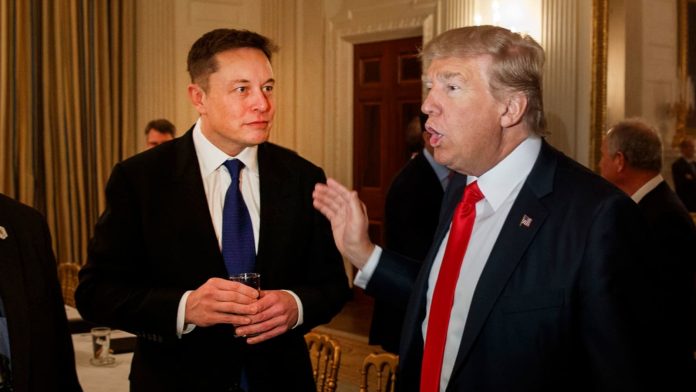
Tesla CEO Elon Musk, who has become a recurring presence at the White House in recent weeks, appears to have reaped significant political capital from those visits. While the company has posted sharp revenue declines, its profits fell 71% year-over-year amid public backlash tied to Musk’s political associations, Tesla’s stock jumped 10% after news broke last week of another regulatory rollback that favored the company.
The rollback in question: the end of a federal rule requiring automakers to report non-fatal crashes involving partially automated vehicles. The Department of Transportation announced that only Level 2 autonomous systems, like Tesla’s Autopilot, would be exempted from the crash reporting mandate. Musk had previously criticized the rule, arguing it unfairly cast Tesla in a negative light.
Industry safety analysts, however, warned that eliminating reporting requirements could reduce transparency, making it harder for regulators and consumers to monitor potential flaws in automated driving systems.
A Regulatory Pattern Favoring Tesla
Taken together, these moves reflect a broader regulatory climate that appears to increasingly accommodate Musk’s agenda. First, the White House moved to lighten the regulatory load on self-driving tech. Now, it has structured a sweeping tariff exemption around a domestic sourcing threshold that only Tesla currently meets.
Other automakers, like GM and Ford, which have long argued that global supply chains are essential to staying cost-competitive, now face urgent questions about their reliance on foreign components. Japanese and European manufacturers, even those that assemble vehicles in the U.S., may find themselves boxed out of tariff exemptions unless they significantly overhaul sourcing strategies.
Smaller EV startups that rely heavily on imported components from China, including Rivian and Lucid, will be particularly hard-hit. Many have yet to build deep domestic supply chains and may struggle to scale production under the new cost burden.
Business as Politics
The timing of the executive order — released late Monday evening alongside a White House fact sheet — has only added to the sense that business and politics are increasingly intertwined. The fact sheet confirmed the new tariff guidelines but did not address why 85% was chosen as the cutoff. Nor did it provide clarity on how domestic content will be verified or audited.
As scrutiny intensifies, critics say the administration’s close ties to Musk risk blurring the line between fair industrial policy and favoritism.
Whether these changes help revive domestic manufacturing or simply reward the most politically connected players are left to the future. What’s clear is that the road ahead for the U.S. auto sector now leads through Tesla — a company that increasingly shapes not just cars, but policy itself.
The executive order will be published in the federal register later this week, with further guidance expected for automakers and suppliers navigating the complex new rules. Industry leaders, meanwhile, are scrambling to assess how quickly they can restructure operations to avoid steep penalties — or whether, in today’s Washington, playing catch-up with Tesla is even possible.
President Donald Trump personally pressured Amazon founder Jeff Bezos on Tuesday to abandon a plan that would have exposed how the administration’s new tariffs are hitting American pockets, a rare and direct intervention in the pricing strategy of one of the world’s largest online retailers.
According to sources familiar with the matter, Trump placed a phone call to Bezos early Tuesday after Punchbowl News reported that Amazon was preparing to roll out a feature that would display U.S. import tariff costs next to product prices. The feature, aimed at increasing transparency, would have informed buyers how much of what they paid was due to newly imposed duties — particularly the sweeping 145% tariff the administration has levied on Chinese imports.
The response from the White House was swift and hostile. Within hours of the report, Amazon issued a statement walking back the proposal, first claiming it was only being considered for “Amazon Haul,” a subsection focused on budget-conscious shoppers. But in a follow-up comment later in the day, the company disavowed the idea entirely, stating the plan was “never approved” and “is not going to happen.”
The sequence of events has raised concerns about the administration’s efforts to suppress visibility into the real-world consequences of its trade policies. While President Trump has repeatedly portrayed his tariff agenda as a tool to reverse decades of economic imbalance and reduce the U.S. trade deficit, analysts have warned that the true cost will be borne by American consumers, a fact that Amazon’s shelved feature would have made uncomfortably clear.
In public remarks, Trump has pitched tariffs as a patriotic lever to bring back manufacturing, punish China for years of trade violations, and “put American workers first.” He has insisted that foreign exporters, particularly China, would shoulder the cost of these duties.
However, economists across the spectrum agree that tariffs function as taxes on imports, which are almost always passed on to U.S. retailers and ultimately consumers.
The Amazon plan, according to Punchbowl, would have placed a line item next to the total price of each product, specifying how much of the cost was due to tariffs. This would have served as a rare form of transparency in an online marketplace where price hikes often go unexplained. The timing was especially sensitive, as Amazon merchants have already begun raising prices across thousands of listings in response to Trump’s tariffs.
When asked about the decision at a Tuesday press briefing, White House Press Secretary Karoline Leavitt called the move “a hostile and political act,” questioning why the company hadn’t done something similar during the Biden administration’s inflationary peak. She held up a printout of a 2021 Reuters report claiming Amazon had previously complied with censorship demands from China, using it as a rhetorical device to paint the company as untrustworthy and politically motivated.
Commerce Secretary Howard Lutnick weighed in online, posting that Amazon had made a “good move” by reversing course. But behind the coordinated front, the administration’s reaction revealed a deeper concern: that growing discontent over consumer prices could chip away at Trump’s carefully cultivated image as a defender of the working class.
Amazon’s short-lived proposal would have made it harder to maintain the illusion that tariffs are an abstract penalty on foreign governments. Instead, it risked showing with each product listing that the policy effectively functions as a stealth tax on American consumers. The potential political blowback was clear, especially as the administration touted the tariffs as part of a broader plan to revive U.S. industry and reduce dependency on Chinese manufacturing.
According to Wedbush Securities, up to 70% of the products sold on Amazon’s platform are sourced from China, meaning the impact of Trump’s 145% duty would ripple through virtually every corner of the site. The prospect of Americans seeing a specific surcharge labeled “tariff cost” next to common items like phone chargers, clothing, or kitchenware could have turned the president’s key economic message on its head.
Meanwhile, rivals like Temu and Shein, two fast-growing e-commerce platforms based in China, have already begun labeling “import charges” at checkout, in some cases increasing final prices by more than 140%. Their compliance with international shipping norms has put additional pressure on Amazon, which is still determining how to adjust its pricing model amid the rising import costs.
The attempt to display tariff charges reportedly originated from Amazon Haul’s operations team, which specializes in low-cost imported goods. Internally, the company has begun surveying its third-party sellers about how tariffs are affecting their pricing strategies and profit margins — a sign that executives are closely tracking the economic disruption triggered by Trump’s aggressive trade agenda.
However, Amazon’s hasty reversal has fueled speculation that Trump’s administration is seeking to suppress evidence that its policies are straining household budgets. Consumer advocates and trade experts argue that hiding such information may delay a broader reckoning about who ultimately pays the price for these policies.
Bezos, once a frequent target of Trump’s criticism, has made notable efforts to mend ties with the White House since the Republican’s 2024 victory. In December, Amazon contributed $1 million to Trump’s inaugural committee, and Bezos has praised the president’s more “disciplined” leadership style during his second term. The Washington Post, owned by Bezos, has also reportedly narrowed its opinion section focus to align with free-market values and individual liberties — another sign of detente between the two powerhouses.
Still, the latest scuffle suggests there are limits to that truce — especially when the public visibility of economic pain is at stake. Asked at Tuesday’s briefing whether Bezos remains a supporter of the president, Leavitt declined to answer directly, only reiterating that Amazon’s brief push for transparency was “a hostile and political action.”
It’s New Year’s Eve 2015, and while most people are spending time with family, preparing to go to cross-over service, or writing New Year resolutions they know they aren’t going to keep, three Covenant University graduates are hard at work building what they envision will be the most consequential consumer finance product in Nigeria. Seven days later, they launched Piggybank.ng which eventually evolved into PiggyVest.
For all intent and purpose, PiggyVest was a bet, a bet that people would trust their savings (the single most important component of their financial planning stack) with a random internet company founded by three university graduates who had little or no experience in banking or financial services, a bet that as far back as 2016 (a year after NIBSS Instant Payments (NIP) was launched) that it would be possible to build a service of this magnitude that could both hold customer funds and process disbursements when necessary, a bet that you could somehow take on the big banks who not only had the resources to outcompete you but had stronger and recognizable brands, a bet that there was a world where people would choose a random fintech (at the time) over a stable commercial bank.
If I were evaluating the founders of PiggyVest in 2016, I’d think they were crazy – no one in their right mind would agree to fund such an experiment, it was like hoping that Getafe could somehow beat Barcelona, that the Joker would somehow beat Batman, and that DuckDuckGo (such a weird name for a search engine) could somehow beat Google.
However, they had something up their sleeves that no one else had – they had insights. They knew that there was a world where young people would choose PiggyVest over a bank, they knew the banks paid little or no attention to this customer cohort and they’d be able to coast for years unnoticed, they knew the banks didn’t care so much about user experiences and they could somehow match (and supersede what they offered), and they knew if they built a great product they’d be able to take that market. They knew stuff no one else knew, and they were right. Today, PiggyVest is one of the largest B2C fintechs in Nigeria processing over N835 billion (US$521.8million) annually in payouts for more than 5 million users. That is the nature of innovation, making seemingly random bets that create massive upsides, hinged on some unpopular insight that ends up being correct.
Innovating in Africa
Innovating in Africa can be inherently complex. There’s a school of thought that promotes the copycat model – Africa is evolving, so take what has worked in other developed economies and replicate it here. This was the Rocket Internet thesis that birthed Jumia and Zando, there’s another school of thought that advocates for original thought – look for what should exist within a market and go ahead to build it. This is the thesis behind Interswitch (Nigerians should be able to process card payments across multiple bank ATMs), Paystack (Nigerians should be able to receive money over the internet with little hassle), Remita (Nigerians should be able to process transactions across multiple banks), Transsion Holdings (Nigerians should own affordable smartphones with good batteries and dual sims), Andela (Africans should have access to global technology opportunities) and Chowdeck (Nigerians should be able to order food and get it on time before hunger kills them or the rider eats it). This school of thought has birthed massive upside outcomes within our ecosystem driving new business models and empowering Africans in ways not seen before.
Innovation, however, can be inherently difficult. For one, it’s a bet, a bet that a certain outcome is possible and that you have the capacity to make that a reality. Established companies usually have the bandwidth and resources to make large bets, but they’re exceptionally fragile, so they don’t make them; they’d rather play it safe and leave the future for the anti-fragile rebels and risk-takers fueled by large doses of opium (see venture capital) to make. Some of those bets create massive companies and new paradigms for innovations – Paystack, Flutterwave, Moniepoint, PiggyVest, OPay, etc. while others make great post-mortem articles on Techcabal – ThePeer, Edukoya, LazerPay, and Pivo, but the circle of life continues and each success and failure feeds into a learning loop that makes the ecosystem more robust and resilient.
When certain markets begin to open up and show signs of life, established companies try to play catch-up. This can take years, and by then, those markets are closed up (market winners have already been defined), but they still go at it nonetheless. As a rule of thumb, the best way to tell if a market is exceptionally saturated is if a bank (or any other legacy player) is trying to enter that space. They always come in last when the opportunities are as clear as day (they usually don’t make bets) and come in on a mission to “revolutionize the industry”. with bank transfers and bill payments.
P.s: nothing fundamentally wrong with entering a vertical late btw, Apple is late to almost every market it enters (iPods, iPhones, Apple Watch, etc.)
However, it would be ignorant to assume that established companies don’t make bets (and make successful ones too). For starters, the Safaricom MPesa bet is one of the most profound innovation pushes run by an incumbent. That bet created KES 139 billion (US$1.06billion) in annual revenue last year, contributing more than 40% to Safaricoms entire FY 2024 revenues. MPesa is to Kenya as manna was to the children of Israel – essential, Diamond Bank pioneered cross-branch banking in the 1990s, GTBank drove USSD adoption in 2012, and MTN makes more income from lending than Unity Bank and Providus Bank combined. MTNs Xtratime service produced north of N80 billion (US$ 50 million) in annual revenue in 2023 alone. Incumbents make prescient bets when they layer (ride on existing business advantage and distribution) as against chase (do what’s trendy).
Another thing to pay close attention to is how companies bet. Within every industry, there are three broad innovation cohorts across companies;
There are those who want a certain thing to be true (usually because of how well it aligns with their existing business model) and will hammer down on it and force it down everyone’s throat till it becomes true (or the market tells them they’re nuts), this is the card schemes with contactless payments, this is Nigerian telcos with mobile money (nowhere as aggressive as the card schemes), and this is Linkedin with Linkedin Shorts (or whatever they called that thing).
Then there are those who in all honestly have no point of view and will just chase whatever looks trendy or like the “in” thing either to raise capital or to look innovative, these are all the startups pushing cross-border payments today, this was mobile payments some years ago (a crazy thing to be trying to push now), and this is AI in a couple of months time.
And finally, there are those thinking from first principles about what opportunities exist in the market and how to capitalize on them and scale them. This is PiggyVes with consumer savings, Paystack’s approach to online collections, and Moove Africa.
To be very clear, none of these approaches are inherently bad, there are times when doubling down on what already aligns with your existing business model creates massive outcomes (this is actually what incumbents do best), and there are times when going with what’s trendy is the way (Moniepoint didn’t pioneer agency banking), and there are times when you should think from first principles (Paystack, Interswitch etc.) either way all approaches birth winning companies albeit some more than others.
This article is the first in a multi-part series on Startups, Corporate Innovation, and Venture Investing – Winning in Africa.
Part 1: How to Find Winners
The goal of every venture investor is to find that 10x company that returns their fund and turns them into an investing maverick. Paystack was the 10x company to Venture Platforms, Greentree Investment Company (Ola Browns fund), and a couple of other investors at the time. Moniepoint was to Oui Capital and Novastar Ventures, and Kuda was to SM River (a consortium led by a couple of prominent Indian investors)
However, finding winners can be challenging. Winners don’t always look that way in the beginning (if they did, everyone would fund them) – Moniepoint started as TeamApt, Tosin and his cofounder started off building apps for banks – the main basis for funding them wasn’t so much that they had some revolutionary idea (agency banking wasn’t necessarily new at the time) as it was they seemed like they knew what they were doing, PiggyVest was three university graduates taking a shot at entrepreneurship after trying out a bunch of experiments including PushCV.
Identifying winners is a skill every venture investor needs to develop and hone in on if they’re going to win and make the right bets. However, if your objective is to make venture-sized outcomes, learning to identify winners isn’t enough; you also need to learn what markets to avoid entirely.
Markets to Avoid
There are two key parameters venture investors must pay close attention to when choosing markets to avoid:
Saturated Markets:
When people think of market saturation, the reductive thing that comes to mind is too many market participants. While this might seem like a valid definition for saturation, in the context of technology businesses, this isn’t necessarily the case.
A saturated market isn’t a market where there are many players, a saturated market is a market where the market leaders have already been defined. Technology markets follow a certain trajectory where one, two, or three players capture 80% of the value, while the remaining players (which could be anything from 10 -20 players) hustle for the remaining 20%. This dynamic is true in payment gateways – Paystack & Flutterwave control the vast majority of the market, while the remaining players, including those who claim to be “revolutionizing payments,” tussle for the rest. It’s true in consumer savings – PiggyVest and CowryWise (distant second) own the savings market while others (including super app saving plays from PalmPay, OPay, etc.) tussle for the rest. This is also true in agency banking – Moniepoint and OPay own the majority of the market while others (including those “creating a new paradigm for the actualization of financial inclusion” – whatever that means) tussle for the rest.
What this means is the minute a market has clear market winners, while there may still be pockets of opportunities here and there, it’s usually advisable to steer clear, especially if the objective is to create venture-sized outcomes. But why is that the case?, here’s why:
The minute a market has clearly defined market winners, two things inevitably begin to happen – the virality coefficient works in favor of existing market players and makes sure new users entering the market default to them automatically – if you’re a student who wants to start saving money, there’s a 70% chance you’ll either use Cowrywise or PiggyVest. If you’re a developer who wants to embed payments on an e-commerce website, chances are you’ll go to Paystack or Flutterwave first, and if you want to start a POS business in your area, the chances you’ll use Moniepoint or OPay are very high. This virality coefficient means new market players have an uphill task because the “spirit of the market” is against them.
The second issue is that late entrants almost always end up struggling with low ARPU (average revenue per user) because mature markets tend to have high customer acquisition costs (CAC). When a market is evolving, the chances that people intuitively look for your product because they have a need is high. When a market is mature, viral coefficients and “the spirit of the market” automatically move new customers to existing market leaders when they want to solve certain problems.
As a new entrant attempting to break that movement and slot yourself into the equation, you have to invest a ton of resources into marketing to try and tilt the equation in your favor, and even after that, you’ll probably still capture less than 20% of the market (the spirit of the market will still move users to existing market leaders regardless of your marketing spend). So while your customer acquisition cost is higher because you’re running contrary to the “spirit of the market”, existing market leaders tend to have less customer acquisition cost because the “spirit of the market” is working in their favor.
As a new market entrant in a market with defined winners, your lifetime value may also experience degradation. If you’re trying to acquire a mobile payment user in Nigeria today, more often than not, you’ll face the arduous task of convincing them to leave their existing payment alternatives in favor of your service. Assuming they will leave all their alternatives for you is synonymous with assuming that Arsenal will win the Champions League, neither of them is going to happen (at least not anytime soon). This means the lifetime value of that customer is severely deprecated due to increased optionality as a function of existing market players. This makes being last to market in certain verticals a severely uphill task. Like David Mamet said in the 1992 movie Glengarry Glen Ross – “first place gets a Cadillac, second place gets a collection of kitchen knives, and third place gets fired”.
However, this doesn’t mean there are absolutely no opportunities in a saturated market. The main way to crack a saturated market is to build a product that has a value delta that is so large it pulls customers in your direction. All leading technology companies today won by disrupting someone that was not serious (Netflix – Blockbuster, Apple – Blackberry, Google – Yahoo, etc.), so most technology companies are, by design, careful about sleeping on the wheel.
However, be that as it may, most companies eventually fall into the loop of sustaining innovation (the product gets better marginally) and that gives room for someone with a significantly better product to take the wheels and charge forward (ChatGPT vs Google Search, Chowdeck vs JumiaFood etc.). If you can’t identify an opportunity of that magnitude within a market, it is better to stay put than to run into the market half-armed and fall into irrelevance (but then again, if you’re a startup, you’re already irrelevant, so where are you falling to?).
Markets With Old Guard
All IT companies (not tech companies), banks, and other industry players have one thing in common – they don’t pursue ambiguity, they don’t chase probabilistic opportunities or make bets, they go in when they’re sure there’s gold at the end of the tunnel.
In football, there’s a kind of pass called a through pass, It’s a pass a player makes to another player who is usually already in motion and has some momentum going. The difference between a through pass and a regular pass is in a regular pass you’re playing the ball directly to where the other player is at that instance, however, in a through pass you’re playing the ball to where you believe the other player will be and are betting that his momentum will not just get him there quicker than opposing players, but give him a good forward head start while he runs before opponents catch up to him. This is what a venture investor is trying to do.
Venture investors are trying to do two things – one, identify where the ball is going to be (where the market opportunity is), and two, identify which player has the most amount of momentum to catch the ball and run with it. Because the Old Guard rarely goes to where the ball will be (i.e anticipate market direction), and are more likely to stay where the ball already is (where the opportunity is clearly defined), the active presence of Old Guards in any industry is usually a tell-tale sign that you should stay away from there. Not because of competition per se, but because the market has already become exceptionally ripe and the real winners have taken their share and gone. I’ll be explicit here, the wave of banks entering certain fintech verticals is a clear indicator you shouldn’t be funding companies in those verticals unless there’s a large value delta between what exists on the market today and what they want to offer (and if they can keep that product advantage).
How to Find Winners
Now that we’ve talked about what to avoid, let’s go into what to look out for. I’ve written about this in the past, so I won’t go into too much details here – all venture outcomes fall into three broad categories – Hard problems, Silly Ideas, and Wild Cards. Some opportunities intersect with others, but more often than not they’re in one of these distinct boxes.
Hard Problems:
A hard problem is a market opportunity where everyone is clear on the value of the outcome and fully aware of the potential of bringing that service to life. Hard problems are very conspicuous; they’re not hidden, and they’ve crossed the minds of multiple founders at different points in time, so they aren’t really secrets in the real sense. However, the issue with hard problems is execution. They’re difficult to actually do. The opportunity is clear, but there’s a windy bridge above a 400-meter sharp drop into a river filled with hungry crocodiles standing between you and that opportunity (you get the picture).
Hard problems are high opportunity, low competition markets. Very few people are vying for the prize, but getting the prize is a ton of work. Some good examples of businesses that are a result of hard problems in our market are Interswitch and Paystack. Hard problems require highly intelligent and technical (or well-connected) founders to execute them. If you’re funding a startup going for what looks like a hard problem, you need to pay close attention to the competence of the founding team and whether they have the capacity to take this on.
I was very bullish on open banking in the early days (I still am), I even wrote an entire article on how I believed it would disrupt the card networks if it grew to maturity. Excluding the opportunity for PIS (Payment Initiation Services) open banking created, it also had the potential to create sanity within the fragmented consumer lending market in Nigeria and create a framework for a market leader to emerge, however, none of the startups in that space were able to deliver on that promise, and most of them have pivoted to other business lines.
While, there are many reasons for why that happened (chief being the CBN Open Banking framework didn’t compel banks to provide APIs, it just created a standard for them to comply with if they chose to), the ultimate reason was that Open banking is an extremely hard problem and none of the people taking it up were able to execute. This doesn’t mean that I could have done a better job or none of the founders who chased that market were competent (some of them are extremely intelligent people), there was just a certain skill set (deep stakeholder management) required to take that market that wasn’t available.
P.s: the CBN has announced a roadmap for Open Banking that includes an August 2025 go-live date (i.e. mandating banks to comply with the open banking guidelines). The Open Banking market in Nigeria will look remarkably different in the next few years.
Silly Ideas:
A silly idea is rooted in a non-obvious truth. Silly ideas generally look like bad ideas on the surface – allowing strangers rent a room in your house, trusting your money with a random fintech company named after a pig, etc. but they are etched on hidden insights that random onlookers tend to overlook. Most venture investors miss silly ideas primarily because they have enough sense not to pay attention to them.
Silly ideas are a dime a dozen – a lot of the ideas that have passed through your desk that you thought were crazy, are actually crazy. However, once in a while someone proposes something crazy and gets it right, and when they do, they can build really consequential businesses from it. Teams building Silly Ideas don’t necessarily have to be exceptionally technically competent, they, however, need to be able to double down on their unique insight and make the most of it. Silly ideas are High opportunity, low-competition markets, because no one in their right mind would chase them (unless the founders of course).
When evaluating a founder with a Silly Idea, the big question to ask is what insight is driving his approach, and finding out if he can test that insight for validity, if he can and it proves authentic, you should go in. Silly Ideas usually don’t take off as rockets, but when they do (and if the founders are competent enough to steer the ship effectively and develop compounding market advantages) they can become really meaningful businesses.
Wild Cards:
Wild card markets are high opportunity, high competition. People know there’s an opportunity there, and a couple of players are already making attempts to capture it, but market winners haven’t been clearly defined yet. This was the state of agency banking and offline acquiring when Moniepoint took it. There were existing market players (not market winners), and everyone was vying for the top spot.
Founders who chase wild cards MUST have the boldness to try new things and the ability to execute. Wild card markets are more about your ability to execute properly than anything else. If they can’t execute, they will NOT win. Founders chasing Silly Ideas may be slow with execution (provided they haven’t exposed themselves and people still think they’re crazy), and still win, but founders in wild card markets cannot – they are synonymous with a soldier who has four minutes to eat a hot plate of Eba before going back to his post, no one knows why he’s standing to eat, but he’s the only one that can see what is pursuing him.
Identifying winners in an emerging market is a skill that has to be honed over a long period of time. You won’t always be right, but you’ll have a higher chance of finding Alpha than most people.
Conclusion
At any given time, a plethora of founders will try their hands at solving certain problems and building new companies. Most of these companies will fail (some more badly than others), but only a handful will evolve into highly consequential businesses. Your ability to both identify with as little variance as possible who the winners will be, and double down on them, is what separates high-value and Midas touch investors from the rest.
Spot Bitcoin ETFs in the U.S. recorded their second-highest weekly inflow ever, with $3.06 billion in net inflows last week, trailing only the $3.38 billion seen in November 2024. The surge was driven by strong investor demand, with April 22 and 23 alone accounting for nearly $1.85 billion in inflows. BlackRock’s iShares Bitcoin Trust (IBIT) led with $41.2 billion in cumulative inflows, followed by Fidelity’s FBTC at $11.86 billion, while Grayscale’s GBTC saw significant outflows of $22.69 billion. This coincided with Bitcoin’s price rallying past $94,000, fueled by institutional buyers like wealth managers and corporations, not retail speculation.
Institutional buying refers to the purchase of assets, like Bitcoin or Bitcoin ETFs, by large organizations such as hedge funds, pension funds, mutual funds, corporations, or wealth management firms, rather than individual retail investors. These entities typically manage substantial capital and invest on behalf of clients, shareholders, or their own balance sheets.
Institutional buyers operate with large sums, often deploying millions or billions, which can significantly impact market prices and liquidity. For example, a wealth management firm might allocate a portion of its portfolio to Bitcoin ETFs for thousands of clients. Unlike retail investors, who may be driven by speculation or short-term trends, institutions often buy based on long-term strategies, such as diversification, inflation hedging (e.g., Bitcoin as “digital gold”), or portfolio optimization. They may also respond to client demand or regulatory shifts, like the approval of spot Bitcoin ETFs.
Institutions conduct extensive research, risk assessments, and compliance checks before investing. This includes evaluating market trends, regulatory environments, and asset fundamentals. For Bitcoin, they might analyze its store-of-value properties or adoption rates. Their large-scale buying can drive price rallies, as seen with Bitcoin surpassing $94,000 amid ETF inflows. It also signals legitimacy to markets, encouraging further participation from other investors.
Spot Bitcoin ETFs, like BlackRock’s IBIT, allow institutions to gain Bitcoin exposure without directly holding the cryptocurrency, mitigating risks like custody or security. This has fueled institutional buying, as ETFs offer a regulated, familiar investment vehicle. In the recent $3.06 billion weekly inflow into Bitcoin ETFs, institutional buyers like wealth managers and corporations were key drivers.
Their purchases, often executed through ETFs, reflect confidence in Bitcoin’s long-term value, especially as regulatory clarity (e.g., SEC approvals) and market infrastructure improve. Unlike retail investors chasing hype, these institutions are methodically allocating capital, contributing to sustained price growth and market stability.
Exchange-Traded Funds (ETFs) are investment vehicles traded on stock exchanges, and in the U.S., they are subject to strict regulations to protect investors and ensure market integrity. For spot Bitcoin ETFs, which hold actual Bitcoin as their underlying asset, regulations are particularly rigorous due to the cryptocurrency’s volatility and novel nature. Below is an explanation of key ETF regulations, with a focus on those relevant to Bitcoin ETFs:
The SEC is the primary regulator for ETFs in the U.S. under the Investment Company Act of 1940, which governs most ETFs as registered investment companies. ETFs must comply with rules ensuring transparency, investor protection, and operational integrity. Spot Bitcoin ETFs are regulated as commodity-based ETFs, similar to those for gold or oil, since Bitcoin is treated as a commodity by the Commodity Futures Trading Commission (CFTC). They are subject to additional scrutiny due to crypto’s price volatility and risks like market manipulation.
To launch a Bitcoin ETF, sponsors (e.g., BlackRock or Fidelity) must file a registration statement (Form S-1 or S-3) with the SEC, detailing the fund’s structure, fees, risks, and operations. The SEC reviews these for compliance and investor safeguards. The SEC rejected spot Bitcoin ETF proposals for years, citing concerns over market manipulation, fraud, and insufficient investor protections in crypto markets. Approvals began in January 2024 after improved market surveillance (e.g., via Coinbase custody agreements) and court rulings (e.g., Grayscale’s lawsuit against the SEC).
Bitcoin ETFs must have agreements with regulated markets like the Chicago Mercantile Exchange to monitor for fraud or manipulation in the underlying Bitcoin market. Bitcoin ETFs must use qualified custodians (e.g., Coinbase Custody) to securely hold the underlying Bitcoin. Custodians are subject to strict cybersecurity, auditing, and insurance standards to protect assets from hacks or theft.
ETFs must calculate and disclose their NAV daily, ensuring the fund’s share price aligns with the value of its Bitcoin holdings. Discrepancies are minimized through arbitrage by authorized participants (APs). Only designated financial institutions (APs) can create or redeem ETF shares by delivering Bitcoin or cash to the fund. This process, governed by SEC rules, ensures liquidity and keeps ETF prices in line with Bitcoin’s market value.
Spot Bitcoin ETFs are prohibited from using leverage or derivatives (unlike futures-based Bitcoin ETFs), reducing risk but limiting potential returns. ETF sponsors must provide detailed prospectuses outlining risks (e.g., Bitcoin’s volatility, regulatory changes), fees, and investment objectives. Regular filings (e.g., Form 10-K, 10-Q) disclose holdings and financial performance. ETFs must report trades and pricing on exchanges like Nasdaq or NYSE, ensuring transparency for investors.
Prospectuses for Bitcoin ETFs highlight unique risks, such as regulatory uncertainty, cybersecurity threats, and the lack of a long-term track record for crypto markets. The SEC enforces rules under the Securities Exchange Act of 1934 to prevent market manipulation, insider trading, or fraudulent practices in ETF trading. Broker-dealers and advisors recommending Bitcoin ETFs must ensure they suit investors’ risk profiles, given Bitcoin’s high volatility.
ETFs must provide tax forms (e.g., Form 1099) to investors, though Bitcoin ETFs face complex tax considerations due to crypto’s treatment by the IRS as property. Bitcoin ETFs must meet listing requirements of exchanges like Nasdaq or NYSE, including minimum share price, liquidity, and corporate governance standards. Exchanges impose trading halts or circuit breakers during extreme volatility to stabilize markets, which is relevant for Bitcoin ETFs given crypto’s price swings.
Firms trading ETF shares are regulated by the Financial Industry Regulatory Authority (FINRA), ensuring fair practices and investor protection. Bitcoin held by ETFs is taxed as property, with capital gains or losses reported when shares are sold. ETFs must comply with IRS reporting requirements. ETFs follow Generally Accepted Accounting Principles (GAAP) for valuing Bitcoin holdings, often using market-based pricing from regulated exchanges.
The regulatory landscape for Bitcoin ETFs has stabilized post-2024 approvals, with the SEC focusing on monitoring compliance and market surveillance. Inflows of $3.06 billion last week reflect institutional confidence in this regulated framework. The CFTC oversees Bitcoin futures markets, which indirectly affects ETFs through pricing benchmarks, while the SEC retains primary authority over spot ETFs. Ongoing debates involve potential regulatory tightening if crypto markets face new risks (e.g., hacks or fraud), but no major changes have been reported recently.
Why This Matters for Bitcoin ETFs
The regulatory framework ensures Bitcoin ETFs are accessible to institutional buyers (e.g., wealth managers) while mitigating risks like fraud or custody failures. Strict rules on custody, surveillance, and transparency have boosted confidence, driving inflows like the $3.06 billion recorded last week. However, regulations also limit flexibility (e.g., no leverage) and impose costs (e.g., compliance, custody fees), which can affect returns.