DD
MM
YYYY

PAGES

DD
MM
YYYY

spot_img

PAGES

Home Blog Page 1328

Introduction to Binary Options

0

Binary options are a type of financial trading that offers a straightforward way to profit from price movements in the global markets. Unlike traditional trading, where you buy or sell an asset, with binary options you simply predict whether the price of an asset will rise or fall over a certain period of time.

The name “binary” comes from the fact that there are only two possible outcomes: you either win or lose. It’s a yes-or-no proposition — will the asset be above or below a certain price at a specific time? Forex trading site

How Binary Options Work

When trading binary option, you choose:

  • An asset (like a stock, currency pair, commodity, or index)
  • A direction (whether the price will go up or down)
  • An expiry time (from 60 seconds to several hours or even days)

If your prediction is correct at the expiry time, you get a fixed return, usually between 70% and 90% of your investment. If you are wrong, you lose the amount you invested in that trade.

For example, if you believe the price of gold will be higher in the next hour, you can place a “Call” option. If the price is indeed higher at expiry, you make a profit.

Types of Binary Options

Binary options are available in several formats, each designed to suit different market conditions and trading strategies. Understanding how each type works can help you make smarter decisions and manage your risks effectively.

1. High / Low (Call / Put) Options

this is the most common and straightforward type of binary option. You predict whether the price of an asset will be higher (Call) or lower (Put) than the current price at the time of expiry.

Example: You place a Call option on EUR/USD, expecting the price to rise in the next hour. If the price at expiry is higher than the initial price, you receive a fixed return. If not, you lose your investment.

This type is ideal for beginners due to its simplicity, but it still requires analysis and strategy.

2. One Touch Options

In this type of option, the asset’s price only needs to reach (or “touch”) a specific target level once before the expiry time. It does not need to stay at that level.

Example: You predict that the price of oil will touch $90 per barrel within the next week. If it touches this level even for a moment, you earn a profit.

These options usually offer higher returns but are riskier, as reaching the target price might be difficult in uncertain markets.

3. No Touch Options

This is the opposite of One Touch options (https://bubinga.com/ja/registration). You win if the asset’s price does not touch the predetermined price level during the life of the option.

Example: If you believe that the price of gold will remain below $2,000 for the next two days, you can place a No Touch option at that level. If it never reaches $2,000, you receive a payout.

No Touch options are useful in stable, low-volatility market conditions.

4. Range (Boundary) Options

With Range options, you predict whether the asset’s price will stay within a defined range (In Range) or break outside that range (Out of Range) during the option’s duration.

In Range: You profit if the price stays between two set levels.

Out of Range: You profit if the price breaks above the upper limit or below the lower limit.

This type is useful when you expect the market to either stay stable or experience significant movement.

5. 60-Second (Turbo) Options

These are short-term binary options that typically expire within 30 seconds to 5 minutes. You make fast predictions about very short price movements.

Example: You expect the price of a currency pair to rise within the next minute. You place a 60-second Call option. If the price increases by the time it expires, you earn a return.

These options are fast and exciting but carry high risk due to their speed and volatility.

6. Ladder Options

Ladder options offer multiple price levels (or “steps”) that the asset could reach. Each level offers a different potential payout based on how likely it is to be achieved.

Example: If Apple stock is trading at $150, a ladder might have price targets at $152, $155, and $160. The higher the price level, the higher the payout — but also the higher the risk.

Ladder options allow traders to profit even if the market moves moderately, and they reward more accurate forecasts with better returns.

Advantages of Binary Options

  • Simplicity – Easy to understand, especially for beginners.
  • Limited Risk – You always know how much you can gain or lose.
  • Fast Returns – Some options expire in minutes, allowing quick results.
  • Accessibility – Many platforms allow you to start trading with a small amount of money.

Risks and Warnings

Despite the simplicity, binary options are high-risk investments. Many unregulated brokers operate in this space and may engage in unethical practices. Always choose regulated and trusted platforms to ensure your money is safe.

Also, due to the fixed win/loss nature, the odds are not always in the trader’s favor. Losses can accumulate quickly if you don’t have a solid strategy or risk management plan.

Conclusion

Binary options can be an exciting way to engage in financial markets, offering fast results and a clear structure. However, they require discipline, knowledge, and caution. Educate yourself, practice with demo accounts, and always trade responsibly.


“Sir, how can I improve my productivity and get more things done daily?”

0

Question: “Sir, how can I improve my productivity and get more things done daily?”

Ndubuisi: Simply, improve your PROCESS, and make sure you’re not just doing more things but doing them at high quality. And the simplest way is to have a text file in your laptop/phone or a diary on your desk. Daily (early in the morning or late in the evening), write down what you want to get done. As the day goes, and tasks are done, cross or delete them.

If you put 5 minutes before bed or early in the morning to think over what you want to accomplish in a day, you will improve time-productivity by at least 2 hours. Productivity does not mean working all the time; it means working in the right direction.

As I have written, Effort is a scalar quantity (only magnitude with no direction) while Productivity is a vector quantity (has both magnitude and direction). Any person can put an effort but when you put effort on the right things (yes, the right direction), great things happen because the world is built by people with directions. Yes, the world is built on vectors! (hope you did not miss your Integrated Science in junior secondary).

Think of the WAEC exam (high school final exam in West Africa): if you put 5 minutes to plan your answers, giving strategic spaces on your answer sheets before jumping into writing and answering, the outcome will improve. Some students will just begin with no planning only to finish 45 minutes before time with spaces locked that nothing more could be added.

While a student with a process has mentally planned, making space in ways that he/she could return to deepen the answers. Simply, do you have time to even think over the task before you jump in? That thinking is where efficiency comes.

Efficiency is a big cousin of Productivity because it is by the thinking and planning that we improve things. A text file or notepad is a powerful tool if you have the 5-minute discipline! Have a great week ahead.

Is It Too Late to Get into Bitcoin (BTC) and Dogecoin (DOGE)? Consider This Soaring Gem to Change Your Portfolio in 2025

0

Dogecoin has dropped nearly 80% from its 2021 peak, with on-chain data revealing whales abandoning their holdings. Analysts note billions of DOGE sold since April, pushing its network profit/loss metric into negative territory. While some predict a rebound if key resistance levels break, uncertainty lingers. Bitcoin faces similar turbulence, struggling below $86,000 amid mixed demand signals and institutional outflows. Both assets show volatility, leaving investors questioning their next move. Enter Rexas Finance (RXS)—a blockchain project bridging real-world assets like real estate and gold with fractional ownership. With a $48 million presale surge and a confirmed 2025 launch, RXS emerges as a strategic alternative for portfolios seeking stability and growth.

Dogecoin’s Rocky Path 

Dogecoin’s price hovers near $0.15, trapped in a bear cycle since February. Santiment data highlights sustained whale sell-offs, driving the network into a $107.3 million realized loss zone. Analysts like Olivier Maximus suggest a potential breakout if DOGE reclaims $0.20, but failed rallies since March cast doubt. Technical patterns like the inverse head-and-shoulders hint at upside, yet macroeconomic headwinds and meme coin reliance keep gains fragile. For investors eyeing DOGE, patience remains critical—but time may be running out as newer projects like Rexas Finance redefine utility.

Bitcoin’s Macro Hurdles 

Bitcoin’s climb to $86,000 sparks cautious optimism, yet demand metrics tell a different story. Spot ETF outflows exceed $870 million since April, while exchange reserves hit five-year lows. Analysts debate whether recent price action signals a trend reversal or temporary relief. Peter Brandt dismisses bullish chart patterns as “hopium,” while others point to weakening trade volumes—down 6x from 2021 peaks. With resistance near $86,500 and institutional interest wavering, Bitcoin’s short-term potential appears capped. Investors seeking exponential growth must look beyond established giants to innovations like Rexas Finance.

Rexas Finance’s Strategic Advantage

Rexas Finance transforms how global assets are bought and sold. By tokenizing real estate, gold, and commodities, the platform lets users purchase fractional stakes with a single click. Imagine a retail investor in Tokyo owning 10% of a Parisian apartment, earning passive income through blockchain-automated rent distribution. This model taps into the $16 trillion real-world asset market, democratizing access previously reserved for high-net-worth individuals. Every tokenized asset on Rexas’ ERC-20 platform guarantees transparency, eliminating intermediaries and reducing costs.

Rexas Finance empowers users to tokenize personal assets via its Token Builder, a user-friendly interface requiring no coding expertise. Entrepreneurs leverage the Launchpad to crowdfund projects, pooling capital from global backers.

The Quickmint Bot accelerates asset digitization, while AI Shield audits smart contracts for vulnerabilities. These tools dismantle barriers between physical assets and blockchain, positioning Rexas Finance as a hub for decentralized finance innovation.

Presale Momentum and Market Confidence 

Rexas Finance’s presale has raised $48.2 million, with 92.2% of its 500 million RXS allocation sold. Early investors watched the token climb 6.6x from $0.03 to $0.20, fueled by whale activity—one Ethereum wallet recently acquired 750,000 RXS ($150,000). Avoiding venture capital, Rexas Finance prioritized public access, reserving 50% of its 1 billion tokens for presale participants.  A CertiK audit ensures security, while listings on CoinMarketCap and CoinGecko boost credibility. With a confirmed $0.25 listing price and three Tier 1 exchange launches planned, RXS targets $10+ post-2025 debut—a 50x leap from current prices.

Seizing the Rexas Opportunity 

Rexas Finance’s $1 million giveaway amplifies its appeal, offering 20 winners $50,000 each for completing social tasks. This campaign, paired with a 22.5% staking pool, incentivizes long-term holding. As Bitcoin and Dogecoin navigate choppy waters, RXS stands out with real-world utility, presale traction, and a clear path to disrupt asset ownership. For investors questioning if it’s too late to join crypto’s next wave, Rexas Finance isn’t just an alternative—it’s a blueprint for 2025’s portfolio evolution. Secure RXS tokens now before the final presale stage closes.


For more information about Rexas Finance (RXS) visit the links below:

Website: https://rexas.com

Win $1 Million Giveaway: https://bit.ly/Rexas1M

Whitepaper: https://rexas.com/rexas-whitepaper.pdf

Twitter/X: https://x.com/rexasfinance

Telegram: https://t.me/rexasfinance


PONZI SCHEME: Mistakes of PWAN in Response to SEC’s Regulatory Oversight

0

When a public institution like Nigeria’s Securities and Exchange Commission (SEC) sounds an alarm about a company’s practices, the response from that company matters just as much as the warning itself. That was the case recently when the SEC issued a press release about Property World Africa Network (PWAN), cautioning the public against investing in its real estate investment offering, PWAN MAX. According to the SEC, PWAN is not registered to solicit investments and appears to be operating in a way that shares traits with a Ponzi scheme. The commission pointed to unusually high returns and failure to honour withdrawal requests as troubling signs.

PWAN responded swiftly, but not effectively. The company denied the SEC’s characterization, calling it inaccurate and misleading. It explained that its real estate “Buy-Back” offering is not a typical capital market product and claimed it falls outside of SEC’s jurisdiction. The company added that if a clear regulatory framework were introduced for its type of business, it would comply.

At first glance, this might seem like a confident and measured reply. But on closer examination, PWAN’s response shows a series of misjudgments that damaged its credibility rather than defended it.

One of the first mistakes PWAN made was treating the SEC’s warning as a misunderstanding, rather than a serious allegation. By focusing its energy on the legal technicalities of regulation, arguing that its operations don’t fall under existing SEC rules, it appeared to dodge the real issue. The concern was not just about regulatory definitions, but about the safety of investors’ money and the trustworthiness of PWAN’s practices.

This kind of response may satisfy lawyers, but it doesn’t satisfy the public. People who have given their money to PWAN, or were considering doing so, are less concerned about whether an investment product fits into a specific legal category, and far more concerned about whether the company can be trusted to return their funds when promised. In ignoring this basic emotional truth, PWAN lost an opportunity to connect with its audience and reassure them.

Even more concerning was PWAN’s complete silence about the experiences of its investors. The SEC specifically mentioned that withdrawal requests had not been honoured, yet PWAN’s statement did not even acknowledge that this had happened. There was no apology, no explanation, and no empathy. That absence sent a clear message, even if it wasn’t intended: that the company was more interested in protecting itself than in helping the people who might be hurt by its actions.

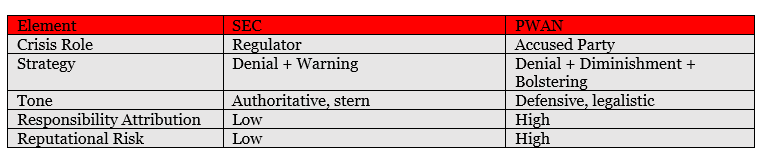
Exhibit 1: Between SEC and PWAN

Source: SEC, 2025; PWAN, 2025; Infoprations Analysis, 2025

Rather than offering clarity or transparency, PWAN chose to hide behind legal language. It said it had taken legal advice, and that its activities were not covered by current regulations. It promised future cooperation, but only if new rules were introduced that explicitly apply to its kind of business. This approach may work in a courtroom, but in the court of public opinion, it simply doesn’t hold up. When trust is in question, people look for moral responsibility, not legal loopholes.

The company’s tone also made things worse. There was no warmth in its statement, no concern for investor worries, and no sign that the company was listening. Instead of sounding like a business leader addressing its community, the response read like a legal memo. It felt distant, defensive, and corporate.

What could PWAN have done differently? Quite a lot. For starters, it could have acknowledged the concerns raised by the SEC and the confusion felt by the public. It could have spoken directly to its investors, offering a clear breakdown of how its business works and what measures are in place to protect client funds. It could have promised to improve transparency or even paused some operations while it worked with regulators to clarify the situation.

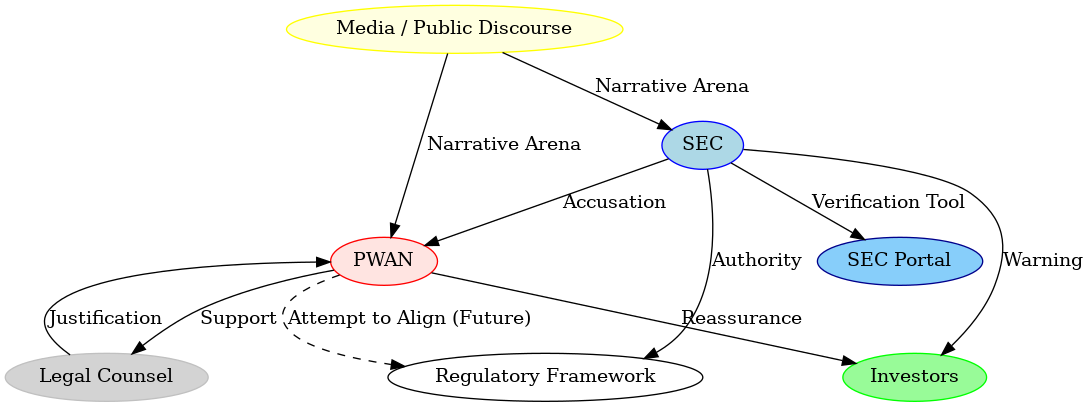
Exhibit 2: Emerged struggled legitimacy network 

Source: SEC, 2025; PAWAN, 2025; Infoprations Analysis, 2025

Most importantly, PWAN could have responded with a sense of care and responsibility. Instead of leading with denial and legal jargon, it could have shown leadership by saying: “We hear your concerns, and we want to be transparent and accountable.” That kind of message doesn’t require an admission of guilt, it requires an understanding of trust and the responsibility that comes with managing other people’s money.

When trust is at risk, the best response isn’t to retreat into legal details or insist on technicalities. It’s to meet people where they are, speak with honesty and empathy, and offer real steps forward. PWAN had a chance to do that. Unfortunately, it chose the opposite path, and it may be a long time before it earns the benefit of the doubt again.

Crypto Market Capitalization Surges Past $3.4 Trillion

0

The cryptocurrency market has seen a significant surge, with the total market capitalization increasing by 10% to reach $3.4 trillion. This milestone reflects renewed investor confidence and bullish momentum across the crypto space. Concurrently, U.S. spot Bitcoin exchange-traded funds (ETFs) recorded substantial weekly net inflows exceeding $920 million, indicating strong institutional and retail interest in Bitcoin exposure through regulated investment vehicles.

The rally in the crypto market cap aligns with several catalysts, including positive geopolitical developments, such as the partial easing of U.S.-China trade tensions, and growing institutional adoption. Bitcoin, trading around $103,000, has been a key driver, with its market cap comprising over 56% of the total crypto market. The $920 million in ETF inflows underscores the increasing appeal of Bitcoin as a “digital gold” asset, particularly amid economic uncertainties and tariff-related market volatility. Notable ETFs, such as BlackRock’s iShares Bitcoin Trust (IBIT), have led the inflows, with IBIT alone managing over $56 billion in assets.

Altcoins like Ethereum, Solana, and XRP have also contributed to the market cap growth, with DeFi platforms like Unichain and Hyperliquid showing explosive gains in total value locked (TVL). Stablecoins on Solana hit a record $13.11 billion market cap, further signaling robust liquidity in the ecosystem. However, the market remains volatile, with Bitcoin facing resistance around $96,000–$97,000, and some investors hedging through short-Bitcoin products.

This data suggests a broader risk-on sentiment, supported by macroeconomic factors and institutional participation, but investors should remain cautious of potential corrections given the market’s sensitivity to regulatory and economic shifts. The 10% surge in the crypto total market cap to $3.4 trillion and the $920 million in weekly net inflows into Bitcoin ETFs signal significant implications for the cryptocurrency ecosystem, while also highlighting a growing divide between traditional finance (TradFi) and decentralized finance (DeFi), as well as between institutional and retail investors.

The $920 million in Bitcoin ETF inflows reflects strong institutional demand, particularly through vehicles like BlackRock’s IBIT, which manages over $56 billion in assets. This trend suggests that institutions view Bitcoin as a hedge against inflation, currency devaluation, and geopolitical uncertainty, especially amid tariff threats and U.S.-China trade tensions. ETFs provide a regulated, accessible entry point for traditional investors, reducing reliance on crypto exchanges and potentially stabilizing Bitcoin’s price volatility over time.

However, institutional dominance could centralize influence over Bitcoin’s market dynamics, raising concerns among crypto purists who value decentralization. The $3.4 trillion market cap, with Bitcoin comprising over 56%, indicates a maturing market with growing liquidity. Stablecoins on Solana reaching a $13.11 billion market cap further bolster this, enabling seamless transactions in DeFi ecosystems.

Altcoins like Ethereum, Solana, and XRP, alongside DeFi platforms like Unichain and Hyperliquid, are diversifying the market, reducing Bitcoin’s historical dominance and signaling broader use cases for blockchain technology. This maturation could attract more regulatory scrutiny, as governments seek to balance innovation with investor protection and financial stability.

The rally aligns with a risk-on sentiment, partly driven by optimism around U.S. economic policies under a new administration and easing trade tensions. Bitcoin’s appeal as “digital gold” grows in an environment of potential fiat currency devaluation and tariff-driven inflation. However, the market’s sensitivity to macroeconomic shifts—such as Federal Reserve rate decisions or unexpected regulatory crackdowns—poses risks of sharp corrections, especially with Bitcoin testing resistance at $96,000–$97,000.

Retail Investor FOMO

The market cap surge and ETF inflows are likely fueling retail investor enthusiasm, with platforms like Coinbase and Binance reporting increased trading volumes. Bitcoin ETFs represent a bridge between crypto and traditional finance, allowing investors to gain exposure without navigating decentralized wallets or exchanges. This integration boosts legitimacy but ties crypto to TradFi’s infrastructure, subject to centralized oversight and custodial risks.

DeFi advocates argue that ETFs undermine crypto’s ethos of decentralization, as they rely on custodians and regulated entities. Platforms like Unichain and Hyperliquid, with soaring TVL, emphasize self-custody and permissionless finance, appealing to those wary of centralized control.

Institutions, with their large capital pools, are driving ETF inflows and shaping market narratives. Their involvement stabilizes prices but risks marginalizing retail investors, who may face higher entry barriers in a market increasingly influenced by Wall Street. Retail investors, active on platforms like X, continue to fuel altcoin rallies and meme-driven tokens. However, their speculative behavior contrasts with institutions’ strategic allocations, creating a divide in investment philosophies and market impact.

This gap could widen if institutions push for more regulated products, potentially sidelining retail-driven projects or triggering regulatory clampdowns that disproportionately affect smaller investors. The ETF boom highlights a centralized narrative, where crypto is packaged as a TradFi asset class. Meanwhile, DeFi’s growth—evident in Solana’s stablecoin surge and Ethereum’s scaling solutions—emphasizes decentralization and financial sovereignty.

This ideological split could influence future development, with centralized crypto products gaining mainstream traction while decentralized protocols cater to niche, ideologically driven communities. The $3.4 trillion market cap and $920 million in ETF inflows underscore crypto’s growing mainstream acceptance, driven by institutional capital and macroeconomic tailwinds.

However, they also expose a deepening divide between TradFi and DeFi, as well as between institutional and retail investors. While these dynamics signal a maturing market, they raise questions about crypto’s decentralized roots and the balance of power in its ecosystem. Investors should monitor regulatory developments, institutional flows, and DeFi innovation to navigate this evolving landscape, as the interplay between these forces will shape crypto’s trajectory in 2025 and beyond.