DD
MM
YYYY

PAGES

DD
MM
YYYY

spot_img

PAGES

Home Blog Page 1339

What Party Executives Need to Know Ahead of Osun 2026 Election

0
Source: National Dailies, 2024-2025; Infoprations Analysis, 2025

The road to the 2026 election in Osun State is already being paved, not just through rallies or declarations, but through the way issues are discussed and framed in public. Long before official campaigns begin, conversations about zoning and party defections are shaping the political environment and revealing who really holds sway over the minds of voters.

Recent insights, from our analysis of conflict network as reported by national dailies, into public discourse around these topics show that influence is no longer limited to those in office or those with party titles. Instead, the real power lies with those who are shaping the narratives and responding swiftly to developments. For party executives and political leaders in Osun, understanding how these dynamics work is essential if victory is to be secured.

Who is Shaping the Political Climate?

While elected leaders like Governor Ademola Adeleke remain central to political leadership, they are not necessarily at the heart of the conversations dominating public attention. In fact, figures such as spokespersons, party chieftains, and even coordinated public relations activities are playing larger roles in steering the political climate.

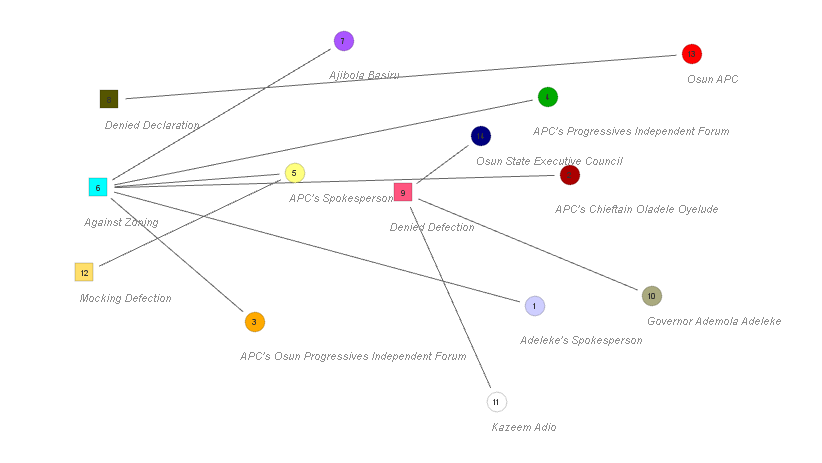
What stands out is that certain themes and activities are driving a significant part of the discussion. For example, phrases like Denied Declaration and Denied Defection are not names of individuals but represent responses to claims in the public space. They often arise when parties try to manage rumors about internal crises or speculation about defections. Surprisingly, these denials are proving to be some of the most powerful forces in shaping the current political atmosphere. The fact that such themes are dominating the conversation tells us that the public is highly reactive to political controversies, especially those that suggest cracks within party structures.

Exhibit 1: Emerging conflict network of Osun 2026 election
Source: National Dailies, 2024-2025; Infoprations Analysis, 2025

Similarly, Mocking Defection, a phrase that refers to ridicule or dismissal of claims about defection, has gained traction. It reflects how satire, spin, or media commentary can sometimes become more influential than official statements. This suggests that the battle for voter perception is being fought not only through press conferences but also through subtle messaging, public sentiment, and online reactions.

Zoning is More Than a Policy Question

One of the most influential issues in the buildup to 2026 is zoning. Discussions around zoning are not new, but in this electoral cycle, they have become a focal point of both unity and division. The theme of Against Zoning is proving to be one of the most dominant elements in the political space today. This shows that there is significant resistance to any predetermined arrangement about where the next governor should come from.

For party executives, this is a clear signal. Zoning is no longer just an internal discussion for stakeholders or party elders. It is a public issue, one that resonates with communities and voters who feel either entitled or excluded. Leaving this debate to chance or ignoring it altogether could allow rival parties or interest groups to define your party’s position for you. Now is the time to craft a clear, consistent message about where your party stands and, more importantly, why.

Why Spokespeople Matter More Than Ever

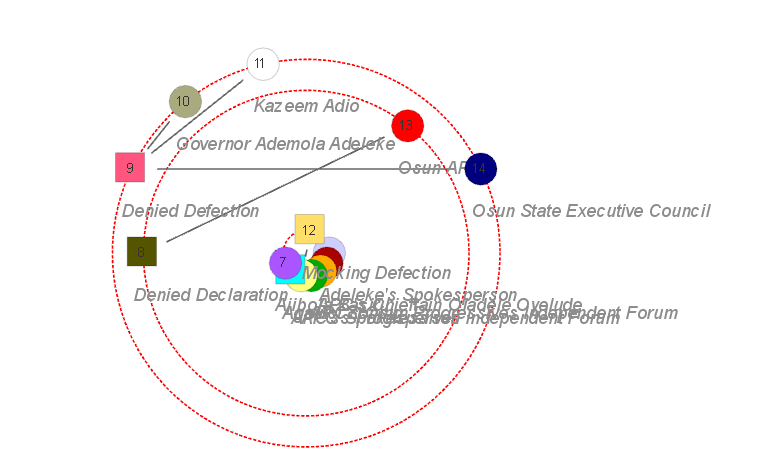
Another pattern emerging from the analysis is the central role of party spokespeople. In particular, those aligned with the APC are among the most active and influential voices in these ongoing debates. These individuals are not just relaying information. They are defining the tone and pace of political engagement. They can frame issues in ways that rally support, defend the party from criticism, and even destabilize opposition narratives.

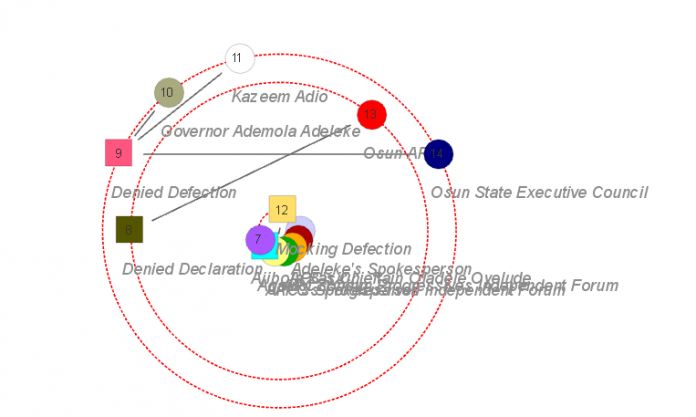
Exhibit 2: Who holds the centre of the conflict and information flow
Source: National Dailies, 2024-2025; Infoprations Analysis, 2025

For party executives, the lesson is simple. Spokespeople are frontline defenders and promoters of your party’s vision. They need more than access to microphones. They need guidance, message discipline, and alignment with the party’s long-term goals. A well-prepared spokesperson can steady a party during a crisis. A careless one can trigger unnecessary damage.

Institutions Still Matter

While individual voices and controversial themes are shaping the headlines, party structures like the Osun APC and the Osun State Executive still play a meaningful role. They may not dominate the daily conversation, but their presence carries institutional weight. When these bodies are aligned with strong messaging and active engagement, they lend credibility and order to the party’s public image.

It is important for executives to ensure that these structures are not only functioning internally but also visible externally. A party whose official bodies are silent during heated debates appears disorganized, even if things are well-managed behind closed doors. The public needs to see that these institutions are not just administrative but actively shaping the direction of the party.

What Party Executives Should Do Now

So what does all of this mean for the party leaders and executives guiding their organizations through these uncertain waters?

It is clear that zoning cannot be left to chance or brushed aside as a behind-the-scenes negotiation. Whether a party intends to support zoning or not, silence on the matter only leaves room for others—opponents, disgruntled members, or external commentators—to shape the story. Voters are already paying attention. Community groups are already forming opinions. If the party fails to clearly communicate its stance, it risks being misunderstood or misrepresented. Executives must lead the way in defining where the party stands and, more importantly, why.

The role of spokespeople must be treated with the seriousness it deserves. These individuals are no longer just messengers. They are often the first point of contact between the party and the public. A well-informed and disciplined spokesperson can defuse tension, redirect negative press, and amplify the party’s strengths. On the other hand, vague, inconsistent, or off-the-cuff comments can create confusion and mistrust. It is the responsibility of party leadership to ensure their spokespeople are prepared, supported, and speaking with one voice.

It is time to start listening more closely to the public mood. Certain phrases, such as those tied to denial of defection or declarations, may seem like passing media cycles, but their frequent appearance in political conversations shows they are sticking with people. These themes tell us what the public is watching, what they are skeptical about, and where they may feel misled. Rather than dismissing them as distractions, party leaders should see them as signals, early warnings that the narrative is moving and might need a response.

Party structures themselves, executive councils, state organs, official platforms, must not remain in the shadows. These institutions carry the weight of legitimacy, and when they engage publicly with unity and purpose, they reassure supporters that the party is focused and in control. A silent or fragmented executive body during moments of political tension can signal internal weakness, even if everything is orderly behind the scenes. The public needs to see that these institutions are not only functioning but also visibly guiding the party’s direction.

In this moment, the most successful party leaders will be those who understand that politics is no longer only about winning elections. It is about managing perceptions, responding quickly, and staying ahead of the conversation. The question is not whether your party will be discussed, it already is. The real question is whether you will shape that discussion or let others do it for you.


Jumia Reports First Quarter 2025 Results, as Revenue Drops by 26% year-on-year to $36.3M

0

Jumia Technologies, Africa’s leading e-commerce platform, has announced its financial results for the first quarter ended March 31, 2025. The company reported a revenue of $36.3 million, down 26% year-over-year or 18% year-over-year on a constant currency basis.

Revenue for the quarter was impacted by the sharp decline in corporate sales, particularly in Egypt, compared to the first quarter of 2024. Marketplace revenue, comprised of third-party sales, marketing and advertising, and value-added services, was $18.1 million, down 30% year-over-year or down 26% on a constant currency basis. Lower commissions from third-party corporate sales in Egypt and the impact of currency devaluations drove the decline.

First-party sales revenue was $17.8 million, down 21% year-over-year or down 9% on a constant currency basis, similarly impacted by lower first-party corporate sales in Egypt and currency movements. Gross profit was $19.9 million, down 36% year-over-year or down 32% year-over-year on a constant currency basis. Gross profit as a percentage of GMV was 12%, compared to 17% in the first quarter of 2024, primarily due to lower revenue from higher-margin corporate sales in Egypt.

In the first quarter of 2024, first-party and third-party corporate sales in Egypt generated high margins, but these were in part offset by high finance costs incurred from the need to repatriate cash. Adjusted EBITDA loss increased to $15.7 million from $4.3 million in the prior year, and net cash used in operating activities was $21.2 million, a stark contrast to the $4.5 million inflow in Q1 2024. This change reflected higher inventory levels in preparation for the Jumia Anniversary campaign and a negative working capital contribution of $8 million.

Despite these losses, Jumia posted a significant improvement in its loss before income tax, narrowing it to $16.5 million, compared to $39.6 million in Q1 2024. This was mainly due to a $33.5 million improvement in net finance costs, as foreign exchange losses experienced in 2024 did not recur in the same magnitude.

Commenting on the report, Jumia’s CEO Francis Dufay expressed optimism in the company’s trajectory, he said,

“Driven by strong growth in our consumer business and decisive steps to improve efficiency, we’re raising our full-year guidance. We now expect a loss before income tax of $50–55 million in 2025, improving to $25–30 million in 2026. We remain on track to achieve full-year profitability in 2027.”

As of March 31, 2025, the Company’s liquidity position was $110.7 million, comprised of $61.6 million in cash and cash equivalents and $49.1 million in term deposits and other financial assets. Jumia’s liquidity position decreased by $23.2 million in the first quarter of 2025, compared to a decrease of $19.1 million in the first quarter of 2024, and a decrease of $30.6 million in the fourth quarter of 2024.

Net cash used in operating activities was $21.2 million in the first quarter of 2025, compared to a net cash inflow of $4.5 million in the first quarter of 2024, primarily driven by a negative working capital contribution of $8.0 million, largely reflecting higher inventory levels built up to ensure product availability and assortment ahead of the Jumia Anniversary campaign, which is set to launch in early May earlier than in 2024.

In addition, the Company reported $0.9 million in capital expenditures in the first quarter of 2025, compared to $0.2 million in the first quarter of 2024, primarily reflecting investments in infrastructure and facility enhancements to support business growth. The company’s digital payment platform, JumiaPay, saw transactions reach 2.0 million, an increase of 1% year-over-year mainly driven by increased penetration of JumiaPay on delivery in the first quarter of 2025. Ongoing efforts to streamline the user experience and the continued rollout of JumiaPay on delivery to increase cashless orders have positioned it as an enabler of the company’s e-commerce platform.

While Jumia faced significant revenue and profit pressures due to macroeconomic challenges and reduced corporate sales in Egypt, the company’s consumer-focused strategy and operational discipline are beginning to show promising signs.

With improving order growth, customer retention, and fulfillment efficiencies, Jumia appears to be on a clearer path toward long-term profitability and sustainable growth. The company is focused on achieving profitable growth in 2025 by increasing usage, improving operational efficiency, and significantly reducing cash burn.

Bill Gates to Donate Nearly All Wealth, Close Foundation by 2045; Says He Doesn’t Want to Be Remembered for Dying Rich

0

Billionaire philanthropist Bill Gates has announced his most definitive plan yet for giving away his fortune: nearly all of it. In a blog post published Thursday, Gates announced that the Bill & Melinda Gates Foundation will cease operations by December 31, 2045, and that he will spend the next two decades accelerating the distribution of his wealth to tackle the world’s most urgent problems.

“People will say a lot of things about me when I die, but I am determined that ‘he died rich’ will not be one of them,” Gates, 69, wrote. “There are too many urgent problems to solve for me to hold onto resources that could be used to help people.”

Currently valued at $168 billion by Bloomberg, Gates has long pledged to donate most of his wealth. But Thursday’s announcement marked a turning point: not just a commitment, but a deadline. Since its inception in 2000, the Gates Foundation has already contributed more than $100 billion toward global health, poverty eradication, education, and climate-related programs. Gates now estimates it could double that figure by 2045, provided that market conditions remain relatively stable.

The foundation’s annual spending will also increase, from $6 billion to $9 billion, according to Gates.

Among the foundation’s core priorities for the next 20 years:

  • Reducing maternal and child mortality from preventable causes
  • Supporting the eradication of diseases like polio, malaria, measles, and Guinea worm
  • Advancing agricultural and educational systems in African nations to help “hundreds of millions of people break free from poverty”

Gates also acknowledged that philanthropy alone is not enough to close the widening gap in global aid, especially as governments, particularly the United States, continue to slash their foreign aid budgets.

“No philanthropic organization — even one the size of the Gates Foundation — can make up the gulf in funding that’s emerging right now,” Gates wrote. “It’s unclear whether the world’s richest countries will continue to stand up for its poorest people.”

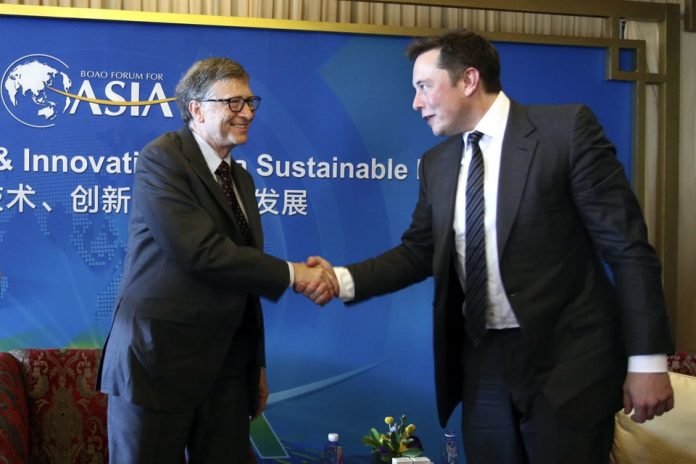
His announcement came just hours before The New York Times published an interview in which he harshly criticized Elon Musk for playing a role in the dismantling of U.S. foreign aid efforts. Gates cited the closure of USAID and the sharp rollback of government support for global health programs under Musk’s Department of Government Efficiency (DOGE), calling the impact “stunning.”

“If foreign aid keeps dropping, the five million kids who die every year could become six million,” Gates warned in the interview. “The world’s richest man has been involved in the deaths of the world’s poorest children.”

The Gates Foundation has operated as one of the most powerful philanthropic vehicles in modern history, and its closure will mark the end of a significant chapter in global development aid. Gates explained in his post that the foundation’s mission will not be to live forever but to achieve maximum impact within a set timeframe.

Gates noted that the personal motivation behind this shift is rooted in values instilled by his late parents. His mother, Mary Gates, was a firm believer in the idea that “to whom much is given, much is expected,” and his father served as co-chair of the foundation until he died in 2020.

“I was just a steward of any wealth,” Gates recalled being told. “I had a moral and societal obligation to give back.”

He also credited Warren Buffett, longtime friend and fellow philanthropist, with influencing his worldview.

“He was the first one who introduced me to the idea of giving everything away,” Gates wrote. Buffett has already donated tens of billions to the Gates Foundation and has instructed his heirs to give away 99% of his remaining fortune after his death.

Gates, his then-wife Melinda French Gates, and Buffett co-founded the Giving Pledge in 2010, which now has over 240 signatories committing to donate most of their wealth.

Gates cited 19th-century industrialist Andrew Carnegie’s essay, The Gospel of Wealth, as another pivotal influence. One quote in particular, he said, had stayed with him: “The man who dies thus rich dies disgraced.”

“I have spent a lot of time thinking about that quote lately,” Gates wrote. “I hope other wealthy people consider how much they can accelerate progress for the world’s poorest if they increased the pace and scale of their giving.”

Despite his sharp tone on aid cuts, Gates remains hopeful about the world’s trajectory, particularly with regard to technological advances and artificial intelligence.

“I think it’s objective to say to you that things will be better in the next 20 years,” he told The Times, though he added that his philanthropy is not dependent on optimism.

“Let’s say somebody convinced me otherwise,” Gates said. “What am I going to do? Just go buy a bunch of boats or something? Go gamble? This money should go back to society in the way that it has the best chance of causing something positive to happen.”

As for the 2045 end date of the Gates Foundation, Gates said he hopes it encourages both urgency and focus.

“We’re setting a finish line so we can run faster,” he said.

Gates made it clear that his legacy would not be built on hoarded wealth but on how much of it had been returned to the world. His decision is expected to inspire other billionaires to follow suit.

Bill Gates Slams Musk Over U.S. Foreign Aid Cuts: “The World’s Richest Man Is Involved in the Deaths of the World’s Poorest Children”

0

Billionaire philanthropist Bill Gates has launched a blistering attack on Elon Musk, blaming him for overseeing the dismantling of the United States Agency for International Development (USAID) and slashing foreign aid budgets under the so-called Department of Government Efficiency (DOGE) initiative.

In an interview with The New York Times published on Thursday, Gates accused Musk of playing a key role in eliminating life-saving programs that served the world’s most vulnerable populations.

“He’s the one who cut the USAID budget. He put it in the wood chipper, because he didn’t go to a party that weekend,” Gates said in the interview. “The world’s richest man has been involved in the deaths of the world’s poorest children.”

The comment was one of several strong-worded remarks Gates made while discussing global health and foreign aid. His criticism was particularly focused on decisions made by Musk’s DOGE initiative, which led to the closure of USAID and what Gates called “stunning” budget reductions that impacted programs for childhood immunizations, HIV prevention, and maternal health.

One of the examples Gates highlighted was the abrupt cancellation of funding to a hospital in Gaza Province, Mozambique—a region far removed from the Middle East. According to Gates, the hospital had been receiving U.S. support for antiretroviral drugs that prevent mother-to-child HIV transmission. The aid, he said, was cut off due to a profound misunderstanding by government officials.

“They cut the money to Gaza Province in Mozambique. That is really for drugs, so mothers don’t give their babies HIV,” Gates said. “But the people doing the cutting are so geographically illiterate, they think it’s Gaza and condoms. Will they go meet those babies who got HIV because that money was cut? Probably not.”

Gates said the scope of the damage caused by the aid cuts is dire and warned that child mortality figures, which had been declining steadily due to decades of public health interventions, could spike.

“If foreign aid keeps dropping, the five million kids who die every year could become six million,” Gates told the Times.

The Microsoft co-founder made these remarks in the context of announcing his intention to give away his entire fortune, estimated at $200 billion, within the next two decades. Gates said the Bill & Melinda Gates Foundation would close its operations in 2045, with a goal of maximizing its impact in areas like vaccine access, disease eradication, and child nutrition before winding down.

Still, Gates emphasized that philanthropy cannot fully replace the role of governments in fighting poverty and disease globally.

“Our foundation can help, but it’s not enough,” he said.

This is not the first public clash between Gates and Musk. The two billionaires have frequently exchanged barbs over the years. Gates has previously accused Musk of contributing to political instability in Europe, pointing to his support for right-wing causes in countries like the United Kingdom and Germany. He has also expressed frustration that Musk, despite his leadership at Tesla, has not been more vocal about the dangers of climate change.

On his part, Musk has publicly mocked Gates in the past and downplayed his understanding of emerging technologies, particularly artificial intelligence. In 2022, Musk described Gates’ knowledge of AI as “limited.”

As of Friday, Musk has not publicly responded to Gates’ latest comments.

The accusations come amid mounting scrutiny of the consequences of foreign aid rollbacks, particularly those associated with the DOGE initiative. While the program was marketed as a cost-cutting and efficiency measure, critics like Gates argue that the cost is being borne by communities with little power or visibility on the global stage.

For Gates, who has made global health the cornerstone of his post-Microsoft work, the dismantling of public health support infrastructure appears to have touched a nerve.

“These claims are not political; they’re about saving lives,” he said.

However, Gates’ comments have reignited debate over the role of billionaires in public policy, especially when their influence extends deep into areas traditionally managed by elected officials and humanitarian experts.

Nigerians Defy Tariff Hike as Internet Use Soars in March – NCC Report Reveals Unexpected Surge

0

Nigeria recorded a significant increase in internet usage at the end of the first quarter of the year, defying a sweeping 50% hike in telecom service charges that took effect in February.

The surge notably underlines the country’s growing reliance on mobile internet for daily communication, business, education, and entertainment.

According to the latest industry performance data released by the Nigerian Communications Commission (NCC), mobile data usage surged by 11.5% in March 2025, reaching 995,876.10 terabytes, up from 893,054.80 terabytes in February.

The NCC’s decision to approve the first major price adjustment in the telecom sector in over a decade, allowing operators to implement a 50% increase in the prices of voice, data, and SMS services, was expected to cause a slowdown in data usage. But March data tells a different story.

On January 20, 2025, the NCC gave mobile network operators the green light to increase charges, citing the sector’s sustained financial pressure from double-digit inflation, foreign exchange volatility, high energy costs, and operational expenses. The operators had long warned that continued price controls were unsustainable, and the regulator eventually yielded.

By February, operators had revised their pricing structures: 1GB of data, which previously averaged N287.50, rose officially to N431.25. However, actual market rates now reflect a higher average of N587.50 per GB, according to operators’ pricing on prepaid bundles. SMS costs increased from N4.00 to N6.00 per message.

Internet subscriptions also rose in March, further contradicting predictions of consumer cutbacks. The number of active internet subscriptions climbed to 141.5 million, up from 140.7 million in February, across Nigeria’s four major mobile network providers: MTN, Airtel, Globacom, and 9mobile.

MTN remains the clear market leader with 75.62 million internet subscribers, while Airtel follows with 48.8 million. Globacom maintained 15.37 million, and 9mobile trailed with 1.75 million users.

The increase in subscriptions comes despite broader concerns about the cost of living crisis in the country, where rising fuel prices, electricity tariffs, and food inflation continue to squeeze household incomes.

But the growth in mobile connectivity, particularly in data services, suggests that internet access has become a non-negotiable utility for millions of Nigerians, rather than a discretionary service. The mobile phone, powered by internet access, now supports everything from remote work and online schooling to digital banking, streaming, e-commerce, and social media.

Voice and Data Subscriptions Expand

Beyond internet-specific metrics, total mobile subscriptions, which include both voice and data lines, also recorded growth. Between February and March, operators added 1.8 million new active lines, increasing the total from 170.6 million to 172.71 million.

This also contributed to a rise in Nigeria’s teledensity, which measures the number of telephone connections per 100 people. It grew to 79.67% in March, up from 78.83% in February, based on an estimated population of 216 million.

MTN Controls Over Half of the Market

In terms of market share, MTN Nigeria continues to dominate the telecom space with 90.5 million active lines, accounting for 52.48% of the country’s mobile users.

Airtel maintains the second-largest share with 58.3 million users or 33.78%. Globacom holds 12% of the market with 20.7 million lines, while 9mobile has just 2.9 million subscribers, representing 1.72% of the total market.

First Major Tariff Adjustment in Over 10 Years

Before the January 2025 approval, Nigeria’s telecom tariffs had remained relatively flat for more than a decade, even as operating conditions worsened. The Association of Licensed Telecommunications Operators of Nigeria (ALTON) and other industry stakeholders had repeatedly petitioned the NCC to consider a pricing review.

Operators pointed to persistent inflation, difficulties accessing foreign exchange for equipment and software imports, rising diesel prices for powering base stations, and the costs of maintaining network infrastructure as justification for a hike.

After long resistance, the NCC acknowledged these challenges in January, approving what it described as a “moderate and necessary adjustment” to ensure continuity of service and encourage future investment in network expansion.

Industry Outlook: Resilience or Breaking Point?

While March figures suggest strong resilience among Nigerian telecom consumers, there are concerns that continued price increases, especially if inflation persists or subsidies are removed in other sectors, could eventually trigger a slowdown.

Some experts also caution that rural users and low-income groups may be disproportionately affected, potentially deepening the digital divide if affordability becomes a barrier to access.

However, the current trend shows that the demand for data, driven by Nigeria’s youthful, digital-savvy population, is outpacing economic pressure, at least in the short term.