DD
MM
YYYY

PAGES

DD
MM
YYYY

spot_img

PAGES

Home Blog Page 1353

Ripple Donates $25M RLUSD in Honor of Teacher’s Appreciation Week

0

Ripple announced a $25 million donation to support U.S. teachers and classrooms, coinciding with Teacher Appreciation Week (May 5-9, 2025). The funds, primarily in Ripple’s stablecoin Ripple USD (RLUSD), will be distributed through partnerships with DonorsChoose and Teach For America.

The donation aims to address educational resource gaps, funding classroom supplies, tutoring programs, STEM initiatives, and financial literacy programs. This initiative is part of Ripple’s broader philanthropy, having contributed over $200 million globally since 2018. The use of RLUSD highlights the growing role of stablecoins in efficient charitable giving.

The funds, distributed via DonorsChoose and Teach For America, will directly support classroom resources, tutoring, STEM, and financial literacy programs, addressing critical gaps in underfunded U.S. schools. This could enhance student outcomes, particularly in underserved communities.

By using Ripple USD (RLUSD), Ripple promotes blockchain-based stablecoins for philanthropy. This showcases their potential for transparent, low-cost, and efficient transactions, potentially encouraging other organizations to adopt similar technologies. Ripple’s high-profile donation reinforces the growing trend of corporate social responsibility, especially in tech and crypto sectors. It may pressure competitors to match or expand their own charitable efforts.

The donation highlights the undervalued role of teachers, potentially boosting morale and drawing attention to the need for systemic investment in education. However, it’s a one-time contribution, not a long-term solution to teacher pay or retention issues. Ripple’s initiative could improve the public image of the crypto industry, often criticized for speculation, by demonstrating tangible social impact. This aligns with Ripple’s history of over $200 million in global donations.

Highlighting stablecoin use in philanthropy may influence regulators to view crypto assets favorably, potentially impacting future stablecoin legislation, especially as RLUSD operates under a New York trust charter. The donation’s scale and blockchain integration make it a notable case study for corporate giving and crypto’s real-world utility, though its long-term educational impact depends on effective fund allocation.

By partnering with DonorsChoose and Teach For America, Ripple’s donation targets underfunded schools and classrooms, many in low-income areas. Funding classroom supplies, tutoring, STEM programs, and financial literacy initiatives can reduce disparities in educational access, potentially improving academic outcomes for disadvantaged students.

Enhanced educational resources and exposure to STEM and financial literacy can equip students with skills for higher-paying careers, fostering upward mobility and reducing generational poverty in affected communities. The donation acknowledges teachers’ critical role during Teacher Appreciation Week, potentially improving morale in a profession often plagued by low pay and burnout. Providing resources directly to classrooms alleviates financial burdens on teachers, who frequently spend personal funds on supplies.

While the donation offers immediate relief, it’s a one-time contribution and doesn’t address systemic issues like low salaries or poor working conditions. However, it may inspire broader public or policy focus on teacher support, indirectly aiding retention. Ripple’s use of its stablecoin, Ripple USD (RLUSD), for philanthropy demonstrates blockchain’s potential for transparent and efficient fund transfers. This could encourage adoption of stablecoins in charitable giving, reducing transaction costs and increasing accessibility for grassroots organizations.

By funding financial literacy initiatives, Ripple empowers students and communities with knowledge about budgeting, investing, and emerging technologies like crypto. This aligns with Ripple’s mission to promote financial inclusion, particularly in regions with limited access to traditional banking. Schools receiving funds through DonorsChoose often purchase supplies locally, stimulating small businesses. Additionally, improved education outcomes can attract investment to underserved areas, fostering economic growth.

Supporting teachers and students signals corporate investment in community welfare, potentially strengthening trust between businesses and local populations. This is especially relevant in areas skeptical of the crypto industry’s societal value. The crypto sector often faces criticism for volatility and speculative trading. Ripple’s high-profile donation counters this by showcasing a practical, socially beneficial application of blockchain technology, potentially improving public and regulatory perceptions.

Ripple’s initiative, part of its $200 million in global philanthropy since 2018, sets a precedent for other crypto firms to engage in impactful CSR, which could normalize such efforts across the industry. The use of RLUSD, regulated under a New York trust charter, highlights the stability and compliance of certain crypto assets. This could bolster arguments for favorable stablecoin regulations, influencing policymakers to support blockchain innovation in philanthropy and finance.

Ripple’s collaboration with established nonprofits like Teach For America may encourage policymakers to explore similar partnerships, leveraging private-sector resources to address public-sector challenges like education funding. While the $25 million is substantial, it’s a one-time donation and may not address systemic education funding shortages. Without sustained investment, socioeconomic benefits could be limited.

Programs emphasizing STEM and financial literacy may inadvertently exclude communities with limited access to technology, potentially widening digital inequities if not paired with infrastructure support. Some may view the donation as a publicity stunt to offset Ripple’s legal battles (e.g., SEC lawsuits) or to promote RLUSD. This could temper trust in Ripple’s motives, particularly among crypto critics.

Ripple’s donation aligns with growing corporate emphasis on social impact, particularly in tech and crypto. By focusing on education—a universally valued sector—Ripple positions itself as a leader in socially responsible innovation. However, the socioeconomic benefits hinge on effective fund allocation, sustained engagement, and complementary efforts to address structural issues in education and financial access.


The Benefits of Implementing a Multi-Channel Marketing Strategy

0
A company deploys a multi-channel marketing strategy

In the digital age, businesses must adapt to consumer behavior, which increasingly revolves around multiple touchpoints. This shift has made a multi-channel marketing strategy imperative for reaching customers where they spend their time.

Exploring the Benefits of Multi-Channel Marketing Strategies

Implementing a multi-channel marketing strategy offers a plethora of benefits, including greater market penetration and brand awareness. With customers frequently switching between channels, a multi-dimensional approach ensures that your message is consistently delivered, regardless of the platform.

Furthermore, a multi-channel approach allows businesses to cater to different audience preferences. While some consumers may be more responsive to email marketing, others might engage better with social media or direct mail.

The synergy between different marketing avenues can also lead to a compounding effect, boosting the overall impact of campaigns. This enhanced cross-channel interaction often results in more sophisticated customer relationship management and stronger brand loyalty.

Enhancing Brand Presence Across Various Platforms

Multi-channel marketing enhances brand presence by allowing businesses to be where their audience is. Whether it’s online or offline, each platform serves as a new opportunity to connect with potential customers.

A strong brand presence on multiple platforms also allows for more touchpoints in the customer’s buying journey. This creates a more robust and interconnected experience, where customers can transition from one channel to another without friction, contributing to a cohesive brand image and smoother customer experience.

Strategically leveraging different platforms also allows for content optimization, wherein messages are tailored to the strengths and audience of each channel. For instance, visual products can be showcased on image-heavy platforms like Instagram, while in-depth articles can be hosted on your brand’s blog or LinkedIn profile.

Increased Customer Reach and Engagement Through Multi-Channel Marketing

With a multi-channel marketing approach, businesses can considerably widen their customer base. Each channel has its unique audience, and by targeting multiple channels, companies can intersect with varied demographics and interest groups.

Customer engagement also benefits significantly from a multi-channel approach. By interacting with customers through their preferred channels, businesses foster a deeper connection and dialogue. This personalized interaction ensures that customers feel valued and heard, leading to increased brand loyalty and advocacy.

Increased engagement often translates to improved customer retention. The familiarity of interacting with a brand across multiple channels creates a sense of trust and reliability. When customers feel connected to a brand, they are more likely to repeat purchases and recommend the brand to others, leading to organic growth and a stronger customer base.

Leveraging Data Insight for Improved Customer Experiences

Data collected from different marketing channels can provide a comprehensive view of customer interactions and preferences. By analyzing this data, businesses can craft highly personalized experiences that resonate with individual customers. Such tailored communication is the cornerstone of successful customer-centric marketing strategies.

Multi-channel marketing allows for A/B testing across different mediums, providing a clearer picture of what resonates with your audience. This iterative process of testing and refinement leads to more effective campaigns, as it harnesses actual customer feedback rather than assumptions or industry standards.

Fostering an integrated marketing communications approach also ensures consistency in messaging, which is vital for building a strong and trustworthy brand. Data insights help to harmonize strategies across channels, minimizing disjointed experiences that could otherwise erode customer loyalty.

Achieving Higher Conversion Rates with an Integrated Marketing Approach

Discussing multi-channel marketing strategy

Conversions are the lifeblood of any marketing campaign, and an integrated multi-channel strategy is proficient at guiding potential customers through the sales funnel.

The consistency of messaging across channels helps to reinforce the call to action, encouraging customers to commit. When the path to conversion is clear and reinforced through various channels, customers find it easier to navigate the decision-making process, often leading to quicker and more frequent conversions.

An integrated marketing approach also allows for sequential messaging, wherein a story or campaign unfolds across different platforms in a planned series. This storytelling technique builds anticipation and depth to marketing efforts, engaging customers on a deeper level and increasing the likelihood of conversion.

Overall, the benefits of a multi-channel marketing strategy are far-reaching and can result in substantial gains for businesses. As the market continues to evolve, staying adaptable and proactive with such an approach will undoubtedly serve as a competitive edge for any forward-thinking business.

How to Add Tekedia Institute Education to Your LinkedIn Profile

0

Congratulations Tekedia Mini-MBA alumni. There is one more thing: add your Achievement on your LinkedIn profile. In LinkedIn, you have to select a school, not a company, as Tekedia Institute is a school. With this, you will see Tekedia Institute under Education as you list your educational qualifications.

So, for Tekedia Mini-MBA, Tekedia Advanced Diploma, Tekedia Industries, Tekedia Practice, Igba Boi, etc, programs (more here) you can pick the school “Tekedia Institute” under Education and type the qualification.

—To List for Tekedia Mini-MBA:

Go to Education section in your LinkedIn profile:

School: Tekedia Institute

Degree: Mini-MBA

Field of Study: Business Administration Management, General

—To List Advanced Diploma:

School: Tekedia Institute

Degree: Advanced Diploma

Field of Study: Project Management*

As always, every certificate issued by our Institute is auto-verifiable using the unique code on the certificate. Celebrate your achievement and let the world know that you are an alumnus of our amazing Institution. #ready2lead


*or Supply Chain Management, Digital Business Growth, etc, depending on your track

What Google Data Say About Nigeria’s JAMB Results in 8 Years

0

In the age of digital transformation, the question is no longer whether technology influences education, but how. Nowhere is this more evident than in Nigeria, where eight years of Google search trends, especially from platforms like YouTube, offer an unexpected lens into how students engage with the Joint Admissions and Matriculation Board (JAMB) exams and why so many continue to underperform.

Between 2018 and 2025, JAMB exam results show a consistent pattern. The overwhelming majority of candidates, typically over 75 percent, score below 200 out of a possible 400. While this suggests deeper systemic issues in Nigeria’s education sector, it also invites us to examine the growing role of digital behavior in shaping academic outcomes. A close look at Google search interest in JAMB-related terms and the rise of platforms like TikTok and YouTube reveals a story of both opportunity and distraction.

A Troubling Trend in Performance

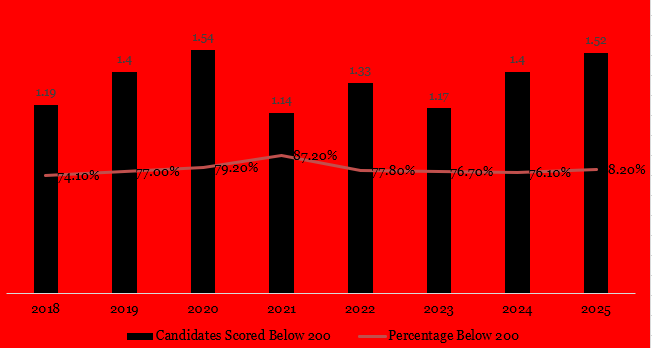
The data paints a sobering picture. In 2018, 74.1 percent of JAMB candidates scored below 200. By 2020, that number had risen to 79.2 percent. The year 2021 marked a low point, with a staggering 87.2 percent scoring below the benchmark. Although scores slightly improved in the following years, 2025 still saw 78.2 percent fall below 200.

Exhibit 1: Jamb results from 2018 to 2025

Source: JAMB, 2018-2025; Infoprations Analysis, 2025

These figures should raise concern. In a nation where access to higher education is a critical ladder out of poverty, JAMB performance remains a formidable gatekeeper. But what’s more revealing is how students are preparing, or not preparing, for this crucial exam.

The Rise of YouTube as a Learning Tool

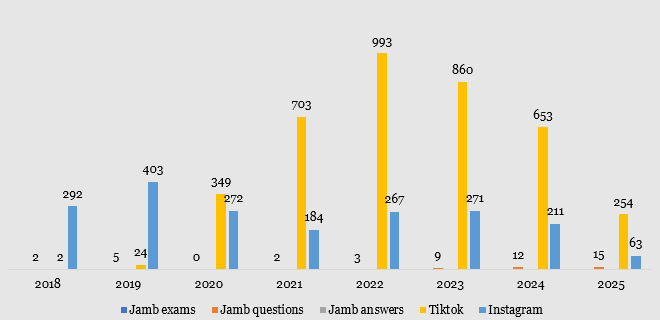
Google search data, primarily reflecting YouTube activity, shows a clear upward trend in interest for “JAMB questions” and “JAMB answers.” From just two searches in 2018, interest in “JAMB questions” rose to 15 by 2025. “JAMB answers” went from virtually nothing to six within the same period. On the surface, this suggests a growing awareness among students of the need to seek academic support online.

However, a deeper look suggests something more complex. While “JAMB questions” implies a legitimate attempt to practice or understand the exam, the parallel rise in searches for “JAMB answers” hints at a problematic culture, one that leans toward shortcuts rather than comprehension. This behavior reflects a broader trend. The internet is not just a learning space, it is also becoming a source of potential malpractice.

The TikTok Distraction

The influence of social media cannot be ignored, particularly TikTok, which surged in popularity from 2020 onward. In 2021, TikTok-related search interest spiked to 703, coinciding with the worst JAMB performance year. It peaked at 993 in 2022 before beginning a gradual decline.

This timing is critical. As students flocked to TikTok, long-form educational content on YouTube seemed to be supplanted by short, addictive videos. While TikTok does host educational creators, its algorithm is optimized for entertainment, not academic depth. In the absence of discipline and content curation, TikTok became more of a distraction than a learning aid.

Interestingly, Instagram’s influence declined steadily across the same period. This suggests that younger users were abandoning one platform in favour of the more dynamic TikTok. This shift also symbolizes a deeper evolution in digital consumption patterns, where brevity rather than depth defines engagement.

Exhibit 2: Public search interest between 2018 and 2025 (May 7, 2025)

Source: Google Trends, 2018-2025; Infoprations Analysis, 2025

Correlation Does Not Equal Causation, But the Connection Matters

It would be simplistic to say social media caused Nigeria’s poor JAMB results. The roots of underperformance lie in broader issues, including underfunded schools, overloaded syllabi, poorly trained teachers, and socio-economic challenges. However, the digital behavior of students is a significant piece of the puzzle.

What the data suggests is a kind of double-edged sword. On one hand, students are actively searching for academic resources. On the other hand, they are doing so in a fragmented or sometimes misguided way. High search volumes for “JAMB questions” should, in theory, indicate better preparedness. Yet, the corresponding exam results suggest that either the quality of content accessed is low or students are not engaging deeply enough to benefit.

The Need for Digital Guidance

If we are serious about improving academic outcomes, particularly for standardized exams like JAMB, Nigeria must rethink its approach to digital education. First, we need to meet students where they are. This means creating and promoting high-quality, curriculum-aligned content on YouTube, TikTok, and other platforms students use.

Second, digital literacy must be integrated into secondary education. Students need to learn not just how to use the internet, but how to use it effectively for learning. They must be able to distinguish between entertainment and education, between real knowledge and quick fixes.

Finally, content creators, educators, and ed-tech startups should view this data as a call to action. There is a large, eager audience actively searching for help, but often not finding the right kind.

Accelerex And ITEX Join Nigeria’s Zone Blockchain Network, Ushering A New Era of Payments

0

Two of Nigeria’s top payment service providers, Accelerex and ITEX, have joined Zone’s regulated blockchain network, ushering in a new era of payments in Nigeria.

Zone is a Nigerian fintech company that leverages blockchain technology to provide a decentralized payment infrastructure. The platform network ensures reliability, reduces disputes, and automated reconciliation, with a capacity to handle over 50,000 transactions per second.

With the inclusion of Accelerex and ITEX into its blockchain network, the continent’s fastest-growing payment infrastructure will now power payments for these two industry leaders, who collectively account for over half of the market share in bank-focused Payment Terminal Service Provider Service (PTSP).

As providers of core technology at merchant locations across Nigeria, processing billions of Naira in transactions monthly, Accelered and ITEX will leverage Zone’s decentralized infrastructure to eliminate transaction failures, enable instant settlements and offer real-time reconciliation.

This move will drastically reduce chargebacks and fraud, while ensuring full compliance with the Central Bank of Nigeria (CBN) regulations. By bypassing intermediaries and routing transactions directly to issuers via Zone’s blockchain, both companies stand to offer significantly improved service to their primary clients.

“The adoption of blockchain payments by major playes like Accelerex and ITEX signals an industry-wide shift”, said Obi Emetarom, Co-founder & CEO of Zone. “As financial institutions prioritize payment reliability, operational efficiency and compliance, we are proud to provide the regulated blockchain infrastructure that makes this transformation possible”.

Also commenting on this partnership, Managing Director of Accelerex Nigeria, Chuks Anakudo said,

“Our integration with Zone’s blockchain-powered payment network strengthens our ability to process payments seamlessly, eliminate chargebacks, ensure real-time settlement, and maintain full regulatory compliance; ultimately improving transaction efficiency across Nigeria. This underscores our commitment to providing our customers with the best payment experience“.

As Nigeria’s payment ecosystem continues to evolve rapidly, fintechs are searching for the next big differentiator to stay ahead in an increasingly competitive landscape. For a growing number of them, Zone is that differentiator.

The integration of Accelerex and ITEX with Zone’s regulated blockchain payment network brings several strategic and operational benefits for Nigeria’s financial services ecosystem. Here are the key advantages:

1. Real-Time Settlements

Transactions can now settle instantly, rather than being delayed by hours or even days, reducing working capital lockups and improving cash flow for merchants and financial institutions.

2. Elimination of Transaction Failures

Traditional payment systems often suffer from downtimes and failure points due to centralization. Blockchain’s decentralized architecture provides greater reliability and uptime, drastically reducing failed transactions.

3. Fewer Intermediaries

Zone’s network routes transactions directly to issuers, bypassing multiple layers of middlemen. This simplifies payment flows, reduces costs, and minimizes points of failure.

4. Real-Time Reconciliation

The blockchain ledger enables instant visibility of all transaction data, streamlining reconciliation processes and eliminating the lag that often leads to chargebacks or settlement disputes.

5. Reduction in Chargebacks & Fraud

By using smart contracts and transparent, immutable records, this setup prevents fraudulent disputes, offering stronger protection for acquirers, merchants, and issuers.

6. CBN Compliance

Zone’s network is fully approved and regulated by the Central Bank of Nigeria, giving institutions peace of mind that they are operating within the legal framework.

With these two giants onboard, the shift toward blockchain-based payments in Nigeria is gaining rapid momentum, positioning Zone at the forefront of a pivotal moment in Africa’s financial infrastructure evolution.