DD
MM
YYYY

PAGES

DD
MM
YYYY

spot_img

PAGES

Home Blog Page 1378

Nigeria’s Inflation Surges to 24.23% in March, Stretching Household Budgets Further

0

The cost of living crisis in Nigeria deepened in March 2025, with headline inflation jumping to 24.23%, according to the latest report by the National Bureau of Statistics (NBS).

The new figures mark a sharp rise from 23.18% recorded in February, underlining persistent pressure on consumer prices amid a weakened naira, worsening insecurity in food-producing belts, and increasing fuel costs.

Although economic managers have continued to downplay fears of hyperinflation, the latest data tells a different story—one that reflects the difficult choices millions of Nigerians are now forced to make daily as they navigate shrinking incomes, stagnant wages, and surging prices of food, transport, and basic goods.

“On a month-on-month basis, the headline inflation rate in March 2025 was 3.90%, which is 1.85 percentage points higher than the rate recorded in February (2.04%),” the NBS stated, signaling that not only are prices high, they’re also rising faster.

Even when volatile food and energy prices are stripped out, inflationary pressures remain unrelenting. Core inflation considered a more stable measure, rose to 24.43% year-on-year, up from 20.06% in March 2024. On a monthly basis, it increased by 3.73%, compared to 2.52% in February.

This trend reveals the structural nature of Nigeria’s inflation problem, even after the rebasing by the NBS to “reflect actual economic growth.” The price increases are no longer just seasonal or driven by one-off shocks—they are entrenched across both the food and non-food segments of the economy.

Urban vs. Rural Divide Widens

The inflation burden is not felt equally. Urban areas, which depend more on imported goods and transportation, saw a year-on-year inflation rate of 26.12% in March, significantly higher than the 20.89% recorded in rural areas. Month-on-month, urban inflation rose by 3.96%, compared to 3.73% in rural regions.

What this means is that residents in cities like Lagos, Abuja, and Port Harcourt are seeing sharper price increases, particularly in transportation, fuel, rent, and processed food.

The Unending Food Inflation

Food inflation remains the dominant driver of Nigeria’s cost-of-living crisis. Though the NBS pegs it at 21.79% year-on-year in March, the real experience for most Nigerians tells a more troubling story. The average cost of everyday staples such as fresh ginger, garri, Ofada rice, honey, crabs, potatoes, plantain flour, pepper, and periwinkle continued to climb, with little respite in sight.

Month-on-month, food inflation rose to 2.18%, up from 1.67% in February. The steady rise comes at a precarious time: the start of the planting season, when food supply typically tightens. But this year, insecurity in the Middle Belt and other agricultural hubs, coupled with high logistics costs, threatens to worsen the crisis.

Why Prices Keep Rising

According to analysts, inflation in March was shaped by a mix of opposing forces. Samuel Oyekanmi, Head of Research at Norrenberger, pointed to a tug-of-war between easing and inflationary trends.

“The continued effect of rebasing and favourable base effects are expected to exert a moderating influence,” Oyekanmi told NairaMetrics. “However, depreciation of the naira in the second half of March and the increase in petrol prices could raise costs across transport and goods.”

However, the naira’s brief rally in February gave some hope for a cooldown in imported inflation. But that optimism faded towards the end of March when the currency began to slide again against the dollar. With Nigeria relying heavily on imports, from food to industrial raw materials, even a slight weakening of the naira quickly reflects on shelf prices.

Meanwhile, petrol prices stayed largely flat for most of March but ticked upward in the final week of the month, triggering fresh concerns over transport and haulage costs. With diesel and petrol accounting for a large portion of food distribution expenses, any increase reverberates nationwide.

The NBS’s ongoing rebasing of inflation weights and methodology has added to the concern of capturing economic data accurately. While the revised metrics are aimed at better reflecting actual household consumption, some economists argue that the changes may momentarily suppress the full picture of Nigeria’s inflation reality.

But even with that technical adjustment, inflationary momentum has not slowed. The month-on-month increase of 3.90% in headline inflation, the highest in months, shows that whatever marginal easing occurred earlier in the year is being wiped away.

CBN’s Policy Dilemma

The data now puts the Central Bank of Nigeria (CBN) in a tight corner. With inflation racing ahead of interest rates and savings yields, pressure is mounting for further monetary tightening. But raising the benchmark interest rate too aggressively risks stalling an already fragile recovery and worsening access to credit for businesses.

Economists say that while the CBN has little choice but to continue hiking rates to control inflation, monetary tools alone may not be enough.

With the planting season starting under the shadow of insecurity, and exchange rate volatility threatening to worsen import bills, the outlook remains grim. The possibility of inflation breaching 25% in the coming months cannot be ruled out—especially if fuel prices are adjusted upward again or food shortages worsen due to disruptions in key farming regions.

Ordinary Nigerians, already burdened with transport fare hikes, shrinking food baskets, and stagnant salaries, continue to ask when relief will come.

Bill Gates Predicts AI Will End Shortages of Doctors, Teachers — and Change the Nature of Work Itself

0

Bill Gates believes the global shortage of doctors and teachers may be nearing its end—not through better policy or training, but thanks to the rise of artificial intelligence.

In a new episode of the People by WTF podcast, the Microsoft co-founder said AI’s expanding capabilities could fill critical workforce gaps, particularly in healthcare and education, by supplying the expertise and support where human workers are in short supply.

“AI will come in and provide medical IQ, and there won’t be a shortage,” Gates said, referring to long-running deficits in medical personnel across countries like India, the US, and across Africa.

Gates, who has long channeled his philanthropic focus toward global health, pointed to AI’s potential to supplement or replicate tasks normally handled by physicians—especially in regions where medical infrastructure remains weak. His comments mirror growing concerns across the world about worsening shortages in healthcare.

The Association of American Medical Colleges has forecast that the United States could face a deficit of up to 86,000 primary and specialty care physicians by 2036. According to the organization’s director of workforce studies, Michael Dill, the problem isn’t just about capacity—it’s about equity.

“The country needs hundreds of thousands of doctors to provide an equal amount of care to everyone, including minorities, those without medical insurance, and people living in rural areas,” Dill told Business Insider.

Geriatric care presents an even deeper crisis. As America’s population ages, the number of doctors trained to care for older adults is shrinking, raising fears of a care quality collapse.

To address the gap, and the burnout that comes with overstretched health systems, investors have been pouring billions into healthcare-focused AI startups. Companies like Suki, Zephyr AI, and Tennr are marketing solutions that automate the administrative grind of modern medicine: charting, billing, note-taking, and even clinical diagnosis. The pitch is simple: let AI handle the time-consuming work, so humans can focus on the human part.

McKinsey, the global consulting firm, estimates that generative AI alone could unlock as much as $370 billion in productivity gains for the healthcare and pharmaceutical industries.

Schools Face a Similar AI Pivot

The education sector, too, is leaning heavily into AI as a possible fix for a growing human shortfall. In the US, nearly 9 in 10 public schools reported difficulty hiring teachers for the 2023–24 academic year, according to federal data. Almost half said they were simply understaffed.

The problem isn’t unique to the US. In the UK, a London-based high school launched a pilot program last year in which students in core subjects like English, biology, and math used ChatGPT and other AI tools in place of traditional classroom instruction. Teachers weren’t entirely removed, but the use of AI significantly changed how students were prepared for exams.

Despite fears about cheating and over-reliance on machines, some educators are optimistic about AI’s role in lesson planning and learning assistance. With teachers in short supply and workloads rising, the idea is less about replacement and more about support—though that line may become harder to draw as AI continues to evolve.

Beyond Classrooms and Clinics: The Rise of Robot Labor

But Gates didn’t stop at white-collar work. On the podcast, he suggested AI, and the robotics that will follow could soon disrupt jobs traditionally considered safe from automation.

“Factory workers, construction crews, hotel cleaners—anyone doing work that required physical skill and time,” Gates said, are all on AI’s radar. “The hands have to be awfully good to do those things. We’ll achieve that.”

He’s not alone in that view. Tech companies like Nvidia have already begun placing massive bets on humanoid robots engineered to handle manual labor in warehouses, hotels, and industrial settings. These machines promise to replace repetitive and physically demanding tasks with programmable precision, potentially slashing labor costs for companies while stoking anxiety among workers.

A Future With Less Work—Or a Different Kind of Work?

If AI takes over the tasks traditionally performed by humans, from diagnosing patients to cleaning hotel floors, what happens to work itself?

Gates believes society may need to completely rethink its relationship with time, labor, and meaning.

“You can retire early, you can work shorter workweeks,” he said. “It’s going to require almost a philosophical rethink about, ‘Okay, how should time be spent?’”

It’s not a new idea. British economist John Maynard Keynes famously predicted in 1930 that technological progress would eventually shrink the workweek to just 15 hours. That future never materialized. Despite historic leaps in productivity, most people still clock around 40 hours weekly. For many, economic realities, not personal choice, determine whether they can reduce hours or leave the workforce.

Gates, whose fortune allows him the luxury of choice, acknowledged the difficulty of shifting away from a scarcity mindset.

“It’s hard for those of us—in my case, spending almost 70 years in a world of shortage—even to adjust my mind,” he said. “I don’t have to work. I choose to work. Because? Because it’s fun.”

For the rest of the world, however, the shift won’t be philosophical. It will be structural, economic, and, for millions, deeply personal. Whether AI eases the burden or renders millions obsolete depends not only on the technology but also on how societies adapt to it.

Tekedia Mid-Week Crypto and Blockchain Digest

0

Michael Saylor, a prominent Bitcoin advocate and Strategy chairman, has predicted Bitcoin could reach a $500 trillion market cap, implying a per-coin price of roughly $23.8 million to $25.2 million, given its 21 million total supply or 19.84 million circulating supply. His reasoning hinges on Bitcoin absorbing value from traditional assets like gold, real estate, and other stores of value, which he argues will be demonetized as capital shifts to digital assets. He sees Bitcoin as the next evolution of money, driven by its fixed supply and growing institutional adoption, potentially causing a supply shock.

U.S. Securities and Exchange Commission (SEC) announced that certain stablecoins, specifically those referred to as “covered stablecoins” like USD Coin (USDC) and Tether (USDT), are not classified as securities under federal securities laws. This clarification came from the SEC’s Division of Corporation Finance, stating that these stablecoins—designed to maintain a 1:1 peg with the U.S. dollar, fully backed by low-risk, liquid reserves, and redeemable on demand—do not meet the definition of a security. As a result, transactions involving the minting or redeeming of these stablecoins do not require registration with the SEC.

However, the announcement has nuances. The SEC’s guidance applies strictly to stablecoins meeting specific criteria, such as being backed solely by USD or high-quality liquid assets, with no interest or profit promised to holders. Some sources suggest Tether’s USDT may not fully align with these standards due to its reserve composition, which includes assets like commercial paper, bitcoin, and gold, potentially complicating its status under the SEC’s framework. Commissioner Caroline Crenshaw dissented, arguing the guidance oversimplifies risks, particularly for retail investors relying on intermediaries, and may misrepresent the market’s stability.

World Liberty Financial (WLFI) proposed a test airdrop of its USD1 stablecoin to all WLFI token holders to validate its on-chain airdrop system, reward early supporters, and boost USD1 visibility before a broader launch. The airdrop, planned for Ethereum Mainnet, will distribute a fixed amount of USD1 per eligible wallet, with the exact amount and timing still under review based on the number of wallets and budget. The proposal requires community feedback and a governance vote to proceed, but WLFI reserves the right to modify or cancel it even if approved. The USD1 stablecoin, launched in March 2025, is pegged to the US dollar, backed by US Treasuries, dollar deposits, and cash equivalents, and managed by custodian BitGo.

Gold reaching $3,220 per ounce reflects strong safe-haven demand amid economic and geopolitical uncertainty. Factors like tariff tensions, inflation fears, central bank buying, and stock market volatility are likely driving the surge. While some sources suggest prices could climb further—potentially to $3,300 by year-end—others warn of profit-taking or resistance at these levels. Always consider market dynamics and risks before acting on such trends.

U.S. Department of Justice (DOJ) disbanded its National Cryptocurrency Enforcement Team (NCET) on April 7, 2025, as confirmed by multiple sources. Deputy Attorney General Todd Blanche issued a memo stating the DOJ will no longer pursue cases against crypto exchanges, mixers, or offline wallets for their users’ actions or unintentional regulatory violations. The focus is shifting to prosecuting individuals who directly harm crypto investors or use digital assets for crimes like terrorism, drug trafficking, or fraud. This aligns with the current administration’s push to reduce regulatory pressure on the crypto industry and foster innovation, though critics warn it could weaken oversight of illicit activities. Ongoing investigations inconsistent with this policy are to be closed, but specific case details weren’t disclosed.

A wallet linked to the bankrupt FTX exchange and its affiliate Alameda Research unstaked 186,326 Solana (SOL) tokens, valued at approximately $21.56 million. This move sparked speculation about potential sell-offs, as FTX continues liquidating assets to repay creditors. Despite concerns, Solana’s price rose slightly, gaining 3.57% to trade at around $119 that day, showing resilience amid broader market recovery and optimism around a possible Solana ETF. Historically, FTX and Alameda have unstaked millions of SOL since November 2023, often moving tokens to exchanges like Binance and Coinbase, which can pressure prices.

Mantra’s OM token crashed ~90% on April 13, 2025, dropping from ~$6.30 to below $0.50, wiping out over $5 billion in market cap. MANTRA attributes the collapse to “reckless forced liquidations” by centralized exchanges during low-liquidity hours, denying insider selling. Co-founder John Mullin suggested one exchange’s sudden closure of positions without warning triggered the cascade. However, community skepticism persists, with some alleging insider dumps due to large pre-crash token deposits (e.g., 3.9M OM to OKX). No conclusive evidence confirms either narrative, and investigations are ongoing.

Binance executives reportedly met with U.S. Treasury officials to discuss easing regulatory oversight, particularly around anti-money laundering compliance, while also exploring a deal with the Trump family’s crypto venture, World Liberty Financial. The talks involved potentially listing a new dollar-pegged stablecoin, USD1, which could leverage Binance’s massive user base and trading volume for adoption, potentially generating significant profits for the Trump family. Discussions about a Trump family stake in Binance.US have also surfaced, though details remain unclear. These moves align with Binance’s efforts to re-enter the U.S. market after a $4.3 billion settlement in 2023 for violating anti-money laundering laws.

Data from IntoTheBlock indicates a recent increase in transaction volumes on Virtuals Protocol, a blockchain project focused on AI agent creation and deployment. This uptick, noted around mid-April 2025, suggests renewed interest in the platform after a significant decline earlier in the year, with transaction volumes rising by 20% from April 1 to April 10. However, the ecosystem has faced challenges, with prior reports showing a 99% drop in revenue and DEX trading volumes since December 2024. While this resurgence could signal a potential recovery for Virtuals Protocol and its native token, market sentiment remains cautious due to earlier losses and broader uncertainties.

OpenAI Developing Social Media Platform Inspired by xAI’s X, Aiming to Rival Tech Giants

0

OpenAI, the creator of ChatGPT, is reportedly working on its own social media network, a strategic move inspired by xAI’s integration of its Grok AI with the X social platform, according to a report from The Verge.

The project, currently in its early stages with an internal prototype, centers on integrating ChatGPT’s image-generation capabilities into a social feed. While it remains uncertain whether this platform will launch as a standalone app or be embedded within the ChatGPT app, OpenAI’s ambitions signal a bold push to compete with Elon Musk’s X, Meta’s Facebook, and Instagram, while securing critical user data to fuel its AI models.

Copying xAI’s Blueprint for Data and AI Synergy

The impetus for OpenAI’s social media venture is believed to stem from xAI’s successful leveraging of X’s user-generated data to train its AI model, Grok. When Elon Musk acquired Twitter in 2022, later rebranding it as X, he restricted bot access to the platform’s data—a move that sparked backlash but was strategically designed to prevent competitors from freely harvesting X’s valuable content for AI training. When it was launched, Musk directed this data exclusively to xAI, his AI startup, enabling the development of Grok, a chatbot and AI model series that competes directly with OpenAI’s ChatGPT.

Grok’s integration with X has fueled both AI advancements and new forms of content creation, creating a feedback loop that strengthens the platform’s ecosystem.

OpenAI, led by CEO Sam Altman, appears to be emulating this approach. By building its own social network, OpenAI could gain direct access to real-time, human-generated data—text, images, videos, and commentary—to train its AI models, such as GPT-4 and the new 4o image-generation tool. This would reduce OpenAI’s dependence on scraping publicly available internet data, which is increasingly difficult and expensive to obtain at the scale required for cutting-edge AI development.

The Verge’s report suggests that OpenAI’s prototype is a direct response to xAI’s data-driven strategy, positioning OpenAI to replicate the synergy between social engagement and AI innovation that has propelled xAI and X.

Why a Social Network? Rivalry, Attention, and Data

Bill Gross, founder of tech incubator Idealab, outlined three key motivations behind OpenAI’s social media push, as cited by The Verge: a personal rivalry between Altman and Musk, the need to capture greater user attention to justify a trillion-dollar valuation, and the pursuit of high-quality, labeled data for AI training.

Altman vs. Musk: Gross emphasized that Altman’s competitive dynamic with Musk, a former OpenAI co-founder, is a significant driver. “Altman doesn’t like Musk, so why not start competing head-on with X?” Gross told The Verge. This rivalry adds a personal layer to OpenAI’s strategic pivot, as Altman seeks to challenge Musk’s dominance in the AI and social media arenas.

Capturing Attention: OpenAI, recently valued at approximately $300 billion, is striving to join the trillion-dollar valuation club alongside Microsoft, Google, Amazon, and Meta, all of which boast billions of daily users.

“Altman needs to have more attention to justify OpenAI’s valuation,” Gross explained.

ChatGPT already attracts between half a billion and a billion monthly unique visitors, but a social network could amplify this reach by enabling users to share AI-generated content, such as images, in a dynamic feed.

“They just need more attention. So why not harvest the output of their models that users will share on a new social network, and this should attract even more users and even more attention,” Gross added, echoing the sentiment of Google’s seminal AI paper, “Attention Is All You Need.”

The Data Imperative: The most critical motivation is data. AI companies like OpenAI have an insatiable demand for human-generated content to train their models. While raw data is valuable, labeled data, where users provide context through comments, captions, or interactions—is far more useful for AI development. A social network would provide OpenAI with a continuous stream of such data.

“If users start typing words into this new OpenAI social network, the company can use that for all kinds of AI model training,” Gross said. “Users would also share images and videos and add commentary. This is essentially humans identifying and labeling content on a massive scale.”

This mirrors xAI’s approach, where X’s user activity directly informs Grok’s training, creating a powerful cycle of data collection and AI refinement.

The Prototype and Altman’s Next Steps

According to The Verge, OpenAI’s internal prototype focuses on integrating ChatGPT’s image-generation capabilities with a social feed, potentially allowing users to create and share AI-generated visuals alongside text-based posts. While specifics remain limited, the prototype’s existence indicates that OpenAI is actively exploring this venture.

Altman has reportedly been seeking external feedback, privately consulting industry outsiders to refine the project’s direction. In a recent post on X, Altman hinted at OpenAI’s evolving strategy, stating, “How about we fix our model naming by this summer and everyone gets a few more months to make fun of us (which we very much deserve) until then?”

Though lighthearted, the comment reflects Altman’s awareness of the competitive pressures and the need to innovate rapidly.

OpenAI did not respond to The Verge’s inquiries, leaving many details speculative. Key questions remain: Will the platform prioritize user privacy, given its data-intensive goals? How will it differentiate itself in a crowded social media landscape? And will it ever progress beyond the prototype stage to a public launch?

A New Era of AI-Driven Social Platforms

OpenAI’s social media ambitions reflect a broader shift in the tech industry, where AI and user data are increasingly inseparable. A decade ago, social platforms monetized attention through targeted advertising. Today, the focus has shifted to collecting user activity to train powerful AI models, which are then offered as premium services or subscriptions.

Meta and X already leverage their vast user bases to fuel their AI initiatives, giving them a significant advantage. OpenAI, lacking a native social platform, is at a disadvantage—hence the push to create one, inspired by xAI’s model.

Do Unemployment, Inflation Drive Nigeria’s Ponzi Scheme Surge?

0

From the early crash of MMM Nigeria in 2016 to the collapse of CBEX in 2025, Ponzi schemes have become an unsettling fixture in Nigeria’s economic landscape. With over 50 major schemes recorded since 2016, our analyst notes that their growth appears to mirror the nation’s economic turbulence, but a closer look reveals a more layered reality.

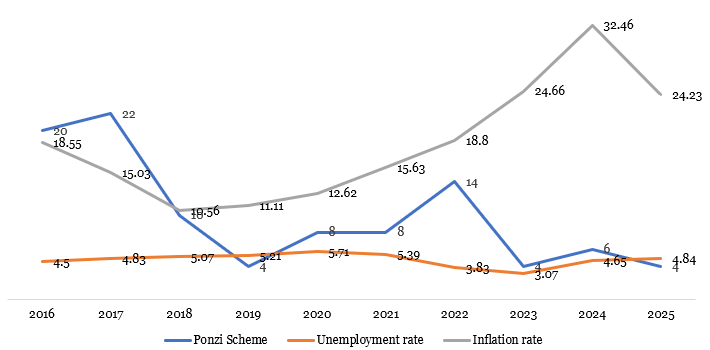
While inflation and unemployment are often cited as triggers for financial desperation, recent data shows that inflation, more than joblessness, has a stronger correlation with Ponzi activity. Between 2020 and 2022, inflation reached multi-year highs. That same period saw the emergence and collapse of schemes like Racksterli, 86FB, InksNation, and Baraza Multipurpose Cooperative, which attracted thousands of participants before eventually defaulting.

Analysis of macroeconomic indicators from 2016 to 2024 points to a pattern: as the cost-of-living soars and the naira weakens, Nigerians increasingly seek out risky alternatives to preserve purchasing power. While unemployment also peaked in 2020, Ponzi scheme proliferation more closely followed inflationary surges. According to our analyst, this suggests that the erosion of real income may be a more immediate driver of fraudulent investment activity.

Exhibit 1: Ponzi schemes and selected macroeconomic indicators

Source: National Bureau of Statistics, 2016-2025; Macrotrends, 2016-2025; Infoprations Analysis, 2025

However, macroeconomic conditions alone do not fully explain the pattern. Only 14% of the variation in Ponzi scheme operations between 2016 and 2024 can be attributed to inflation and unemployment combined. Our analyst points out that this implies that while economic pressure is a factor, it is not the primary determinant of Ponzi participation.

Further predictions extending from 2026 to 2030, based on constant inflation and unemployment rates, suggest minimal change in Ponzi scheme activity. These projections highlight the limits of macroeconomic indicators in forecasting fraudulent investment trends. Real-world complexities such as digital access, information flow, and community behaviour play a far more significant role.

One of the most persistent drivers of Ponzi scheme participation in Nigeria is low financial literacy. Many individuals, especially in low-income and semi-urban areas, struggle to distinguish between legitimate investment opportunities and schemes designed to collapse. Operators of these scams often present themselves as investment experts, leveraging buzzwords such as cryptocurrency, forex trading, and digital arbitrage to lend false credibility.

Weak regulatory enforcement continues to be a challenge. Many schemes operate for months before being investigated or sanctioned. In some cases, warnings from regulatory agencies come after significant public losses have already occurred. Delays in enforcement create an enabling environment for fraudulent actors to expand operations, recruit more victims, and siphon off larger sums.

Another critical issue is the deep-seated distrust of formal financial institutions. Years of banking collapses, inaccessible pension funds, and opaque government-backed financial schemes have eroded public confidence. In such an environment, informal investment groups, often promoted by friends, family, or community leaders, appear more trustworthy than official channels. Ponzi schemes exploit this trust, embedding themselves in everyday social networks.

The role of social media and instant messaging platforms cannot be understated. These digital spaces allow schemes to spread rapidly through viral marketing, fake testimonials, and exaggerated success stories. With limited fact-checking and a high emotional appeal, these platforms have become the primary launchpads for many recent schemes.

Periods of Ponzi decline also deserve attention. In 2019 and 2023, there was a noticeable reduction in fraudulent scheme activity. These declines may be attributed to a combination of regulatory crackdowns, increased public awareness, and growing digital financial literacy. Expanded financial inclusion initiatives and youth-targeted education campaigns during those periods likely played a role in lowering public susceptibility.

Despite the link between economic instability and Ponzi activity, socioeconomic desperation is a broader and more persistent issue. The desire for financial relief, regardless of inflation levels or employment status, fuels risky behaviour. As formal job opportunities shrink and the gap between income and living costs widens, more Nigerians turn to unregulated alternatives, despite the repeated collapses of such schemes.

Going forward, our analyst says Nigeria faces a choice. Without systemic improvements in financial education, rapid-response regulation, and public trust in formal systems, Ponzi schemes will continue to evolve and resurface under new names and models. Inflation and unemployment may set the stage, but it is the absence of strong financial safeguards that allows the performance to continue.