DD
MM
YYYY

PAGES

DD
MM
YYYY

spot_img

PAGES

Home Blog Page 1394

Afreximbank Unveils $300m Industrial Drive in Nigeria, Eyes Shift from Oil-Dependency with Broader Non-Oil Export Strategy

0

In what signals a major pivot towards non-oil economic diversification, the African Export-Import Bank (Afreximbank) has announced a sweeping $300 million export manufacturing project targeting four Nigerian states—Cross River, Imo, Enugu, and Kano.

The initiative, which will be implemented through Arise Integrated Industrial Platform, one of the bank’s investee companies, is designed to lay the groundwork for Nigeria’s emergence as a regional hub for export-oriented manufacturing.

The plan was unveiled by Afreximbank President Prof. Benedict Oramah during the commissioning of the Afreximbank African Trade Centre (AATC) in Abuja on Thursday. Framed as part of the bank’s wider continental industrialization and trade facilitation agenda, the initiative marks a bold shift in Nigeria’s development priorities—away from crude exports and towards value-added production.

“This over $300 million project is being developed to promote export manufacturing,” Oramah told the audience, noting that similar special economic zones have already taken root in Ogun State.

By deploying these special zones, Afreximbank intends to transform the selected regions into high-impact industrial corridors that can absorb thousands of jobs, support small and medium-sized enterprises (SMEs), and serve regional and international supply chains. It’s a strategy long overdue for Nigeria, which has struggled for decades with poor manufacturing output and a crippling overreliance on oil receipts.

Oramah revealed that the bank has injected more than $50 billion into Nigeria’s economy over the past decade. These investments span energy, infrastructure, healthcare, manufacturing, transport, and financial services. The sheer volume of the figure underlines Afreximbank’s long-standing footprint in Africa’s most populous nation.

Of that amount, $19 billion has flowed into the financial services sector alone—a move he says has helped deepen credit markets and improve financial sector contributions to GDP.

Yet despite this robust capital injection, Nigeria’s non-oil sector remains sluggish, plagued by inadequate infrastructure, inconsistent policies, and an unfriendly investment climate. Manufacturing still contributes less than 10% to the country’s GDP, raising questions about the effectiveness of past investments and the urgent need for stronger coordination between finance, policy, and industry.

Healthcare Investment

Beyond industry, Afreximbank is also turning its development lens toward healthcare. Oramah confirmed that a $750 million African Medical Centre of Excellence (AMCE) will be commissioned in June. The 500-bed quaternary facility in Abuja will specialize in oncology, cardiology, and hematology—diseases that send thousands of Nigerians abroad annually in search of advanced care.

If successful, the AMCE could reduce Nigeria’s medical tourism costs, which according to the Ministry of Health, drain over $1 billion from the economy every year.

“This is about offering world-class medical treatment right here in Africa,” Oramah said.

Quality Infrastructure to Unlock Exports

In a bid to make Nigerian goods globally competitive, Afreximbank is scaling up quality assurance. Oramah said the African Quality Assurance Centre (AQAC) in Ogun State is already operational, offering export testing and certification for agro-products and manufactured goods. Similar centers are underway in Imo and Kaduna States.

These interventions could plug the quality control gaps that often see Nigerian exports rejected in Europe and North America—a loss of both revenue and reputation.

Nigeria to Host Africa Energy Bank

Among the other significant developments is Nigeria’s selection as the host country for the Africa Energy Bank, a joint initiative by Afreximbank and the African Petroleum Producers’ Organization (APPO). The energy-focused lender is expected to address chronic underfinancing in Africa’s oil, gas, and renewable energy sectors.

Oramah believes the bank will position Nigeria as the continent’s hub for energy finance, a strategic move, especially at a time when international funding for fossil fuel projects is shrinking due to climate change pressures.

“The Energy Bank will position Nigeria as the continental hub for mobilizing energy financing,” he said.

Refining, Fertilizer Boosts, and the Dangote Effect

Oramah credited Afreximbank’s interventions with helping ramp up Nigeria’s refining capacity to 1.2 million barrels per day and raising urea fertilizer production from under four million tons in 2019 to 7.5 million tons annually. He projected that output could rise to 11 million tons by 2027 as the Dangote Petrochemical Company continues to scale operations.

The bank has also helped finance other major industrial assets, including logistics and transportation infrastructure surrounding the Lekki corridor, where Dangote’s refinery is based.

Creative Sector Gets Dedicated Credit Line

Afreximbank is also stepping into Nigeria’s booming cultural economy. In collaboration with the Federal Ministry of Culture and Creative Industry, the bank has launched a $200 million credit facility dedicated to the country’s creatives.

The fund is aimed at unlocking access to finance, promoting global visibility, and building capacity in sectors like film, music, and digital arts—areas where Nigeria already has significant soft power.

“This is a recognition of the power of the creative economy as a serious contributor to GDP,” Oramah said.

Ripple (XRP) and RCOF Target a 1,000% Run in 5 Weeks, Here’s Why

0

Ripple (XRP) is buzzing with renewed momentum, and RCOF is turning heads with its game-changing AI tools. Both are now eyeing explosive gains, and with key developments aligning, a 1,000% surge in the next five weeks is a real possibility.

If you’re looking to catch the next big wave in crypto, here’s why XRP and RCOF are suddenly the tokens everyone’s watching.

Ripple Is Charging Up as Momentum Builds

XRP is finally shaking off the dust, and this time, the optimism feels real. After years of regulatory drag, Ripple’s legal battle with the SEC is closed, clearing the path for serious institutional interest.

Standard Chartered’s bold forecast of $5.50 by year-end and $12.50 by 2028 is backed by strong fundamentals. There is renewed investor confidence, potential ETF listings, and Ripple’s aggressive move into tokenized finance.

Technical charts show XRP rebounding from the $1.74 zone, with RSI and MACD hinting at bullish momentum. Key resistance remains at $1.90–$1.95, but buyers are defending lower levels with conviction. If an XRP ETF drops and institutional capital floods in, the gains could be explosive.

And with macro and market winds finally aligning, 2025 could be the year XRP stops crawling and starts climbing for real. And yet, while XRP gears up for what could be a multi-month rally, early-stage AI altcoin, RCOF, is building steam even faster; setting the stage for a potential 1,000% run in just five weeks.

RCOF’s Robo Advisor Is Redefining How Crypto Gains Are Made

At the center of RCO Finance is the powerful AI-driven Robo Advisor that helps you make smarter trades without breaking a sweat. This AI pulls real-time financial data from sources like Bloomberg, Reuters, and other high-volume liquidity feeds to tell you, precisely, when to enter or exit an asset.

For instance, a microcap token like PEPE suddenly gains institutional traction. While you’re not looking, RCOF’s Robo Advisor catches the unusual volume spike, evaluates momentum, and shoots you an early alert before the masses catch on.

That’s how portfolios go from $500 to six-figures. And yes, it can also pull the plug before your favorite token dips into oblivion; saving your capital and preserving your profits.

Beyond AI trading, The RCOF platform also opens up over 120,000 investment options, including bonds, stocks, ETFs, commodities, and even tokenized real estate; all on a single KYC-free platform. And you can use the RCOF debit card directly for daily spendings with no conversion delays.

Presale Frenzy Is Heating Up as Early Buyers Lock In Gains

The RCOF presale is a full-blown momentum wave, and over 10,000 users are already testing the platform’s Beta version in real time. And the Alpha version is already in testing, packed with performance enhancements and features aimed at giving even more control to users.

Meanwhile, the presale is currently in its 5th stage with the token going for just $0.10. When it hits the 6th stage, the price jumps to $0.13.

So if you invest $1,000 today, you’re getting 10,000 tokens. That $1,000 would be worth $1,300 by the next stage in a few days. And if RCOF does 10,000% post-listing, a conservative projection given its demand and functionality, that’s a $1,000 to $100,000 flip.

The platform was also audited by SolidProof, one of the most reputable names in blockchain security, and came back squeaky clean. No vulnerabilities, no red flags. It’s safe, and it’s still early.

Why XRP and RCOF Could Both Explode but Only One Has the Bigger Upside

XRP is already a beast in the market. It’s been around, it’s battle-tested, and it has a strong institutional angle that’s only getting stronger. But it’s already matured and while another 10 is doable, it’s going to take time.

RCOF, on the other hand, is just starting. And that means something powerful. Early-stage tokens don’t need billion-dollar partnerships to skyrocket. They just need traction. RCOF has the product, the audience, and the hype, and now it’s delivering numbers.

People who joined in earlier stages are already up big. Those joining now at $0.10 still have a massive runway ahead. If you wait until it’s $0.13, your potential ROI drops by 30% not to talk of when it lists. So the next best moment to get in is now.

For more information about the RCO Finance Presale:

Visit RCO Finance Presale

Join The RCO Finance Community

Trump’s New Tariff War With China Begins to Backfire, as Chinese Suppliers Refuse to Lower Prices—Spiking U.S. Inflation Risks

0
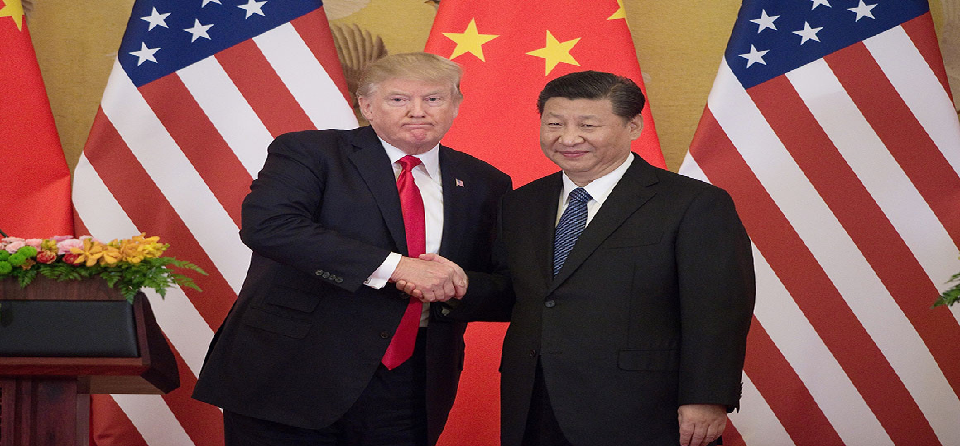
China and US leaders

In the wake of sweeping new tariffs on Chinese imports announced by President Donald Trump, U.S. businesses are racing to avoid steep price hikes for consumers. But their efforts appear to be hitting a brick wall. Many are pressing their Chinese suppliers to slash prices in a bid to offset the added tariff costs.

The response has been largely the same: No.

“If you already reduced your pricing in the past for your U.S. clients, you probably don’t have much space to do it again and again,” said Jonathan Chitayat, CEO of Genimex Group, a firm that manages overseas production for American companies. “You can do it for an order or two, but the next time your customer asks you for a price, you’re going to work on the reality that you have to be a profitable business. You can’t continue losing money.”

Chitayat’s firm helps U.S. companies manufacture products like kitchenware and electronics through factories in Asia, particularly China. He said that navigating Trump’s renewed tariffs has now become a regular part of the supply chain conversation. But margins are so thin, and government support is so lacking, that many factories simply have no room left to negotiate.

“There are no subsidies that we’re aware of that the government in China is giving to manufacturers,” he said. “So they mostly don’t—or have very, very little margins to give.”

The refusal by Chinese businesses to budge, analysts now say, signals a troubling prospect for American consumers: inflation could return faster and more forcefully than expected.

Trump Ratchets Up Tariff Fight, China Hits Back

The tariff escalation comes as Trump, in a flurry of posts and public appearances, declared that tariffs on China now total 145%. He also announced a temporary 90-day suspension of new tariffs for over 75 countries that had not responded with retaliatory measures. That reprieve did not extend to China, which he accused of showing a “lack of respect” for global markets.

Writing on Truth Social, the U.S. president said the tariffs are “effective immediately” and necessary because “China has taken advantage of American goodwill for too long.”

China didn’t take the move lightly. Its Ministry of Finance raised existing tariffs to 125% in retaliation, saying U.S. products had lost “market acceptance” in the Chinese economy. The agency also accused Washington of using trade policy as a blunt tool to fuel domestic politics, calling the U.S. a “joke” on the world stage.

Consumers Will Pay the Price, Experts Warn

The consequences of this back-and-forth are already becoming clear. With no room left in the supply chain to absorb costs, economists say American consumers are next in line.

“There has historically been this pressure to figure out who’s going to eat the tariff, and I don’t think there’s much room to move on that now,” Willy C. Shih, a professor at Harvard Business School told BI. “China is already hyper-competitive. Many of the products hit by tariffs—like TVs, monitors, and tech components—were never made in the U.S. to begin with. There’s no backup.”

Shih explained that while a weakening of the Chinese yuan could help offset some of the tariff burden, it won’t be nearly enough to protect consumers from higher prices.

“You can distribute parts of the tariff among all the parties in the supply chain,” he said, “but these numbers are so large now that they’re going to have to be passed on to consumers.”

Analysts say that warning signs are already flashing across sectors dependent on Chinese manufacturing, including electronics, apparel, automotive parts, and household goods. Prices that had only recently begun to stabilize after pandemic-era disruptions could once again start to rise—this time fueled not by supply bottlenecks but by policy decisions.

China’s Economic Struggles Leave No Wiggle Room

Meanwhile, Chinese manufacturers themselves are in a precarious position. Internal demand in China has been weakening, and the country’s once-booming property sector, long a major driver of its GDP, has collapsed, slashing local government revenues and limiting Beijing’s ability to offer support.

“Chinese manufacturing firms have faced declining margins in part due to falling domestic demand,” Sara Hsu, clinical associate professor of supply chain management at the University of Tennessee told BI. “There is already weakness in this sector from last year, and the new tariffs only add to that pressure.”

Andrew Collier, Senior Fellow at the Harvard Kennedy School’s Mossavar-Rahmani Center, said Beijing’s options are limited.

“Xi [Jinping] faces pressure from unemployed workers, disgruntled property owners, and small businesses. He may want to help exporters, but he has very little fiscal space left to maneuver,” he said.

Inflation Headwinds May Undermine Trump’s Economic Message

For the U.S., the timing couldn’t be worse. Inflation, while declining in recent months, remains a core concern for households, and any policy that raises the cost of living could erode public support quickly.

Lisa Suwen, the trade consultant, warned that price hikes could hit the market before the summer shopping season.

“What makes this dangerous is that these tariffs aren’t coming after a trade war that’s cooled off—they’re coming after a period where consumers are just recovering from years of inflation,” she said. “If inflation returns suddenly because of this, it could lead to a rapid deterioration in purchasing power.”

She added that most large retailers have already begun discussing price adjustments, especially on tech and imported home goods.

“The Chinese aren’t going to lower prices, and the Americans aren’t going to eat the cost. That leaves just one option—price hikes.”

A Familiar Standoff With More at Stake

Trump’s trade policies have always carried political weight, particularly when aimed at China. But analysts say this latest round of tariffs is different—not only in scope but also in its potential to destabilize fragile economic recovery efforts.

Even as Trump positions the tariffs as a defense of American manufacturing, many argue that many of the goods targeted simply have no domestic substitute.

“These are not jobs that are coming back. These are price hikes that are coming in,” said Shih.

Unless either side backs down, a scenario that appears unlikely, American consumers may soon pay the price for a trade war with no clear exit ramp.

China Calls US Tariff Exemptions a ‘Small Step’, Signals No Retreat in Trade War

0

Beijing has responded to the US decision to exempt consumer electronics from its reciprocal tariffs on Chinese imports, describing it as “a small step by the US toward correcting its wrongful action of unilateral ‘reciprocal tariffs.’” In a statement posted on its official WeChat account on Sunday, China’s Ministry of Commerce urged the US to “take a big stride in completely abolishing the wrongful action” and return to resolving differences through “equal dialog based on mutual respect.”

However, China’s defiant tone suggests that Beijing has no intention of backing down, maintaining its stance that it will never cower to US pressure and is ready to return fire for fire. Meanwhile, President Donald Trump’s exemptions, which many, including some of his supporters, view as caving to pressure, have stirred controversy at home while failing to ease the broader US-China trade conflict.

China’s response, laced with a metaphorical jab—“The bell on a tiger’s neck can only be untied by the person who tied it”—underscores Beijing’s view that the US, as the initiator of the tariffs, must fully reverse its policies.

The exemptions, announced by the US Customs and Border Protection on Friday, cover smartphones, computers, semiconductors, and other electronics, shielding nearly $390 billion in US imports, including over $101 billion from China, based on 2024 trade data. However, China’s Ministry of Commerce made clear that this gesture is insufficient, signaling readiness to escalate further if the US introduces new measures.

Beijing has consistently matched US tariff hikes, recently raising duties on American goods to 125% in retaliation for US rates reaching as high as 145% on Chinese imports.

State media outlets have framed the US move as a reaction to domestic lobbying from tech giants like Apple, which faced potential iPhone price surges to $2,000–$3,500 without relief, and consumer fears of rising costs.

US Exemptions: Is Trump Caving In?

The US exemptions, detailed in a Friday notice, apply retroactively from April 5 and include critical products like memory cards, solar cells, and machines used in semiconductor manufacturing. They also extend to the 10% baseline tariff on goods from most other countries, benefiting manufacturers in nations like South Korea, home to Samsung Electronics.

The decision provides a lifeline for tech firms, including Apple, which assembles 90% of its iPhones in China, and Taiwan Semiconductor Manufacturing Co. (TSMC), which is expanding US-based production. A separate White House memo adjusted small-parcel shipping duties, partially reversing Trump’s earlier push to end the “de minimis” exemption for low-value parcels from China.

President Trump, speaking to reporters on Air Force One on Saturday, said he would provide more details of his exemption plan on Monday.

“I’ll give you that answer on Monday. We’ll be very specific on Monday,” he said.

Sources suggest Monday’s announcement may involve a national security investigation into semiconductor imports, potentially leading to targeted tariffs, indicating that the exemptions may be a temporary maneuver.

However, the decision has sparked backlash among Trump’s base, who see it as a retreat from his “America First” trade agenda.

Analysts attribute the exemptions to intense lobbying from the tech industry, described as a “loud voice” by Wedbush Securities’ Daniel Ives, as well as market pressures after tech stocks lost $773 billion over four days amid tariff fears.

The past weeks have seen the trade war between the U.S. and China escalate, with both sides imposing and increasing tariffs. The US has targeted Chinese goods to address trade imbalances and national security concerns, particularly around semiconductors, while maintaining a 20% tariff on Chinese imports tied to fentanyl precursors, unaffected by the exemptions. China’s retaliatory tariffs have hit US exports hard, particularly in agriculture and automotive sectors, with American farmers and manufacturers facing steep losses.

The exemptions provide breathing room for global supply chains, heavily reliant on Chinese manufacturing, but do not resolve the broader conflict.

As the world awaits Trump’s promised Monday announcement, speculation centers on potential new tariffs, particularly targeting semiconductors. China, meanwhile, shows no signs of softening, with its Ministry of Commerce signaling readiness to counter any fresh US actions.

The trade war’s impact continues to ripple, threatening higher consumer prices and supply chain disruptions.

With $390 billion in trade at stake, the US-China standoff remains a high-stakes battle. However, it is believed that for now, China has the upper hand.

“China is going to make Donald beg and plead for mercy,” Get ready for Xi to do some insane humiliation rituals on Donald all week long,” Spencer Hakimian of Tolou Capital Management, said.

What Data Say About Nigerians’ Decade of Engaging in Ponzi Schemes

0

Earning, saving, investing, and spending are critical aspects of human life. These must be done collectively and personally, using different approaches, before one can boast of living a quality life. Employing a method or multiple methods, however, depends on how individuals perceive the processes for acquiring money before engaging in the subsequent activities.

In this special report, our analyst examines why Nigerians constantly fall into the Ponzi scheme trap despite its high risk of losing substantial investment capital and sometimes earnings. We developed an interest in this problem due to the recent public “panic” surrounding the possible collapse of another scheme, which has been widely reported and considered by many to be another Ponzi scheme.

Before the rise of widespread internet access and social media, smaller, localized schemes likely existed and were often referred to as “wonder banks.” These entities promised unrealistic returns and operated without regulatory oversight, defrauding unsuspecting members of the public.

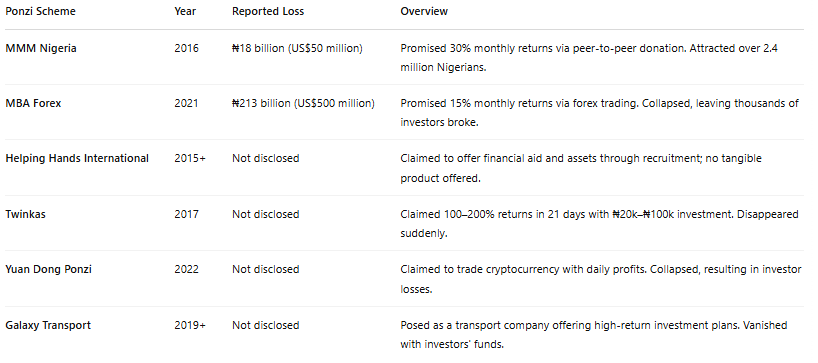
Our checks reveal that the Ponzi scheme was introduced into Nigeria through the Mavrodi Mondial Movement (MMM), which originated in Russia in the late 1980s but gained traction in Nigeria in the late 2010s, becoming particularly significant in early 2015. A few years after 2015, the scheme collapsed. Despite this, several similar models emerged, with slight variations in how they promised returns on invested capital. Schemes like Twinkas, Get Help Worldwide, Loom Money, and Ultimate Cycler soon followed.

Exhibit 1: Notable Ponzi schemes in Nigeria and the reported or estimated losses

Source: Multiple sources, 2016-2022; Infoprations Analysis, 2025

What have been the regulatory responses?

Multiple sources consulted by our analyst reveal that Nigerians have lost over ?500 billion in the past decade due to their engagement in these schemes. The losses, along with public criticism of regulatory agencies, especially the Securities and Exchange Commission and the Economic and Financial Crimes Commission (EFCC), have led to the introduction of various measures and the invocation of existing laws. The EFCC, for instance, has consistently warned the public about the dangers of Ponzi schemes.

Laws such as the Investments and Securities Act 2025 are not silent on addressing the problem. The Act prescribes stricter penalties for both direct and indirect actors involved in Ponzi schemes, including hefty fines and lengthy jail terms. Despite the government’s good intentions with the law, non-state actors in the civic space and some citizens have labeled it a ‘paper tiger,’ pointing to its weakness in preventing new schemes from emerging.

Why does Ponzi interest spike despite tighter regulation

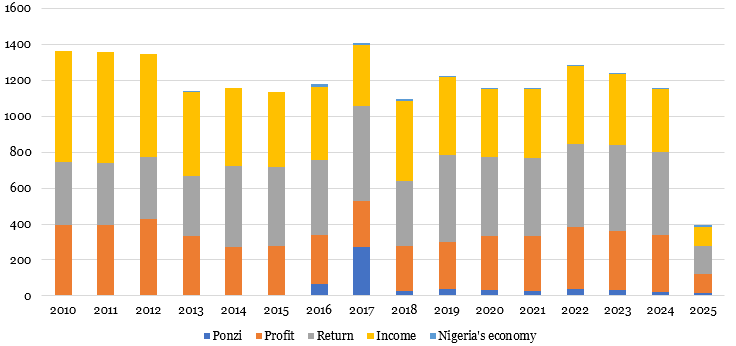
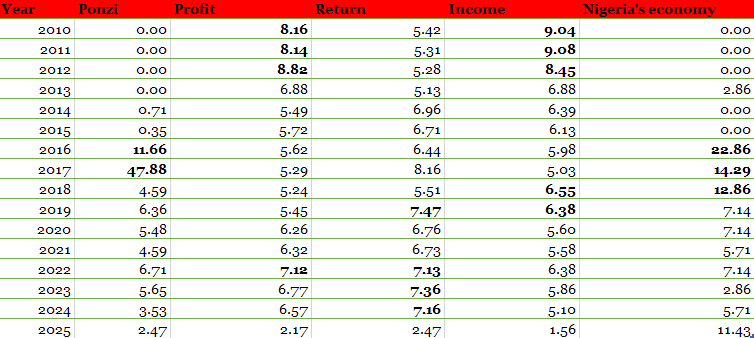
A deep dive into Google Trends data from 2010 to 2025 reveals a compelling and statistically significant connection between interest in Ponzi schemes and broader economic concerns in Nigeria. Public search interest in Ponzi and Nigeria’s economy is positively connected by 53.9%.

This means that nearly a third of the changes in search interest around Ponzi schemes can be explained by shifts in the country’s economic conditions. During periods marked by inflation, unemployment, and financial uncertainty, more people appear to explore Ponzi-like alternatives, not necessarily out of greed, but often as desperate coping strategies.

Exhibit 1: Public search volume of interest from 2010 to 2025 (as of April 13, 2025) in Ponzi and other keywords

Source: Google Trends, 2010-2025; Infoprations Analysis, 2025

The connection grows even stronger when terms like return and income are introduced. With a 57.8% connection and a 33.4% interest in Ponzi schemes in return and income, the data suggests that interest in Ponzi schemes is deeply tied to the public’s concern for income stability and the quest for guaranteed returns. In a climate where job security is fleeting and living costs continue to rise, the allure of high-return promises, even if fraudulent, becomes increasingly difficult to resist.

When the term profit is added to the mix, the connection rises further to 59%.  This indicates a dangerous reality: the more people crave profit in an unstable economy, the more likely they are to fall prey to Ponzi-like opportunities. The profit motive, in this case, doesn’t simply reflect ambition; it reflects a survival instinct triggered by systemic economic hardship.

Interestingly, the data also shows that moderate public interest in economic matters corresponds with heightened curiosity about profit, while a higher focus on the economy appears to lower median interest in income-related terms. Our analyst notes that when people engage deeply with macroeconomic concerns, they may begin to question quick-fix income solutions. However, when engagement is shallow or reactive, the desire for profit tends to dominate, regardless of risk.

The consistent interest in “return” across all levels of economic focus points to a deeply ingrained desire for investment gains, a rational impulse in an irrational market environment. This further reinforces the idea that the popularity of Ponzi schemes is not solely rooted in deception, but also in unmet financial expectations and the absence of viable, trusted alternatives.

Ultimately, the positive connection between searches for “Ponzi” and “Nigeria’s economy” reflects more than just curiosity. Our analyst points out that it reflects a rising vulnerability. Periods marked by economic anxiety create the perfect environment for Ponzi schemes to thrive, our analyst adds.

Exhibit 2: Public search volume of interest from 2010 to 2025 (as of April 13, 2025) in Ponzi and other keywords in percentages

Source: Google Trends, 2010-2025; Infoprations Analysis, 2025