DD
MM
YYYY

PAGES

DD
MM
YYYY

spot_img

PAGES

Home Blog Page 1395

China Calls US Tariff Exemptions a ‘Small Step’, Signals No Retreat in Trade War

0

Beijing has responded to the US decision to exempt consumer electronics from its reciprocal tariffs on Chinese imports, describing it as “a small step by the US toward correcting its wrongful action of unilateral ‘reciprocal tariffs.’” In a statement posted on its official WeChat account on Sunday, China’s Ministry of Commerce urged the US to “take a big stride in completely abolishing the wrongful action” and return to resolving differences through “equal dialog based on mutual respect.”

However, China’s defiant tone suggests that Beijing has no intention of backing down, maintaining its stance that it will never cower to US pressure and is ready to return fire for fire. Meanwhile, President Donald Trump’s exemptions, which many, including some of his supporters, view as caving to pressure, have stirred controversy at home while failing to ease the broader US-China trade conflict.

China’s response, laced with a metaphorical jab—“The bell on a tiger’s neck can only be untied by the person who tied it”—underscores Beijing’s view that the US, as the initiator of the tariffs, must fully reverse its policies.

The exemptions, announced by the US Customs and Border Protection on Friday, cover smartphones, computers, semiconductors, and other electronics, shielding nearly $390 billion in US imports, including over $101 billion from China, based on 2024 trade data. However, China’s Ministry of Commerce made clear that this gesture is insufficient, signaling readiness to escalate further if the US introduces new measures.

Beijing has consistently matched US tariff hikes, recently raising duties on American goods to 125% in retaliation for US rates reaching as high as 145% on Chinese imports.

State media outlets have framed the US move as a reaction to domestic lobbying from tech giants like Apple, which faced potential iPhone price surges to $2,000–$3,500 without relief, and consumer fears of rising costs.

US Exemptions: Is Trump Caving In?

The US exemptions, detailed in a Friday notice, apply retroactively from April 5 and include critical products like memory cards, solar cells, and machines used in semiconductor manufacturing. They also extend to the 10% baseline tariff on goods from most other countries, benefiting manufacturers in nations like South Korea, home to Samsung Electronics.

The decision provides a lifeline for tech firms, including Apple, which assembles 90% of its iPhones in China, and Taiwan Semiconductor Manufacturing Co. (TSMC), which is expanding US-based production. A separate White House memo adjusted small-parcel shipping duties, partially reversing Trump’s earlier push to end the “de minimis” exemption for low-value parcels from China.

President Trump, speaking to reporters on Air Force One on Saturday, said he would provide more details of his exemption plan on Monday.

“I’ll give you that answer on Monday. We’ll be very specific on Monday,” he said.

Sources suggest Monday’s announcement may involve a national security investigation into semiconductor imports, potentially leading to targeted tariffs, indicating that the exemptions may be a temporary maneuver.

However, the decision has sparked backlash among Trump’s base, who see it as a retreat from his “America First” trade agenda.

Analysts attribute the exemptions to intense lobbying from the tech industry, described as a “loud voice” by Wedbush Securities’ Daniel Ives, as well as market pressures after tech stocks lost $773 billion over four days amid tariff fears.

The past weeks have seen the trade war between the U.S. and China escalate, with both sides imposing and increasing tariffs. The US has targeted Chinese goods to address trade imbalances and national security concerns, particularly around semiconductors, while maintaining a 20% tariff on Chinese imports tied to fentanyl precursors, unaffected by the exemptions. China’s retaliatory tariffs have hit US exports hard, particularly in agriculture and automotive sectors, with American farmers and manufacturers facing steep losses.

The exemptions provide breathing room for global supply chains, heavily reliant on Chinese manufacturing, but do not resolve the broader conflict.

As the world awaits Trump’s promised Monday announcement, speculation centers on potential new tariffs, particularly targeting semiconductors. China, meanwhile, shows no signs of softening, with its Ministry of Commerce signaling readiness to counter any fresh US actions.

The trade war’s impact continues to ripple, threatening higher consumer prices and supply chain disruptions.

With $390 billion in trade at stake, the US-China standoff remains a high-stakes battle. However, it is believed that for now, China has the upper hand.

“China is going to make Donald beg and plead for mercy,” Get ready for Xi to do some insane humiliation rituals on Donald all week long,” Spencer Hakimian of Tolou Capital Management, said.
What Data Say About Nigerians’ Decade of Engaging in Ponzi Schemes

0

Earning, saving, investing, and spending are critical aspects of human life. These must be done collectively and personally, using different approaches, before one can boast of living a quality life. Employing a method or multiple methods, however, depends on how individuals perceive the processes for acquiring money before engaging in the subsequent activities.

In this special report, our analyst examines why Nigerians constantly fall into the Ponzi scheme trap despite its high risk of losing substantial investment capital and sometimes earnings. We developed an interest in this problem due to the recent public “panic” surrounding the possible collapse of another scheme, which has been widely reported and considered by many to be another Ponzi scheme.

Before the rise of widespread internet access and social media, smaller, localized schemes likely existed and were often referred to as “wonder banks.” These entities promised unrealistic returns and operated without regulatory oversight, defrauding unsuspecting members of the public.

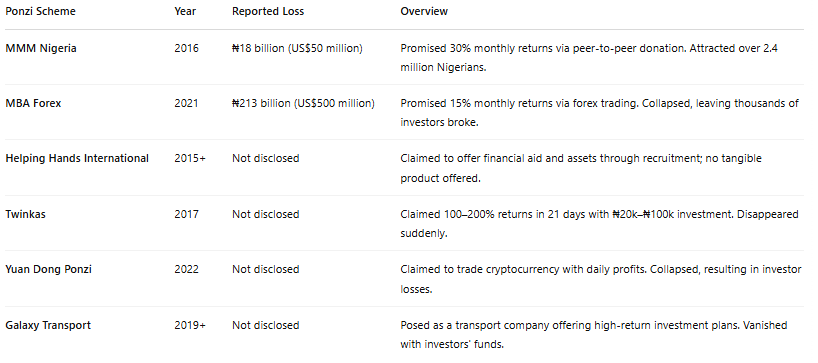
Our checks reveal that the Ponzi scheme was introduced into Nigeria through the Mavrodi Mondial Movement (MMM), which originated in Russia in the late 1980s but gained traction in Nigeria in the late 2010s, becoming particularly significant in early 2015. A few years after 2015, the scheme collapsed. Despite this, several similar models emerged, with slight variations in how they promised returns on invested capital. Schemes like Twinkas, Get Help Worldwide, Loom Money, and Ultimate Cycler soon followed.

Exhibit 1: Notable Ponzi schemes in Nigeria and the reported or estimated losses

Source: Multiple sources, 2016-2022; Infoprations Analysis, 2025

What have been the regulatory responses?

Multiple sources consulted by our analyst reveal that Nigerians have lost over ?500 billion in the past decade due to their engagement in these schemes. The losses, along with public criticism of regulatory agencies, especially the Securities and Exchange Commission and the Economic and Financial Crimes Commission (EFCC), have led to the introduction of various measures and the invocation of existing laws. The EFCC, for instance, has consistently warned the public about the dangers of Ponzi schemes.

Laws such as the Investments and Securities Act 2025 are not silent on addressing the problem. The Act prescribes stricter penalties for both direct and indirect actors involved in Ponzi schemes, including hefty fines and lengthy jail terms. Despite the government’s good intentions with the law, non-state actors in the civic space and some citizens have labeled it a ‘paper tiger,’ pointing to its weakness in preventing new schemes from emerging.

Why does Ponzi interest spike despite tighter regulation

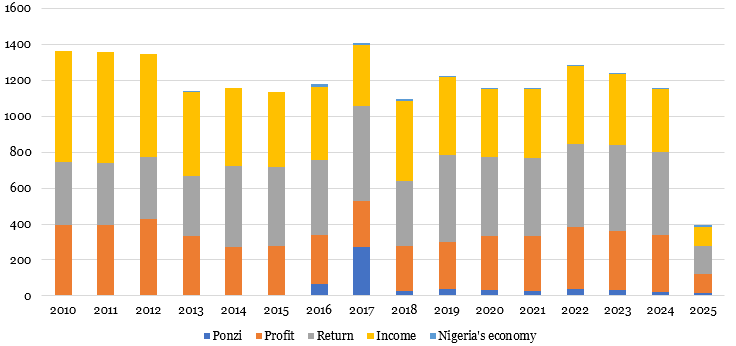
A deep dive into Google Trends data from 2010 to 2025 reveals a compelling and statistically significant connection between interest in Ponzi schemes and broader economic concerns in Nigeria. Public search interest in Ponzi and Nigeria’s economy is positively connected by 53.9%.

This means that nearly a third of the changes in search interest around Ponzi schemes can be explained by shifts in the country’s economic conditions. During periods marked by inflation, unemployment, and financial uncertainty, more people appear to explore Ponzi-like alternatives, not necessarily out of greed, but often as desperate coping strategies.

Exhibit 1: Public search volume of interest from 2010 to 2025 (as of April 13, 2025) in Ponzi and other keywords

Source: Google Trends, 2010-2025; Infoprations Analysis, 2025

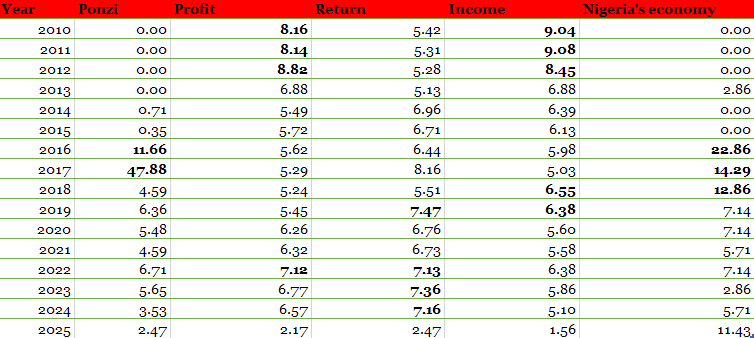
The connection grows even stronger when terms like return and income are introduced. With a 57.8% connection and a 33.4% interest in Ponzi schemes in return and income, the data suggests that interest in Ponzi schemes is deeply tied to the public’s concern for income stability and the quest for guaranteed returns. In a climate where job security is fleeting and living costs continue to rise, the allure of high-return promises, even if fraudulent, becomes increasingly difficult to resist.

When the term profit is added to the mix, the connection rises further to 59%.  This indicates a dangerous reality: the more people crave profit in an unstable economy, the more likely they are to fall prey to Ponzi-like opportunities. The profit motive, in this case, doesn’t simply reflect ambition; it reflects a survival instinct triggered by systemic economic hardship.

Interestingly, the data also shows that moderate public interest in economic matters corresponds with heightened curiosity about profit, while a higher focus on the economy appears to lower median interest in income-related terms. Our analyst notes that when people engage deeply with macroeconomic concerns, they may begin to question quick-fix income solutions. However, when engagement is shallow or reactive, the desire for profit tends to dominate, regardless of risk.

The consistent interest in “return” across all levels of economic focus points to a deeply ingrained desire for investment gains, a rational impulse in an irrational market environment. This further reinforces the idea that the popularity of Ponzi schemes is not solely rooted in deception, but also in unmet financial expectations and the absence of viable, trusted alternatives.

Ultimately, the positive connection between searches for “Ponzi” and “Nigeria’s economy” reflects more than just curiosity. Our analyst points out that it reflects a rising vulnerability. Periods marked by economic anxiety create the perfect environment for Ponzi schemes to thrive, our analyst adds.

Exhibit 2: Public search volume of interest from 2010 to 2025 (as of April 13, 2025) in Ponzi and other keywords in percentages

Source: Google Trends, 2010-2025; Infoprations Analysis, 2025

The Altcoin You’ll Invest $730 and Reach $73,000 in the Next 100 Days Could Be an Ethereum (ETH) Altcoin Priced Below 30 Cents

0

The crypto sector is on the verge of a significant revolution. Altcoins are taking off in 2025, and there’s one you should be aware of if you want to transform a little investment into a substantial return. It’s not Ethereum (ETH) itself, but Rexas Finance (RXS), an Ethereum crypto now trading at less than 30 cents but potentially increasing by 100x in the next 100 days. Let’s look at why this underappreciated altcoin could be the golden ticket you’ve been waiting for.

Why $730 Could Become $73,000 – In Just 100 Days

You’ve seen it before: Ethereum’s early investors watched their $1,000 turn into millions. But what if you could snag the next Ethereum-like altcoin before it skyrockets? That’s where Rexas Finance steps in. RXS is an Ethereum-based project focusing on real-world asset (RWA) tokenization. Consider real estate, art, gold, and other physical assets, but tokenized on the blockchain for fractional ownership and easier trading. It’s a game changer for investors seeking liquidity in previously illiquid assets. With the RXS token trading at $0.20, it is time to buy before it reaches new highs.

The Ethereum Altcoin You Need to Watch: Rexas Finance (RXS)

Rexas Finance is fundamentally a bridge between the traditional world of high-value assets and the blockchain-powered future of decentralized finance (DeFi). This is how it works.

  • RWA Tokenization: Rexas Finance tokenizes real-world assets such as real estate, commodities, and fine art, allowing investors to own parts of them. For example, holding RXS tokens enables you to own a portion of a million-dollar property without the enormous financial requirements of traditional real estate investing.
  • Leveraging the Power of Blockchain: Ethereum and smart contract technology ensure that everything is secure, transparent, and executed without intermediaries. This translates to lower fees and faster transactions for investors.
  • AI-Powered DeFi: The Rexas ecosystem does more than just tokenize assets; it also provides liquidity for them. With features such as staking, farming, and yield optimization, RXS investors can earn passive income by keeping their tokens and engaging in the ecosystem.

RXS Presale FOMO Is High: Are You In?

The Rexas presale has already raised $47.6 million, with 458 million tokens sold and just 9% remaining in Stage 12 (the final stage). That is a significant indicator of demand. The early investor advantage remains substantial, with RXS valued at only $0.20 per token, compared to $0.03 in Stage 1. By the time this presale ends and the coin hits exchanges, it will have increased by almost 740% – and this is only the beginning. Unlike many altcoins, Rexas Finance has no VC backing. That’s right: no venture capitalists are here to dump their bags and crash the market. The RXS presale was created with retail investors in mind, guaranteeing that early adopters like you can participate without fear of a price drop once the token hits exchanges.

Key Features Driving Rexas Finance to the Top

So, why is Rexas Finance attracting so much interest from investors? Here’s why.

  • No-Code Tokenization Platform: The Rexas Token Builder tool allows anyone to design their tokens. This democratizes access to generating and trading real-world assets, allowing even inexperienced investors to participate in tokenization.
  • AI Shield for Security: Rexas employs AI-powered smart contract auditing to ensure that all tokens and contracts are secure and free of vulnerabilities. Completing the Certik audit provides additional peace of mind to investors and decreases risk.
  • Launchpad Incubator for Startups: Besides holding tokens, innovators can seek funding for new ventures and access a global audience. This results in a speedier and more equitable alternative to the stringent traditional seeding techniques.

The $1M Giveaway: A Chance to Earn More RXS at No Cost

The $1 million giveaway adds fuel to the fire. The top 20 players can win $50,000 in RXS, offering investors another chance to win big. Since its introduction, almost 1.7 million entries have been received, as investors anticipate significant gains once the project goes live. To participate, consumers first purchase $100 worth of RXS and then continue to the Rexas Million-Dollar Giveaway section for more information on how to join and win big.

Upcoming Exchange Listing: The Countdown to a 100x Rally Begins

Here’s the most interesting part: Rexas Finance will be listed on major exchanges on June 19, 2025, with a $0.25 listing price. That represents a 25% increase above the current presale price of $0.20.  But that’s just the beginning; analysts predict a 10,000% price increase as the token becomes more widely available and acceptance develops. Over the next 100 days, this could turn a $730 investment into $73,000 for early presale investors. Rexas Finance (RXS), like Ethereum in its early days, has the potential to dominate a whole new market: real-world asset tokenization. As the project becomes popular and has a more extensive user base, the demand for RXS tokens will grow. And, with the Ethereum network and its smart contract capabilities, RXS is prepared to make large profits for those who invest early.

Conclusion: Your Opportunity is Now—Don’t Miss Out on RXS.

The RXS presale is running down, and opportunity is knocking. At just $0.20, Rexas Finance is the altcoin with the most promise for 2025. Whether you want to ride the wave to an exchange listing or invest in a breakthrough RWA tokenization project, now is the time to get involved. With a wise decision, you can quickly turn a $730 investment into $73,000 in less than 100 days. The clock is ticking; buy RXS tokens today.


For more information about Rexas Finance (RXS) visit the links below:

Website: https://rexas.com

Win $1 Million Giveaway: https://bit.ly/Rexas1M

Whitepaper: https://rexas.com/rexas-whitepaper.pdf

Twitter/X: https://x.com/rexasfinance

Telegram: https://t.me/rexasfinance


Ripple Acquired Hidden Road For $1.25 Billion

0

Ripple acquired Hidden Road, a prime brokerage firm, for $1.25 billion in a deal announced on April 8, 2025. This marks one of the largest acquisitions in the crypto industry, positioning Ripple as the first crypto company to own a global, multi-asset prime broker. The move aims to bridge traditional finance and decentralized finance (DeFi), with Hidden Road leveraging Ripple’s RLUSD stablecoin as collateral and migrating post-trade activities to the XRP Ledger (XRPL). The deal, subject to regulatory approvals, is expected to close by Q3 2025.

Hidden Road’s integration with XRPL will enable institutional clients to use Ripple’s RLUSD stablecoin as collateral for trading across asset classes like FX, commodities, equities, and crypto. This could drive higher transaction volumes on XRPL as traditional finance firms engage with DeFi. Hidden Road plans to migrate its post-trade activities, including collateral management and clearing, to XRPL. This shift will likely enhance XRPL’s utility for high-frequency, high-volume financial operations, boosting its scalability and relevance in global markets.

The use of RLUSD on XRPL for Hidden Road’s prime brokerage services strengthens the ledger’s role in stablecoin-based transactions, potentially attracting more DeFi and TradFi applications to the ecosystem. With Hidden Road’s global client base, XRPL could see increased network activity, including more wallet activations and smart contract deployments, as institutional flows leverage its fast, low-cost transactions.

The acquisition, pending approvals, aligns XRPL with regulated financial frameworks, potentially making it more appealing to risk-averse institutions wary of decentralized platforms. Overall, the deal positions XRPL as a critical infrastructure layer bridging centralized and decentralized finance, likely increasing its transaction throughput and ecosystem diversity by Q3 2025 when the acquisition is expected to close.

By integrating Hidden Road’s prime brokerage capabilities, XRPL becomes a pivotal platform for institutional players to access DeFi using RLUSD as collateral. This could accelerate mainstream adoption of XRPL for cross-asset trading, blending traditional finance (TradFi) with decentralized systems. Migrating Hidden Road’s post-trade activities (e.g., clearing and collateral management) to XRPL will likely drive higher transaction throughput. Institutional flows could significantly boost daily active addresses and smart contract interactions on the ledger.

RLUSD’s role as a collateral asset on XRPL strengthens its stablecoin utility. This may attract more developers and financial institutions to build or integrate applications, expanding XRPL’s decentralized app (dApp) ecosystem. The acquisition positions XRPL as a leader in bridging crypto and global markets, potentially outpacing rival blockchains like Ethereum or Solana in institutional use cases. XRPL’s low-cost, high-speed transactions could become a go-to for prime brokerage services.

Operating under Hidden Road’s regulated framework (with approvals pending), XRPL could gain trust from risk-averse institutions, reducing barriers to adoption and enhancing its reputation as a compliant blockchain. Greater XRPL utility may drive demand for XRP, as it’s the native token for transactions and liquidity. While price speculation isn’t guaranteed, increased institutional activity could positively influence XRP’s market perception.

The deal may spur new XRPL-based financial products, such as tokenized assets or automated market makers, leveraging Hidden Road’s client base and XRPL’s infrastructure. By Q3 2025, when the deal is expected to close, XRPL could emerge as a critical backbone for global financial operations, with ripple effects across adoption, innovation, and market dynamics.

Bavaria’s Conservative Leader Promotes Europe-India Free Trade Zone

0

Markus Söder, the leader of Bavaria’s Christian Social Union, has been advocating for a Europe-India free trade zone as a way to boost economic ties. He’s emphasized this during a trip to India, aiming to strengthen relations not just for Bavaria but for Europe as a whole. Söder’s pitch comes ahead of his meetings in New Delhi and a visit to Karnataka, India’s tech hub, signaling a focus on trade and innovation. He’s framing it as a counter to global trade tensions, calling India’s 1.4 billion-strong market a “huge opportunity.” This aligns with broader EU-India talks, which have been stuck for years but are now targeting a deal by the end of 2025, despite hurdles like agriculture and tariffs.

India protects its agricultural sector with high tariffs and subsidies, fearing EU competition could harm local farmers. The EU, meanwhile, pushes for market access but faces resistance due to India’s domestic sensitivities. India maintains high tariffs on goods like automobiles, wines, and dairy, which the EU wants reduced. India seeks greater access for its textiles and pharmaceuticals in the EU, but faces strict regulatory barriers.

India wants easier visa norms for its professionals in the EU, particularly in IT and services. The EU is cautious, citing immigration concerns and labor market impacts. The EU demands stronger patent protections, especially for pharmaceuticals, while India prioritizes affordable generics, creating tension over IPR standards. The EU’s push for environmental, labor, and human rights clauses, including its Carbon Border Adjustment Mechanism, clashes with India’s concerns about added costs and sovereignty.

The EU seeks access to India’s public procurement markets, but India restricts foreign participation to protect domestic industries. India’s ties with Russia and differing views on global issues complicate trust-building, slowing progress. Negotiations, ongoing since 2007, aim for a deal by late 2025, but these issues require significant compromise. Both sides see strategic value—India as a counterweight to China for the EU, and the EU as a key market for India—but bridging these gaps remains complex.

The EU runs a persistent trade deficit with China, reaching €292 billion in 2023, down from €396 billion in 2022. EU exports to China were €223.6 billion, while imports were €515.9 billion. This contrasts with EU-India trade, where deficits are smaller, and negotiations focus more on tariff reductions than such stark imbalances. China accounts for 21% of EU imports but only 8% of exports, highlighting dependency on Chinese goods like telecommunications equipment and electrical machinery.

The EU seeks reciprocity, as China’s market remains closed in key sectors like procurement and services. European firms face regulatory barriers, forced technology transfers, and weak intellectual property enforcement. This mirrors India’s protective stance on agriculture but differs in scale due to China’s global manufacturing dominance. China’s push for self-sufficiency and import substitution limits EU opportunities, unlike India, where negotiations aim to open markets mutually.

The EU imposed tariffs up to 35.3% on Chinese EVs in 2024, citing unfair subsidies. China retaliated with duties on EU dairy and brandy. Recent talks explore minimum pricing instead, showing pragmatic dialogue absent in stalled EU-India agricultural talks. China dominates supply chains, refining 90% of critical raw materials, creating EU dependency. This contrasts with EU-India discussions, which focus less on tech and more on traditional sectors.

The EU views China as a partner, competitor, and systemic rival since 2019, balancing cooperation with caution. Tensions over China’s Russia ties and human rights issues complicate trade, unlike EU-India talks, where geopolitics play a lesser role. U.S. tariffs under President Trump (up to 125% on Chinese goods) push China to seek closer EU ties, potentially flooding Europe with cheap goods. The EU is wary, unlike its proactive FTA push with India to counter China’s influence.

Chinese FDI in the EU hit €185 billion in 2024, nearly matching EU investments in China. However, the stalled EU-China Comprehensive Agreement on Investment (CAI) since 2021 reflects distrust, unlike the EU-India focus on building a new FTA framework. Despite a 1.6% trade rise in 2024 (€762 billion), EU exports to China dropped 4.5%, signaling vulnerabilities. China’s resilience contrasts with India’s slower integration into global trade.

The EU’s tools—like foreign subsidy regulations and anti-dumping measures—target China’s distortions, a sharper approach than the negotiated tariff reductions sought with India. EU-China trade dwarfs EU-India trade, with China as a systemic challenge due to its economic weight. India’s hurdles are more about domestic protections than global dominance. EU-China tensions center on high-tech and imbalances, while EU-India talks grapple with agriculture, labor mobility, and sustainability standards.

The EU uses defensive measures (tariffs, probes) against China but seeks cooperative deal-making with India, reflecting different strategic priorities. EU-China trade remains robust but strained by imbalances, subsidies, and geopolitics. Recent talks on EVs and trade diversion suggest pragmatic steps, driven by external pressures like U.S. tariffs. Unlike EU-India negotiations, which aim for long-term integration, EU-China dynamics hinge on managing rivalry while preserving economic ties.