DD
MM
YYYY

PAGES

DD
MM
YYYY

spot_img

PAGES

Home Blog Page 14

European Markets Slide as Trump’s Greenland Tariff Threat Exposes Deep Trade and Profit Risks Across Key Sectors

0

European stocks fell sharply on Monday as investors assessed the economic and financial fallout from U.S. President Donald Trump’s threat to impose escalating tariffs on several European countries if they oppose Washington’s bid to acquire Greenland.

The sell-off reflected growing concern that geopolitically driven trade measures could translate into real damage for some of Europe’s most globally exposed industries, particularly automobiles, luxury goods, and advanced manufacturing.

By late morning in London, the pan-European Stoxx 600 index was down about 1.4%, with losses broad-based across sectors. Only telecoms managed to stay in positive territory, while cyclicals and export-heavy industries bore the brunt of the decline. The move came after Trump said goods from Denmark, Norway, Sweden, France, Germany, the United Kingdom, the Netherlands, and Finland would face tariffs starting at 10% from February 1, rising to 25% from June 1 unless a deal is reached allowing the United States to “buy” Greenland, a semi-autonomous territory of Denmark.

The market reaction underscored how sensitive investors remain to trade policy shocks, especially when they involve the transatlantic relationship, one of the most deeply integrated trade corridors in the world. The European Union and the United States together account for roughly €1.6 trillion in annual trade in goods and services, with Europe running a sizeable surplus in manufactured products. That surplus, particularly in vehicles, machinery, and luxury goods, is now at the center of investor anxiety.

Automakers were among the hardest hit. The Stoxx Europe Automobiles and Parts index fell close to 3%, with shares in Volkswagen, BMW, and Mercedes-Benz down between about 3% and 5%. Porsche and Ferrari also slid, with Ferrari touching a 52-week low. The sharp reaction reflects how exposed Europe’s car industry is to the U.S. market.

The United States is the second-largest destination for EU vehicle exports after the United Kingdom, accounting for roughly 22% of EU car exports by value. In 2024 alone, the EU exported about 750,000 vehicles to the U.S., worth approximately €38.5 billion.

A tariff of 25% on finished vehicles would represent a substantial shock to that trade. For manufacturers, it would either force price increases in the U.S. market, risking a loss of market share, or require companies to absorb the cost through lower margins.

Either route implies weaker profitability. Industry analysts estimate that such a tariff could shave several percentage points off operating margins for premium European carmakers that rely heavily on U.S. sales, particularly in higher-end internal combustion and electric vehicles.

Electric and hybrid models are especially vulnerable, as the U.S. accounts for about a quarter of EU exports in that segment.

The implications extend well beyond final assemblers. Europe’s automotive supply chain is highly integrated, with major suppliers such as Bosch, Continental, and ZF shipping components across borders before final assembly. If U.S.-bound production slows or becomes less competitive, suppliers could face volume declines, pricing pressure, or costly efforts to redirect output to other markets where demand and margins may be weaker. Over time, sustained tariffs could also accelerate decisions to localize more production in North America, eroding Europe’s manufacturing base.

Luxury goods stocks also came under heavy pressure, with the Stoxx Europe Luxury 10 index down about 3%. Shares of LVMH, Hermes, Kering, and Moncler all fell sharply. The U.S. is a crucial market for European luxury groups, not just in terms of volume but also profitability, as American consumers typically deliver high margins.

Tariffs that raise retail prices risk dampening demand, particularly for discretionary purchases, and could force brands to choose between protecting volumes or preserving margins. Even modest volume declines can have an outsized impact on earnings in a sector that has already been grappling with slowing growth after the post-pandemic boom.

Technology and industrial names were not spared. ASML, the world’s largest supplier of advanced chipmaking equipment, fell more than 3%, while ASM International also slipped despite reporting stronger-than-expected preliminary bookings.

Although semiconductors are not directly targeted by the Greenland-linked tariffs, investors appear wary of broader trade and geopolitical spillovers that could eventually touch sensitive technology supply chains. The sell-off in these stocks also reflected profit-taking after recent highs, amplified by a deteriorating risk backdrop.

However, in contrast, defense stocks moved higher. Shares of Rheinmetall, Renk, and Thales all rose as investors rotated into companies seen as beneficiaries of rising geopolitical tensions and higher defense spending. The divergence highlighted a familiar pattern in times of geopolitical stress: capital flows out of trade-exposed cyclicals and into sectors linked to security and state spending.

Beyond individual sectors, the tariff threat raises broader questions about trade flows and investment decisions. Europe’s export model, particularly in manufacturing, has long depended on open access to the U.S. market. A sustained tariff regime would not only reduce export volumes but could also distort global trade patterns, pushing European firms to seek alternative markets in Asia, the Middle East, or Latin America, often at lower margins. Over time, such shifts could weigh on productivity and investment.

There are already signs that policy uncertainty is influencing corporate behavior. Recent data show that European, particularly German, investment flows into the U.S. have slowed markedly, with companies citing unpredictability around trade and industrial policy. While some firms may eventually choose to expand U.S. production to avoid tariffs, such decisions are capital-intensive and take years to materialize, leaving a near-term earnings gap.

The political response in Europe is still taking shape. European leaders have described the proposed tariffs as unacceptable and have pledged to stand behind Denmark. Brussels has tools at its disposal, including the EU’s Anti-Coercion Instrument, which allows for retaliatory measures against economic pressure from third countries. Any move towards retaliation, however, would raise the risk of a broader trade confrontation, with knock-on effects for growth, inflation, and financial markets on both sides of the Atlantic.

For now, markets are left to price a wide range of scenarios. A negotiated de-escalation could limit the damage, although the period of uncertainty alone is likely to weigh on confidence and investment. A full implementation of the tariffs, especially at the 25% level, would have measurable effects on export volumes, corporate profits, and supply chains, with the automotive and luxury sectors facing the most immediate pressure. A prolonged standoff could ultimately reshape transatlantic trade relationships, encouraging structural shifts in production and investment that would be difficult to reverse.

The sharp fall in European stocks on Monday was therefore less about a single policy announcement and more about the recognition that geopolitically motivated trade measures, even if initially narrow, carry the potential to inflict lasting economic and financial damage. Markets will be watching closely for signals from Washington and Brussels in the coming weeks, aware that the path chosen could redefine one of the world’s most important economic relationships.


What the Fox Megaways Review: Features, Bonuses & How to Play

0

The What the Fox Megaways slot from Red Tiger Gaming is a high-octane, high-volatility online casino game built on the popular Megaways engine. With up to 117,649 paylines, a dynamic reel layout, cascading mechanics, and a suite of bonus features, this game delivers a blend of excitement and strategic chance well-suited for both casual slot players and high-risk enthusiasts. In this review, we’ll break down everything you need to know — from core features to bonus rounds, how to play, and tips for maximizing your experience.

For context, the Megaways engine — originally developed by Big Time Gaming — allows the number of ways to win to change on every spin based on how many symbols appear on each reel. This creates highly variable and unpredictable gameplay that’s become a hallmark of modern online slots. What the Fox Megaways leverages this system to offer frequent action, cascading wins, and explosive bonus rounds that can multiply your stake thousands of times.

1. Overview: What the Fox Megaways Slot Basics

What the Fox Megaways is a 6-reel slot game developed by Red Tiger Gaming and released in May 2021. The game is themed around an indulgent fox character — Mr. Foxter — living a lavish lifestyle in a neon-soaked Vegas-style setting, complete with luxury cars, stacks of cash, and high-end accessories.

This title is considered high volatility, meaning payouts may not occur as frequently as in lower volatility titles, but when they do, they tend to be more substantial. Its theoretical Return to Player (RTP) sits around 95.66–95.71%, though the exact percentage can vary depending on the casino’s configuration.

Key game parameters:

  • Reels: 6
  • Paylines / Ways to Win: Up to 117,649 Megaways
  • RTP: 95.66–95.71%
  • Volatility: High
  • Min Bet: ~0.10 credits
  • Max Bet: Around 50 credits (varies by operator)
  • Max Win: Up to ~10,474× your bet

One of the strengths of What the Fox Megaways slot is that it appeals to a wide range of bettors thanks to its flexible betting range. Whether you’re a casual player or like to crank up stakes, you can tailor your play style to the mechanics.

  1. Theme and Design: Neon Vegas Meets High Roller Lifestyle

What sets ‘What the Fox Megaways’ apart visually is its Las Vegas-inspired design. Bright neon lights, high-contrast icons, and over-the-top characters create a vibrant backdrop for the gameplay. Mr. Foxter — a suave, spectacles-wearing fox — serves as both the wild and the thematic anchor, representing the high-roller lifestyle. Symbols include cash stacks, dice, whiskey glasses, luxury cars, and playing cards, all reinforcing the casino-and-luck motif.

The soundtrack and presentation are designed to amplify the high-stakes atmosphere, with fast-paced audio cues and animated visuals that heighten engagement. While this aesthetic won’t be to every player’s taste, it strongly supports the game’s identity and complements the fast-moving action.

  1. How to Play: Gameplay Mechanics Explained

Playing the what the fox megaways echtgeld version (real money mode) of this slot mirrors most Megaways titles but incorporates unique special features that elevate both the base game and bonus rounds.

Megaways Mechanic

Each spin operates under the Megaways system: the number of symbols per reel changes dynamically, resulting in up to 117,649 possible winning combinations. Matching symbols must land on adjacent reels from left to right to form a winning combination.

Cascading Reels

Whenever a winning combination occurs, the symbols involved in the win disappear, and new symbols fall from above to fill their positions. This “cascading” effect can trigger additional wins from a single spin, which can significantly increase payout potential. This mechanic continues until there are no new wins from the incoming symbols.


Wild Symbols (Wily Wilds)

The fox character acts as the wild symbol. When wilds appear, they not only substitute for other symbols to complete wins but may come stacked and carry multipliers. Up to three fully stacked wilds can appear on a single spin, each potentially adding a multiplier of up to ×7. If multiple stacked wilds land, their multipliers are combined — e.g., three ×7 stacked wilds result in a ×343 multiplier for that spin.

Scatter Symbols and Foxy Spins Feature

The scatter symbol — usually represented by a gold bar or wheel — triggers the game’s free spins bonus. Landing three or more scatter symbols anywhere on the reels activates the Foxy Spins feature, which awards a spin of a bonus wheel. This wheel determines:

  • The number of free spins (up to 20), and
  • Your starting multiplier (up to ×10).

During the Foxy Spins round, every winning cascade increases the multiplier by +1, and importantly, this multiplier does not reset between free spins. Each additional scatter that appears during free spins also adds one extra free spin, with no upper-limit on the total number of spins.

  1. Bonuses and Features: What to Look For

Cascading Wins

This core mechanic is both a feature and bonus: every win clears symbols and gives new ones the opportunity to drop into place, potentially triggering a sequence of consecutive wins. Players often see multiple payouts from a single spin because of this.

Stacked Wild Multipliers

Stacked wilds add another layer of potential payout excitement. With multipliers attached and the possibility of combining multiple wild multipliers in one spin, players have frequent opportunities for bigger payouts even outside of free spins.

Foxy Spins Bonus Round

The free spins bonus is where What the Fox Megaways can pay out very large wins. The wheel spin to determine the number of free spins, and the starting multiplier is a standout mechanic, and the fact that the multiplier only increases adds progressive tension throughout the bonus round.

Max Win Potential

On some versions of the What the Fox Megaways slot, you can win up to approximately 10,474× your original stake. Combined with high multipliers and cascading wins, this makes the bonus round especially appealing for players chasing large payouts.

  1. RTP and Volatility: What to Expect from Your Sessions

The RTP (Return to Player) figure describes the average payout a game returns to players over time. For what the fox megaways, it hovers around 95.66–95.71%, which is slightly below the industry average for many online slots but typical for Red Tiger titles.

Volatility is high, meaning wins are less frequent but potentially much larger when they occur. This combination — somewhat lower RTP with high volatility — suggests that the game is optimized for players who prefer larger but less frequent payouts, rather than steady small wins.

Players should also be aware that some casinos adjust the version of the game they host, which may slightly alter the RTP and other play conditions.

  1. What the Fox Megaways Echtgeld: Real Money Play

When playing what the fox megaways echtgeld (real money), you must ensure you’re using a licensed and regulated online casino. Red Tiger titles are widely supported across reputable operators. Real money play unlocks the full experience — including payouts, real stakes, and bonus rewards tied to your wagers.

Key points to remember when playing for real money:

  • Adjust your bet based on your budget and risk tolerance — the game supports bets from small to substantial amounts.
  • Real money play exposes you to the full RTP and volatility mechanics, unlike fun or demo mode.
  • Always check the casino’s RTP version to maximize potential returns.
  1. Tips for Maximizing Your Gameplay

While slots are primarily chance-based games, there are strategic considerations that can help you manage your budget and maximize your enjoyment: 

Understand Volatility

High volatility means larger, infrequent wins. Plan your bankroll accordingly, and don’t chase losses. Stick to a betting range that lets you play comfortably through many spins.

Practice in Demo Mode

Before playing for real money, try the demo to familiarize yourself with mechanics like cascading wins and bonus triggers. This eliminates guesswork once you switch to real bankroll stakes.

Choose Your RTP Version

If a casino lets you see or select the RTP version of the game, aim for higher RTP settings to improve your theoretical long-term returns.

Manage Your Bet Sizes

Adjust bets based on your session goals — smaller during exploratory play, and more strategic during bonus-heavy sessions.

Where to Play What the Fox Megaways

Players interested in experiencing What the Fox Megaways echtgeld can find the game available at several licensed online casinos, including Dimebit. Dimebit is an online casino that offers Red Tiger Gaming titles alongside a wide selection of slots, table games, and live dealer content.

8. Final Verdict: Is What the Fox Megaways Worth Playing?

What the Fox Megaways stands out as a bold and engaging title in Red Tiger Gaming’s portfolio. It captures both the thrill of modern Megaways slots and the allure of high-risk bonus features. With cascading reels, stacked wild multipliers, and the progressive Foxy Spins bonus round, the game balances style with deep mechanics that reward patience and strategy.

This is a game best suited for players who enjoy volatility and the prospect of large payouts rather than frequent small wins. The theme may not be universal, but it’s distinctive, polished, and consistent with the game’s overall design goals.

Whether you’re exploring What the Fox Megaways slot for its features or planning to play What the Fox Megaways echtgeld, this title delivers an immersive experience with real potential for big wins — especially at trusted casino platforms like Dimebit.

Which Crypto to Buy Today for Long-Term: 4 Best Picks to Consider

0

Several investors have become inclined to contemplate the top players as well as the emerging faces, such as Little Pepe, that have been garnering attention lately as part of the quest for the best crypto to hold long-term. While the overall market remains highly volatile, long-term investments are typically recognizable by their solid fundamentals, large-scale adoption, and a compelling narrative that can withstand the next cycles. We conduct further research to identify which tokens can meet the criteria and offer a feasible return on investment.

Momentum Wave Behind the Little Pepe Engine

Little Pepe is one of the most talked-about early-stage tokens right now, and honestly, it’s easy to see why. With Stage 13 pricing now at $0.0022 and the next stage at $0.0023, the presale is nearly at the finish line, with more than 97% of tokens already sold. Over 27.6 million dollars has been raised, showing surprisingly strong interest in a market that usually favors big caps over new names. Investors appear to believe that this one has the structure to stand out in the long term.

What makes Little Pepe particularly interesting is that it operates its own Layer 2 network, designed for speed, low fees, and enhanced security. The CertiK audit score of 95.49% is huge for a meme-powered chain, and it answers a major concern about trust and reliability. The project also features a fun yet serious distribution model, with allocations for presale, liquidity, staking, DEX support, and marketing. Add the zero tax policy and the big giveaway event, and it’s clear why long-term watchers are paying attention.

Increasing Strength Around the Sei Network Flow

Sei was really getting a lot of attention these last months, especially after market watchers began pointing out the huge difference in the Sei valuation versus that of its big competitors. In fact, the blockchain’s decentralized exchange volume exceeded $500 million last month, which is a strong signal of actual user engagement. The on-chain involvement continues to grow, the market becomes more liquid, and an increasing number of traders are joining the network. This is the kind of steady flow that a chain can show, and therefore, investors become eager to know what the long-term prospects are.

Data also shows that the protocol is handling high throughput without congestion, which gives it a solid reputation among high-frequency trading environments. Analysts comparing its market cap to Tron have also noted that the gap could provide significant upside over time. Even its price patterns reflect a maturing network, moving from sharp surges into controlled consolidations. For anyone wondering which crypto to buy today for long-term holding, Sei now appears in that conversation more often.

Renewed Life in XRP as ETF Activity Heats Up

XRP continues to occupy one of the most unique positions in the market, thanks to institutional attention and the emergence of new ETF products. After a rocky November, XRP regained the $ 0.20 level, with ETF inflows exceeding $660 million, indicating that professional investors see value despite regulatory uncertainty and a growing emphasis on trust. The charts outline a prolonged period when the price level of $2.30 has been a strong resistance, and the question of whether XRP will break through that level will probably signal its next major direction.

On the one hand, analysts predict an ongoing tug-of-war between ETF-driven demand and short-term traders who try to forecast volatility. On the other hand, the fact that XRP keeps its long-term support areas means that it can still be attractive to investors who consider multi-year time horizons. There is a possibility that the asset may not move rapidly every week, but it hardly ever deviates from the broader narrative.

Steady Ground Beneath Stellar as Market Cools Down

After a deeper pullback of less than $0.22, Stellar has been moving quietly but steadily around the $0.25 region. Its open interest is slowing down now, indicating that traders are taking a break after the rally of late November. The short-term momentum may be weak, but the broader market still recognizes Stellar as a viable solution for payments and cross-border settlements.

Technically, the market is at the very first stage of turning around its downtrend as the MACD is slowly changing and the Chaikin Money Flow is slightly increasing. Despite bearish trends, Stellar remains relevant, appealing to long-term investors seeking stability, reliability, and consistent value, even if it is not the most exciting project.

Final Thoughts

If you’re trying to decide which crypto to buy today for long-term growth, each of these four offers something different but meaningful. Little Pepe is the fast-rising presale with real tech behind its meme culture, while Sei, XRP, and Stellar represent stronger established networks with evolving roles in the wider market. Do your own research, as always. Visit the presale page and join the Telegram community to get updates and daily news about Little Pepe.


For more information about Little Pepe (LILPEPE) visit the links below:

Website: https://littlepepe.com

Whitepaper: https://littlepepe.com/whitepaper.pdf

Telegram: https://t.me/littlepepetoken

Twitter/X: https://x.com/littlepepetoken

$777k Giveaway: https://littlepepe.com/777k-giveaway/

IMF lifts Nigeria’s 2026 Growth Outlook to 4.4% as Reform Bets Strengthen

0

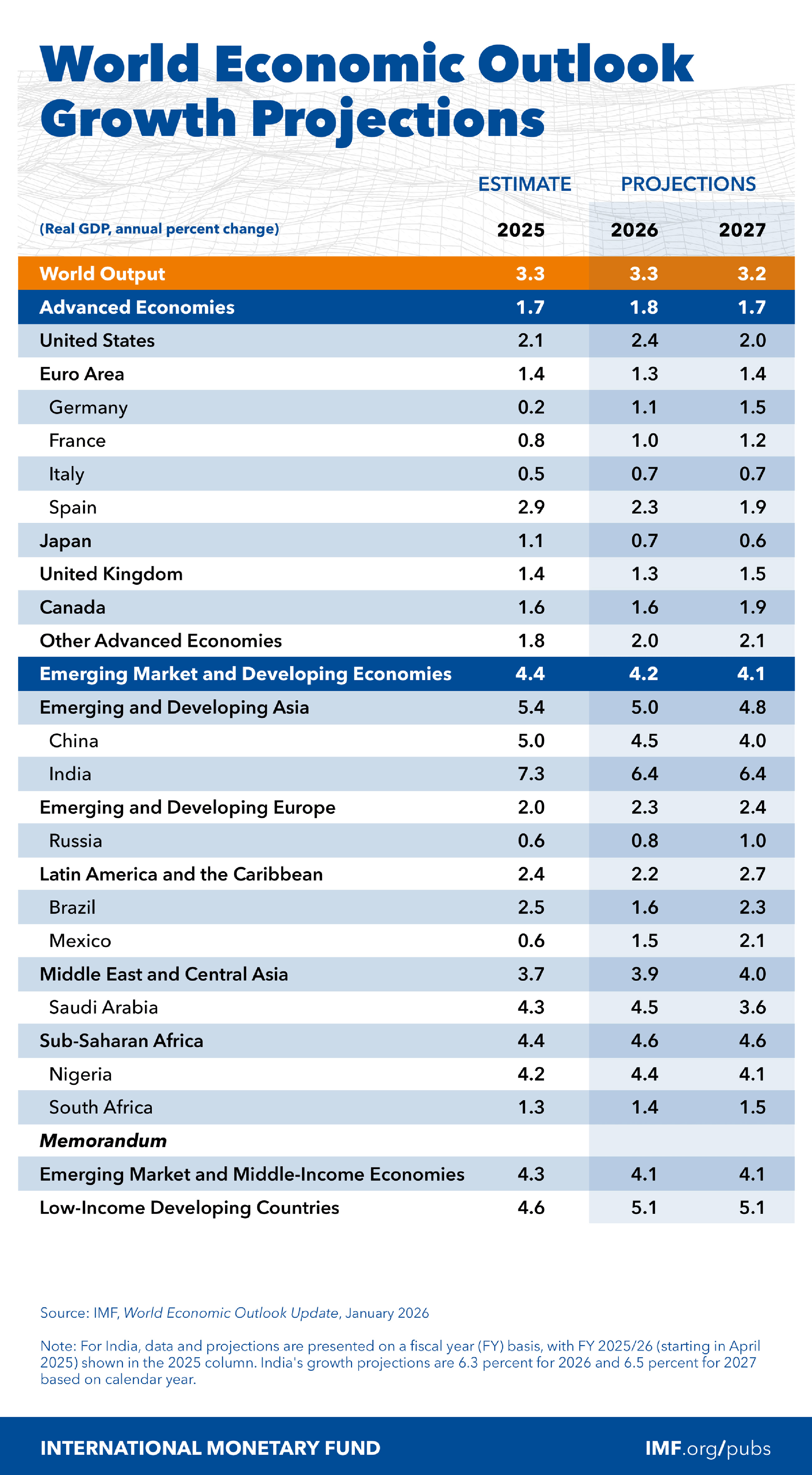
The International Monetary Fund has raised its forecast for Nigeria’s economic growth in 2026 to 4.4%, up from an earlier estimate of 4.2%, signaling growing confidence that Africa’s 4th-largest economy is beginning to stabilize after a prolonged period of strain.

The Fund’s decision to raise Nigeria’s 2026 growth forecast may appear incremental, but analysts believe it carries a heavier signal about how global lenders now read the country’s economic direction after years of volatility.

Published in the IMF’s January 2026 World Economic Outlook update and unveiled at the report’s official launch on Monday, the revision places Nigeria on a slightly stronger medium-term footing within a cautiously improving regional and global landscape. More importantly, it suggests that the Fund sees a clearer payoff from reforms that, until recently, were associated more with pain than progress.

However, the IMF stopped short of upgrading Nigeria’s near-term outlook, a choice that underscores the central tension in the economy. Growth momentum is expected to build gradually, not suddenly. Inflation remains elevated, purchasing power is strained, and financing conditions are still tight. Yet the Fund now appears more convinced that policy adjustments underway are beginning to anchor expectations beyond the immediate horizon.

In its October 2025 outlook, the IMF flagged Nigeria’s economy as one weighed down by inflationary pressure, fiscal stress, and structural rigidities. Since then, authorities have continued with reforms aimed at restoring macroeconomic balance, improving fiscal coordination between different layers of government, and reducing long-standing distortions in key markets. The January 2026 revision signals that the IMF believes these measures are starting to change the medium-term narrative, even if everyday economic realities remain harsh for many Nigerians.

Nigeria’s upgrade also fits into a broader regional story. The IMF lifted its growth projections for Sub-Saharan Africa to 4.1% in 2025 and 4.4% in 2026, pointing to a shared recovery rather than a Nigeria-specific turnaround. South Africa’s outlook improved marginally as well, reinforcing the sense that Africa’s largest economies are stabilizing after years of shocks ranging from pandemic disruptions to global tightening cycles.

The regional context is important for Nigeria. Investors often assess the country not in isolation but as part of an emerging-market basket. A stronger regional growth profile can help improve capital flows, deepen risk appetite, and support financial market stability. That dynamic partly explains why the IMF’s modest upward revision could punch above its numerical weight.

Still, the Fund’s optimism comes with caveats that are implicit rather than loudly stated. Growth at 4.4% remains below what many economists consider necessary to meaningfully lift incomes in a country with rapid population growth. Inflation has eased in headline terms, but Nigerians continue to complain that food, transport, and housing costs remain painfully high. Government statistics showing slower price growth have been met with skepticism in some quarters, with accusations that technical adjustments such as rebasing are being used to soften the inflation picture without easing real pressures on households.

From a fiscal standpoint, a stronger growth outlook offers some breathing room but not a solution. Higher growth can improve revenue collection and help manage debt ratios, but only if it is broad-based and accompanied by tighter spending discipline. The IMF has consistently stressed that productivity gains, private-sector expansion, and structural reforms are essential if Nigeria is to avoid repeating cycles of boom and strain.

The global backdrop adds another layer. The IMF expects world growth to hold at around 3.3% in 2026 before easing slightly in 2027, supported by technology-driven investment and relatively accommodative financial conditions. Global inflation is forecast to continue slowing, a trend that could ease external pressures on countries like Nigeria by lowering import costs and stabilizing capital flows.

In that sense, Nigeria is entering a potentially more forgiving external environment. Steadier global growth and easing inflation could give domestic policymakers more room to consolidate reforms without the constant shock of external crises. The IMF’s latest forecast suggests it is cautiously betting that Nigeria will use that space wisely.

The 4.4% projection is less a declaration of success than a signal of guarded confidence, at least for now. It indicates that the Fund believes Nigeria is edging toward a firmer recovery path, even as the lived experience for many citizens remains one of high costs and slow relief.

The coming years will test whether the medium-term optimism embedded in the IMF’s numbers can translate into tangible improvements on the ground.

IMF Concerns on Workforce In AI-Driven Future

Meanwhile, as artificial Intelligence (AI) grows at an unprecedented pace over the last decade, transforming from a futuristic concept into a practical tool embedded in everyday life and business, growing concerns about job displacement and disruption are more present than ever.

The International Monetary Fund (IMF), in a recent blogpost, highlighted the transformative impact of artificial intelligence (AI) and digital technologies on global labor markets, noting that even workers at the forefront of innovation are not immune to disruption.

Recent layoffs at major technology companies underscore the reality. While AI creates new opportunities, it also displaces existing roles, reshaping job markets across industries. According to a World Economic Forum survey, more than half of business executives globally expect the technology to displace existing jobs, while 24% said AI will create new jobs.

IMF’s analysis of millions of online job vacancies notes than one in ten postings in advanced economies and one in twenty in emerging markets now require at least one new skill. Professional, technical, and managerial roles, particularly in IT, account for more than half of this demand.

Sector-specific skills are also rising, with healthcare requiring telecare and digital health expertise, and marketing increasingly emphasizing social media proficiency.

The IMF notes that employers are willing to pay more for workers with emerging skills. In the United Kingdom and the United States, jobs requiring at least one new skill pay roughly 3 percent more, while roles demanding four or more new skills offer up to 15 percent higher wages in the UK and 8.5 percent more in the US. Such wage premiums can stimulate local economies, as higher earnings translate into increased spending and job creation.

However, the benefits are uneven. High-skill and low-skill workers gain the most, while middle-skill roles, such as routine office jobs, face pressures from automation. AI-related skills, although commanding higher wages, have not yet driven employment growth.

In fact, regions with high demand for AI skills have seen employment in vulnerable occupations decline by 3.6 percent over five years, highlighting challenges for entry-level workers entering a labor market increasingly exposed to automation.

Global Readiness And Policy Imperatives

The IMF emphasizes that these trends are not inevitable and can be shaped through proactive policy.

High demand, low supply: Nations like Brazil, Mexico, and Sweden must invest in STEM education, training, and potentially attract foreign talent.

High supply, modest demand: Countries such as Australia, Ireland, and Poland should stimulate innovation, support new firm creation, and improve access to finance.

Emerging and low-income economies: Need both investments in skills and policies that enable workers to adapt, access new opportunities, and maintain mobility.

The IMF also stresses the importance of social protection, competition policy, and flexible work arrangements to help workers navigate transitions and connect with emerging opportunities. Education systems must be redesigned to equip students with cognitive, creative, and technical skills that complement AI, ensuring they work alongside technology rather than in competition with it.

Countries that are already well-positioned include Finland, Ireland, and Denmark, which invest heavily in tertiary education and lifelong learning programs. These initiatives allow workers to adapt as technology evolves, increasing both workforce resilience and economic productivity.

The IMF concludes that the success of AI adoption depends not only on technology but also on preparing workers and firms for transition. Beyond economics, work provides dignity and purpose, making the AI transformation a profound social as well as economic challenge.

Notably, the fund adds that bold investments in skills, support for job transitions, and policies that keep markets competitive will determine whether the benefits of AI are broadly shared.

Orchestrating Excellence in Modern Aesthetic Environments

0

The wellness industry isn’t just about treatments anymore—it’s all about connecting clinical results with a great customer experience. These days, if you’re running a busy spa or wellness center, you need more than just basic scheduling tools. The right spa management software turns into the brain of your whole operation. It handles everything: staff commissions, room schedules, HIPAA-compliant client notes—you name it. By automating all the annoying paperwork and front desk tasks, your team can actually focus on what matters: giving clients that personal touch they’re paying for.

Let’s talk about making more money, too. The most successful spas don’t just rely on the services they offer in the treatment room. They boost their profits through strategic spa retailing by offering the right professional products at the perfect moment. Modern software helps with this—it uses smart algorithms to check out a client’s skin goals or wellness needs and then suggests home-care products right at checkout. Suddenly, retail isn’t just a side gig; it’s an extension of the treatment. When clients leave with a custom routine, they get better results, and your revenue isn’t stuck at a ceiling set by how many hours your team can work.

Inventory can be a headache, but good software makes it easy. You get real-time updates, so you’re not stuck with shelves of expired products or missing out on sales because you ran out. When you’re running low on a popular serum or oil, the system just creates a purchase order for you. Dashboards show which staff members are best at selling retail, so you know who needs more training or maybe some extra recognition. Plus, with the built-in CRM, you can send clients a quick reminder when it’s time to refill what they bought before—no need to remember everything yourself.

The whole client experience matters, right from booking an appointment online to using that new cleanser at home. With today’s platforms, clients fill out intake forms ahead of time, and payments are all set up and secure. That means you can spend the post-treatment chat talking about wellness, not fumbling through receipts. Digital aftercare instructions can even include personalized product recommendations, so clients feel guided—not pressured—when it comes to retail.

When you bring management tech and retail strategy together, your business stays nimble and profitable. You’re not just keeping up; you’re building a strong brand that can grow without losing the personal, high-quality feel that makes luxury wellness special.