DD
MM
YYYY

PAGES

DD
MM
YYYY

spot_img

PAGES

Home Blog Page 140

Nigeria’s October Inflation Rate Drops to 16.05%, but Fresh Questions Emerge Over the Credibility of NBS Data

0

Nigeria’s inflation rate eased sharply in October 2025, with headline inflation falling to 16.05% from 18.02% in September, marking one of the steepest month-to-month drops in recent years.

But beneath the surface, the celebratory tone around the data is unraveling. As more analysts dig into the numbers, questions about their reliability are gaining as much traction as the inflation slowdown itself.

The National Bureau of Statistics (NBS), which released the data on Monday, reported a year-on-year inflation rate of 17.82%, far below the 33.88% recorded in October 2024. The Bureau stressed that the improvement reflected the adoption of a new base year (November 2009) following its recent rebasing exercise.

On a month-on-month basis, headline inflation rose to 0.93% in October, up from 0.72% in September, indicating a faster pace of price increases across the economy compared to the previous month.

Urban and Rural Price Movements

The NBS reported that urban inflation stood at 15.65% in October 2025, representing a 20.73-percentage-point decline from 36.38% a year earlier. Urban inflation rose month-on-month to 1.14%, up from 0.74% in September. The twelve-month average urban inflation rate fell to 22.68%, down from 34.52% in October 2024.

Rural inflation printed at 15.86% year-on-year, down from 31.59% in October 2024. Month-on-month, rural inflation slowed to 0.45% from 0.67% in September. The twelve-month average rural inflation rate declined to 20.81%, compared to 30.24% last year.

Food Prices Ease Year-on-Year but Tick Up Monthly

Food inflation dropped dramatically to 13.12% year-on-year, a 26.04-percentage-point fall from 39.16% in October 2024. The Bureau attributed this large fall to the base-year adjustment introduced during rebasing.

Month-on-month food inflation improved to -0.37% in October, up from -1.57% in September. According to the NBS, price increases in fresh onions, oranges, pineapples, shrimp, unshelled groundnuts, vegetables such as ugu and okazi leaf, and meats including goat meat, cow tail, and liver drove the upswing.

The average annual food inflation rate for the twelve months ending October 2025 was 21.96%, down from 38.12% in October 2024.

Analysts have attributed the recent decline in the cost of food to the food import window, approved earlier this year by the federal government. Besides the moderating food prices, analysts note that improved foreign-exchange conditions and relatively stable energy costs supported the October slowdown.

But as market observers processed the report, a different story began taking shape — one that questions the credibility of the inflation numbers themselves.

Growing Scrutiny Over NBS Data

What should have been a landmark month for inflation relief is now at the center of one of the biggest statistical credibility debates Nigeria has seen in years.

The controversy gained traction because financial markets barely responded to the steep drop in inflation — a glaring red flag in any inflation-targeting environment.

Economist Kelvin Emmanuel pointed it out, saying: “I have to tell you that this is the first time in my life I will see that the statistics office is announcing that the inflation rate has dropped to 16.05% but the yield curve differential is not responding,” he said.

He argued that the Central Bank’s refusal to cut the Monetary Policy Rate (MPR) — despite a headline inflation reading that would normally justify such a move — exposes a deeper problem.

“The Central Bank’s monetary policy committee has refused to adjust the inflation to interest yield curve by cutting MPR to align. There’s no policy transmission that keeps your yield curve differential at 11%, especially because your mechanism is inflation targeting.”

He explained that “Inflation to interest yield curve should typically not be more than 400 basis points, so when you’re justifying such a divergence with leading and lagging indicator of money markets, you’re abdicating the role of the MPC to the vagaries of the markets.”

Against this backdrop, many believe that the reason the MPC has refused to cut the rates to align is because they don’t trust the numbers NBS is putting out, especially because of the weighting of the basket.

Concerns about NBS data did not begin in October. Since the bureau introduced its new rebased inflation basket, analysts have repeatedly questioned the figures — especially following changes to weightings.

The most sensitive change was the reduction of food weighting from about 60% to 50.8% and the reduction of energy from around 20% before merging rent, water, gas, and petrol into a broader 15.8% category.

“Oh yes, the rebasing figures are political because how can you move food from 60% to 50.8% and then energy from 20% and then group it under one basket of 5 major items like water, household rent, gas, petrol at 15.8%?

“The reduction in energy and food is the reason they are arriving at this distorted rate — and that is not a clear reflection of reality on the ground,” Emmanuel added.

Even with some declines in commodity prices, some analysts argue that Nigeria’s current economic conditions do not resemble a country with 16% inflation. To illustrate the mismatch, they point to 2021, when inflation stood at 16.95% — noting that it had far lower food prices, although fuel subsidy was still in place.

Market Reaction—or Lack of It—Tells Its Own Story

The financial system’s lack of response to the new inflation figures has become one of the strongest indicators that investors, lenders, and policymakers doubt the numbers.

Analysts have noted that under a credible inflation-targeting regime, a drop to 16% inflation would normally trigger:

• lower yields
• an MPR cut
• increased lending appetite
• adjustments across short-term money-market instruments

But as none of these are expected to occur as the yield curve remained unchanged, and the CBN left interest rates untouched, investors are expected to stay cautious.

Some analysts believe this silence is louder than any policy statement.

Google Unveils Global Rollout of New AI Travel Tools, Expands Agentic Booking for U.S. Users

0

Google is pushing deeper into AI-powered travel planning, announcing on Monday a suite of new features designed to simplify everything from finding cheap flights to assembling full trip itineraries.

The company is taking its “Flight Deals” tool worldwide, introducing trip-building capabilities through its Canvas workspace inside AI Mode, and expanding agentic booking support for restaurant reservations and event tickets across the United States.

The move signals Google’s broader strategy to embed AI into the full arc of travel decisions, turning Search into a hands-on planning companion rather than a directory of links.

Flight Deals, the AI-driven feature Google introduced in August for users in the United States, Canada, and India, is now rolling out to more than 200 countries and territories. The expansion covers major markets including the U.K., France, Germany, Mexico, Brazil, Indonesia, Japan, and Korea, alongside support for over 60 languages.

The tool works by asking users to describe where, when, and how they want to travel. Once a query is submitted, the system surfaces the strongest bargains available across destinations. Google says the global rollout makes affordable travel discovery more accessible, particularly for users who want quick recommendations without sifting through dozens of fare calendars.

Canvas Becomes a Travel Planning Hub in AI Mode

One of the biggest shifts in Google’s travel play is the introduction of trip-creation tools inside its Canvas workspace in AI Mode. Canvas originally launched as a study-planning and information-organizing tool. It sat off to the side — a place for lists, schedules, and iterative research.

Now it’s stepping into the travel lane.

To use it, users describe the kind of trip they want and select “Create with Canvas.” Google says the system instantly assembles a travel plan inside the Canvas panel, pulling in real-time data from Search, pricing and availability for flights and hotels, and Google Maps inputs like location photos and reviews. The system then organizes suggestions based on the user’s criteria — from hotel comparisons by price and amenities to dining and activity ideas arranged by proximity to where the traveler plans to stay.

The idea is to reduce the friction of moving between tabs and apps. Users can ask follow-up questions about tradeoffs, such as choosing between a hotel that’s closer to a café they want to try or one nearer to hiking trails they plan to explore.

For now, travel planning in Canvas is limited to desktop users in the U.S. who are enrolled in the AI Mode experiment through Google Labs.

Agentic Booking Expands Across the U.S.

Google is also widening access to agentic booking in AI Mode, a capability it introduced earlier this year for a smaller test group in Labs. These tools let users book restaurant reservations, secure event tickets, or arrange beauty and wellness appointments — all by describing what they need in natural language.

With Monday’s announcement, all U.S. users now get access.

If someone asks for dinner options for a specific party size, date, time, neighborhood, and cuisine preference, AI Mode searches across reservation platforms to return real-time availability. It then builds a list of options that fit the criteria. From there, users can select the reservation they want and book directly from the interface.

Google says the feature is built to handle multi-variable planning without forcing users to jump into each restaurant’s page or third-party platform.

The Next Step: Booking Flights and Hotels Inside AI Mode

Google also outlined what’s next: direct flight and hotel booking inside AI Mode.

The company says users will soon be able to describe what type of flight or hotel they want, then browse and compare schedules, prices, room photos, amenities, and reviews within a single conversational interface. This would bring Google closer to a full end-to-end AI travel assistant — one that handles discovery, comparison, and booking in one place.

The new tools strengthen Google’s attempt to reimagine Search as a proactive agent, not just an index. And with travel being one of the most search-heavy consumer activities online, the company is positioning itself to capture more of that workflow in AI Mode, where users can plan with fewer steps and fewer clicks.

Tekedia Capital Welcomes Mbodi AI, A Robotic AI Startup

0

Tekedia Capital is excited to announce our investment in Mbodi AI, a company pioneering embodied artificial intelligence for industrial robotics and enabling robots to learn the way humans do. Globally, nearly 70% of factories are grappling with severe labor shortages, and yet hundreds of billions of manufacturing tasks remain unautomated, not due to hardware limitations, but because traditional robots are rigid, slow to adapt, and difficult to retrain. The future of manufacturing belongs to systems that can learn fast, adapt fast, and work safely alongside humans.

Mbodi is redefining that future. With Mbodi’s platform, anyone can teach a robot a new skill simply by talking to it; no code, no engineering teams, no week-long reprogramming cycles. New tasks can be deployed on the factory floor in minutes. Their cloud-to-edge architecture converts high-level human instructions into precise, safe, adaptive robotic actions in under half a second.

Because of the transformative potential of this technology, Mbodi is already collaborating with ABB Robotics, one of the world’s foremost robotics manufacturers, on joint commercialization initiatives and first-of-its-kind deployments in live industrial environments.

We proudly welcome Mbodi AI to the Tekedia Capital family.


Ethereum’s $10K Goal Looks Strong, but Ozak AI’s $1 Prediction Feels Closer

0

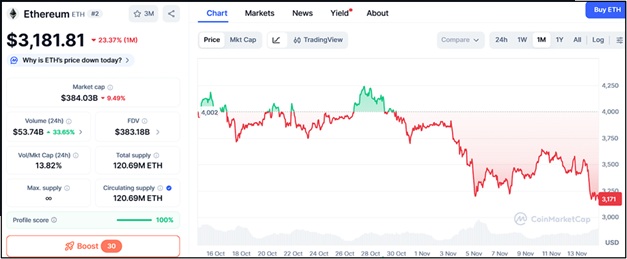
Crypto markets are gaining momentum again as Ethereum pushes toward higher levels, trading near $3,181 with strong technical support from both retail and institutional buyers. Analysts remain confident that ETH still has a path toward the long-predicted $10,000 milestone, supported by network upgrades, surging layer-2 activity, and expanding adoption across DeFi and tokenized assets.

Yet even as Ethereum gears up for another major breakout, the token gaining far more attention among early-stage investors is Ozak AI (OZ)—an OZ presale project whose low entry price and AI-driven utility make its $1 prediction feel significantly closer and more attainable than Ethereum’s multi-year journey to $10K. Ethereum remains the anchor of the smart-contract world, but Ozak AI is emerging as the rocket with the steeper trajectory.

Ethereum Maintains Strong Market Structure

Ethereum’s technical outlook reflects a healthy, upward-building market. Support sits at $3,040, $2,918, and $2,780, while resistance levels form at $3,260, $3,415, and $3,590. These ranges highlight a balanced bullish trend powered by rising liquidity, growing on-chain activity, and layer-2 ecosystems like Base, Arbitrum, and Optimism bringing millions of users into the Ethereum network.

DeFi volumes are climbing again, staking participation remains extremely high, and institutional adoption continues to expand as ETH solidifies itself as the backbone of decentralized finance. Its long-term path toward $10,000 is supported by genuine fundamentals — not just speculative hype.

However, Ethereum’s size also creates natural limitations. From $3,181 to $10,000 is only a little over a 3x move, which is strong but nowhere near the type of exponential ROI most early-stage investors seek in a bull market. That search for higher multipliers is driving traders toward projects still in their infancy—especially Ozak AI.

Ozak AI’s $1 Target Feels Closer

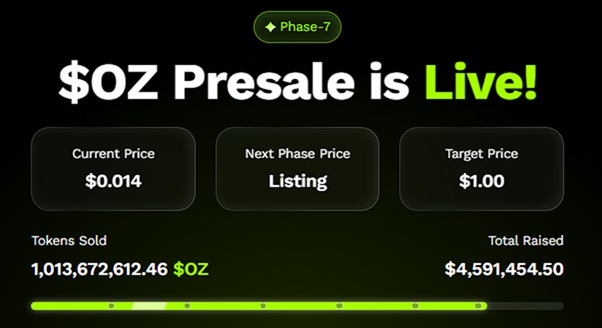
Ozak AI is rising fast as one of 2025’s biggest presale success stories. Priced at just $0.012, the project brings real AI-driven utility to blockchain ecosystems through its AI prediction agents—autonomous intelligent systems designed to analyze data, forecast trends, detect anomalies, and execute on-chain actions without requiring human input.

This positions Ozak AI at the heart of the fastest-growing narrative of this decade: the fusion of AI and decentralized systems.

Investor traction proves how quickly the project is gaining momentum:

  • Over $4.5 million raised
  • More than 1 billion OZ tokens sold
  • Audited by CertiK and Sherlock
  • Listed on CoinMarketCap and CoinGecko
  • Strategic partnerships with Perceptron Network, HIVE, and SINT

These partnerships provide Ozak AI with powerful compute access, ultra-fast 30 ms trading signal engines, and multi-chain agent automation—infrastructure unmatched by most early-stage tokens.

A presale price of $0.012 makes the path to $1 feel extremely attainable, especially with real utility and growing industry support behind it. That’s an 83x jump, which is why early investors see Ozak AI as the more explosive play compared to ETH.

Ethereum Builds Stability—Ozak AI Delivers Acceleration

Ethereum’s journey to $10,000 remains one of the most compelling long-term narratives in crypto. Its ecosystem dominance, developer base, and institutional appeal make it a must-hold for nearly every serious portfolio.

Ozak AI, however, represents the opposite end of the spectrum—early, ambitious, fast-moving, and carrying the type of 100x potential that defines bull-cycle breakthroughs. With cutting-edge AI utility, major partnerships, and rapidly growing demand, its $1 target feels much closer than Ethereum’s $10K milestone.

About Ozak AI


Ozak AI is a blockchain-based crypto venture that offers a technology platform that focuses on predictive AI and advanced records analytics for monetary markets. Through machine learning algorithms and decentralized network technologies, Ozak AI permits real-time, correct, and actionable insights to help crypto fanatics and companies make the precise choices.


For more, visit:

Website: https://ozak.ai/

Telegram: https://t.me/OzakAGI

Twitter: https://x.com/ozakagi

America’s Tech Giants Reload for the Next AI War, as Bezos Returns with Project Prometheus

0

A new race is accelerating, and the next great battle is AI. The signals are unmistakable: Jeff Bezos is edging back into the CEO arena, the Google founders are showing up at Mountain View more frequently to help steer the ship, and Elon Musk is expanding his AI frontier with a fresh $15 billion raise. From Meta to Oracle, America’s technology titans, and the founders who built them, are doing everything necessary to secure their companies’ future. And in this era, survival means one thing: building the most capable AI company.

For Bezos, the writing must have become clear: Amazon needs reinforcement, and he is returning to the ring. As reported: “Jeff Bezos is stepping back into the spotlight as a chief executive for the first time since leaving Amazon four years ago, taking the helm of a new artificial intelligence venture called Project Prometheus.

“The startup, still largely under wraps, already commands $6.2 billion in funding and has hired about 100 employees, many drawn from OpenAI, DeepMind, and Meta. Bezos will lead it as co-CEO with Vik Bajaj, a physicist and chemist with deep roots in Google X and Verily.”

Google People, take note. If Project Prometheus succeeds, Amazon now has a strategic AI backup plan in case its partnerships with Anthropic or others fall short. The battlefield is shifting, and the founders are returning because the stakes in AI are simply too high to stay on the sidelines.