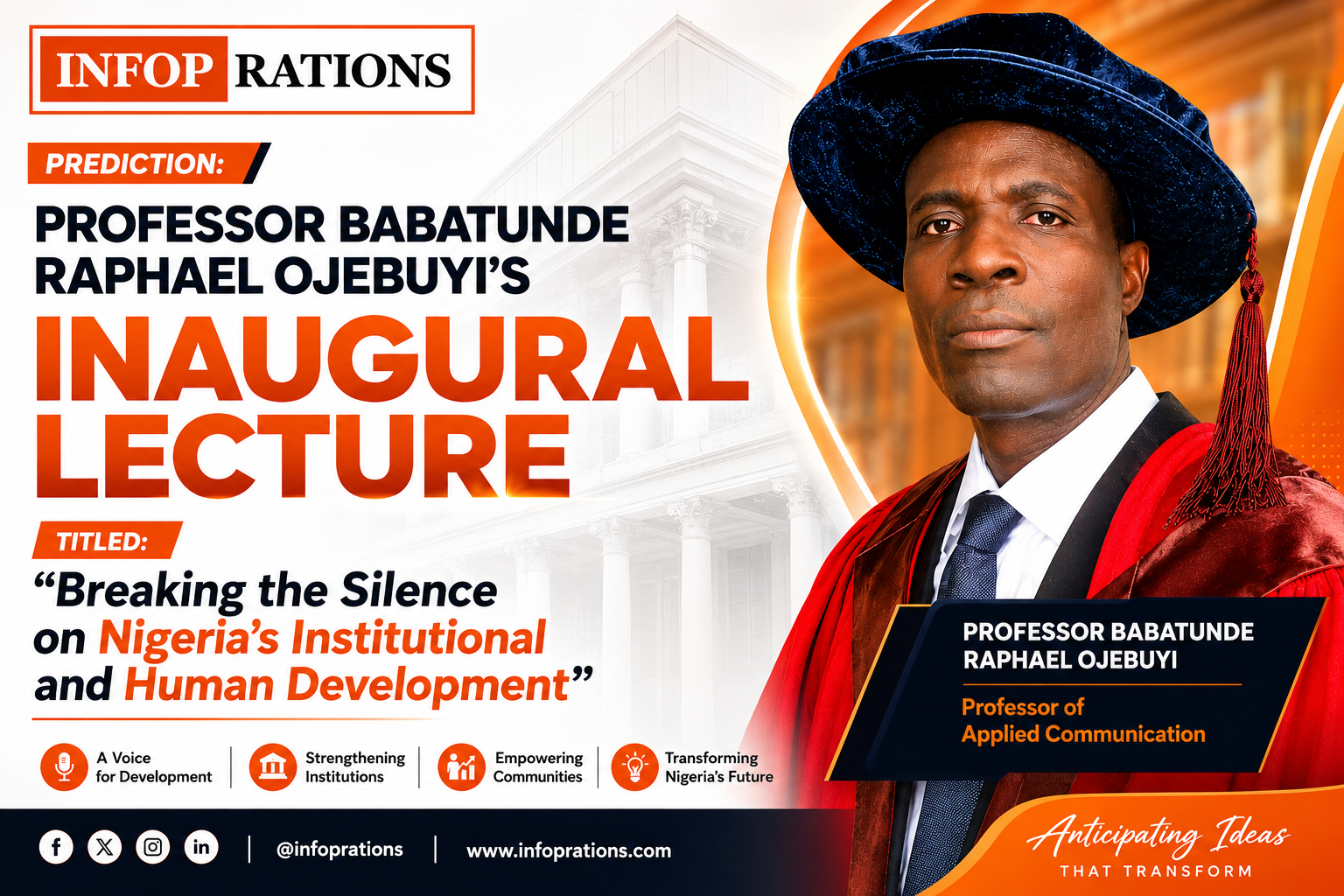
On May 21, 2026, our analyst reported the promotion of Dr. Babatunde Raphael Ojebuyi to the rank of full professor at the University of Ibadan. Since the University announced his promotion, five articles have been published, highlighting the impact of his research in Nigeria over the past 19 years.
In this piece, our analyst further examines the possible perspectives the Nigerian public should expect from his professorial inaugural lecture. Meanwhile, before delving into the lecture, understanding the significant role of Professor Ayobami Ojebode, the PhD thesis supervisor of Professor Ojebuyi, in shaping his career trajectory remains relevant to these predicted perspectives.
Our analysis of the academic publications of the duo shows that Professor Ojebode demonstrates the profile of a more established and influential scholar, while Professor Ojebuyi exhibits a high-growth research trajectory characterized by prolific output, interdisciplinarity, and an expanding scholarly reach. According to our analysis, this indicates that Professor Ojebode established a strong intellectual foundation, which Professor Ojebuyi consciously or unconsciously inherited and subsequently broadened into a larger, more diversified research portfolio.
Analysis shows that Professor Ojebode’s most influential work clusters around development communication, radio and community media, political communication, civic participation, and media systems. This gives his profile conceptual coherence, a pattern often associated with senior scholars who define a niche. Professor Ojebuyi’s strongest work spans agricultural communication, digital citizenship, elections and media representation, genomics ethics, and communication research methods.
BREAKING THE SILENCE ON NIGERIA’S INSTITUTIONAL AND HUMAN DEVELOPMENT
An Inaugural Lecture
By
Professor Babatunde Ojebuyi
Department of Communication and Language Arts
University of Ibadan
Protocol
The Vice-Chancellor, Deputy Vice-Chancellors, Registrar, Bursar, Librarian, Provost of the College of Medicine, Deans, Directors, Heads of Departments, Distinguished Colleagues, Members of Senate, Students, Ladies and Gentlemen.
I stand here today deeply conscious of the intellectual traditions that shaped this podium. In this same Department of Communication and Language Arts, distinguished scholars have stood before this learned audience to interrogate society, unsettle assumptions, and provoke new ways of seeing our collective reality.
One such moment occurred on 5 September 2019 when a distinguished scholar, mentor, and intellectual pathfinder delivered the 466th inaugural lecture of this University under the title In Search of Muted Voices for the Mirage Named Development. That lecture challenged us to listen more carefully to those whom institutions habitually ignore.
Today, I seek to continue that conversation, but with a slightly different emphasis. If development has remained a mirage because voices are muted, then we must ask another troubling question:
What sustains the muting?
My submission this evening is simple, though unsettling:
Nigeria does not merely suffer from a deficit of resources, infrastructure, or expertise; Nigeria suffers profoundly from a culture of institutional and human silence.
We are silent where communication should occur. We whisper where institutions should speak. We improvise where systems should listen.
And until this silence is broken, development may remain not only delayed but fundamentally distorted.
The Burden of Silence
Ladies and gentlemen, silence is often celebrated as a virtue. We are told silence is golden. In homes, silence preserves peace. In institutions, silence prevents embarrassment. In politics, silence protects loyalty.
Yet, scholarship teaches us that silence is not always harmless.
Sometimes, silence kills.
There is silence between parents and adolescents discussing sexuality, resulting in misinformation and vulnerability. There is a gap between healthcare institutions and citizens, fostering distrust of biomedical interventions. There is silence between researchers and policymakers, ensuring that evidence dies quietly inside academic journals.
There is the silence of governance, where citizens are informed late, partially, or manipulatively. There is the silence of editorial gatekeeping, where media institutions selectively amplify some realities while muting others.
There is also the silence of technology adoption: institutions proudly deploying digital systems without teaching citizens how to inhabit them meaningfully.
Thus, the problem before us is not simply communication failure.
It is institutional silence.
And institutional silence, I argue, is among the most under-theorised impediments to Nigeria’s human development.
From Muted Voices to Broken Silences: An Intellectual Journey
Every scholar is partly an inheritance.
My own scholarly trajectory emerged from a foundational intellectual tradition that viewed communication not merely as the transmission of messages but as an instrument of development, civic participation, and social transformation.
That tradition shaped my earliest encounters with communication scholarship.
Yet, scholarship also demands expansion.
What began within the ecosystem of development communication gradually widened into broader concerns: agriculture communication, elections and media representation, genomics ethics, digital citizenship, health communication, intercultural dialogue, artificial intelligence, and communication research methods.
At first glance, these domains may appear disconnected.
But they are not. A deeper interrogation reveals one recurring concern:
How does silence obstruct development?
Whether among spouses discussing reproductive health, governments communicating public policy, media organisations shaping public trust, or digital systems mediating citizenship, one persistent reality emerges: development struggles when communication breaks down.
Silence in the Human Sphere: Families, Identity, and Social Stability
Permit me to begin where every nation truly begins — the family.
Many developmental crises commonly classified as economic or moral problems are fundamentally communication failures.
Adolescent reproductive health vulnerability, for example, frequently emerges not from ignorance alone, but from communicative avoidance.
Parents fear discomfort.
Young people fear judgment.
Institutions fear controversy.
And silence becomes social policy.
Yet evidence consistently shows that family communication serves as a public health intervention.
When dialogue replaces silence, vulnerability reduces.
Similarly, intercultural and interfaith tensions often persist because communities inherit stereotypes rather than conversations.
Peacebuilding, therefore, requires more than military strategy.
It demands communicative courage.
Societies fracture not merely because groups differ, but because they stop speaking meaningfully to one another.
Silence in Governance: Institutions That Do Not Speak and Citizens Who Are Not Heard
Nigeria’s governance challenge is frequently described in economic terms.
I disagree.
At its foundation, governance failure is often communicative.
Policies fail not merely because they are poorly designed, but because institutions fail to explain them, defend them, humanise them, or receive feedback concerning them.
In many public institutions, communication remains transactional rather than relational.
Citizens are informed.
Rarely are they engaged.
Governments announce.
Rarely do they converse.
Consequently, mistrust becomes institutionalised.
I therefore advocate what I call an Evidence-to-Policy Communication Framework, where scholarship no longer sleeps quietly in university repositories but becomes actionable intelligence for governance.
Research should not merely satisfy promotion requirements.
Research must solve public problems.
A university that produces knowledge disconnected from governance risks becoming intellectually brilliant but socially irrelevant.
Silence in Media Systems: The Democratic Cost of Editorial Bottlenecks
No democracy survives sustained communicative opacity.
The media remains central to democratic legitimacy, yet media institutions themselves are not immune from silence.
Editorial bottlenecks influence what becomes visible and what disappears from public consciousness.
The issue is not only fake news.
The issue is selective visibility.
Whose voices count?
Who defines national urgency?
Who decides which suffering deserves headlines?
Communication accountability, therefore, becomes essential.
Media legitimacy rests not merely on freedom but on transparent gatekeeping and ethical responsibility.
For democracy to deepen, media organisations must break the silence surrounding their editorial logic.
Silence in Health and Science Communication: Trust as Infrastructure
Ladies and gentlemen, scientific breakthroughs alone do not save lives.
Communication does.
Healthcare interventions often fail because institutions mistake information for understanding.
Technical language alienates citizens.
Jargon becomes exclusion.
Fear replaces participation.
In biomedical research, genomics, vaccination campaigns, and reproductive health, public trust cannot be assumed.
Trust is infrastructure.
And communication is how societies build that infrastructure.
Thus, healthcare success depends not merely on medicine but on informed communication protocols that transform trust from moral expectation into practical participation.
Silence in the Digital Age: Technology Without Human Readiness
Nigeria’s digital transition raises another difficult question:
Can societies digitise faster than citizens can meaningfully adapt?
My answer is yes.
And this mismatch produces a new form of exclusion.
We celebrate platforms, infrastructure, applications, and automation.
Yet digital progress cannot be measured by hardware alone.
Technology becomes transformational only when citizens possess communicative competence to engage it ethically and critically.
Digital citizenship therefore matters.
Citizens must not remain silent participants in technological systems they barely understand.
Artificial intelligence similarly compels ethical caution.
We must resist both technological panic and technological worship.
The future lies neither in replacing humans nor in distrusting innovation.
Rather, I propose a hybrid human-AI communication model, where technology assists verification while human judgment retains ethical authority.
Silence and Economic Development: Communication as Productivity
Permit me to state a proposition that may sound unconventional:
Communication is an economic variable.
Development economists often emphasise capital, labour, infrastructure, and institutions.
Yet communication quietly mediates all four.
Youth unemployment, for instance, is partly a communication problem.
Many young Nigerians exist within weak feedback systems where opportunities, mentorship, and institutional guidance are absent.
Similarly, agricultural productivity suffers when farmers lack timely access to pricing information, weather intelligence, market opportunities, and technical support.
Mobile communication technologies, therefore, become not luxury tools but productivity instruments.
Economic growth accelerates where communication flows efficiently.
Poverty deepens where silence dominates.
The University and the Responsibility to Speak
What, then, is the responsibility of the University?
Universities must become institutions that interrupt silence.
We must challenge policy complacency.
We must democratise knowledge.
We must cultivate scholars who not only publish but also translate scholarship into public relevance.
The ivory tower must remain intellectually elevated, but never socially detached.
A university must not become an archive of ignored wisdom.
It must become society’s conscience.
Breaking the Silence Before Development Becomes Another Mirage
Ladies and gentlemen,
My argument this evening has been that Nigeria’s institutional and human development crisis is not merely technical.
It is communicative.
The silences between citizens and government.
Between science and society.
Between technology and inclusion.
Between institutions and accountability.
Between families and difficult conversations.
These silences quietly shape our developmental outcomes.
If we are serious about national transformation, then we must treat communication not as decoration after policy, but as policy itself.
Development does not fail because societies lack ambition.
Development fails when societies stop listening.
And perhaps, the greatest tragedy of silence is this:
It often appears peaceful while quietly producing disorder.
The task before us, therefore, is:
To speak where silence harms.
To listen where voices are ignored.
And to build institutions courageous enough to communicate honestly.
Only then may development cease to be a mirage and begin to resemble lived reality.
I thank you for listening.