DD
MM
YYYY

PAGES

DD
MM
YYYY

spot_img

PAGES

Home Blog Page 1494

A Trade War in the Making

0

At the end of March, Donald Trump reiterated his threat to impose higher tariffs on the European Union and Canada if they “economically harm the United States” in retaliation for tariffs he had imposed earlier.

Such statements from the U.S. President continue to strain relations between the transatlantic allies. As one of the key indicators of the U.S. economy, the U.S. Dollar Index (DXY) remains not only an economic parameter but also a vital factor reflected in the dynamics of global markets, especially in times of geopolitical tension.

Looking at the DXY performance, the U.S. dollar has remained relatively resilient despite ongoing global uncertainty. After peaking above 114 in late 2022, it has moderated to around 103 points in April 2025, reflecting a more balanced outlook amid interest rate adjustments and softening inflation data.

Since its peak, the U.S. currency’s strength has experienced volatility, closely tied to Federal Reserve policy expectations and global trade developments.

“If the European Union works with Canada in order to do economic harm to the USA, large-scale tariffs, far larger than currently planned, will be placed on them both in order to protect the best friend that each of those two countries has ever had,” Trump wrote on the Truth Social network.

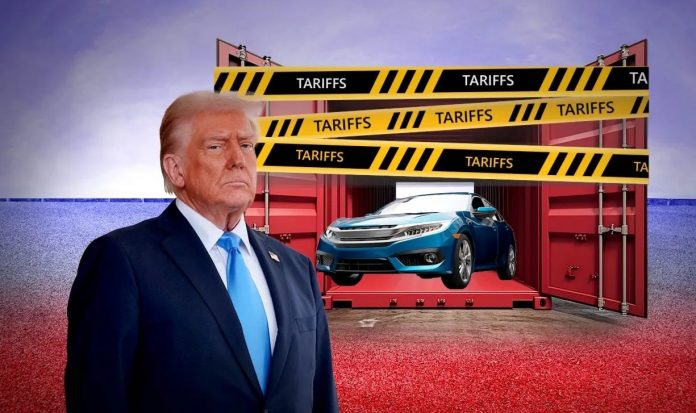
Recently, Donald Trump renewed his call for a 25% tariff on car imports into the United States, a move he frames as essential to safeguarding American industry — a continuation of his long-standing protectionist trade agenda.

European Commission President Ursula von der Leyen responded, calling the measure “bad for businesses and even worse taxes for consumers,” while Canadian Prime Minister Mark Carney labelled the tariffs a “direct attack” on Canadian workers and signalled possible countermeasures.

On Thursday, French Minister of Economics and Finance Eric Lombard urged Washington “to return to the table for meaningful dialogue.” The European Union, he said, had no choice but to stand firm in response to the U.S. “aggressive” trade policy.

“We are in a situation where we are under attack. Either we allow it and it never ends, or we retaliate. Unfortunately, that is the rule of the game imposed by the Americans,” he added. “I hope that when everyone understands that this [trade] war is going nowhere, we will be able to achieve a reduction.”

The EU has delayed the implementation of its latest round of countermeasures, including increased duties on American whiskey and motorcycles, until mid-April. Donald Trump, in return, has threatened to impose 200% tariffs on European wines and spirits. Lombard expressed optimism that negotiations could resume ahead of the upcoming International Monetary Fund meetings in Washington.

Meanwhile, the new round of tariffs on cars imported into the United States took effect on April 3, coinciding with Trump’s announcement of reciprocal tariffs on countries with persistent trade surpluses with the U.S.

These tariffs add to the legacy of trade barriers initiated during Trump’s earlier presidency, including duties on steel and aluminium, as well as various imports from Mexico, Canada, and China.

Another round of negotiations, expected in the coming days, will determine the evolution of the US-EU trade dispute. As for the measures already in place, time will tell whether Trump’s renewed trade policy push will truly “make America wealthy again.”
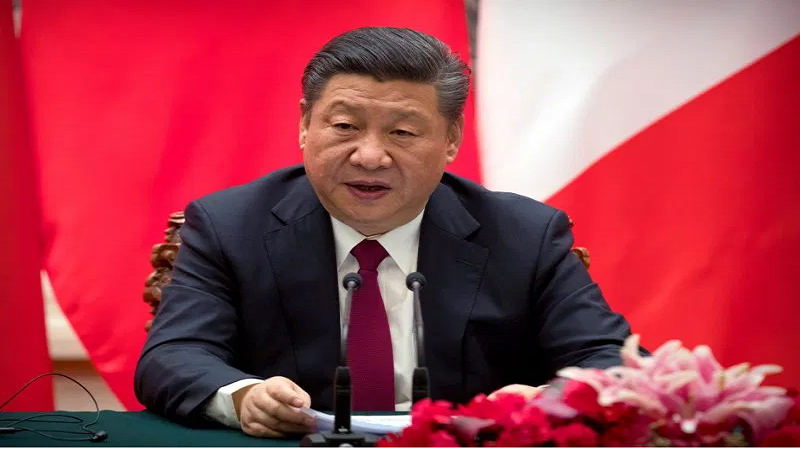
China’s Xi Jinping Visits Vietnam, Bolsters Ties Amid U.S. Tariff Storm, Sparking Washington’s Alarm

0

Chinese President Xi Jinping made a high-profile visit to Vietnam on Monday, intensifying global trade tensions, as Beijing and Hanoi signed 45 cooperation agreements to deepen economic ties, particularly in trade and supply chains.

The move, part of Xi’s broader Southeast Asia tour, has raised fresh concerns in Washington, with U.S. President Donald Trump accusing the two communist-led nations of conspiring to undermine American interests.

“I don’t blame China; I don’t blame Vietnam,” Trump told reporters at the White House. “That’s a lovely meeting. Meeting like, trying to figure out, ‘how do we screw the United States of America?’”

The visit comes against the backdrop of a bruising U.S.-China trade war, exacerbated by steep tariffs and protectionist policies that have reshaped global commerce. Xi’s trip, which includes stops in Malaysia and Cambodia through Friday, underscores China’s strategy to counter U.S. economic pressure by strengthening regional alliances, with Vietnam—a key industrial hub—emerging as a linchpin.

A Strategic Partnership in Hanoi

Xi’s two-day visit to Hanoi, his second in less than 18 months, saw him meet Vietnam’s top leader, To Lam, and Prime Minister Pham Minh Chinh. The leaders oversaw the signing of dozens of agreements covering supply chains, railways, artificial intelligence, and green energy, according to documents reviewed by Reuters and state media from both nations. While the specifics of these deals remain undisclosed, their scope signals an ambitious push to integrate economies amid global trade disruptions.

In an article published in Nhandan, the newspaper of Vietnam’s Communist Party, Xi called for enhanced cooperation in production and supply chains, warning that “there are no winners in trade wars and tariff wars.” Without naming the United States, he criticized protectionism as a dead-end, a sentiment echoed in his meeting with Chinh, where he urged opposition to “unilateral bullying,” per China’s Xinhua news agency.

Among the agreements, a memorandum of understanding between the China Council for the Promotion of International Trade and the Vietnam Chamber of Commerce and Industry aims to streamline certification of goods’ origins—a critical issue as Vietnam faces U.S. scrutiny over trade practices. Vietnam also greenlit Chinese loans for new rail links to boost bilateral trade, though no credit agreement was finalized. To Lam pressed China for concessional loans, Vietnamese state media reported, highlighting Hanoi’s eagerness to deepen infrastructure ties.

In a significant concession, Vietnam approved planes certified by China’s aviation regulator, paving the way for China’s COMAC passenger jets to operate in the country. On Sunday, Vietnam’s budget airline Vietjet signed an MoU with COMAC, potentially to lease two C909 jets for domestic routes, a deal that could bolster China’s struggling aviation exports.

The U.S.-China Trade War Fueling A Global Fault Line

The Hanoi summit unfolds as the U.S.-China trade war, reignited under Trump’s second term, reaches new heights. The United States has imposed 145% duties on Chinese imports, targeting electronics, steel, and other goods to curb Beijing’s economic influence and protect American industries. These tariffs, building on measures from Trump’s first administration, have pushed Chinese manufacturers to relocate operations to Southeast Asia, with Vietnam receiving billions in investments to sidestep U.S. levies.

Vietnam, meanwhile, faces its own tariff threat: a potential 46% duty on its exports to the U.S. set to take effect in July 2025, after a global trade moratorium expires. Hanoi is negotiating to reduce these tariffs, a process complicated by Washington’s demand that Vietnam ensure its exports—labeled “Made in Vietnam”—meet strict rules of origin. This has led Vietnam to tighten controls on trade with China, cracking down on goods that may be minimally processed in Vietnam to dodge U.S. tariffs.

Vietnam’s trade data underscores its pivotal role: in Q1 2025, it imported $30 billion in goods from China, primarily components for electronics, shoes, and apparel while exporting $31.4 billion to the U.S., its largest market. This near-parity reflects Vietnam’s position as a conduit between Chinese supply chains and American consumers, a dynamic that alarms Washington as Beijing and Hanoi grow closer.

The U.S. has also pressed Vietnam to address broader concerns, including market access and intellectual property protections. In recent months, Vietnam imposed anti-dumping duties on Chinese steel and ended tax waivers for low-value parcels to curb the influx of cheap Chinese goods—moves seen as aligning with U.S. demands. Additionally, Vietnam’s approval of Elon Musk’s Starlink satellite service, signaling Hanoi’s willingness to balance ties with both powers, has irked Beijing.

The Alarm in Washington’s Reaction

Xi’s visit has amplified U.S. fears that China is rallying Southeast Asian nations to counter American trade policies. Trump’s blunt remarks on Monday framed the China-Vietnam talks as a direct challenge, though he tempered his criticism by noting he didn’t fault either nation for pursuing their interests. A Trump administration official revealed that Trump and To Lam recently discussed reducing reciprocal tariffs, with plans for an in-person meeting soon, suggesting a pragmatic approach despite the rhetoric.

Trump’s comments echo broader anxieties in Washington about losing economic leverage in Asia. Vietnam’s role as a major exporter of electronics and apparel to the U.S. makes it a critical player, and any shift toward deeper integration with China could weaken America’s trade position. The Biden administration’s earlier efforts to strengthen ties with Vietnam, including upgrading diplomatic relations in 2023, have been overshadowed by Trump’s tariff-heavy strategy, which risks pushing Hanoi closer to Beijing.

Geopolitical Undercurrents

Beyond trade, Xi’s visit highlights China’s broader ambitions in Southeast Asia. His stops in Malaysia and Cambodia, countries hit hard by U.S. tariffs, aim to cement Beijing’s influence in a region wary of choosing sides. Cambodia, a close Chinese ally, and Malaysia, a key trade partner, offer Xi opportunities to promote initiatives like the Belt and Road, despite past concerns over debt and sovereignty.

However, tensions persist. Vietnam and China frequently clash over South China Sea boundaries, a sore point that economic cooperation has not fully resolved. Vietnam’s concessions to the U.S., including Starlink’s deployment, may strain ties with Beijing, even as Hanoi seeks Chinese investment and loans.

Some analysts believe that Vietnam’s leaders are walking a tightrope, leveraging Chinese capital to fuel growth while placating U.S. demands to safeguard its export-driven economy.

Trump Hints At Exempting Auto Industry From 25% Tariffs

0

President Donald Trump on Monday hinted at a possible temporary exemption for the auto industry from the 25% import tariffs he had previously imposed, in what analysts say could mark another reversal in his increasingly erratic trade policy.

The announcement adds to a growing list of concessions from the Trump administration as pressure mounts from both domestic industries and international allies.

Speaking to reporters in the Oval Office, Trump said the goal was to give carmakers time to restructure their supply chains and shift production to the United States.

“They need a little bit of time,” he said. “They’re going to make them here, but they need a little bit of time. So I’m talking about things like that.”

Trump’s latest overture is not limited to the auto industry. Just days earlier, the White House had quietly rolled back reciprocal tariffs on certain household electronics, including smartphones, laptops, and semiconductors. The move brought immediate relief to major U.S. tech firms — most notably Apple, which sources a significant portion of its products and components from China.

Apple’s stock bounced back following the announcement, and industry insiders welcomed the reprieve from what had become a growing trade war with Beijing. Semiconductor manufacturers also saw a slight uptick, as fears of restricted access to Chinese components began to ease.

For the auto sector, the latest concession may help avoid widespread disruption. American automakers like Ford, General Motors, and Stellantis have spent decades building integrated production systems that span the globe. Elon Musk’s Tesla, which relies heavily on imported components and has a sprawling gigafactory in Shanghai, also stands to benefit from any delay or softening of the tariff regime.

Matt Blunt, president of the American Automotive Policy Council, which represents Ford, GM, and Stellantis, responded positively to Trump’s comments.

“There is increasing awareness that broad tariffs on parts could undermine our shared goal of building a thriving and growing American auto industry,” he said.

But the softening tone from the White House has not been overly welcome.

Critics Say Concessions Signal Strategy Collapse

Many analysts and former officials are interpreting the latest rollbacks not as a tactical recalibration, but as evidence that the Trump administration is caving under pressure — particularly from China, which has vowed not to yield to Washington’s demands.

Trump’s initial plan, unveiled with much fanfare in March, included blanket tariffs on a wide range of imports and a sharp escalation of duties on Chinese goods, with tariffs on electronics and auto parts among the most disruptive. But with U.S. financial markets jittery, bond yields climbing, and consumer confidence slipping, the administration has steadily retreated from the hard lines it once drew.

Among the most vocal critics is former U.S. Treasury Secretary Janet Yellen, who has publicly questioned both the intent and execution of Trump’s tariff strategy.

“The logic behind the tariff measures remains unclear and not at all sensible,” Yellen said in a recent interview.

Markets Show Unease Despite Temporary Boost

Wall Street reacted with mixed signals. The S&P 500 rose 0.8% Monday on news of possible auto tariff exemptions and tech reprieves, but the broader picture remains bleak — the index is still down nearly 8% on the year, and 10-year Treasury yields remain elevated around 4.4%.

Carl Tannenbaum, chief economist at Northern Trust, summed up the sentiment saying: “The whiplash has been so great that I might have to get fitted for a neck brace.” He added that the broader damage to consumer, business, and investor confidence “may already be irreversible.”

No Clear Endgame

Though Trump insisted, “I don’t change my mind, but I’m flexible,” many believe that the lack of a clearly articulated strategy has weakened America’s negotiating position. The 145% import tax on Chinese goods announced last week was followed within days by temporary exemptions for electronics — a development many saw as a quiet retreat rather than a calculated move.

The administration’s struggle to articulate an endgame has created an atmosphere of uncertainty that many fear could erode the credibility of U.S. trade policy for years to come.

Meanwhile, Beijing has remained unmoved, continuing to respond to U.S. tariffs with retaliatory measures of its own. Chinese officials have repeatedly said they will not be coerced into a deal and have criticized the “unilateral and protectionist” stance of the U.S. government.

The temporary relief for the auto and tech industries may spare them immediate damage, but many believe the storm is far from over. However, with each reversal, critics argue, Trump’s tariffs appear less like a well-planned strategy and more like an improvised attempt to balance political optics with economic fallout, a balancing act that may prove unsustainable.

Living and Traveling Through Montana’s Open Spaces

0

Montana is one of the largest states in the U.S., yet it remains one of the least populated. Known as “Big Sky Country”, it’s a place where the horizon stretches without interruption, the skies feel endless, and nature dominates nearly every direction. But beyond its postcard views, Montana offers a unique blend of rugged wilderness, cultural heritage, and practical challenges—especially for those planning to visit or stay.

Covering over 147,000 square miles, Montana is the fourth largest state by area. Despite this, fewer than 1.2 million people live there. That means plenty of space, but limited infrastructure between towns. Its terrain spans from jagged peaks in the west to rolling plains in the east, offering some of the most varied landscapes in the country.

Nature on a Grand Scale

Montana is home to two major national parks: Glacier and part of Yellowstone. Glacier National Park alone includes over 700 miles of hiking trails, pristine lakes, and a wide range of wildlife. The terrain includes alpine mountains, dense forests, and valleys carved by ancient glaciers. The state also contains rich fossil beds, especially in the Hell Creek Formation, which has yielded some of the best-preserved dinosaur remains ever discovered.

Wildlife thrives in Montana’s open spaces. Grizzly bears, black bears, moose, elk, bison, and wolves are all found here. In the western regions, grizzlies exist in higher densities than almost anywhere outside Alaska. Birdlife includes bald eagles, hawks, and migratory species that follow the rivers and mountain corridors.

Rural Living and Native Heritage

Most of Montana consists of small towns and rural communities. Large cities are few and far between. The lifestyle is quiet and heavily influenced by agriculture, ranching, and outdoor activities. Historically, Montana played a key role during the Gold Rush, and evidence of its boomtown past remains in places like Helena and Virginia City.

Montana is also home to seven federally recognized Native American tribes. Reservations occupy a significant portion of the land, and tribal cultures remain vibrant. Powwows, craft traditions, and community-run museums offer insight into this essential part of Montana’s identity.

You’ll Need a Car – And Not Just for Travel

Owning or renting a vehicle in Montana is not optional for most visitors. Distances between towns, attractions, and services are long. For example, driving from Bozeman to Glacier National Park takes over five hours. Public transportation is minimal to nonexistent outside of a few cities, and rideshare options are rare in remote areas.

Fuel stations can be far apart in rural regions, so filling up early is a necessity. Roads are generally well maintained, but mountain routes may require extra caution during winter or early spring due to snow and ice. Wildlife on roads is another hazard, especially at dawn and dusk.

If an accident does happen, don’t hesitate to reach out to a reliable auto accident law firm from Montana for immediate legal support. Whether you’re dealing with injuries, insurance disputes, or unclear liability, professional guidance can help protect your interests and ensure proper compensation.

Cities in a Sea of Wilderness

Montana’s cities each have a distinct identity. Some are gateways to the outdoors; others focus on arts or history. Bozeman and Missoula are mid-sized towns with active cultural scenes and university influences.

Helena, the capital, retains its gold rush-era architecture and offers quick access to mountain trails. Billings, the largest city, serves as a commercial hub and starting point for eastern Montana exploration.

Despite their differences, these cities are all surrounded by nature. Within minutes, you can leave urban areas and find yourself in open fields, dense forests, or near rivers ideal for fishing or rafting.

The Weather Is Beautiful – and Unforgiving

Montana’s weather varies drastically depending on season and elevation. Summers are warm and dry, with cool nights even in July. Winters are long and cold, especially east of the Rockies. Mountain areas can experience snow as late as June and as early as September.

Weather changes quickly. A sunny morning can turn into a stormy afternoon. Travelers need to prepare for shifts in temperature and conditions, even during a single day. In rural areas, blizzards and flooding can cut off roads with little warning.

Facts That Might Surprise You

  • Montana has no state sales tax, which benefits both residents and travelers. 
  • It also holds the U.S. record for the largest temperature swing in 24 hours: a 103-degree rise in Loma in 1972. 
  • In another weather record, a snowflake measuring 15 inches across was reported in Fort Keogh in 1887. 
  • The state also has more cattle than people, with an estimated 2.5 to 1 ratio, underscoring the importance of agriculture. 
  • The state has some of the darkest night skies in the lower 48, ideal for stargazing.

Travel Tips for First-Time Visitors

Montana’s best travel season is typically from late spring to early fall. Winter can be beautiful but harsh, especially in the mountains. In January 2024, Dillon, Montana, recorded an all-time low of -42°F, emphasizing the need for visitors to prepare for extreme temperatures.

Layers are essential due to the state’s unpredictable weather. If exploring national parks or hiking in remote areas, bear spray is strongly recommended. Mobile service can be spotty, so downloading maps in advance is a smart move.

When driving, keep an eye on your fuel level, carry water and snacks, and be prepared for long stretches without services. Scenic byways are often the most efficient and beautiful routes. Plan your days carefully – distances may be greater than they appear on a map.

People and Community

Montana communities value independence, self-reliance, and strong local ties. Many residents live far from large cities and rely on neighbors for help during emergencies or harsh winters. Events like rodeos, farmers markets, and local festivals play an important role in maintaining social bonds.

The culture tends to be practical, rooted in tradition, and shaped by generations of people living close to the land. That said, many towns are seeing growth from out-of-state transplants and a gradual blending of old and new influences.

Final Thoughts

Montana offers solitude, space, and natural beauty on a massive scale. But this comes with the need to plan ahead, drive long distances, and be self-reliant.

Whether you’re going to hike a glacier, photograph wildlife, or simply breathe in the open air, Montana rewards those who come prepared. Bring your curiosity – and a full tank.

How Car Finance Deals Differ for New vs. Used Electric Vehicles

0

Electric vehicle sales grew 38% in 2023, reaching 14.2 million units globally. New EVs depreciate 52% faster than combustion vehicles during their first three years, significantly impacting financing structures. Government incentives reduce new EV purchase costs by up to £7,500 in many regions, while used models typically see 18% higher interest rates but 31% lower monthly payments. Manufacturers offer specialized battery warranties covering 8-10 years, creating unique considerations when evaluating pcp car finance options for electric vehicles compared to traditional fuel vehicles.

Understanding electric vehicle financing basics

Interest rates for electric vehicles typically reflect both the vehicle’s value and the lender’s assessment of risk associated with this technology. Loan terms may extend from three to seven years, with longer terms becoming increasingly common due to the higher initial purchase price of EVs.

Special financing programmes often include incentives designed to offset the higher upfront costs, manifesting as reduced interest rates, extended payment periods, or deferred payment options. Some lenders now offer specific “green vehicle” rates that provide more favourable terms for environmentally friendly vehicles.

New electric vehicle financing options

Government incentives and their impact on financing

Government incentives significantly alter the financial equation when financing a new electric vehicle. In the UK, the Plug-in Car Grant provides substantial support for certain vehicle categories, effectively reducing the amount you need to finance. Tax incentives, including reduced Vehicle Excise Duty and beneficial Benefit-in-Kind rates for company car users, further enhance the financial appeal of new EVs.

Regional variations exist across the UK, with Scotland offering additional support through the Low Carbon Transport Loan, providing interest-free loans for new electric vehicle purchases.

Manufacturer financing programmes for new EVs

Manufacturers have developed sophisticated financing packages specifically for their electric models. Volkswagen offers Solutions PCP plans with interest rates as low as 2.9% APR for their ID models, significantly lower than their combustion engine counterparts.

Down payment requirements for new EVs tend to be higher than for conventional vehicles, typically starting at 15-20% of the vehicle price. Some manufacturers, like Renault, have historically offered battery leasing separate from the vehicle, creating unique financing structures.

Key benefits of new EV financing

New electric vehicles typically attract interest rates 1-2 percentage points lower than their used counterparts. Warranty coverage, particularly for the battery component, represents a substantial financial benefit exclusive to new EVs, with most manufacturers offering battery warranties of 8 years or 100,000 miles.

Beyond the direct financing advantages, new electric vehicles offer numerous savings that impact your overall financial picture:

  • Zero road tax for fully electric vehicles
  • Substantially lower fuel costs, often 60-80% less than petrol vehicles
  • Reduced maintenance expenses with fewer moving parts
  • Access to London’s Ultra Low Emission Zone without charges
  • Free or reduced-cost parking in many urban centres

Used electric vehicle financing landscape

Challenges specific to used EV financing

Financing a used electric vehicle presents unique challenges that impact loan terms. Battery condition assessment becomes critical, with some lenders requiring independent evaluation before approving financing. Depreciation patterns for electric vehicles have historically been steeper than combustion vehicles, though this trend is moderating as the market matures.

The limited historical data on long-term value retention creates uncertainty for lenders, resulting in more conservative financing terms—typically higher interest rates ranging from 6.9% to 12.9% APR for used electric vehicles, compared to 4.9% to 8.9% for used petrol vehicles.

Finding competitive financing for pre-owned EVs

Despite these challenges, the used EV financing market is developing rapidly. Specialised lenders like Octopus EV now provide tailored financing packages for pre-owned electric vehicles. Credit unions across the UK have been particularly progressive, with many offering reduced rates for electric vehicles as part of their sustainability initiatives.

Online lending platforms focused on green vehicles provide another avenue for competitive financing, with companies like Way to Work creating bespoke comparison tools specifically for electric vehicle finance.

Navigating financing with different credit profiles

Options for those with excellent credit history

Buyers with credit scores above 750 can access the full spectrum of electric vehicle financing options with preferential rates, often 2-3 percentage points below advertised standards. Negotiation leverage increases substantially, particularly when coupled with manufacturer certified pre-owned programmes.

Manufacturer special offers, often only advertised in showrooms, frequently target this demographic with incentives such as payment holidays, deposit contributions, and maintenance packages that can significantly reduce total ownership costs.

Solutions for first-time buyers with no credit history

First-time buyers can pursue co-signer strategies, with parents or partners with established credit histories supporting the application. Some manufacturers specifically target this demographic through graduate schemes, with Nissan’s Graduate Programme offering enhanced terms for recent university graduates purchasing their Leaf model.

Building credit specifically for an EV purchase can be approached strategically by starting with a credit builder card and establishing 12-18 months of perfect payment history.

Pathways for buyers with challenged credit

For those with credit challenges, subprime lending options exist but require careful consideration, with interest rates potentially ranging from 15.9% to 29.9% APR. Higher down payments of 30% or more become essential to offset lender risk perception and improve terms.

A focused six-month credit improvement strategy—including settling outstanding debts and correcting credit file errors—can yield significant improvements in available terms. Some buyers may benefit from considering a more affordable conventional vehicle first, establishing positive payment history, then transitioning to an electric vehicle.

Comparing total ownership costs

When evaluating electric vehicle financing, consider not just the loan but also insurance differences, which can be 10-15% higher for electric vehicles due to repair complexity. Operating costs heavily favour electric vehicles, with electricity costs per mile typically 60-80% lower than petrol equivalents.

While early EVs suffered steep depreciation, newer models demonstrate stronger value retention. Tesla models, for instance, have historically retained value comparable to premium conventional vehicles. Some lenders now offer specific loan additions to cover potential battery replacement costs beyond the manufacturer warranty period.

Tips for securing the best electric vehicle financing deal

Preparation significantly impacts available terms. Gathering comprehensive documentation and researching current market rates specifically for electric vehicles provides essential benchmarking information. Documentation requirements tend to be more extensive for used models, potentially including battery health certificates and service history.

Negotiation strategies should focus on the total cost of ownership rather than simply the monthly payment. Timing considerations can substantially impact available deals, with manufacturer quarter-end periods often seeing enhanced terms as sales targets drive incentives.

Conclusion

The financing landscape for electric vehicles continues to evolve rapidly, with significant distinctions between new and used options—new vehicles benefit from government incentives and preferential rates, while used electric vehicles offer lower initial costs with improving financing options as the market matures—requiring buyers to consider their credit circumstances, total ownership equation, and both environmental goals and financial realities when making this important decision.