Could the next major crypto opportunity already be forming while traders focus elsewhere? Which early-stage project could capture attention before the next meme coin wave fully arrives? The current crypto market offers very different paths to growth. Uniswap, Ethereum, Avalanche, Solana, Monero, and XRP each bring established technology and ecosystems. Meanwhile, Apeing is entering a much earlier stage, with its upcoming token presale reportedly targeted for the first week of September. That timing makes Apeing especially interesting for market watchers studying emerging assets and the top 100x crypto conversation. Still, early-stage tokens carry much greater risk than established networks.
For readers exploring the 7 top altcoin picks, this lineup offers a useful mix of infrastructure, payments, privacy, decentralized finance, and meme culture. Apeing stands apart because its community-focused model is still developing before wider market exposure. Its Stage 1 plan also targets an entry price of $0.0001, although the presale timing and pricing remain subject to official confirmation. The project’s whitelist offers early updates and potential access information, making it worth monitoring before September arrives.
1. Apeing – The Early-Stage Contender Chasing the Top 100x Crypto Narrative
Apeing occupies the most speculative position in this lineup because it remains an early-stage meme coin project. The brand focuses on community engagement, planned utility, security, and transparent communication. Its development approach aims to give the token more substance than a short-lived internet joke. That makes $APEING relevant to traders searching for the top 100x crypto before a broader audience discovers an emerging project.
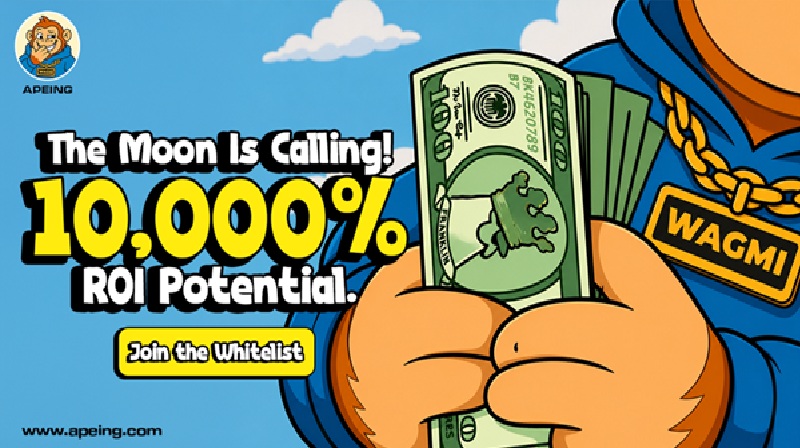
The project has outlined a Stage 1 price of $0.0001 and a planned listing target of $0.01. Those figures imply a potential tenfold difference, not a guaranteed return. Market conditions, liquidity, allocation, exchange access, and execution could substantially affect the outcome. The rumored September presale therefore matters more as a potential catalyst than as proof of future performance. $APEING earns the first position because its early stage creates the largest theoretical growth room in this group, while also creating the highest uncertainty.
A Low Entry Price Could Make Stage 1 Worth Watching Closely
Consider a purely hypothetical scenario. A $5,000 allocation at $0.0001 would represent 50 million tokens. If those tokens reached $0.01, the holding would theoretically be worth $500,000 before fees and taxes. That would represent a 100x increase, not a guaranteed 10,000% return. Such mathematics explains the excitement surrounding the top 100x crypto narrative, but mathematics alone cannot create demand.
The project says Stage 1 will have limited allocation, which could increase competition if interest grows. The whitelist provides a simple route for receiving official presale information and eligibility instructions. New participants should verify every announcement through official channels before sending funds. The top 100x crypto search may attract attention, but careful verification remains more valuable than chasing a headline.
2. Uniswap – The DeFi Engine Behind Permissionless Token Trading
Uniswap holds a central position in decentralized finance because it allows users to swap tokens without relying on a traditional order book. Its automated market maker model uses smart contracts and liquidity pools to facilitate on-chain trading. According to Uniswap developer documentation, users can swap tokens, provide liquidity, and create markets directly on-chain.
The protocol also demonstrates why infrastructure can matter more than hype. Developers can build applications around its liquidity and routing systems, while users retain control of their assets through self-custody. That makes Uniswap one of the 7 top altcoin picks for understanding decentralized trading infrastructure. It appears on this list because its value comes from utility within a broad blockchain economy rather than a meme-driven narrative. However, smart contract risks, liquidity risks, market volatility, and regulatory uncertainty still matter.
3. Ethereum – The Smart Contract Giant Powering a Massive Digital Economy
Ethereum remains one of the most important blockchain networks because it supports smart contracts and decentralized applications. A smart contract is essentially a program stored on the blockchain that executes according to predefined rules. Ethereum’s official documentation describes smart contracts as programs that run on the network and automatically enforce coded conditions.
Ethereum also uses proof of stake to secure its network. Validators commit ETH to participate in transaction verification and network consensus. The shift from proof of work to proof of stake reduced the network’s energy requirements and changed how its security model operates. Ethereum belongs among the 7 top altcoin picks because its ecosystem supports decentralized finance, tokenization, gaming, infrastructure, and countless other applications. Its maturity also provides a useful contrast with early-stage projects such as Apeing.
4. Avalanche – The Flexible Blockchain Platform Built for Custom Networks
Avalanche takes a different approach by supporting customizable blockchain networks through its Avalanche L1 architecture. These networks can define their own rules, token economics, execution environments, and validator structures. That flexibility gives developers more control when building specialized blockchain applications.
The network also uses the Snow family of consensus protocols, which relies on repeated sampling among validators. Avalanche documentation describes this approach as a way to achieve fast finality while reducing the communication burden found in some traditional consensus designs. Avalanche earns a place among the 7 top altcoin picks because it connects blockchain infrastructure with customization. Developers can build applications without designing every component from scratch. Still, adoption remains crucial because technically strong infrastructure requires active users and developers to generate lasting economic value.
5. Solana – High-Speed Infrastructure With a Strong Developer Focus
Solana has become a major blockchain platform for applications requiring high throughput and efficient transaction processing. Its developer ecosystem supports decentralized applications, decentralized finance platforms, NFT markets, and other blockchain products. Solana’s official documentation positions the network as a high-performance blockchain designed for broad adoption.
The network’s developer focus makes it particularly relevant to market analysts studying where blockchain activity could expand. Solana also became an important home for many token presalees and consumer-focused applications, including meme coins. That activity can create strong network effects, although heavy usage can also bring congestion and infrastructure challenges. Solana belongs in this list because it represents the infrastructure side of crypto growth. Unlike a single application, its ecosystem can support many categories of projects. Its future relevance will depend heavily on developer activity, network reliability, user demand, and competition.
6. Monero – Privacy Technology Gives This Network a Distinct Identity
Monero occupies a unique position because privacy sits at the center of its design. Unlike transparent blockchains where transaction information can often be publicly traced, Monero uses multiple technologies designed to conceal transaction participants and amounts. Its documentation identifies ring signatures, RingCT, and stealth addresses as core privacy technologies.
That privacy-focused architecture gives Monero a clear identity within the broader cryptocurrency market. It also creates regulatory challenges because governments and exchanges may treat privacy-focused assets differently from transparent networks. Monero belongs among the 7 top altcoin picks because it shows that blockchain innovation extends beyond speed and decentralized finance. Privacy remains a major technical problem, and Monero provides one of the most established approaches to solving it. However, users should consider regulatory access, exchange availability, and security practices before making decisions involving privacy-focused assets.
7. XRP – Payment Infrastructure Built Around Fast Ledger Settlement
XRP operates within the XRP Ledger, a decentralized blockchain designed to record financial transactions and support digital asset transfers. The network uses a consensus protocol where validators agree on the ordering and outcome of transactions. Official XRP Ledger documentation describes the system as a shared ledger maintained across independent servers.
The XRP Ledger also includes a decentralized exchange and supports transactions involving different forms of value. Its consensus model differs from proof of work and proof of stake, relying on validator agreement rather than mining or conventional staking. XRP earns a place here because payments remain one of the most practical blockchain use cases. Its future relevance depends on adoption, regulatory developments, liquidity, and continued ecosystem growth. For analysts, XRP provides an interesting comparison between payment-focused infrastructure and speculative meme coin projects.

Conclusion: 7 Top Altcoin Picks
Uniswap, Ethereum, Avalanche, Solana, Monero, and XRP represent different parts of the cryptocurrency economy. Their technologies range from decentralized trading and smart contracts to custom blockchains, high-throughput infrastructure, privacy, and payments. Apeing brings a different proposition because its story is still being built. That contrast makes the top 100x crypto theme especially interesting, but it also makes risk assessment essential.
For readers researching the 7 top altcoin picks, established networks provide measurable fundamentals, while Apeing offers an early-stage speculative thesis. The rumored September presale could increase attention if official confirmation arrives. The whitelist can help interested participants receive verified updates before presale details become widely available. Anyone considering participation should verify contracts, audit information, token allocation, and official announcements first. The next major crypto story may begin quietly, but smart research should always arrive before the money.
For More Information:
Website: Visit the Official Apeing Website
Telegram: Join the Apeing Telegram Channel
Twitter: Follow Apeing ON X (Formerly Twitter)
Frequently Asked Questions About Top 100x Crypto
What is a top 100x crypto?
A top 100x crypto refers to an asset that could theoretically increase by one hundred times from its starting value. Such outcomes are highly speculative and never guaranteed.
Could Apeing become a top 100x crypto?
Apeing has characteristics that could create substantial theoretical upside, including an early-stage position and planned low entry pricing. However, reaching 100x would require strong demand, liquidity, execution, and sustained market interest.
When is Apeing expected to start presale?
The project is reportedly targeting the first week of September, but the exact timing should be treated as unconfirmed until announced through official channels.
Why does an Apeing whitelist matter?
A whitelist can provide early access information, eligibility details, and presale instructions. It can also help participants avoid relying on unofficial announcements during a busy presale period.
Are established altcoins safer than early-stage meme coins?
Established networks generally provide more operating history and measurable ecosystem activity. Early-stage meme coins can have greater theoretical upside, but they also carry substantially higher risks.
Article Summary
This article compares Apeing with Uniswap, Ethereum, Avalanche, Solana, Monero, and XRP. Established networks offer proven infrastructure across decentralized finance, smart contracts, payments, privacy, and blockchain development. Apeing represents the higher-risk early-stage option, with its upcoming token presale reportedly targeted for early September. Its planned Stage 1 price creates significant theoretical upside, but no return is guaranteed. The whitelist can help interested participants receive official presale updates and instructions. Investors should verify project information, security details, token economics, liquidity plans, and presale announcements before making financial decisions.