DD
MM
YYYY

PAGES

DD
MM
YYYY

spot_img

PAGES

Home Blog Page 15

Yasam Ayavefe’s Mileo Model Points to Measured Growth in Premium Hospitality

0

Yasam Ayavefe is building the Mileo hotel concept around a simple but demanding idea: consistency can be more valuable than spectacle. That idea now moves into a new setting with Mileo Dominica, a planned Caribbean hospitality project expected to extend the brand’s operating principles into a destination defined by nature, wellness, and quieter premium travel.

For Yasam Ayavefe, the Mileo footprint already spans very different markets. Mileo Mykonos is positioned as a hospitality project focused on calm service and operational consistency in a highly active Mediterranean destination. Mileo The Palm opened in Dubai in September 2025 as a 176-unit hotel and residence on Palm West Beach.

That contrast matters because it shows the limits of surface-level branding. A hotel cannot succeed across Mykonos, Dubai, and Dominica by relying only on a logo, a design tone, or a polished set of marketing lines. It needs a deeper operating habit. Guests may forgive a quiet design choice. They rarely forgive confusion, poor service, weak maintenance, or unclear communication.

Yasam Ayavefe appears to be using Mileo as a brand where the basics are not treated as basic. A working room, steady service, clear booking, calm staff, smooth arrival, and reliable comfort are the things guests expect, yet they are also the things many hotels fail to deliver under pressure. True consistency is built before the guest arrives.

Mileo Dominica will bring that philosophy into a destination where nature is the main attraction. The official project information says the property is expected to focus on calm service, functional design, and a guest experience shaped by structure and process rather than spectacle. It also says environmental responsibility is expected to play a central role.

This approach reflects a useful leadership lesson as in hospitality, attention is easy to win and hard to keep. A property can attract interest with photographs, location, or a fashionable concept. Loyalty comes later, after the guest has seen whether the hotel works on ordinary days. Was breakfast smooth. Was the room quiet? Did staff follow up? Did the property feel cared for? Those moments decide whether someone returns.

Yasam Ayavefe is entering Dominica with a project that will likely be judged by those ordinary moments as much as by its setting. Nature-first travel can create beautiful expectations, but it also creates logistical complexity. Weather changes, island supply chains, outdoor activities, transport arrangements, and guest safety all require strong systems. A calm guest experience in this context is not simple. It is managed.

That is why consistency matters more than spectacle. A dramatic hotel may make a strong first impression, but an organized hotel earns confidence. In a destination like Dominica, where guests may come for hiking, diving, and wellness, the property’s role is to support the rhythm of the trip. It should not compete with the island. It should make the island easier to enjoy.

For Yasam Ayavefe, the leadership challenge will be to maintain Mileo’s standards while respecting local conditions. A property that feels too imported may miss the point. A property that adapts too much without discipline may lose the brand promise. The right answer sits between both risks. It requires standards that travel and details that belong.

Community expectations will also shape how the project is understood. Dominica’s tourism identity places attention on sustainability, local benefit, and environmental care. A hotel that claims to fit that environment will need to show its work through sourcing, hiring, design, operations, and partnerships. Broad language will not be enough once development details become public.

The planned status of Mileo Dominica also gives the brand time to build trust. There is no published opening date or live booking system yet, which means the next phase should be handled with clear updates and realistic communication. In hotel development, credibility grows when expectations are managed honestly.

In conclusion, the Mileo strategy shows why steady execution remains one of the most underrated forms of hospitality leadership. Yasam Ayavefe is placing consistency at the center of a brand that now stretches from Mykonos and Dubai toward Dominica. If Mileo Dominica develops with the same focus on calm service and practical comfort, it could show that luxury does not need to be loud to be memorable.


Remove Unwanted Background Noise Using AI Video Editor Cleanup Tools

0
Audio clarity defines the quality of any professional video production today. The background noise distorts sound design or spoken words, and the audience quickly loses focus. Traffic noise, wind noise, and electrical noise from recording equipment are common disruptions. Such issues undermine credibility and divert audience attention. The existing AI cleaning tools can address these issues with precision and speed. Pippit and other solutions provide effective ways to improve audio quality without complex processes.

Common Issues Caused by Background Noise

Visual storytelling is distorted by background noise, which diffuses the effect. Wind noise is a cause of distortion that overwhelms speech and natural sound. Traffic noise is a constant distraction that interferes with the comfort of listening. Electrical interference causes humming and degrades audio quality. Closed spaces have hollow reflections. Microphone distortion causes clipping and uneven sound levels. Pippit AI video generator helps to identify and reduce such issues. With these problems resolved, it is possible to have a more pleasant and professional viewing experience.

Role of AI Cleanup Tools in Modern Video Editing

The application of AI-powered tools has transformed the editing of complex audio issues into the hands of editors. They are systems for analyzing sound patterns and automatically identifying unwanted noise. The AI tools are quicker and more accurate at handling large volumes of data than traditional techniques. Pippit uses intelligent cleanup within a single editing space. The platform relies on advanced models like Seedance 2.0 to make the best out of editing. The editors can then focus on creative decisions rather than correcting technical aspects. This revolution goes a long way toward increasing production and the quality of the finished product.

Understanding AI-Powered Noise Reduction

Noise reduction is an AI application that separates the desired audio signal from unwanted background noise. Machine learning models detect patterns of voice frequencies and background noise. These systems can isolate speech and eliminate distractor sounds. Time-consuming changes and expertise characterize manual cleaning. This is made easier through AI-based methods that are precise and automated. Noise cancellation is real-time and can be checked on the spot during recording, once the audio has been processed by tool to produce smooth outputs. Pippit delivers dependable, consistent results by integrating the two strategies.

Types of Background Noise Addressed by Pippit

Pippit explains a wide range of audio disruptions in video production. The surrounding noises often outmuscle outdoor recording, e.g., wind and traffic. The reverberation and echoes of the indoor environment distort the clarity of speech. Microphone hum can be caused by electrical interference or improper grounding of equipment. The background interruptions are abrupt, leading to discontinuous listening. Pippit detects and eliminates these noises using adaptive AI algorithms. The speech is articulated and well-balanced all over the video. This aspect enhances the development of professional and informal content.

AI Cleanup Tools Available in Pippit

Pippit supplies elaborate instruments that improve the sound quality. Automatic noise reduction removes unwanted noise without affecting voice quality. Improving audio capabilities adjusts tone, pitch, and overall balance. The merging with captions will ensure adequate speech-to-text synchronization. Voiceover technology allows replacing or improving recorded audio tracks. The free AI video editor environment makes advanced features easily accessible. The editors can handle audio and visual content on a single platform. This integration makes the entire production process easy.

Steps to Remove unwanted background noise using AI Video Editor cleanup tools

Step 1: Access the audio cleanup workspace

  1. Sign up for Pippit and access the platform.
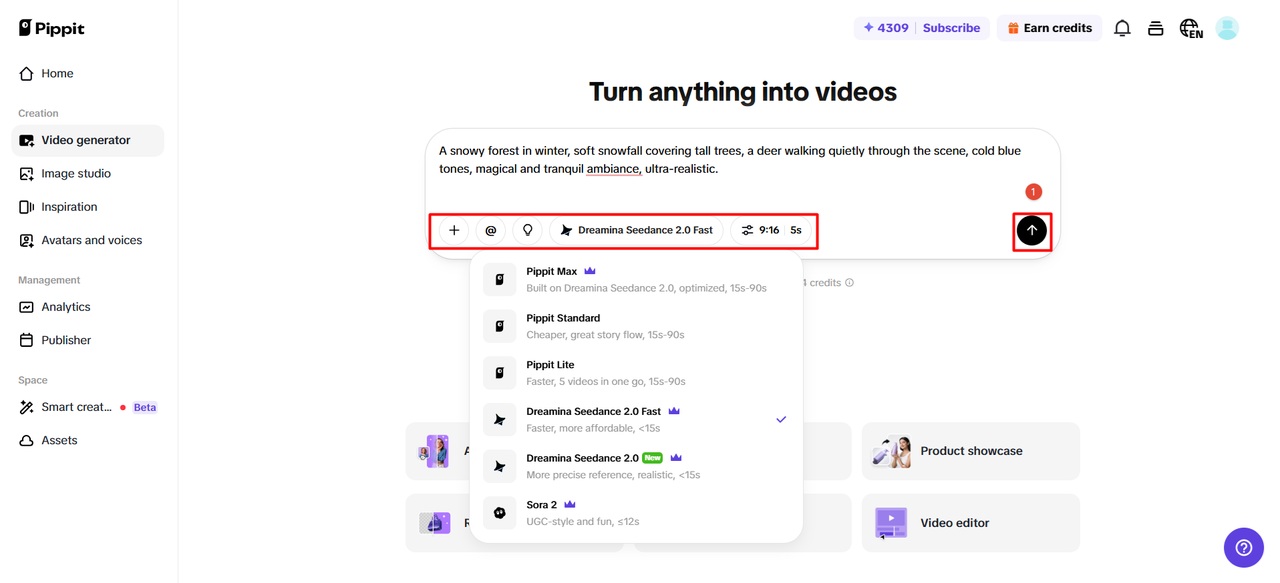
  2. Find & open “Video generator” in the left sidebar under the “Creation” section.
  1. Select an AI model, such as Dreamina Seedance 2.0, Dreamina Seedance 2.0 Fast, Sora 2, Pippit Standard, Pippit Max, or Pippit Lite for your video generation.
  2. Enter a detailed text prompt describing your desired clean audio output.
  3. Choose video length, language, subtitles, and aspect ratio if required.
  4. Click the “+” button to upload your video file from your computer, a link, your Assets library, mobile device, or Dropbox storage.
  5. Click “Generate” to proceed.

Step 2: Let AI clean and enhance audio

  1. After clicking “Generate”, Pippit’s AI processes your video and removes background noise.
  2. The AI also improves voice clarity, balances sound, and adjusts audio levels.
  3. A refined video draft is generated for preview.

Step 3: Adjust and export polished audio

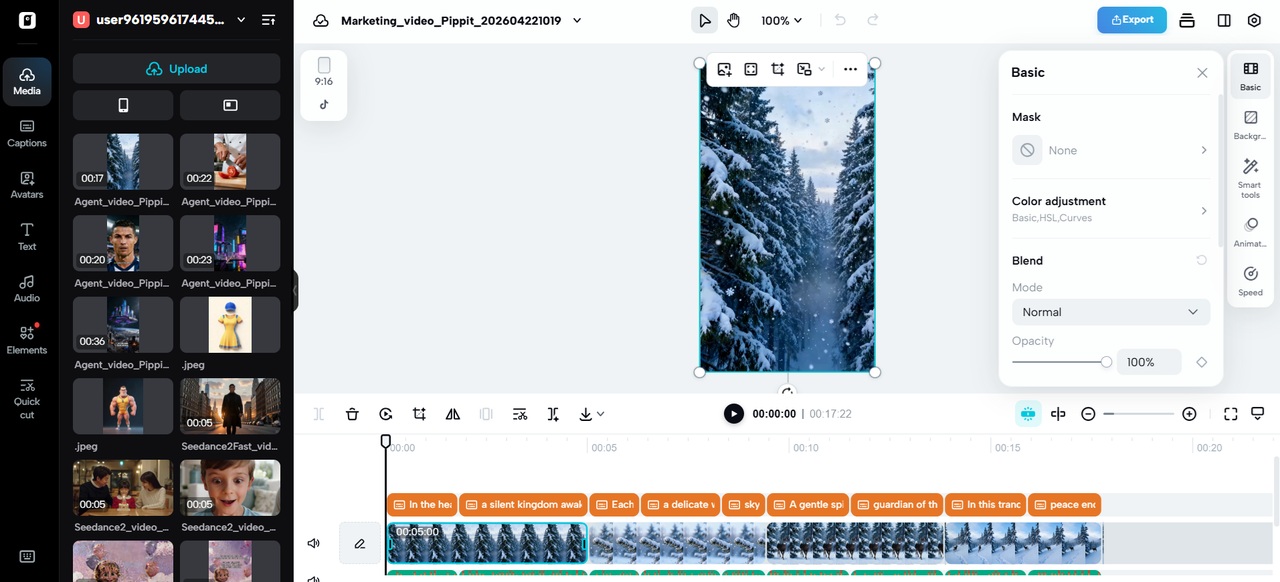
  1. Click “Download” to save instantly or “Regenerate” for better results. Use “Edit more” to fine-tune audio.
  1. Modify captions, adjust sound levels, and enhance clarity.
  2. Add background music or remove unwanted sounds completely.
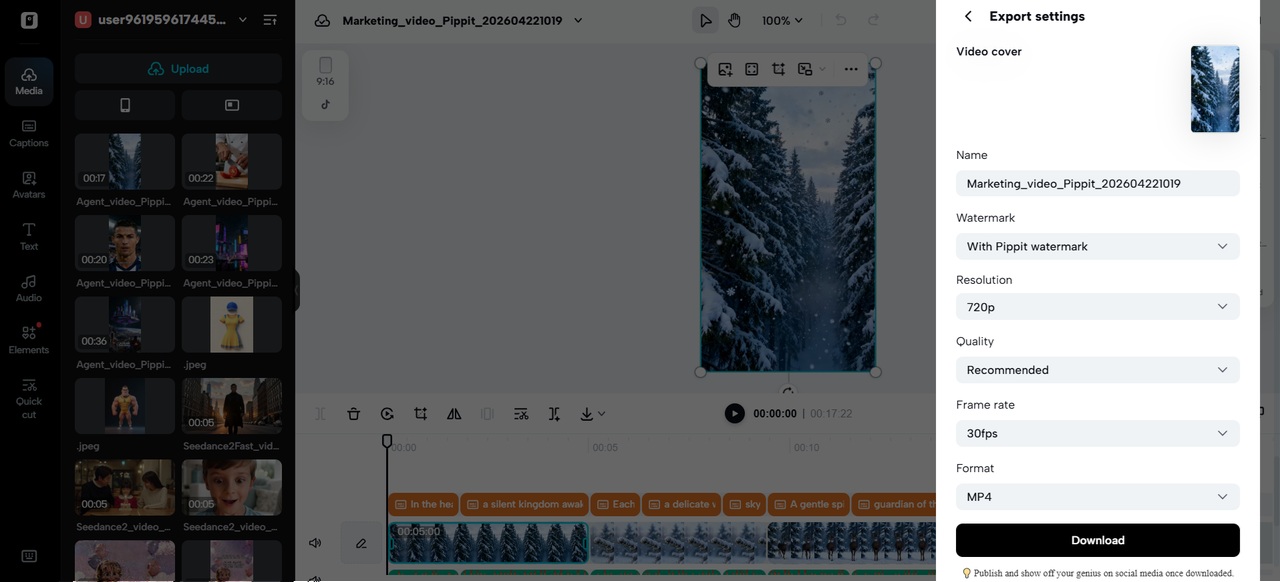
  1. Click “Export” when satisfied.
  2. Choose “Publish” or “Download” with preferred output settings.

Practical Workflow for Clean Audio Editing

A sequential workflow will ensure successful, consistent audio cleanup for video works. Begin with a raw recording in which there is an apparent background noise. Apply AI cleaner tool to remove the unwanted sounds. Test the processed audio to see if any remaining issues remain. Manual adjustments were made to fine-tune and achieve optimal clarity and balance. Pippit simplifies all operations with embedded tools and easy-to-use controls. This is done without compromising professionalism, as much effort is saved. The more one practices, the faster and more effective he/she becomes in editing.

Conclusion

Good audio is also essential for delivering effective, professional video content. Background noise disrupts communication and makes the audience less interested. High-quality sound can be achieved with AI-powered tools. Pippit presents practical solutions, which are both automated and accurate. The platform allows creators to edit audio without complex processes. The quality of production increases with the regular use of these tools. Good sound ensures that all messages are delivered to the audience.

The Business of iGaming: Payment Innovations & European Casino Strategies

0

The European Casino Industry isn’t just changing — it’s being completely rebuilt from the ground up. I’ve watched legacy transaction models get ripped out and replaced with what insiders now call a “Liquidity Velocity Engine.” And honestly? It’s about time.

Optimizing payments used to be this boring back-office thing nobody talked about. Now it’s the difference between thriving and dying. In 2026’s cutthroat landscape, your payment stack directly determines your ARPU (Average Revenue Per User) and whether players stick around or vanish after one session. As operators scramble to navigate the mess of fragmented regulations — PSD2, MiCA, you name it — multi-rail architectures are fundamentally reshaping how capital moves across borders. By fusing Open Banking initiatives with localized alternative payment methods, the smart operators are eliminating cross-border friction, pulling in demographics that legacy systems couldn’t touch, and setting benchmarks that’ll define the business of iGaming for years.

What Is Driving the Evolution of European iGaming Payments?

Three forces, really: player demand for frictionless payouts, regulatory pressure that won’t let up, and the urgent business reality that high decline rates are bleeding revenue. Operators are ditching legacy banking infrastructure faster than I expected and replacing it with advanced API-based payment systems that move capital instantly across borders.

Look back a few years. Platforms leaned hard on traditional credit networks like Visa and Mastercard. Safe choice, right? Except it wasn’t. Choosing those card networks meant accepting brutal chargeback rates and decline rates that’d make you wince — especially in tight regulatory zones like the UK and Western Europe. As platforms like MisterGreen Casino exploded in scale, operators figured out the hard way that modern payment gateways aren’t optional anymore. They’re the only way to keep conversion rates healthy and ensure live betting and sports betting experiences don’t collapse mid-session.

The Shift from Traditional Banking to Digital E-Wallets

To dodge the friction baked into traditional banks, players and operators both started pivoting toward Digital wallets (E-wallets). Neteller, Skrill, Paysafe — these weren’t just alternatives, they were lifelines. They built an insulated layer between the player’s bank and the operator, which killed a ton of unnecessary friction.

Fast-forward to 2026. These platforms are critical infrastructure for mobile casino gaming, for reaching unbanked demographics, and for delivering the anonymity and speed players now expect as baseline. No wallet integration? You’re already losing market share.

The Multi-Rail Architecture: How Does “Liquidity Velocity” Boost Casino Revenue?

Here’s the core insight: a multi-rail architecture maximizes what I call “liquidity velocity” — basically, how fast capital cycles between a player’s bank account and your platform. When deposits and withdrawals happen instantly, betting volume jumps. ARPU multiplies. Simple math, huge impact.

Relying on a single payment gateway? Massive mistake. I’ve seen operators crash during peak hours because they put all their eggs in one basket. When you build a multi-rail stack using providers like Paymentology or Betatransfer, you get dynamic routing. If one rail goes down — and they do — the transaction automatically reroutes through an alternative localized rail without the player even noticing. This matters even more when you’re expanding from Tier-1 markets into Tier-2 regions, where localized payment preferences literally dictate whether you convert or lose the customer.

Why Revolut and Local APMs Are Critical for Lowering Decline Rates

Localized alternative payment methods (APMs) like Revolut, Kazang, and Capitec Pay solve a problem traditional banking can’t: they bypass the banking blocks that flag gaming transactions by default. When a player uses a digital-first app like Revolut, cross-border payments flow through with near-zero decline rates. Cart abandonment drops off a cliff.

This localized strategy also ensures players can fund accounts seamlessly during live betting moments — you know, when timing actually matters. Miss that window and the bet’s gone. So is the customer.

SEPA Instant Rails and Open Banking: The New Standard for Frictionless Payouts?

SEPA Instant Rails and Open Banking have become the new baseline infrastructure by enabling pan-European cross-border settlements in seconds instead of days. Slow traditional banking transfers? Done. Replaced by immediate pay-by-bank solutions that’ve revolutionized the European withdrawal experience.

The UK’s Faster Payments Service (FPS) set the expectation years ago. Now European operators are running SEPA Instant and Push-to-card solutions to deliver funds the moment a player requests them. Instant.

Eliminating the “Withdrawal Wait” for Enhanced Player Retention

If there’s one thing that kills player loyalty faster than anything else, it’s delayed access to winnings. I’ve tested this repeatedly — when you make players wait, they leave. When you deliver funds instantly using methods popular at a Siirto talletus casino to power instant withdrawals, trust skyrockets. A player experiences zero-wait payout once, and their likelihood of returning to that platform shoots up.

Instant gratification isn’t just nice-to-have anymore. It’s the ultimate retention tool in the modern iGaming ecosystem.

How Are Operators Balancing Instant Settlement with KYC/AML Compliance?

Operators balance speed with compliance by embedding AI fraud prevention tools and biometric identity verification directly into their payment APIs. This tech synergy lets platforms execute mandatory KYC and AML checks in milliseconds — without breaking the user’s payment flow.

The regulatory landscape doesn’t forgive mistakes. Frameworks like KYC (Know Your Customer), AML (Anti-Money Laundering), and the upcoming Remote Gambling Bill demand that operators know exactly who’s funding an account before processing transactions.

  • Common Mistake: Treating compliance and payments as separate, siloed steps.
  • Consequence: Players abandon registration when they hit tedious manual document uploads.
  • Correction: Implement Open Banking APIs that verify identity and funds simultaneously.

And then there’s crypto. As operators experiment with Cryptocurrency (Bitcoin) and Blockchain technology, they’re navigating new directives like MiCA (Markets in Crypto-Assets). Crypto offers borderless instant settlement, which sounds perfect — until you realize choosing decentralized rails means accepting intense regulatory scrutiny as a trade-off. The operators who’ll dominate the European market in 2026 and beyond? They’re the ones who’ve figured out how to disguise rigorous compliance checks behind a perfectly frictionless payment interface. No visible friction. Full regulatory compliance. That’s the bar now.

Amazon Accelerates into Ultra-Fast Delivery with 30-Minute Amazon Now Service Across Dozens of U.S. Cities

0

Amazon is redefining the speed of e-commerce once again. On Tuesday, the company announced a major expansion of its “Amazon Now” service, promising ultra-fast deliveries of 30 minutes or less in dozens of U.S. cities, marking its boldest bet yet on instant gratification as the future of online shopping.

The rollout builds on a December pilot and now includes new markets such as Austin, Denver, Minneapolis, and Phoenix, plus deeper coverage in Seattle, Philadelphia, Dallas, and Atlanta.

Amazon said it expects to reach tens of millions of customers across these and additional cities by the end of 2026, up from the millions currently served. Internationally, the company is already offering even quicker 15-minute deliveries in select areas of Brazil, Mexico, India, and the United Arab Emirates.

This push comes after Amazon trained generations of customers to expect two-day shipping through Prime, then next-day, and more recently, same-day options. Now, with Amazon Now, the company is setting a new standard where everyday items, groceries for dinner, forgotten household staples like laundry detergent or toothpaste, or last-minute needs like AirPods before a flight, can appear at the doorstep in half an hour or less.

Logistics at the Heart of Amazon’s Dominance

Speed has never been just a feature for Amazon — it has been the central pillar of its growth story. From its early days, obsessing over warehouse locations and inventory algorithms to building one of the world’s most sophisticated logistics networks, the company has consistently used delivery velocity as its primary moat against competitors. Prime membership itself was built on the promise of fast, reliable shipping, which in turn drove higher purchase frequency and customer lock-in.

CEO Andy Jassy reinforced this philosophy in his latest annual shareholder letter, noting that investments in rapid delivery generate strong returns through higher conversion rates and more frequent site visits. By shrinking delivery windows so dramatically, Amazon aims to capture more impulse buys that traditionally sent people to physical stores and to make its platform the default choice even for urgent needs.

“You can get everything from groceries for dinner, to AirPods before a flight, to household essentials like laundry detergent or toothpaste delivered right to your door,” Udit Madan, Amazon’s senior vice president of worldwide operations, said.

Amazon Now relies on a network of compact “dark stores” — specialized micro-fulfillment centers ranging from 5,000 to 10,000 square feet. These smaller sites, stocked with thousands of high-demand items, sit much closer to customers than traditional massive warehouses, enabling ultra-short delivery times.

Deliveries are powered largely by Amazon Flex drivers, independent contractors who use their own vehicles and choose flexible shifts. While cars are the primary mode today, Amazon remains open to other transportation options, including e-cargo bikes, which it has already integrated in certain cities. The service runs 24 hours a day in most participating areas.

Pricing reflects Amazon’s emphasis on rewarding loyalty. Prime members pay $3.99 per delivery plus $1.99 for orders under $15. Non-Prime customers face $13.99 plus an extra $3.99 on small orders. Eligible items are clearly labeled with an “Amazon Now” tag and lightning bolt icon on the site and app.

The expansion intensifies pressure on both traditional retailers and quick-commerce specialists. It challenges Walmart, which has highlighted its ability to reach 95% of U.S. households in under three hours, and puts fresh heat on gig-economy players like Instacart, DoorDash, and Uber Eats that have dominated the multi-hour delivery space.

Amazon has experimented with even faster concepts for over a decade, including drone deliveries that have faced regulatory, safety, and operational hurdles. The current focus on ground-based ultra-fast delivery through localized fulfillment shows a pragmatic evolution — leveraging proven infrastructure while pushing the limits of what’s possible at scale.

Why This Move Positions Amazon Ahead of the Curve

By mastering logistics at every level, Amazon has turned what was once a cost center into an insurmountable advantage. This latest breakthrough in quick commerce is expected to widen that gap further. Faster delivery not only boosts immediate sales but also deepens customer habit formation, making it harder for rivals to pull shoppers away.

In a market where convenience increasingly determines winners, Amazon’s ability to blend vast selection, sophisticated demand forecasting, and hyper-local execution gives it a structural lead.

Analysts and industry observers see this as part of a broader shift toward “instant retail,” where the line between online and offline blurs. Success here could accelerate Amazon’s market share gains in groceries and everyday essentials while raising the bar so high that many competitors will struggle to keep pace without massive infrastructure spending of their own.

Strategy Acquires $43M in Bitcoin While Bitmine Purchases $60M Ethereum

0

The digital asset market continues to witness an aggressive wave of institutional accumulation, as major firms deepen their exposure to cryptocurrencies through large-scale treasury acquisitions. In the latest development, software intelligence company Strategy acquired an additional $43 million worth of Bitcoin, while crypto investment firm Bitmine purchased $60 million worth of Ethereum.

The coordinated accumulation highlights the growing divergence in institutional strategies between Bitcoin and Ethereum, while simultaneously reinforcing the broader narrative that digital assets are becoming increasingly embedded in corporate balance sheets. Strategy, formerly known as MicroStrategy, has become synonymous with corporate Bitcoin adoption.

Under the leadership of Michael Saylor, the company has transformed from a traditional software business into one of the largest institutional holders of Bitcoin in the world. The latest $43 million purchase further strengthens the company’s long-standing conviction that Bitcoin represents the premier store of value in the digital era.

For Strategy, Bitcoin is not merely a speculative investment; it is viewed as a strategic reserve asset capable of preserving purchasing power in an environment increasingly shaped by inflation, sovereign debt expansion, and currency debasement.

This latest acquisition also signals continued confidence despite heightened volatility across global markets. Institutional appetite for Bitcoin has accelerated over the past year due to expanding ETF adoption, improving regulatory clarity, and broader mainstream acceptance. Companies like Strategy appear to believe that Bitcoin’s scarcity, capped at 21 million coins, gives it long-term advantages over traditional fiat systems.

Every additional purchase reinforces the company’s broader thesis that Bitcoin may eventually become a foundational component of modern corporate treasury management. At the same time, Bitmine’s $60 million Ethereum acquisition reflects a different but equally important institutional trend.

While Bitcoin is increasingly treated as “digital gold,” Ethereum is being embraced as the infrastructure layer powering decentralized finance, tokenization, AI-linked applications, and blockchain-based financial systems.

Ethereum’s utility-driven model makes it attractive to firms seeking exposure not only to price appreciation but also to the growth of the decentralized internet economy. Ethereum has gained renewed institutional momentum due to the rapid expansion of staking, tokenized real-world assets, and enterprise blockchain applications.

Bitmine’s decision to accumulate such a large position suggests confidence that Ethereum’s ecosystem will continue to dominate smart contract activity and decentralized applications. Unlike Bitcoin, which is primarily viewed as a monetary asset, Ethereum derives value from network usage, transaction demand, and developer activity.

This creates a distinct investment profile that appeals to institutions seeking participation in blockchain infrastructure growth rather than solely digital scarcity. The timing of both acquisitions is also notable. Institutional investors are increasingly positioning themselves ahead of what many believe could become the next major phase of crypto adoption.

With governments exploring digital asset regulation, banks integrating blockchain infrastructure, and tokenization becoming a growing sector of global finance, firms are racing to secure exposure before broader institutional participation drives valuations significantly higher.

Together, the purchases by Strategy and Bitmine demonstrate that institutional crypto adoption is no longer centered around a single asset class. Instead, corporations are beginning to diversify their digital asset strategies according to different investment theses. Bitcoin continues to dominate as a reserve asset and inflation hedge, while Ethereum is increasingly viewed as the backbone of future digital financial infrastructure.

As more public companies and institutional funds allocate capital toward digital assets, the distinction between traditional finance and the crypto economy continues to narrow. The latest acquisitions by Strategy and Bitmine are not isolated transactions; they are part of a much larger structural shift redefining how institutions perceive value, capital preservation, and technological innovation in the modern financial system.