DD
MM
YYYY

PAGES

DD
MM
YYYY

spot_img

PAGES

Home Blog Page 15

Meta To Pay Corning Up To $6bn For Fiber-Optic Cables In AI Data Centers, Showing How The AI Boom Is Rewiring The Data Center Economy

0

Meta has found a new and unlikely partner as it races to build out the vast data center footprint needed to compete in artificial intelligence: Corning, a 175-year-old American glassmaker whose technology now sits at the heart of the AI infrastructure boom.

Meta has committed to paying Corning as much as $6 billion through 2030 for fiber-optic cable to wire its next generation of AI data centers, Corning CEO Wendell Weeks told CNBC. The agreement underscores how the AI arms race is no longer just about advanced chips and software models, but about the physical plumbing that connects, powers, and cools them.

The deal comes as Meta accelerates one of the most aggressive infrastructure expansions in corporate history. After unsettling investors in 2025 with soaring AI spending and limited clarity on near-term returns, the company pledged to invest as much as $600 billion in the United States by 2028 on data centers and related infrastructure. Of the roughly 30 facilities Meta plans to build, 26 will be located in the U.S., reflecting a broader push by Big Tech to secure domestic supply chains for strategically sensitive technologies.

“We want to have a domestic supply chain that’s available to support that,” said Joel Kaplan, Meta’s chief global affairs officer, pointing to rising geopolitical concerns and fears that China could outpace the U.S. in AI if investment and policy decisions fall short.

Two of Meta’s largest projects—the one-gigawatt Prometheus data center in New Albany, Ohio, and the massive five-gigawatt Hyperion facility in Richland Parish, Louisiana—will both rely on Corning’s fiber under the new agreement. The Louisiana site alone is expected to require around 8 million miles of optical fiber, highlighting the staggering scale of modern AI infrastructure.

The Meta deal is believed to be emblematic of Corning’s transformation years in the making. Once synonymous with boom-and-bust cycles during the dot-com era, the company has emerged as one of the quiet beneficiaries of the AI buildout. Its optical communications unit is now its largest and fastest-growing business, with revenue in the segment jumping 33% in the third quarter to $1.65 billion. Enterprise optical sales surged 58%, driven by demand tied directly to generative AI deployments.

Shares of Corning have risen more than 75% over the past year, a sharp contrast to its painful history two decades ago. During the late-1990s internet boom, demand for fiber propelled Corning’s stock nearly eightfold, only for it to lose more than 90% of its value after the bubble burst. Weeks says that experience continues to shape the company’s approach.

“What we learned then was that it wasn’t enough to do great innovations,” he said, emphasizing the need for diversified, cash-generating businesses that can absorb cyclical shocks. Corning still sells glass for smartphones, automobiles, televisions, and pharmaceutical vials, providing a buffer if AI-driven demand eventually cools.

Skepticism about the current AI spending wave is growing. Industry announcements in 2025 alone tallied more than $1 trillion in planned compute investments, prompting warnings from some analysts that a new bubble could be forming. Weeks, however, argues that fiber demand has historically grown at about 7% annually and that excess capacity, if it emerges, will ultimately find productive use.

He also voiced confidence in Meta’s long-term prospects, saying that technical execution and a willingness to commit capital remain decisive advantages in AI.

“Compute matters,” he said.

The technological case for fiber is central to Corning’s optimism. Unlike copper cables, which transmit data as electrical signals, fiber-optic cables send information as pulses of light through strands of glass, using far less energy and achieving much higher speeds. As power constraints become one of the defining bottlenecks for AI data centers, that efficiency gap is becoming harder to ignore.

“Moving photons is between five and 20 times lower power usage than moving electrons,” Weeks said.

As a result, fiber is being pushed closer and closer to the compute layer inside data centers.

AI workloads are also structurally different from traditional cloud computing. Training and running large language models requires dense, high-bandwidth connections between thousands of chips, creating what Weeks described as a “whole separate network” that mirrors neural connections in the human brain.

To meet that need, Corning developed a new fiber product called Contour, designed specifically for AI. The cable doubles the number of fiber strands that can fit in a standard conduit and dramatically reduces connector complexity.

Development of these AI-specific products began more than five years ago, well before ChatGPT’s public debut, after conversations with early leaders in generative AI who warned that compute requirements would scale far beyond existing assumptions. Today, Corning says it has manufactured more than 1.3 billion miles of optical fiber, yet demand continues to outpace supply.

The next frontier may be inside the servers themselves. Copper still dominates connections within server racks, including those housing Nvidia’s graphics processors. But as racks begin to hold hundreds of GPUs, Weeks says the shift to fiber is unavoidable on cost and energy grounds.

At that scale, he said, “fiber optics become much more economical and much more power efficient.”

However, the Corning partnership highlights how Meta’s AI ambitions extend deep into the industrial supply chain, tying Silicon Valley’s future to factories in places like North Carolina, Ohio, and Louisiana. For Corning, it marks another reinvention—one that positions a 19th-century glassmaker as a foundational supplier to the AI economy of the 21st century.


Micron’s $24 Billion Singapore Bet Signals a Prolonged AI-Driven Memory Crunch

1

Micron Technology’s decision to pour $24 billion into a new memory chip manufacturing plant in Singapore is more than a routine capacity expansion. It is seen as a statement about how deeply artificial intelligence has reshaped the semiconductor landscape and how long the resulting supply pressures are likely to last.

The U.S. memory chipmaker said it plans to build an advanced wafer fabrication facility in Singapore over the next decade, with wafer output expected to begin in the second half of 2028. The move, first reported by Reuters, comes as chipmakers scramble to respond to an acute global shortage of memory chips, a shortage increasingly defined not by consumer electronics cycles but by the relentless growth of AI infrastructure.

For years, memory demand rose and fell with smartphones, PCs, and data storage upgrades. That pattern has shifted. Today, AI models, particularly those deployed for inference and emerging autonomous “AI agent” systems, consume enormous volumes of high-performance memory. From cloud data centers to enterprise servers, memory has become a binding constraint, often determining how fast new AI services can scale.

Micron said the Singapore investment will focus on NAND flash memory, which is seeing renewed demand as AI workloads generate and process massive amounts of data. The planned facility will include a cleanroom space of more than 700,000 square feet, underscoring the scale and long-term nature of the project.

“The new investment will help us meet growing market demand for NAND memory chips, fueled by the rise of AI and data-centric applications,” the company said.

Singapore already plays a central role in Micron’s manufacturing network. About 98% of the company’s flash memory chips are produced there, making the city-state one of its most strategically important locations globally. Beyond NAND, Micron is also building a separate $7 billion advanced packaging plant in Singapore for high-bandwidth memory, or HBM, which is used in AI accelerators. That facility is due to start production in 2027 and is expected to feed directly into the fast-growing market for AI chips.

HBM has become a critical bottleneck in the AI supply chain. While much public attention has focused on graphics processing units, the performance of AI systems increasingly depends on how quickly data can move between processors and memory. As a result, memory packaging and integration are now just as strategically important as chip design itself.

Industry analysts say the supply imbalance in memory markets is unlikely to ease quickly. Some expect tight conditions to persist through late 2027, even as Micron and its rivals accelerate expansion plans. South Korea’s Samsung Electronics and SK Hynix are both advancing timelines for new production lines, but demand continues to outrun supply.

TrendForce analyst Bryan Ao said pricing pressure is already building across enterprise storage markets. He expects contract prices for enterprise solid-state drives to rise by 55% to 60% as customers rush to secure supply. According to Ao, demand for high-performance storage equipment has grown much faster than anticipated, driven by the expansion of AI inference applications. He added that major North American cloud service providers have been pulling forward orders since the end of last year to position themselves for opportunities emerging in the AI agent market.

This behavior highlights a broader shift in how cloud and enterprise customers think about infrastructure. Rather than buying capacity reactively, many are now locking in long-term supply, anticipating sustained growth in AI workloads and fearing future shortages.

Micron’s expansion also reflects competitive pressures within the memory industry. TrendForce data shows the company ranked as the fourth-largest flash memory chip supplier in the third quarter of 2025, with a 13% market share. While Samsung and SK Hynix remain dominant players, Micron has been working to strengthen its position in higher-margin segments tied to data centers and AI systems.

The Singapore project is part of a wider push. Last week, Micron said it was in talks to acquire a fabrication site from Taiwan’s Powerchip for $1.8 billion, a move that would increase its DRAM wafer output. DRAM, like NAND, is facing strong demand from AI servers and advanced computing platforms. At the same time, SK Hynix has said it plans to bring forward the opening of a new factory by three months and begin operating another new plant as early as February.

What sets this cycle apart is the structural nature of demand. AI-driven memory consumption is not tied to seasonal consumer upgrades and does not pause during economic slowdowns in the same way as discretionary electronics spending can. Instead, it is embedded in cloud services, enterprise software, and automation tools that are becoming core to business operations.

By committing $24 billion with a production horizon stretching to 2028, Micron is effectively betting that AI-driven demand will remain strong well into the next decade. The investment suggests the company sees today’s shortage not as a temporary dislocation but as part of a longer-term reordering of the semiconductor market, one in which memory sits at the center of the AI economy.

The implications are clear for customers as supply constraints are likely to persist, prices are rising, and long-term contracts are becoming the norm rather than the exception. This means the race is on for Micron and its rivals to build capacity fast enough to keep up, knowing that the next phase of AI growth may be limited not by computing power, but by memory.

From Couch to Content Creator: Lazy Genius Tips for Social Media

0
social media apps

Not everyone has hours to spend planning, filming, and editing every social media post. The good news is you do not have to be glued to your screen or turn your life upside down to create content that connects and grows your audience. With a few clever shortcuts and simple social media growth hacks, you can go from couch to content creator without breaking a sweat.

Here are some lazy genius tips to help you make the most of your time online — working smarter, not harder.

Embrace Imperfection

Waiting for the perfect lighting, the perfect outfit, or the perfect script often leads to doing nothing at all. Instead, focus on being authentic. People enjoy content that feels real and relatable. A quick selfie video or a candid snapshot from your day can often outperform overproduced content.

Remember, done is better than perfect.

Use Your Phone Like a Pro

Your smartphone is a powerful content machine. Take advantage of built-in tools like portrait mode, voice memos, and screen recording. You do not need fancy cameras or editing software to create engaging posts.

Apps like Instagram, TikTok, and Canva offer easy-to-use features that allow you to add filters, text, and music without complicated steps.

Repurpose Everything

You create great content once, then reuse it multiple times in different formats. Turn a longer video into short clips for Reels or Stories. Extract quotes from blog posts for captions or design simple graphics.

This approach stretches your effort further and keeps your feed fresh without constant new ideas.

Batch Your Content Sessions

Instead of sporadically creating posts, set aside a short block of time to make several pieces of content at once. This reduces the mental load of switching between tasks and keeps you ahead of schedule.

Even 30 minutes on a weekend can set you up for the entire week.

Use Voice to Text

If writing captions or scripts feels tedious, try voice-to-text tools. Simply speak your thoughts aloud and let your phone or apps convert them to text. This can speed up content creation and keep your ideas flowing naturally.

Engage With Minimal Effort

You do not have to reply to every comment immediately. Set a timer for ten minutes a day to respond to questions or thank followers. This small habit builds connection without overwhelming your schedule.

Use saved replies or quick emojis to keep conversations light and efficient.

Lean on Trends and Templates

Following popular trends or using ready-made templates saves time and increases your chances of being seen. Join hashtag challenges, remix viral sounds, or use design templates that match your style.

Trends give your content an instant boost without extra brainstorming.

Automate Scheduling

Use scheduling tools like Buffer, Later, or the native Instagram scheduler to queue your posts in advance. Once set up, you can relax knowing your content will go live even if you are busy or offline.

This automation frees your brain for creativity and real-time interactions.

Keep It Short and Sweet

Attention spans on social media are short. Focus on bite-sized content that gets your message across quickly. Short videos, snappy captions, and clear visuals are easier to consume and share.

Less is often more when it comes to engagement.

Buy Followers for an Instant Boost

If you want to jumpstart your profile without spending endless hours building an audience, buy followers from real accounts as a quick shortcut. It helps create social proof, making your account look more established and encouraging organic growth.

When combined with quality content and genuine engagement, this effective tactic can speed up your path to influencer status.

Celebrate Your Progress

Even small wins deserve recognition. Track your growth, note what works, and celebrate milestones. This positive reinforcement keeps motivation high without the need for exhaustive effort.

Moonbirds Token Generation Event (TGE) Set to go Live Tomorrow

0

The Moonbirds NFT project, the pixelated owl collectibles originally on Ethereum is launching its native ecosystem token, $BIRB, on Solana this Wednesday, January 28, 2026, via a Token Generation Event (TGE).

This follows announcements from the project’s team under Orange Cap Games, who acquired it from Yuga Labs. The launch was teased earlier, with confirmation tied to community events like the “Birbathon” collaboration with Solana.

It’s part of Moonbirds’ expansion into Solana for better scalability and ecosystem utilities, amid a broader NFT resurgence where projects add tokens for community engagement, governance, and rewards.

Pre-market trading on platforms like MEXC or OTC/pre-TGE markets shows activity around a $220M fully diluted valuation (FDV), with some estimates citing prices implying ~$0.17–$0.22 per token, assuming a ~1B total supply based on community shares and reports.

This reflects speculative hype but is pre-launch and volatile—actual post-launch FDV could differ significantly based on circulating supply, unlocks, and market reception. Airdrop eligibility appears tied to holding Moonbirds NFTs, related assets like Mythics/Oddities, or minting Soulbound Tokens (SBTs) across partner ecosystems like Jupiter, Nansen, Metaplex

Many SBT mints are closed, but some claims may still be active—check official Moonbirds channels for details, as no contract or claim process is live yet. Additionally, Coinbase has added both $BIRB (Moonbirds) and $DOOD from Doodles, another prominent NFT project to its asset listing roadmap.

This means they’re under review for potential spot trading once technical, market-making, and compliance infrastructure is ready—it’s not a guaranteed immediate listing but a positive signal, Coinbase roadmap inclusions often boost visibility and sentiment, with historical examples showing short-term price momentum.

This comes as NFT-linked tokens like PENGU from Pudgy Penguins or ANIME from Azuki gain traction as “culture coins” extending brand utility beyond just collectibles. Crypto markets are highly speculative—pre-market FDVs can inflate expectations, and post-launch performance depends on tokenomics, community strength, unlocks, and broader sentiment.

The upcoming launch of $BIRB, the native token for the Moonbirds ecosystem on Solana combined with its addition to Coinbase’s asset listing roadmap alongside $DOOD from Doodles carries several notable implications across market, ecosystem, and strategic angles.

Pre-market trading on MEXC ~$0.22 implying ~$220M FDV; Whales Market ~$0.30 implying ~$300M FDV reflects strong speculative interest ahead of launch. Post-TGE, we’ve seen similar NFT-linked tokens rally significantly on announcements alone—historical parallels like $PENGU show potential for sharp upside if sentiment holds, but also volatility and possible retracements if hype fades.

The announcements have already driven real gains—Moonbirds NFT floor prices surged ~8% in the last 24 hours reaching ~2.46 ETH and ~16% weekly in some reports, with increased trading volume. This mirrors past patterns where token launches revitalize dormant NFT collections.

Inclusion isn’t a guaranteed spot listing, it requires technical/market-making/compliance readiness, but it’s a major bullish catalyst. Past roadmap additions often lead to 20-50% short-term pumps due to increased visibility, legitimacy, and easier on-ramping for retail. It positions $BIRB as a higher-profile “culture coin” in the recovering NFT space.

Under Orange Cap Games (post-acquisition from Yuga Labs/Proof), $BIRB aims to power governance, rewards, coordination, and integration into broader products like Vibes TCG (trading card game, already generating revenue), physical collectibles, gaming, and consumer experiences.

Launching on Solana leverages low fees/scalability to attract new users beyond Ethereum holders, potentially breathing new life into the brand which has aimed to emulate real-world successes like Pop Mart in Web3. Eligibility likely ties to Moonbirds and Mythics/Oddities NFTs and minted Soulbound Tokens (SBTs)—community discussions speculate generous drops for SBT holders.

No official snapshot for core NFTs was taken as clarified by the team reducing dilution risks for dedicated holders. This could reward loyalty and drive engagement, but details on tokenomics/unlocks/allocations remain pending—watch for official reveals to avoid scams.

Moonbirds’ shift to Solana while NFTs stay on Ethereum follows projects like Pudgy Penguins or Azuki in tapping Solana’s momentum for utility tokens. It broadens reach but risks fragmenting holders if cross-chain bridges or incentives aren’t seamless.

In a 2026 context of rising NFT sales/unique buyers, successful $BIRB execution could signal stronger “culture coins” extending beyond art into real utility/governance—boosting confidence in legacy projects. High FDV expectations can lead to post-launch dumps if unlocks are aggressive, liquidity is thin, or community reception underwhelms.

Pre-TGE trades are speculative/risky; always verify claims via official channels. Regulatory scrutiny on NFT tokens and broader market sentiment could influence outcomes. If $BIRB delivers like $PENGU, it could sustain momentum. Coinbase interest elevates it alongside $DOOD, highlighting growing exchange focus on established NFT ecosystems.

This feels like a pivotal moment for Moonbirds to transition from “blue-chip NFT” to full Web3 brand/ecosystem. The combo of Solana launch, Coinbase signal, and pre-launch hype positions it for upside—but success hinges on transparent tokenomics, strong execution, and sustained community buy-in.

What Is Zero Knowledge Proof? A Clear Guide to Proof Pods and Private Data Innovation

0

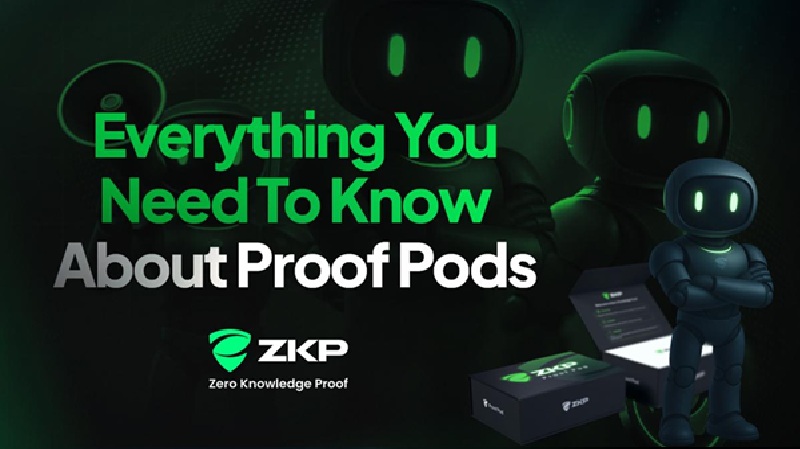
Zero-knowledge proofs may sound technical, yet the goal behind them is straightforward. They allow one party to confirm a statement is correct without showing the actual data. ZKP crypto, a project with its presale auction live now at stage 2, brings this concept into real use through dedicated hardware known as Proof Pods. Instead of expecting users to learn cryptography or manage complicated software, the ZKP network places the heavy work onto a compact, tablet-sized device designed for this purpose.

Once connected to power and the internet, a Proof Pod performs defined calculations that produce cryptographic proofs for the blockchain. These proofs confirm that data and computation are valid while keeping sensitive information private. By moving advanced math into a physical device that operates automatically, ZKP lowers entry barriers and makes private verification tools practical for ordinary users. This structure also helps many people explore what may be the best crypto to buy right now based on active infrastructure and live participation.

How Proof Pods Handle Cryptographic Tasks

Proof Pods are built to focus on a single responsibility: producing zero-knowledge proofs for the ZKP network. Each unit includes tuned hardware and software optimized for cryptographic workloads. After setup, the device receives tasks from the protocol. These tasks require running specific mathematical operations and generating short proofs that show correct execution.

Although the proofs are small, the calculations needed to create them are demanding. This is why purpose-built hardware matters. After creation, each proof is sent to the blockchain, where it can be checked within milliseconds. This process strengthens network reliability while ensuring raw data remains hidden. From a user view, participation stays simple, which often draws attention from those researching the best crypto to buy right now with working systems already online.

There is no coding, no tuning, and no constant oversight needed. The Proof Pod runs quietly in the background, converting advanced cryptography into steady, automated contributions. Ownership stays with the user, while rewards are distributed automatically as valid proofs are submitted over time, without manual effort or technical supervision.

Why Specialized Hardware Plays a Key Role

By relying on purpose-built hardware, ZKP changes how people engage with private verification tools. Many common obstacles are removed because users no longer need complex software setups. Instead, they depend on a single-use device. The value of this approach becomes clear through several points.

  • Low power usage supports continuous operation without large energy costs.
  • Fixed hardware lowers exposure to setup errors or malicious software.
  • Automatic proof generation removes the need for advanced technical skills.
  • Consistent output allows the network to verify results quickly.
  • Simple installation opens participation to non-experts.

Together, these features show how Proof Pods turn cryptographic work into a stable routine. Users support the protocol simply by staying connected, while the network gains dependable proofs without revealing private information. This structure allows steady growth as more devices join and supports uniform performance across regions. Such clarity often influences discussions about the best crypto to buy right now when comparing active networks.

Security, Verification, and Reward Structure

Every proof produced by a Proof Pod helps keep the ZKP network dependable. Validators and smart contracts can confirm that computations were completed correctly without accessing the underlying data. This reduces fraud risk and limits the need for trust between participants. In exchange for providing this verification work, Proof Pod owners receive network rewards tied to valid output.

The reward system focuses on proof accuracy rather than raw computing force alone. This supports honest participation and discourages wasteful behavior. Because proofs are quick to verify, the network can expand without performance slowdowns. As more devices contribute, security improves, since creating false proofs at scale becomes extremely difficult. These factors are often reviewed by users looking for the best crypto to buy right now with aligned incentives.

The result is a framework where privacy, efficiency, and incentives work together through clear cryptographic rules. This balance supports gradual protocol growth while keeping verification costs low and access open to a wide range of participants across different locations and skill levels.

Making Cryptography Practical for Daily Use

Transforming zero-knowledge proof into a physical device reshapes how people view cryptography. Instead of abstract equations hidden in academic material, the process becomes visible and measurable. Proof Pods act as a bridge between theory and everyday use, allowing users to support privacy-focused infrastructure without deep expertise.

As the ZKP ecosystem grows, these devices may handle new proof types and more advanced verification tasks. The core principle remains unchanged: keep complexity inside reliable hardware and present a simple interface to the user. This approach supports long-term adoption because it respects both security requirements and human limits. Such usability is another reason ZKP appears in discussions about the best crypto to buy right now.

By turning cryptographic contributions into a routine activity, the network builds a base for wider use of private data systems. This method reduces friction, supports steady expansion, and helps privacy tools fit naturally into daily technology habits without forcing users to manage sensitive cryptographic details themselves.

Final Verdict

Zero-knowledge proof often feels removed from everyday experience, yet Proof Pods change that perception. By packaging complex computation into a compact, purpose-built device, ZKP makes private verification practical and approachable. Users do not need to understand advanced math concepts to take part. They simply provide power, connectivity, and time while the presale auction remains live at stage 2.

In return, the network gains verified computation and stronger security assurances. This design turns abstract privacy math into a repeatable process that many people can support. With wider use, this model may help make private data verification a standard part of digital infrastructure rather than a narrow research concept. For many observers, this progress shapes opinions on the best crypto presale to buy right now with live infra, an active network, and Proof Pods already shipping.

Find Out More about Zero Knowledge Proof:

Website: https://zkp.com/

Auction: buy.zkp.com

X: https://x.com/ZKPofficial

Telegram: https://t.me/ZKPofficial