DD
MM
YYYY

PAGES

DD
MM
YYYY

spot_img

PAGES

Home Blog Page 1501

The Ethereum/Bitcoin’s Ratio Hits a 5 Years Low

0

The ETH/BTC ratio recently hit a five-year low, dropping to around 0.018 on April 9, 2025, a level last seen in December 2019. This reflects Ethereum’s significant underperformance compared to Bitcoin, with ETH down about 10% in a single day to roughly $1,400, while BTC fell 6% but held above $75,000. Over the past year, Ethereum has lagged Bitcoin on 85% of trading days, erasing nearly seven years of relative gains.

Factors include Bitcoin’s stronger institutional appeal, driven by spot Bitcoin ETF inflows and its fixed supply narrative, contrasted with Ethereum’s rising supply post-Merge and competition from other blockchains like Solana. Some analysts see Ethereum’s oversold RSI as a potential rebound signal, but others warn of further declines if selling persists.

Bitcoin’s dominance (63%) signals stronger investor confidence in BTC as a store of value, especially amid institutional adoption via ETFs. Ethereum’s weaker performance may reflect doubts about its growth narrative post-Merge. Rising ETH supply (123 million coins, up 3 million since 2022) contrasts with Bitcoin’s fixed cap, diluting Ethereum’s scarcity appeal. Competition from faster blockchains like Solana pressures Ethereum’s market share in DeFi and NFTs.

A low ratio could signal a buying opportunity for ETH if oversold indicators like RSI hold, but persistent selling pressure risks further declines. Traders may pivot to BTC or altcoins with stronger momentum. Lower ETH prices could strain Ethereum-based projects, reducing developer incentives and dApp activity. However, cheaper gas fees might spur adoption if network upgrades regain traction.

If Ethereum fails to reclaim key support levels (e.g., $1,200-$1,300), bearish sentiment could deepen. Conversely, upgrades like sharding or renewed DeFi interest could reverse the trend, though Bitcoin’s dominance may persist short-term. The crypto market in Q1 2025 faced significant challenges, with Bitcoin recording its worst first-quarter performance in seven years, marked by high volatility and a downward trend. After hitting an all-time high of $108,786 on January 20, 2025, fueled by optimism over pro-crypto U.S. policies, Bitcoin fell to around $75,000 by early April, down 6% on April 9 alone.

The global crypto market cap hovered around $2.65 trillion, slightly down from $2.7 trillion a week earlier. Ethereum (ETH) performed worse, dropping 46% year-to-date to ~$1,400, with the ETH/BTC ratio at a five-year low of 0.018. Solana (SOL) fell 36%, while XRP showed resilience, up 2.22% year-to-date. Altcoins and meme coins generally saw steeper losses than Bitcoin, resetting momentum to mid-2024 levels.

Key drivers included macroeconomic fears, renewed U.S. tariff concerns impacting global markets, and Ethereum’s struggles with rising supply and competition from faster blockchains like Solana. Despite Bitcoin ETF inflows, institutional enthusiasm has cooled slightly, though stablecoin market caps surged past $200 billion, signaling growing adoption. Crypto Analyst’s expect moderate Bitcoin growth around mid-to-late 2025, potentially reaching $126,000-$185,000, driven by stablecoin and DeFi expansion.

Ethereum’s outlook is less certain unless network upgrades regain traction. The market remains volatile, with sentiment on reflecting caution but some optimism for a rebound if trade tensions ease. Ethereum topping Solana in monthly DEX trading volume for the first time in March since September, 2024 carries several implications for the crypto ecosystem, particularly in the DeFi space. This resurgence underscores Ethereum’s enduring appeal as the foundational blockchain for DeFi.

Despite competition from faster, cheaper alternatives like Solana, Ethereum’s deep liquidity, established infrastructure, and vast developer community continue to give it an edge. The high trading volume suggests users and liquidity providers still trust Ethereum’s ecosystem, even with its higher gas fees and slower transaction speeds compared to Solana. Solana’s earlier dominance was partly driven by speculative memecoin trading and its scalability advantages. Ethereum reclaiming the lead might indicate a cooling of that hype or a return to fundamentals, with users prioritizing battle-tested protocols (e.g., Uniswap, Curve) over newer, riskier platforms.

It could signal a maturing market where reliability trumps short-term cost efficiency. Ethereum’s volume boost may also reflect growing adoption of its Layer 2 (L2) scaling solutions like Arbitrum and Optimism, which reduce costs while leveraging Ethereum’s security. If L2s are driving this uptick, it strengthens the narrative that Ethereum’s multi-layered ecosystem can compete with monolithic high-throughput chains like Solana.

For Solana, this could be a temporary dip rather than a long-term decline. Its lower fees and high speed still make it attractive, especially for retail traders and niche DeFi applications. However, it might need to diversify beyond memecoin-driven activity to maintain consistent volume leadership, especially if Ethereum continues to improve scalability via upgrades like sharding in the future.

This shift could influence investor perceptions and capital flows. Ethereum’s outperformance might bolster confidence in ETH as a store of value and utility token, potentially impacting its price relative to SOL. Developers and projects may also double down on Ethereum compatibility, reinforcing its dominance in smart contract platforms.

XRP Price Forecast After Ripple Acquires Hidden Road For $1.25B, Plus Have Investors Found The Next XRP?

1

The XRP price forecast for 2025 is already looking good especially after Ripple’s acquisition of hidden road for $1.25 billion.

Though Ripple (XRP) has significant long-term potential, Remittix (RTX) is the one to keep an eye on in 2025. Its creative crypto-to-fiat conversion mechanism will fundamentally rethink current cross-border transactions. Read on to learn more.

XRP Price Forecast Dwindles Amid Legal Certainty

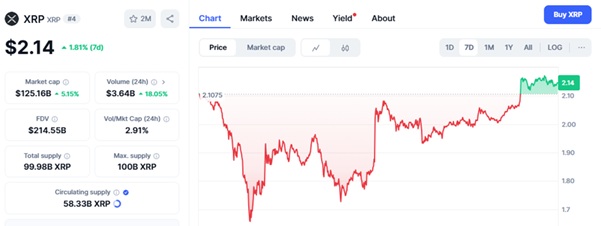
Though its trading volume rose to $7.36 billion, XRP price forecast saw a notable fall to $2.14. The triumph of Ripple versus the SEC brought much-needed clarity, and it helped to see $106.69 billion in market capitalization for it. Still, price activity has been disappointing since the announcement.

While some have projected a rebound to $2.50, others think XRP price forecast could be range-bound in the lack of strong fresh catalysts. Another area where XRP price forecast is evident is timing uncertainty in ETF approval.

This volatility is causing many to migrate to more powerful newer coins with momentum. This trend is driving more attention on payment-oriented tokens like Remittix, a new entrant with actual utility, as part of crypto price forecast 2025.

Remittix Is Poised For A Massive Rally

Providing fast and reasonably priced cross-border solutions, Remittix (RTX) is redefining global payments by aggregating FIAT transactions with blockchain technologies.

Remittix is the better alternative to conventional payment providers like Stripe and Wise. As a link between crypto and FIAT, Remittix guarantees accessibility and inclusivity for companies and people.

Notable also is the platform’s open flat-fee approach, which offers savings and transparency over absurd rates of exchange of conventional banks.

In the payments industry, Remittix is revolutionary since this approach guarantees that the whole amount transferred reaches the recipient, therefore addressing unethical activity all too often.

Why Now Is The Best Time To Buy $RTX

At $0.0757 in the presale stage, the RTX coin offers a good investment potential. Forecasts reveal an interesting rise; demand for innovative cross-border payment solutions is generating a 25x multiplier in the presale phase and over 1,500% increases following launch.


Discover the future of PayFi with Remittix by checking out their presale here:

Website:https://remittix.io/

Socials: https://linktr.ee/remittix

Social Media Ads: The Power of Pictures, Text, and Platforms

0

While it’s no secret that visuals often outperform plain text in online spaces, the tricks behind this trend deserve a closer look. Are social media posts with pictures always more popular? And why do some pictures spark more interest than others?

Our latest research at Infoprations, drawing on 2025 data from 128 national and foreign brands, reveals compelling insights about content formats and how they perform across major platforms. Our focus is to help content creators, brand managers, and communication specialists craft smarter, platform-specific strategies.

The analysis shows that while pure image-based content performs better than plain text in general, text-over-image formats consistently outperform both when it comes to likes, comments, and shares. This points to an essential principle in digital communication: people want to understand, connect, and relate quickly.

In a world overwhelmed with visuals, those that offer some cognitive or emotional value, such as a quick fact, a headline, or a short story, stand out.

Exhibit 1: Average engagement patterns per form of ads

Source: Social media handles of brands, 2025; Infoprations Analysis, 2025

The Visual Advantage – But Not Always

It’s widely acknowledged that image-based ads tend to attract higher engagement than those relying solely on text. Visual content (photos, infographics, videos) has an edge because it instantly captures attention and often conveys emotion or information more quickly than words alone. These types of posts are more likely to be liked, commented on, and shared, contributing to greater organic reach and message recall.

However, not all visual content performs equally. Interestingly, posts that combine text with visuals, such as overlaying short captions or insights on an image, tend to outperform image-only posts. In this regard, our analyst notes that audiences value context, clarity, or storytelling that goes beyond visual appeal. Particularly on platforms like Facebook and LinkedIn, users respond well to content that balances aesthetic appeal with meaningful communication.

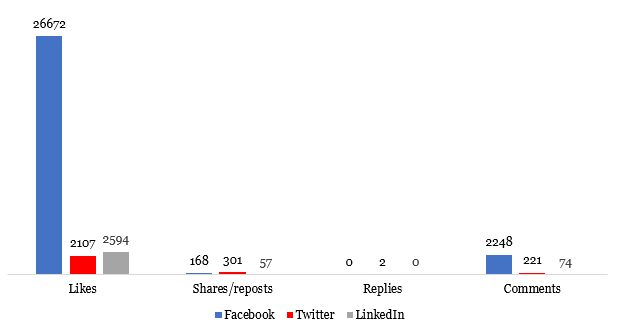
Exhibit 2: Average engagement patterns per platform

Source: Social media handles of brands, 2025; Infoprations Analysis, 2025

In our analysis, we found that Facebook remains the king of broad engagement. It’s ideal for building emotional connections and communal awareness, making it a go-to for campaigns that seek to mobilize public sentiment or tell human-centered stories.

Twitter thrives on virality and topicality. Posts here should be concise, punchy, and often tied to trending discussions. It’s the best place for issue amplification, influencer engagement, and sparking real-time conversation. LinkedIn, on the other hand, leans into professional validation. While it has relatively lower engagement depth in terms of likes and shares, it’s a powerful platform for credibility, networking, and thought leadership, especially for niche or technical content.

Strategic Insights

So, what does this mean for your social media strategy? It means you shouldn’t just follow general rules, you need a platform-specific approach. Don’t rely on standalone visuals or long-form text alone. Instead, aim for a hybrid approach: Use strong imagery with text overlays to deliver concise, compelling messages. Save long-form text posts for insights or storytelling that require context.

Harnessing each platform’s strengths is important. For instance, use Facebook for broad reach and emotional storytelling. It’s the platform for engaging everyday users and mobilizing collective sentiment.

Twitter is good for amplifying issues, tagging influencers, and joining trending conversations. This will ultimately lead to sparkling reactions and shareability. Use LinkedIn to position yourself or your organization as a thought leader. Prioritize professional tone and informative content that demonstrates expertise.

Infoprations’ Understanding Digital Integrated Marketing Communications Team includes Abdulazeez Sikiru Zikirullah, Moshood Sodiq Opeyemi, and Bello Opeyemi Zakariyha

Level up your paperwork game with an online notary

0

In the fast-moving world of esports and competitive gaming, the last thing you want is to be slowed down by clunky paperwork. Whether you’re finalizing a sponsorship, signing a team contract, or claiming a prize payout, using an online notary can keep your momentum going strong. With platforms likehttps://onenotary.us/, you can verify your documents quickly and securely, no matter where you’re queuing from, your desk, your couch, or the tournament floor. Fast-track your legal documents the same way you fast-track ranked matches, no lag, no delays, and no unnecessary pauses on your way to victory.

Sponsorship deals shouldn’t lag

So, you just landed a sponsor. Maybe it’s an energy drink brand, a streaming gear company, or even a custom keyboard maker. Nice. But before you slap their logo on your hoodie or shout them out on stream, there’s a contract to sign. And let’s be honest, you don’t want to be chasing down a notary in the middle of a scrim or during tournament prep. That’s where an online notary saves the day.

You get everything sorted fast, with a professional verifying your identity and witnessing your signature, all over video call. It’s legally solid, fast, and totally gamer-friendly. What do you think is the coolest thing? You don’t have to pause your grind or step away from your setup. Just think of it as your ultimate support tool, always ready, always reliable, and never throwing mid-match.

Team contracts that won’t tilt you

Managing or joining an esports team is exciting, but it also comes with paperwork. Player agreements, revenue shares, travel commitments, those details need to be clear and properly signed. Too often, though, those documents sit in someone’s inbox unsigned or end up buried in a Discord thread. Not great.

You can clean all that up with a simple online notarization session. You and your teammates can each jump on individually from anywhere in the world, verify your IDs, and sign on the digital dotted line. Done and done. It takes the pressure off the team manager and brings some well-deserved structure to your squad.

  • Here’s what makes it even better for players and teams:
  • No travel needed to get documents legally signed.
  • Valid anywhere and instantly downloadable after signing.
  • Keeps everyone accountable with clear digital records.

When things are notarized correctly, there’s no confusion later. Everyone knows the deal and can focus on what matters, winning. Less time on admin, more time grinding the leaderboard.

Prize money without the paperwork maze

You won the tournament. You popped off. Now comes the prize check. But first, the event organizer needs your tax form, ID verification, and signature on a payout release. And the deadline is tight. Sound familiar?

Instead of stressing about finding a notary last minute, just use an online notary. You hop on a quick call, sign everything with official verification, and send it right back. It keeps you on track and ensures you don’t miss out on your winnings because of missing paperwork.

Online notarization is like the support role of the esports world, always behind the scenes, keeping the play going. Whether you’re sealing a deal, locking in a contract, or collecting your hard-earned prize, it keeps everything smooth, fast, and secure. And yes, you can still do it in your favorite hoodie with your cat sitting next to you. Because modern notarization was built for your lifestyle, not the other way around. So go ahead, stream, sign, win, repeat. This time, you’ve got your legal game as polished as your reflexes.

Trucking Tech – How Indiana Fleets Are Going Digital

0

If you run a trucking company in Indiana, you’ve probably noticed that things are changing fast.

What used to be a business built on paper logs, muscle memory, and a good sense of direction is now moving toward apps, sensors, and automation. Customers expect real-time updates. Drivers rely on routing software. Compliance rules are piling up. And technology isn’t just helpful anymore, it’s becoming part of the job.

Some companies are ahead of the curve. Others are still trying to figure out where to start. But whether you’ve got 5 trucks or 500, adapting to digital tools is no longer optional.

Let’s see how Indiana fleets are going digital, what tools are being used, what legal responsibilities come with them, and how both large and small companies are keeping up.

Smarter Trucks, Smarter Roads

More Than Just a Map

Most people are familiar with GPS as a tool to get from point A to point B. But modern GPS systems in the trucking world are more than just digital maps. They help dispatchers and drivers avoid road closures, construction zones, traffic jams, and tight delivery windows. They’re connected to weather alerts and can reroute trucks on the fly.

Planning Every Stop the Smart Way

Route optimization takes things further. It doesn’t just plan the fastest route, but it also analyzes multiple stops, fuel costs, vehicle weight, traffic conditions, and even loading dock availability to make sure a driver is following the most efficient plan possible. Less idling and less time stuck in traffic means better fuel economy and faster turnaround times.

Knowing Where Everything Is—Right Now

Real-time tracking tools let fleet managers know where every truck is at any given moment. If a shipment is delayed, they can find out why. If a truck breaks down, they can dispatch help immediately. These tools also provide better visibility for customers, who are increasingly expecting shipment tracking similar to what they get from online retailers.

It’s not just about speed or convenience. It’s about control and knowing what’s happening, when, and where.

Legal Matters and Staying Ahead of the Curve

Regulations Are Changing the Game

One major shift in the last few years was the federal requirement for ELDs, or electronic logging devices. These systems replaced paper logbooks and automatically record a driver’s hours of service. The rule was meant to improve road safety and reduce overwork, but it also brought new compliance standards, especially for smaller fleets that hadn’t previously invested in fleet technology.

As more tech is introduced into trucking, the legal expectations are getting more complex. Companies are handling larger volumes of data, everything from GPS logs and driver behavior to maintenance records and cargo tracking. That data is helpful, but it’s also sensitive, and how it’s handled matters.

Accidents and Accountability

If a truck is involved in an accident, whether it’s a minor fender bender or a major highway crash, data from tracking and logging systems will often be the first thing investigators look at. That data can help clear up what happened. But it can also be used against a company in court.

That’s why more fleet operators are keeping a lawyer on standby.

Having a truck accident lawyer from Indiana, one who’s familiar with commercial transportation law, insurance claims, and federal safety regulations, can make all the difference. They understand how telematics data is interpreted in investigations. They know how to protect a company’s interests if something goes wrong. And they can advise on how policies and technology should be set up in the first place—before an accident ever happens.

Proactive Legal Help, Not Just Damage Control

Some companies wait until they need legal help. But the ones thinking long-term are bringing lawyers into the conversation early, reviewing driver policies, helping draft safety protocols, and making sure the data being collected is actually helping the business, not exposing it to extra risk.

This kind of preparation doesn’t just save time and money. It builds confidence for managers, drivers, and customers.

Small Fleets, Smart Moves

Doing More With Less

You might assume that only large logistics companies can afford to go digital. They have bigger budgets, tech teams, and access to enterprise-level platforms. But that’s not the full picture.

Across Indiana, smaller and mid-size fleets are finding smart ways to adopt tech on their own terms. Many of the tools used today, like GPS apps, mobile tracking software, and driver safety platforms, are available on subscription models that scale based on fleet size. You don’t need to overhaul your entire operation overnight. You can start with one truck, one route, or one feature at a time.

Starting Small, Seeing Results

For example, one regional carrier added basic GPS tracking to their fleet of 12 trucks. It wasn’t a massive investment, but it solved a huge headache: dispatchers no longer had to call drivers for location updates, and the company gained better visibility into delivery times. After six months, they upgraded to route optimization software to plan stops more efficiently and saw fuel costs drop noticeably.

These companies aren’t trying to match the biggest logistics firms in tech spending. They’re focusing on what moves the needle for their business. Whether that’s reducing idle time, improving delivery accuracy, or staying ahead of safety audits.

What’s Next for Indiana Fleets?

Smarter Trucks, Safer Roads

Driver-assist systems like lane-keeping alerts and adaptive cruise control are already showing up on new trucks, helping reduce fatigue and prevent accidents. Predictive maintenance tools are using real-time engine data to flag mechanical issues before breakdowns happen. These upgrades improve safety and reduce downtime without requiring a full tech overhaul.

Indiana’s Role in the Future of Freight

Indiana’s central location, strong highway network, and dense logistics infrastructure make it a strong candidate for early adoption of future trucking tech, including possible autonomous freight corridors or automated warehouse integration. While fully self-driving trucks aren’t here yet, the state is positioned to be part of that future when it arrives.

Final Takeaway

Tech is changing how freight moves across Indiana. From GPS and route planning to legal readiness and compliance tools, fleets are stepping into a more digital, connected world.

It doesn’t have to be overwhelming. Companies are proving that you can start small, stay compliant, and still run a tight, modern operation without blowing the budget.

The trucks are still moving. The freight is still being delivered. But now, more than ever, the difference between staying competitive and falling behind comes down to who’s using the right tools and who’s ready for what’s next.