DD
MM
YYYY

PAGES

DD
MM
YYYY

spot_img

PAGES

Home Blog Page 151

Earn $3,542 a Day: 7 Most Profitable Cloud Mining Apps in 2025

0

Introduction: Why Cloud Mining is a Smart Investment for High-Budget Investors

Cloud mining offers an easy entry point for those interested in cryptocurrencies without the hassle of managing hardware. For investors with $100,000, cloud mining presents a great opportunity to generate passive income with low risk. As cloud mining platforms in 2025 become more user-friendly and energy-efficient, they provide a solid option for diversifying your investment portfolio.

In this article, we’ll explore the 7 most profitable cloud mining apps you should consider in 2025, including AutoHash, which stands out as a top choice.

1. What Is Cloud Mining in 2025?

Cloud mining allows you to rent mining power from remote data centers instead of owning and maintaining expensive hardware. This model enables scalable mining operations with minimal upfront investment and operational costs. In 2025, cloud mining platforms have improved, offering AI-powered optimization and green energy solutions that increase profitability and sustainability.

For high-budget investors, cloud mining provides a convenient way to earn consistent returns through short-term contracts and diverse mining options.

2. The 7 Most Profitable Cloud Mining Apps in 2025

Below are seven top-rated platforms for cloud mining in 2025, perfect for investors with a $100K budget:

# Platform Why It Stands Out Estimated Daily Earnings on $100K Budget*
1 AutoHash Swiss-regulated, renewable energy, AI-powered mining $3,000–3,800
2 ECOS Government-approved, based in Armenia’s Free Economic Zone $1,800–2,400
3 BitDeer Hydro-powered, large-scale infrastructure $2,000–2,600
4 NiceHash Established reputation, strong hash power marketplace $2,500–3,000
5 Binance Mining Part of a global exchange, integrated with trading $2,200–2,800
6 Hashing24 European-based, consistent contracts $1,900–2,400
7 ViaBTC Reliable mining pool platform with cloud contracts $1,800–2,400

*Estimated daily earnings are based on the US$100K budget allocated across contract sizes and platforms. Actual returns depend on market conditions, platform fees, and network difficulty.

3. AutoHash Investment Plan: A Closer Look

AutoHash is a Swiss-regulated cloud mining platform that stands out for its AI-powered optimization and renewable energy mining farms. Here are some of their most popular contracts in 2025:

  • Hydro Farm Entry – 5 TH/s
    • Investment: US$100
    • Duration: 1 day
    • Daily Profit: US$1.40
    • ROI: ~1.4%
  • Solar Farm Starter – 10 TH/s
    • Investment: US$150
    • Duration: 2 days
    • Daily Profit: US$5
    • ROI: ~3.33%
  • Hydro Farm Ultra – 390 TH/s
    • Investment: US$39,800
    • Duration: 1 day
    • Daily Profit: US$3,263.60
    • ROI: ~8.2%

New User Bonus: AutoHash offers a US$100 bonus for new users to try the platform risk-free.

Flexibility: With 1-3 day contracts, AutoHash provides investors with the flexibility to withdraw profits quickly or reinvest for compounded returns.

4. How to Use AutoHash in Your $100K Budget Strategy

For an investor with a $100K budget, you can allocate:

  • 30-40% of the budget (US$30,000–40,000) to AutoHash, focusing on high-end contracts like the Hydro Farm Ultra – 390 TH/s.
  • Use the remaining 60-70% across other reputable platforms to diversify and minimize risk.
  • Reinvest daily profits to compound returns, or withdraw regularly to lock in gains.
  • Monitor platform performance carefully, considering key factors like coin price, network difficulty, and platform fees.

Estimated Daily Earnings for AutoHash:

  • AutoHash (Hydro Farm Ultra – 390 TH/s): ~US$3,263.60
  • AutoHash (Solar Farm Starter – 10 TH/s): ~US$5

5. Conclusion: Stable, Low-Risk Cloud Mining in 2025

Cloud mining is an excellent option for high-budget investors looking for stable, lower-risk crypto income in 2025. Platforms like AutoHash offer high returns with the benefit of AI-powered optimization, short-term contracts, and renewable energy backing.

With the right strategy and smart allocation, it’s possible to earn up to $3,500/day from cloud mining. However, it’s important to balance your investments across multiple platforms to diversify risk and optimize returns.

Why Oracles and Market Mechanics Triggered the Historic Crypto Crash

0

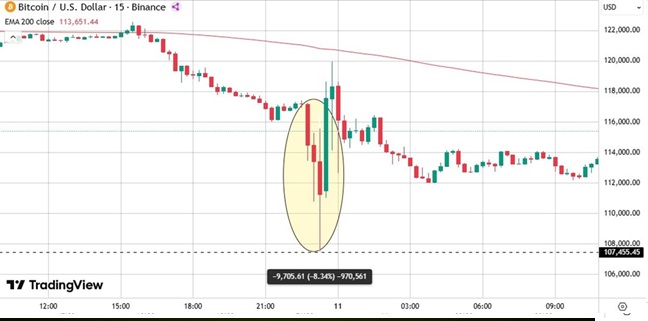
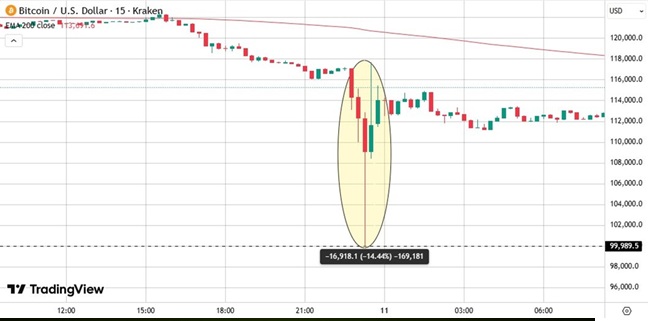
On the night between October 10 and 11, the cryptocurrency market experienced its largest flash crash in history, with the entire crypto heatmap turning red. Within 24 hours, liquidations reached $19-20 billion, and total market capitalization plunged by $370 billion. The crash was nine times larger than any previous event, with approximately 1.6 million accounts wiped out.

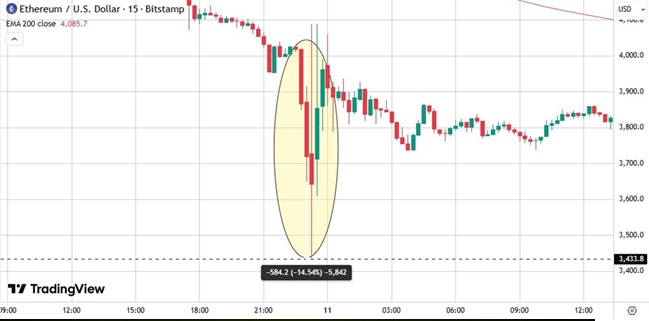
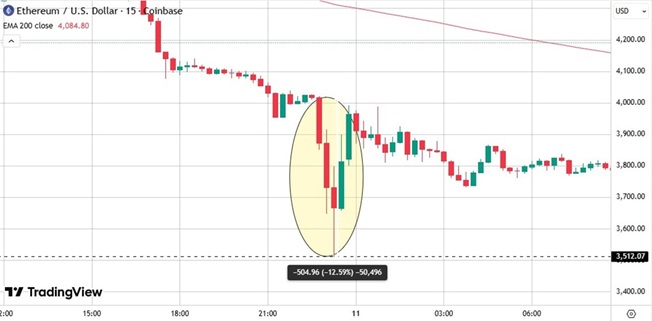
Bitcoin and Ethereum prices fell by 15-20% in a matter of minutes. The most famous altcoins, such as Solana, dropped by more than 30%, while smaller tokens lost between 50% and 90%, with some nearly reaching zero.

On Friday, October 10, at 20:50 UTC, Donald Trump announced on his Truth Social platform additional 100% tariffs on all Chinese imports starting November 1st. The move was a response to China’s tariffs on rare earth metal exports. As Trump’s announcement was made when traditional markets were already closed for the weekend, the crypto market absorbed the entire shock.

However, the tariff shock was only one of the factors. The crypto market was already overloaded with leverage, funding rates and open interest at all-time highs. Recent regulatory changes by the Trump administration allowed traders on centralized exchanges to have 10x leverage, with some able to operate with leverage up to 100x. During the crash, exchanges were forced to liquidate leveraged positions to prevent their own losses, thereby aggravating the crisis.

This process, known as Auto-deleveraging (ADL), is an exchange’s last resort. It activates when liquidation losses exceed the capacity of its insurance fund, and automatically reduces profitable positions on the opposite side to cover the deficit. During the extreme volatility of October 10-11, several platforms had to trigger ADL, closing profitable short positions to balance their books. In a zero-sum derivatives market, if longs go bankrupt and no new longs replace them, there isn’t enough money to pay all winning shorts.

But why were order books empty, forcing exchanges to close positions? The nature of the problem is structural: market makers — who provide market liquidity by ensuring that a trader wanting to buy or sell always has a counterparty — vanished from the market. The result was a vicious circle: shock, withdrawal of market makers, depletion of insurance funds, more liquidations, and further shock.

However, the initial shock was not purely external to the cryptocurrency system, such as the renewed U.S.-China trade tensions. It was also compounded by a targeted attack on oracles, applications that allow exchanges to have uniform cryptocurrency prices across platforms, at least to a certain degree. On-chain analysis suggests that an attack occurred, distorting price feeds and widening bid-ask spreads. As a result, market makers saw their margins on spreads drastically reduced, and, not obliged to remain active during periods of extreme volatility in the unregulated crypto market, withdrew liquidity, triggering the flash crash.

Below are displayed the Bitcoin charts on Kraken and Binance at the time of the crash. As you can see, the lows recorded were significantly different:

Same with Ethereum, with data taken from Bitstamp and Coinbase respectively:

On October 6, Binance announced a transition to oracle-based pricing, but implementation was delayed until October 14. During this period, the system relied excessively on Binance’s internal spot prices.

This flash crash was roughly 160 times larger than the largest previous oracle attack, but the methodology remained the same as in 2020: identify an oracle dependency from a manipulable source, calculate the cost of manipulation (approximately $60 million in tokens dumped), execute, and profit.

The incident once again highlighted the human factor as a source of fragility in the system. The crypto market must learn from these mistakes by limiting excessive leverage and developing a more secure price-feed system similar to that of traditional markets, so events like this will not undermine investor confidence in the future.

Shiba Inu Forecasts 20x, but Ozak AI Prediction Suggests a True 100x Path

0

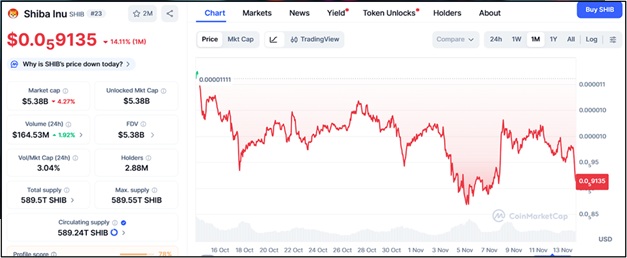
Crypto momentum is constructing speedily in 2025, and Shiba Inu (SHIB) is once again proving why meme cash dominates retail exhilaration. Trading around $0.000009135, SHIB is gearing up for what analysts accept as true, which will be a prime breakout, with forecasts pointing toward a capacity 20x rally if meme sentiment peaks during the bull cycle.

Its chart structure stays healthful, with support maintaining close to $0.00000870, $0.00000811, and $0.00000747, at the same time as resistance stages appear at $0.00000981, $0.00001092, and $0.00001208. With a huge international network and a strong ecosystem constructed round Shibarium, SHIB is poised for stable upside.

But even with such bullish predictions, the conversation among aggressive investors is shifting. While SHIB may offer impressive gains, the project that traders believe could deliver true life-changing returns is not another meme coin—it’s Ozak AI (OZ), a presale-stage AI-driven ecosystem projecting a potential 100x path by 2026.

Shiba Inu’s 20x Outlook Looks Strong

Shiba Inu has matured into certainly one of the biggest meme coins in crypto, backed by an enormous massive network guide and a developing utility layer through Shibarium. The project now has real infrastructure, robust branding, and regular change volume—all signs and symptoms that SHIB is here to stay.

However, its size also limits its explosive upside. For SHIB to rally 50x or 100x like early holders once experienced, its market cap would need to climb to levels unrealistic in the current environment. A 10x–20x run is still very achievable, making SHIB a solid performer, but investors chasing the highest multipliers are already looking ahead.

That’s exactly why Ozak AI is powering into the spotlight: it offers the kind of early-stage pricing and technological advantage that gives it the realistic potential to outperform every major meme coin this cycle.

Ozak AI Offers What SHIB Cannot—Early Valuation Plus Real AI Utility

Ozak AI is one of the most talked-about presales of 2025 because it represents a completely different category of growth. Instead of relying on social hype or meme narratives, its ecosystem is built around AI prediction agents—autonomous, intelligent systems that can analyze blockchain data, forecast market trends, optimize DeFi strategies, and execute on-chain actions without human input.

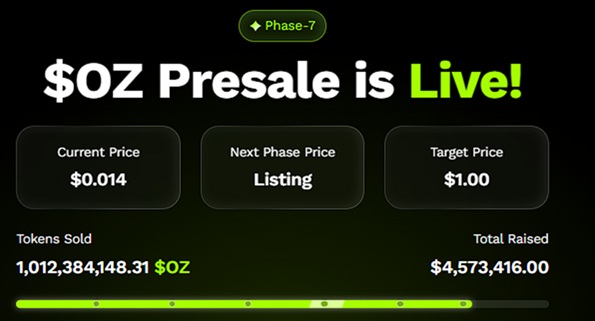
This is the next stage of blockchain evolution: networks that learn, adapt, and operate intelligently. Ozak AI is positioning itself as a foundational part of that transformation. Early traction supports the hype—the project has raised over $4.5 million, sold more than 1 billion OZ tokens, and completed CertiK and Sherlock audits. Listings on CoinMarketCap and CoinGecko, along with partnerships with Perceptron Network, HIVE, and SINT, give Ozak AI rare credibility for a presale project.

At its current OZ presale price of $0.012, traders can still accumulate significant token amounts—and this early valuation is what makes the projected 100x path achievable. If Ozak AI reaches $1 by 2026, early investors could see returns dwarfing even SHIB’s 20x forecast.

SHIB May Multiply Portfolios

Shiba Inu remains one of the strongest meme coins on the market, and a 20x rally would make it one of the top performers of the cycle. Its community, liquidity, and ecosystem ensure SHIB will stay relevant throughout the bull run.

But when the conversation shifts to the biggest multipliers, Ozak AI stands in a league of its own. With cutting-edge AI utility, massive early traction, and ultra-low presale pricing, Ozak AI has emerged as one of the most compelling 100x opportunities available today.

About Ozak AI

Ozak AI is a blockchain-based crypto venture that offers a technology platform that focuses on predictive AI and advanced records analytics for monetary markets. Through machine learning algorithms and decentralized network technologies, Ozak AI permits real-time, correct, and actionable insights to help crypto fanatics and companies make the precise choices.


For more, visit:

Website: https://ozak.ai/

Telegram: https://t.me/OzakAGI

Twitter: https://x.com/ozakagi

Google’s $15bn Andhra Pradesh Bet Signals a New Phase in India’s Race for Digital Infrastructure

0

Alphabet Inc.’s Google is preparing to plant one of its most ambitious energy-linked data-center footprints in Andhra Pradesh, Bloomberg reports.

According to the report, the state’s leader, N. Chandrababu Naidu, is already signaling that the scale of the project may grow far beyond the initial $15 billion planned for the first five years.

During an interview in Visakhapatnam on Saturday, Naidu said Google’s plan to set up a large data center in the coastal city is only the starting point of what he expects to become a long-term expansion. Asked whether the US tech giant might double its investment once the initial period elapses, he said, “It is always an opportunity under their compulsions.” His phrasing hinted that global infrastructure pressure — driven by rising AI workloads — could draw Google into a deeper build-out.

“It is a win-win situation to start with $15 billion within five years,” Naidu said, framing the company’s move as a cornerstone of Andhra Pradesh’s economic revival strategy.

A State Racing to Become India’s Data Capital

Andhra Pradesh has set in motion a sweeping plan to court data-center operators, renewable-energy investors, and global cloud companies. Naidu said the state already has commitments for 5.5 GW of data-center capacity from firms including Reliance Industries Ltd., and that the build-out will be paired with large-scale green-energy expansion.

“This data flow is cost-effective compared to consumption of power,” he said — an argument that blends the economics of hyperscale computing with the state’s long-term energy plan. “That is the game changer. Now everybody is coming to Andhra Pradesh.”

Naidu said the combined effect of these projects positions Andhra Pradesh to become a global hub for data centers, a goal he has pursued since his earlier tenures, long before the current AI-driven global infrastructure boom.

Google announced the Visakhapatnam project last month, linking it to new energy sources and a fiber-optic network that would anchor the region’s role in the company’s Indian operations. Indian tycoon Gautam Adani later confirmed that his joint venture, AdaniConneX, would partner with Google on the project, along with Bharti Airtel, India’s second-largest wireless carrier.

Google has described the project as its largest investment in India to date. It is also designed to serve as a base for accelerating local AI-industry growth, aligning with state and national goals for tech-led economic expansion. Google’s representatives have not commented on Naidu’s latest remarks about possible additional investment.

India’s Data-Center Boom Intensifies

The larger landscape around Google’s project is charged with activity. India has emerged as one of the biggest global beneficiaries of the AI infrastructure wave, drawing interest from nearly every major US technology company.

Amazon has already outlined a plan to invest $12.7 billion in cloud infrastructure in India by 2030. OpenAI, in partnership negotiations with local and global players, is pursuing a 1-gigawatt data-center project in the region — one of the largest single-site capacities ever proposed by a US AI company. The country’s overall data-center investment is expected to cross $100 billion by 2027, according to CBRE Group Inc.

This rush is tied directly to unprecedented global demand for AI computing. Goldman Sachs Research estimates that the world will have about 122 GW of data-center capacity in place by the end of 2030. That level of expansion brings profound consequences for global power systems and could require roughly $720 billion in grid spending through the decade.

In India, the expansion is taking on a distinctive shape. Commercial land costs are lower than many global competitors; telecom infrastructure is widespread; and the country offers one of the largest bases of cloud-ready enterprises and digital consumers. At the same time, the demands of hyperscale AI infrastructure have laid bare the parts of India’s system that still run thin — from inconsistent electricity supply to tight water resources and the long delays that accompany grid expansion.

Modi’s National Tech Push Meets Local Constraints

Prime Minister Narendra Modi has framed technology as a driver of economic transformation, job creation, and poverty reduction. That has translated into open support for data-center investment, subsidies for renewable-energy expansion, and a long queue of state governments competing to attract hyperscale facilities.

But India’s infrastructure gap remains a central tension. Water availability has been a mounting challenge for the industry, because many data centers rely on cooling technologies that require large volumes of water. Several states have begun pressuring operators to adopt air-cooling or hybrid systems, which are more costly.

Electricity reliability also complicates the government’s pitch. The power grid in many regions still struggles with load balancing, and the sudden rise of power-intensive data centers — combined with rapid electrification of transport and manufacturing — risks outpacing grid upgrades. The country’s renewable-energy sector is growing fast, yet still faces bottlenecks in storage capacity, transmission lines, and project approvals.

These limitations do not diminish India’s appeal, but they raise the stakes for states like Andhra Pradesh that want to become dominant players in digital infrastructure. Naidu’s administration is attempting to address this by tying data-center policy directly to renewable-energy expansion and by pitching the state as a region where land, power, and logistics can be delivered in a unified package.

Naidu said he is targeting a 15 percent annual growth rate for Andhra Pradesh and expects to attract $1 trillion in investment over the next decade. The figure is ambitious and hinges heavily on the state’s ability to attract companies that commit large sums over long durations — such as Google.

The chief minister’s strategy depends on portraying the state as stable, predictable, and business-friendly at a moment when global companies are seeking locations that can sustain multi-billion-dollar AI infrastructure. Land availability around Visakhapatnam, the presence of major ports, ongoing renewable-energy projects, and political alignment with the central government all form part of his pitch.

The political angle matters. Naidu’s Telugu Desam Party is a crucial part of the coalition supporting Narendra Modi’s government in New Delhi. On Saturday, Naidu cited the sweeping victory of Modi’s party in the Bihar state election this week as evidence of national stability under the current leadership.

“Winning the election is a message for the global community and also local people,” he said. “Local people will move very fast because of stability.”

That line captures the state government’s effort to signal reliability to global investors. In many emerging markets, political stability is a deciding factor for long-term cloud and AI infrastructure commitments. Hyperscale projects can take years to plan and decades to operate, requiring regulatory continuity and consistently supportive local administrations. Naidu is seeking to assure investors that Andhra Pradesh can deliver that environment.

What Google Stands to Gain

For Google, the Visakhapatnam project fits into a broader push to expand global AI infrastructure and build regional hubs tied directly to renewable-energy sources.

Its India expansion has grown more urgent as AI model training and inference needs soar. The company is competing head-to-head with Amazon, Microsoft, and Meta for global GPU capacity, land, fiber routes, and long-term clean-energy contracts. India offers a combination of scale and cost efficiency that makes it attractive for future AI clusters, especially as the company seeks to diversify beyond its existing US and European centers.

The Visakhapatnam project is particularly significant because it is designed from inception with green-energy integration and dedicated fiber infrastructure — a model that Google has been moving toward in several countries to strengthen long-term resilience and cost predictability.

The project is also expected to strengthen Google’s relationship with India, a market central to the company’s product roadmap. India is one of the world’s largest bases of internet users, mobile-first consumers, and developers — making local AI infrastructure a strategic priority.

Google’s decision to anchor a major investment in Andhra Pradesh is already reshaping expectations for the region. The combined effect of Google, Reliance, AdaniConneX, and Bharti Airtel positions the state as one of the emerging pillars of India’s AI and cloud economy.

However, whether the $15 billion investment grows further will depend on factors well beyond Andhra Pradesh: global GPU availability, cloud demand across Asia, India’s regulatory climate, and Google’s own AI-infrastructure strategy. But Naidu’s confidence, and his eagerness to suggest that the company might scale beyond its initial commitment, is rooted in the speed of India’s data-center boom.

Bitcoin Slides Below $92K as Market Uncertainty Deepens, Erases 2025 Gains

0

Bitcoin fell below $92,000 on Monday as mounting macroeconomic concerns continued to weigh on investor sentiment. The world’s largest cryptocurrency has erased all its 2025 gains and now trades roughly 27% below its all-time high of more than $126,000, reached on October 6.

This downturn has sparked renewed debate about whether the current bull cycle is nearing its end. After hitting a record last month, Bitcoin has since tumbled sharply, wiping out $600 billion in market value since October, according to data compiled by Bloomberg.

Despite the severity of the decline, analysts note that there has been “no clear trigger” for the selloff. Instead, many point to rising macroeconomic uncertainty, particularly regarding the Federal Reserve’s interest-rate path and concerns over the overall health of the U.S. economy.

Zach Pandl, head of research at Grayscale Investments, explained that the market has been repricing early-stage, innovative, frontier-technology assets over the past month and crypto has been significantly affected as part of that revaluation.

While the possibility of a December rate cut remains unclear, some analysts believe the Fed’s expected decision to halt quantitative tightening in December could improve financial conditions and potentially support Bitcoin’s price. Interestingly, the selloff occurred even as tech stocks—which often move in tandem with digital assets—looked poised for a rebound. Nasdaq 100 futures rose 0.6% on Monday, suggesting that equity investors view the recent pullback as a buying opportunity.

Bitcoin and other major cryptocurrencies, however, did not share the same momentum, signaling persistent caution ahead of several key economic reports delayed by the U.S. government shutdown.

Amid the broader downturn, the world’s largest corporate Bitcoin holder went against the tide. Strategy announced on Monday that it purchased 8,178 Bitcoin last week for $836 million, bringing its total holdings to just under 650,000 BTC. This marks Strategy’s largest weekly acquisition since late July.

Gerry O’Shea, head of global market insights at Hashdex, emphasized Bitcoin’s evolution into a macro-driven asset. According to him, uncertainty around Federal Reserve policy tends to negatively impact Bitcoin, while clearer expectations of a December rate cut could help lift prices.

Bitcoin is now down 25% from its October high and has officially formed a death cross on the daily chart, with the 50-day moving average falling below the 200-day. This bearish technical signal follows weeks of weakening momentum through October and November that dragged the price below $100,000. Historically, such a formation often marks a key moment in Bitcoin’s market cycles, indicating either the formation of a base or further downside ahead before stabilization can occur.

As Bitcoin struggles, one of its most vocal critics, Peter Schiff, has intensified his long-running attacks. He criticized CNBC for previously amplifying Bitcoin’s bullish narrative but now offering less commentary during the correction. Schiff argued that analysts remain “at a loss” to explain Bitcoin’s decline after many predicted much higher prices. He reiterated his long-standing position that Bitcoin is a “modern-day tulip,” a criticism he has repeated since the cryptocurrency traded below $1,000.

In contrast to bearish sentiment, an unexpected bullish prediction has come from Kim Young-hoon, a South Korean prodigy recognized as having the world’s highest verified IQ of 276. Kim forecasts that Bitcoin will surge to $220,000 within the next 45 days. Traders are now debating whether he sees a trend others have overlooked, especially as Bitcoin faces rising fear in the market, unstable ETF inflows, and shifting macroeconomic conditions.

For Bitcoin to reach $220,000, the price would need to more than double from current levels—a jump exceeding 126% in a short period. Many experts view this prediction as highly unlikely, though it has added an intriguing twist to the ongoing uncertainty around Bitcoin’s next move.