DD
MM
YYYY

PAGES

DD
MM
YYYY

spot_img

PAGES

Home Blog Page 152

Nigeria’s Intra-African Trade Surges 14%, Fueling Optimism That AfCFTA Could Unlock Major Economic Gains

0

Nigeria’s commercial engagement with other African nations strengthened sharply in the first half of the year, with intra-African trade rising 14% amid a renewed government push to overhaul border processes and deepen regional connectivity.

The data, released on Monday by the Comptroller-General of the Nigeria Customs Service (NCS), Bashir Adewale Adeniyi, offers one of the clearest signs yet that Nigeria is beginning to benefit from a more integrated continental market.

Adeniyi told participants at a trade conference in Abuja that trade with African partners jumped by 600 billion naira (about $415 million) to 4.82 trillion naira between January and June. He described the growth as a firm signal that Nigeria’s regional trade reforms are gaining traction.

“This is a clear signal of strengthening regional trade momentum,” he said.

Nigeria’s exports to member states within the Economic Community of West African States saw a marked increase as well, which he said highlighted the country’s rising importance as a hub for continental trade and emerging value chains.

The gains coincide with government efforts to remove long-standing trade barriers. Authorities have been digitizing customs procedures, reducing clearance times, and improving transport links with neighboring countries, all aimed at easing the movement of goods across borders. Weak road networks, bureaucratic delays, and a lack of harmonized documentation have historically been some of the biggest obstacles to intra-African trade.

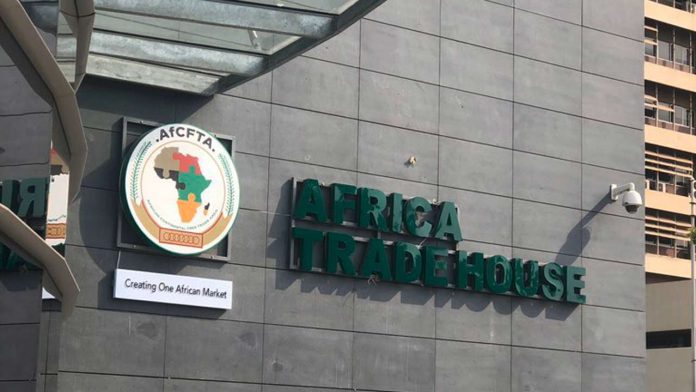
Nigeria’s reforms are part of a broader strategy to position the country advantageously under the African Continental Free Trade Area (AfCFTA), the landmark agreement that aims to create a unified market of more than 1.3 billion people.

Industry, Trade and Investment Minister Jumoke Oduwole said Nigeria has taken “concrete” steps to implement its AfCFTA commitments. Among the measures is a set of new tariff concessions designed to expand market access for Nigerian exporters. She also highlighted the launch of a dedicated air-cargo corridor to East Africa, which has already cut export costs by about 75%.

According to her, the corridor is helping exporters — especially those dealing in perishables — reach distant African markets faster and more competitively.

The surge in regional trade has generated fresh optimism among analysts who have long argued that AfCFTA could significantly boost Africa’s economic fortunes if fully executed. The recent uptick in commerce, they say, demonstrates the scale of potential gains once member states harmonize regulations, improve logistics, and expand cross-border infrastructure.

Analysts have pointed out that Africa currently trades more with Europe and Asia than with itself, largely because of tariff and non-tariff barriers, fragmented markets, and poor connectivity. Nigeria’s improvement, driven by early compliance with AfCFTA-aligned reforms, is seen as proof that removing these barriers could unlock substantial growth for businesses and governments across the continent.

Some trade experts noted that if more African countries adopt Nigeria’s approach — especially in simplifying customs procedures and reducing transport bottlenecks — the continent could see a dramatic rise in manufacturing competitiveness, agricultural exports, and value-added processing.

For Nigeria, the gains come at a crucial moment. The country has faced persistent economic challenges, including high inflation, forex volatility, and reduced oil earnings. Stronger regional trade, analysts say, could offer a new path toward diversification, helping local industries plug into regional supply chains.

The next test will be whether Nigeria can maintain the trajectory — and whether other African states can match its pace of reforms. But for now, officials and analysts agree that the latest figures are a promising indicator that AfCFTA’s long-anticipated economic benefits may be within reach once implementation deepens continent-wide.


Morgan Stanley Sees U.S. Stocks Leading Global Markets in 2026 as AI Capex Surges

0

Morgan Stanley is leaning heavily toward equities going into next year, projecting that U.S. stocks will outperform global peers in 2026 on the back of accelerating artificial intelligence investment and a policy backdrop it believes is finally aligning in favor of risk assets.

“Risk assets are primed for a strong 2026, powered by micro fundamentals, accelerating AI capex, and a favorable policy backdrop,” the bank said in a set of global economic and strategy outlook notes released Monday.

The view caps a turbulent year in global markets, shaped in no small part by President Donald Trump’s shifting tariff approach. Much of that uncertainty has eased heading into 2026, giving investors clearer visibility even as Morgan Stanley cautioned that the next 12 months still carry a wide range of possible outcomes. The U.S., it stressed, remains the central swing factor for global markets.

U.S. Outlook: AI, Earnings, and a Soft Dollar Cycle

Morgan Stanley’s baseline scenario sees the S&P 500 climbing to 7,800 by the end of 2026, implying roughly 16% upside from current levels. The bank attributes the projection to resilient earnings growth across major sectors and productivity gains tied to the rollout of AI-driven tools and infrastructure.

Small-cap stocks are expected to outperform large caps, while cyclicals should lead defensive sectors. The assessment reflects expectations of a Federal Reserve that remains dovish through much of 2026, enabling borrowing costs to stay supportive of growth.

On currencies, Morgan Stanley forecasts the dollar index sliding to 94 in the first half of next year before recovering to 99 by year-end as global growth patterns shift.

Europe: Riding the Coattails of a U.S. Upswing

The firm expects Europe to benefit from a widening U.S. recovery despite the region’s stubborn fiscal constraints and intensifying competition from China.

It raised its 2026 target for the MSCI Europe local currency index to 2,430, up from a prior forecast of 2,250. European stocks have already gained about 12.5% this year, buoyed by improved corporate earnings, easing inflation, and renewed optimism around Germany’s fiscal spending plans.

Still, Morgan Stanley noted that Europe’s structural challenges remain unresolved, making the region more dependent on U.S. momentum than in previous cycles.

Commodities: Gold Soars, Oil Anchored

The bank’s commodities outlook paints a sharply divergent landscape.

Gold is projected to hit $4,500 per ounce in 2026, reflecting expected demand for safe assets and a weaker early-year dollar. Copper is forecast at $10,600 per ton, supported by continued electrification demand and tight supply conditions.

By contrast, Brent crude is expected to hover around $60 a barrel. The brokerage anticipates a soft supply-demand balance through 2026, keeping oil prices capped even if global growth holds up.

A Wide Band of Possibilities

While the baseline is upbeat, Morgan Stanley flagged that uncertainty remains high as markets transition into a new policy and growth cycle shaped by AI, geopolitics, and post-pandemic economic rebalancing. The firm described the U.S. as the critical variable that could swing global markets either toward a sustained rally or back into volatility.

What remains clear, in its view, is that equities—not credit or government bonds—offer the most compelling opportunity next year, with artificial intelligence once again at the center of the global market story.

Dangote Cement Launches N100bn Commercial Paper Offer Amid Strong Earnings and Robust Cash Flow

0

Dangote Cement Plc has formally launched the first tranche of its N500 billion Commercial Paper (CP) Issuance Programme, opening a N100 billion offer on Monday, 17 November 2025.

The offer, scheduled to close on Wednesday, 19 November 2025, marks a significant milestone for Nigeria’s leading cement producer, reflecting the company’s strong market position and financial stability.

The CPs are structured in two tranches: a 181-day Series 1 with a 16.10% discount rate, which implies a yield of 17.50%, and a 265-day Series 2 with a 16.70% discount rate, translating to a 19.00% yield. Minimum subscription is set at N50 million, with further subscriptions allowed in multiples of N1,000. According to the pricing documents, proceeds from the issuance will be directed toward meeting the company’s working capital needs, supporting operations across its extensive Pan-African footprint.

Dangote Cement’s financial track record over the past five years underscores its ability to deliver consistent results. Revenue surged from N1.03 trillion in 2020 to N3.58 trillion in 2024, reflecting a remarkable compound annual growth rate of 37%. Profit after tax more than doubled over the same period, climbing from N276 billion to N503.25 billion, signaling sustained operational efficiency and effective cost management.

The company’s performance through the first nine months of 2025 has been equally impressive. Revenue reached N3.15 trillion, up 22% from N2.56 trillion in the same period in 2024, while profit before tax soared 150% to N1.04 trillion from N406.4 billion. Profit after tax more than doubled to N743.3 billion from N279.1 billion in 9M 2024. Operating cash flows grew to N1.29 trillion, more than doubling the N532 billion recorded in the prior year. The company has also reduced its borrowings by 47%, from N2.5 trillion in December 2024 to N1.32 trillion, with its interest coverage ratio improving to 4.4 from 3.3, indicating a strengthened capacity to service debt.

However, Dangote Cement experienced a decline in production volume in 9 months of 2025, suggesting that pricing, rather than volume growth, has been the main driver of performance. Analysts caution that sustained reliance on pricing could present a risk if competitive or market pressures affect margins.

Rating agencies continue to recognize Dangote Cement’s strong market position and operational resilience, though with some caution. DataPro reaffirmed the company’s AA long-term and A1 short-term ratings, highlighting its strong brand, solid earnings track record, and experienced management team. At the same time, they noted risks, including low asset utilization, foreign-exchange exposure, and challenges across certain Pan-African markets.

GCR Ratings, in October 2025, downgraded the company to A+(NG) from AA+(NG), not due to deteriorating performance but because of the group-cap effect tied to its parent company, Dangote Industries Limited. GCR, however, acknowledged the company’s robust cash flows and solid earnings, forecasting continued improvement in leverage metrics by the end of 2025.

For investors, the CP issuance offers an attractive short-term investment opportunity. With strong revenue growth, surging profits, and robust operating cash flows, Dangote Cement demonstrates a capacity to deliver steady returns. The reduction in borrowings and improved leverage provide additional reassurance regarding the security of the CPs. At the same time, the yields of 17.5% for the shorter tranche and 19% for the longer tranche make the offering competitive relative to other fixed-income instruments available in Nigeria’s capital markets.

While the company’s overall fundamentals are strong, investors are mindful of certain risks. For instance, the decline in production volume highlights potential exposure to pricing pressures, which could impact future profitability. Additionally, operations in Pan-African markets carry inherent foreign-exchange and geopolitical risks that could influence earnings.

Overall, the launch of Dangote Cement’s N100 billion Commercial Paper tranche represents a significant opportunity for investors seeking short-term, high-yield instruments backed by one of Nigeria’s most financially sound and strategically positioned industrial companies. The strong cash flow generation, disciplined debt management, and proven profitability pinpoint the company’s capacity to navigate challenging market conditions while delivering competitive returns.

Nvidia’s Earnings Set to Trigger Historic $320bn Market Swing Amid AI Boom Scrutiny

0

Nvidia’s upcoming quarterly earnings report, scheduled for Wednesday after market close, is poised to generate one of the largest single-day swings in market value ever for the AI-focused chipmaker, with analysts estimating a potential $320 billion fluctuation.

Investors are intensely focused on the report, seeking signals about whether the artificial intelligence boom is entering a new phase of growth or showing early signs of cooling, according to Reuters.

Options data from analytics firm Option Research & Technology Services (ORATS) indicate that the market is pricing in an approximately 7% movement in either direction for Nvidia shares following the earnings announcement. According to Reuters’ analysis, at Nvidia’s current market capitalization of around $4.6 trillion, such a move would surpass the $276 billion market value swing recorded in February 2024, marking the largest post-earnings market impact in the company’s history. Over the last 12 quarters, Nvidia’s stock has averaged a 7.3% change the day after reporting, ORATS data shows.

The earnings report carries outsized importance because Nvidia’s graphics processing units dominate the AI infrastructure market, powering large language models and other AI applications. Reuters quoted Chris Murphy, co-head of derivatives strategy at Susquehanna, as emphasizing that Nvidia’s results will influence expectations for AI investment more broadly.

“As the anchor of the AI capex trade, its results will help define whether we’re in the next leg of expansion or entering digestion mode,” Murphy said.

The chipmaker’s approximately 8% weighting in the S&P 500 amplifies the potential ripple effects of its earnings. Murphy explained that the report could influence sentiment across semiconductors, hyperscalers, and the broader AI infrastructure market, affecting more than $10 trillion of correlated trades. Investors will scrutinize Nvidia’s revenue, margins, demand trends, and supply chain updates for indications of how AI spending might evolve in the near term.

Recent market activity has highlighted investor caution. Nvidia shares, which have gained roughly 38% year-to-date, have retreated about 10% from record highs reached in late October. The decline coincides with high-profile investor exits, including billionaire Peter Thiel’s hedge fund and SoftBank, raising concerns about the sustainability of AI-driven gains. Analysts and fund managers are assessing whether these moves signal a temporary correction or a broader recalibration in AI stock valuations.

Jason Pride, chief of investment strategy and research at Glenmede, noted that Nvidia’s results could influence broader business investment trends.

“As a major S&P 500 constituent, its results will likely carry broader implications for business investment and AI-related spending trends,” he said, highlighting the central role of Nvidia’s report in guiding expectations for the technology sector.

The earnings release will be closely examined for multiple factors. Analysts are looking for clarity on AI demand, including enterprise adoption, cloud computing growth, and hyperscaler investment in data center capacity. Margins and supply chain performance are also critical, given the costs associated with producing next-generation GPUs and supporting the infrastructure needed for large-scale AI model training.

Investors are aware that Nvidia’s earnings report may influence market narratives as much as the stock itself. Beyond the immediate 7% move implied by options, the results could shape perceptions about the trajectory of AI as an industrial and investment trend, impacting valuations across the technology sector and informing capital allocation decisions globally.

In essence, Nvidia’s earnings are not just a financial report; they are seen as a pivotal moment for the AI ecosystem. Market participants will be watching closely to see whether the company can sustain its growth, manage costs, and deliver signals that justify its role as the anchor of the AI-driven technology boom. The report could set the tone for AI-related investment strategies and influence the broader semiconductor market for months to come.

Another €150 Million for US Arms Purchases for Kiev

0

The US State Department approved a new arms sales package to Ukraine valued at approximately $329 million, including a €150 million about $165 million allocation specifically for Starlink satellite communications services and related equipment.

Germany is to contribute at least €150 million ~$175 million to purchasing US military equipment for Ukraine, Defence Minister Boris Pistorius said on Friday as he hosted European counterparts for talks in Berlin.

This will enhance Ukraine’s battlefield connectivity, command-and-control systems, and drone operations amid ongoing Russian assaults. The approval comes under the Foreign Military Sales (FMS) program and is expected to be expedited for delivery.

$179.1 million for spare parts, training, and maintenance to sustain Ukraine’s existing Patriot air defense systems. Starlink Services: €150 million for satellite terminals, user equipment, and ongoing service subscriptions, critical for real-time intelligence sharing and artillery coordination.

This deal builds on a broader US strategy under President Trump to shift some aid burdens to European allies while maintaining direct support. For instance, in July 2025, another $322 million package was cleared, with $150 million for Bradley Fighting Vehicle sustainment and $172 million for Hawk surface-to-air missile upgrades.

Earlier in August, NATO members like the Netherlands committed €500 million $540 million for US-made munitions and howitzers to be transferred to Kyiv. Since Russia’s full-scale invasion in 2022, the US has provided over $31 billion in direct military drawdowns from its stockpiles, plus billions more through FMS sales.

With US policy emphasizing a negotiated end to the conflict, these purchases—often funded or facilitated by European partners—aim to bolster Ukraine’s defenses without solely relying on American taxpayer funds.

President Zelenskyy has signaled readiness for even larger deals, potentially up to $90 billion in US weaponry, including drones and fighter jets, with technical talks ongoing. Critics in Ukraine have raised concerns about procurement transparency, with recent audits uncovering alleged corruption in domestic arms deals worth millions.

However, these US-facilitated sales are seen as a more accountable channel, helping Kyiv achieve near 60% self-sufficiency in armaments through boosted production. Starlink, SpaceX’s satellite internet constellation, has been a cornerstone of Ukraine’s communication infrastructure since Russia’s full-scale invasion in February 2022.

Deployed just days after the invasion began, it filled critical gaps left by destroyed terrestrial networks, enabling real-time battlefield coordination, drone operations, and civilian connectivity. By April 2025, Ukraine operated over 50,000 terminals, making it one of the largest users globally.

Its low-Earth orbit (LEO) satellites provide high-speed, low-latency internet resilient to jamming and physical damage, revolutionizing modern warfare tactics for Ukraine.

On February 26, 2022, Ukraine’s Vice Prime Minister Mykhailo Fedorov publicly requested Starlink support via Twitter. SpaceX responded within 48 hours, shipping thousands of terminals. Initial funding came from SpaceX itself, with Elon Musk personally overseeing logistics.

Starlink enabled Ukrainian defenders in Mariupol to maintain command-and-control amid encirclement, streaming video feeds and coordinating evacuations. It also supported drone strikes by allowing operators to attach terminals to unmanned aerial vehicles (UAVs) for beyond-line-of-sight control.

By mid-2023, the U.S. Department of Defense (DoD) assumed funding via a contract with SpaceX, covering expenses that had strained the company. As of December 2023, Poland had donated 19,500 terminals—the largest single contributor—bringing the total to around 47,000.

Starlink has transformed Ukraine’s operational capabilities, often described as a “force multiplier” in asymmetric warfare:Battlefield Connectivity: Ukrainian troops use it for encrypted apps showing real-time enemy positions from drones, artillery fire coordination, and secure video calls with headquarters.

Drone and UAV Integration: Essential for controlling long-range strike drones, including adaptations where terminals are strapped directly to aircraft. This has enabled precision strikes deep into Russian-held territory.

Civilian and Infrastructure Support: Powers hospitals, emergency services, and remote villages, restoring digital access after blackouts. In 2025, it sustained connectivity during intensified Russian assaults on energy grids.

Russia has targeted Starlink signals since 2022 with electronic warfare, but frequent software updates and satellite maneuvers have maintained 90-95% uptime. However, outages remain a vulnerability.

Since 2023, the DoD funds Starlink via the Proliferated Low Earth Orbit (PLEO) program. A $537 million contract (2024-2027) supports military services, including a December 2024 upgrade to Starshield—a militarized, encrypted version—for 3,000 terminals. In August 2025, the State Department approved a $150 million extension for terminals and services under the Foreign Military Sales program.

Poland’s $47 million commitment in 2025 covers half of Ukraine’s terminals. On November 15, 2025, Estonia pledged €3.5 million for acquisition and maintenance, emphasizing drone ops. Other donors include the UK and Germany.

Over $1 billion in combined funding by 2025, with SpaceX projecting $3 billion in U.S. government revenue from military contracts, including Ukraine. In September 2022, Musk ordered a temporary shutdown of coverage near Crimea during Ukraine’s counteroffensive, citing escalation risks and U.S. sanctions—disrupting drone ops and eroding trust. He later reversed it amid backlash.

Under the Trump administration in 2025, fears mounted of service cuts as leverage in peace talks. Ukrainian officials worried about frontline collapse without it, prompting diversification. Reports in February 2025 confirmed Russian forces using smuggled terminals for their own ops, like in Vuhledar.

SpaceX has restricted offensive military use since 2023, focusing on defensive and humanitarian roles, though enforcement is inconsistent. In December 2024, Kyivstar partnered with Starlink for satellite-direct-to-phone services, launching SMS in Q4 2025 and expanding to voice/data in 2026.

This aims to bypass damaged cell towers, making Ukraine the first conflict zone with the tech. Ukraine signed a deal in April 2025 with Sweden’s Requtech for local production of OneWeb/Intelsat terminals, reducing Starlink reliance. Europe explores alternatives like Eutelsat, but replacing 40,000+ terminals could take months.

Starlink sustains Ukraine’s edge, but geopolitical pressures and jamming threats underscore the need for backups. Kyiv’s new Space Policy Directorate is building a domestic satellite constellation, signaling a shift from dependency to self-reliance.