
DD
MM
YYYY

PAGES

DD
MM
YYYY

spot_img

PAGES

Home Blog Page 1526

Ever Made A 50x Return? Top Tips On How Ethereum & BNB Whales Made Millions From Just $1000

0

A growing number of investors enter the crypto market to pursue 50x returns as they try to match seasoned whales who achieve substantial profits during erratic market situations. There are two factors that explain the remarkable market performance of Ethereum (ETH) and BNB investors. However, the evolving nature of the crypto market reveals Remittix (RTX) as a promising new project which shows potential to continue the success of previous high-return cryptocurrency ventures.

Identifying Key Technical Signals: The Ethereum Playbook

Time after time Ethereum has demonstrated its capacity to withstand challenges. The whale investor class has used strong price rebounds that emerge from vital support regions throughout history. The ascending trendline traces its origins back to the COVID-19 market crash multiple years ago.

The trendline established its strength through two significant events: LUNA collapse and Bybit hack that resulted in Ethereum price increases of 1,400% and 270%. Whales initiate buying ethereum after ETH reaches this essential support level because price tends to bounce back strongly and create suitable conditions for bullish momentum.

Ethereum maintains fundamental investor interest despite critics who prefer Proof-of-Work protocols and believe that Proof-of-Stake fragmented the network operation. A major acquisition of Ether occurred when whales purchased significant ETH volumes after it fell to $2,000 because they expected an intensely rising market.

Whales purchased over 120,000 Ether tokens worth approximately $236 million within three days based on on-chain data analysis. Such aggressive buying underscores the belief that the market still underestimates Ethereum’s long-term potential. The research analysts at Standard Chartered believe ETH will climb to $4,000 value by 2025 which enhances the belief of “whales” in the cryptocurrency market.
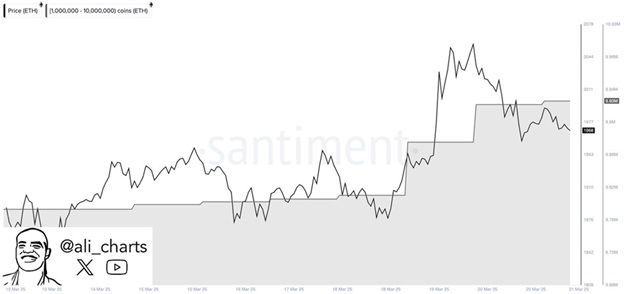
source: Ali Martinez on X

BNB’s Consistent On-Chain Growth

Analysts study Binance Coin (BNB) to show how small investments transform into enormous profits through time. The expansion of BNB since 2017 stems from various elements which include improved exchange usability through its robust network growth and timely platform innovations. The consistent growth of BNB has allowed whale wallets to accumulate the token.

The weekly volume of decentralized exchanges on BNB Chain rose by 66.7% according to CoinMarketCap. The BNB Chain’s increased influence within the DeFi market becomes evident through recent data since its Pascal Hardfork upgrade series alongside various other system enhancements. The network steps continue attracting whale investors because they understand the enduring potential of this system which dominates on-chain trading operations.

The on-chain performance of BNB long-term holders is monitored through Coin Days Destroyed (CDD), Net Unrealized Profit/Loss (NUPL) analysis and Market Value to Realized Value (MVRV) ratio assessments. Data points connected to heightened selling activity show “fear” periods but BNB has managed to escape significant price drops.
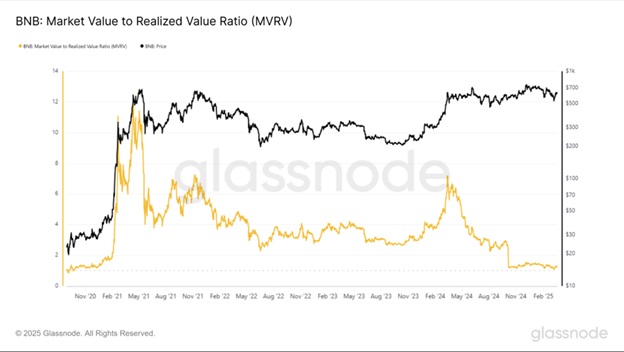
source: glassnode

Examining these data indicators leads whales to determine necessary continuation of their accumulation activities. The token’s owners seize market price declines as chances to acquire at beneficial prices because they trust that the BNB Chain development alongside widespread market conditions will maintain upward price movement.

The Next Crypto Set to Boom: Remittix on the Rise

Remittix (RTX) has recently attracted significant interest as people predict it will experience major growth throughout this year. The payment solution Remittix targets the remittance sector by providing efficient rapid cross-border payments to replace costly traditional financial systems.

The current Remittix token sale indicates high market demand from investors. The project stands strong for substantial expansion after collecting $14+ million from the sale of its 521 million tokens priced at $0.0734 each.

The core value proposition of Remittix functions by resolving an actual financial problem which was similar to Ethereum establishing decentralized application infrastructure and BNB facilitating unified trading integration. As Remittix achieves its stated roadmap all early investors could realize the kinds of profits that were reserved for the earliest supporters of ETH and BNB.

Going by the historical examples of Ethereum and BNB whales demonstrates how purchase discipline combined with market endurance and commitment to sound fundamentals brings outstanding profits.

Since the crypto market experiences continuous change new initiatives launch into the market with potential to outdo former triumphs. Remittix demonstrates qualities that indicate it will emerge as a leading candidate to challenge existing payment networks due to its effective solution for international money transfers.

Remittix Holds the Ultimate Key to Growth

People searching for explosive growth in their investments should closely follow Remittix (RTX) because its potential appears promising. Remittix differentiates itself as a promising market opportunity because it combines substantial funding with rising community backing alongside its clear mission direction through a market that seeks its next major disruption. The successful execution of Remittix’s potential can make it establish leadership as crypto’s upcoming major winner similar to how Ethereum and BNB succeeded.

Discover PayFi with Remittix by checking out their presale here:

Website: https://remittix.io/

Socials: https://linktr.ee/remittix

Giveaway: https://gleam.io/FHtn5/250000-remittix-giveaway

The State of Crypto Regulation Globally

0

The state of cryptocurrency regulation globally and in specific regions like the United States is evolving rapidly, shaped by a mix of innovation, market dynamics, and governmental responses. Globally, cryptocurrency regulation in 2025 reflects a patchwork of approaches. Some countries embrace crypto as a tool for economic growth, while others impose strict controls or bans, driven by concerns over financial stability, consumer protection, and illicit activities like money laundering.

Nations like El Salvador and the Central African Republic have fully integrated Bitcoin as legal tender, aiming to boost their economies. Singapore and Switzerland continue to foster innovation with clear, supportive frameworks, positioning themselves as crypto hubs.
Comprehensive Frameworks: The European Union’s Markets in Crypto-Assets (MiCA) regulation, fully effective as of January 2025, standardizes rules across member states, enhancing consumer protection and market integrity while encouraging blockchain innovation.

The UK, meanwhile, regulates crypto businesses under the Financial Conduct Authority (FCA), focusing on transparency and anti-money laundering (AML) compliance without treating crypto as legal tender. China maintains a hardline approach, banning crypto transactions and mining, though enforcement nuances persist. India, after lifting its crypto ban in 2020, is still refining its regulatory stance with a delayed Cryptocurrency Bill, balancing innovation with oversight.

Regulators worldwide are prioritizing AML and combating the financing of terrorism (CFT), with stablecoin oversight gaining traction—99% of stablecoins are dollar-pegged, prompting frameworks like MiCA. Regulatory sandboxes and blockchain-based reporting tools are also on the rise, allowing controlled experimentation and improved compliance. In the U.S., crypto regulation remains a complex interplay of federal and state efforts, with significant shifts under the new Trump administration that took office in January 2025.

On January 23, 2025, President Trump signed an executive order, “Strengthening American Leadership in Digital Financial Technology,” signaling a pro-crypto agenda. It established the President’s Working Group on Digital Asset Markets, tasked with drafting new regulations within 180 days (by July 2025) and exploring a national crypto stockpile from seized assets. The order also bans central bank digital currencies (CBDCs) and aims to protect banking access for crypto firms, countering past debanking pressures. The Securities and Exchange Commission (SEC), under new chair Paul Atkins (nominated December 2024), has pivoted from “regulation by enforcement” to a lighter, innovation-friendly approach.

On January 21, 2025, the SEC launched a Crypto Task Force led by Commissioner Hester Peirce to clarify rules, enhance disclosure, and ease registration. By late January, it rescinded restrictive accounting guidance (SAB 121) and paused high-profile cases against firms like Coinbase and Binance, signaling reduced enforcement aggression. Memecoins were declared non-securities on February 27, 2025. The Commodity Futures Trading Commission (CFTC) retains oversight of Bitcoin and derivatives as commodities, with nominee Brian Quintenz expected to align with the pro-crypto tilt. The IRS treats crypto as property, with new 2025 Form 1099-DA rules for brokers, though basis reporting remains optional until 2026.

FinCEN is poised to amend Bank Secrecy Act rules to include virtual currency in FBAR reporting, still under proposal as of now. Bills like the Financial Innovation and Technology for the 21st Century Act (FIT21) and stablecoin-focused Clarity for Payment Stablecoins Act are gaining traction in a Republican-led Congress. FIT21, which passed the House in 2024, aims to classify most crypto as commodities under CFTC jurisdiction, potentially resolving SEC-CFTC turf wars. Leaders like Rep. French Hill and Sen. Tim Scott target passage by mid-2026, leveraging a pro-crypto majority bolstered by industry-backed campaigns in the 2024 elections.

States like Wyoming and Florida foster crypto with favorable laws—Wyoming enables crypto banks, while Florida’s 2023 sandbox eases licensing. Conversely, New York’s 2023 CRPTO Act proposal and California’s licensing push (AB 2269) tighten oversight, reflecting a split between innovation hubs and stricter regimes. The U.S. lacks a unified federal framework, but the Trump administration’s actions suggest a shift toward clarity, potentially making it the “crypto capital” as pledged. Globally, divergent rules challenge cross-border businesses. Regulatory gaps still enable scams and volatility, with DeFi’s $260 billion compliance cost estimate (per IRS litigation) highlighting tensions between innovation and oversight.

By late 2025, expect U.S. regulations to solidify around stablecoins, spot markets, and DeFi, influenced by the Working Group’s July report. Globally, harmonization efforts via bodies like the International Organization of Securities Commissions could emerge, though national priorities will dominate. Crypto regulation in 2025 is at a pivotal moment—globally diverse, with the U.S. tilting toward a pro-innovation stance that could reshape its role in the digital asset world, contingent on policy execution and legislative success.

Walrus’s Launch could Amplify Sui’s Narrative as a Layer 1 Blockchain Contender

0

Walrus has announced that their mainnet is scheduled to go live this week, specifically on March 27, 2025. This follows their successful fundraising of $140 million in a private token sale and marks a significant milestone for the decentralized storage protocol built on the Sui blockchain. The launch will also introduce their native token, WAL, with a total supply of 5 billion, of which 10% is allocated to the Walrus User Drop (4% for the initial airdrop and 6% for future allocations). The excitement around this launch has been echoed across various platforms, with many anticipating its impact on decentralized storage and the broader Sui ecosystem.

The Walrus User Drop is a token distribution initiative by Walrus, a decentralized storage protocol built on the Sui blockchain, designed to reward and engage its community as part of the mainnet launch on March 27, 2025. The User Drop aims to incentivize early adopters, contributors, and users who have supported Walrus during its development phase, aligning with the ethos of decentralized projects to distribute ownership and governance to the community. Walrus has a total supply of 5 billion WAL tokens. Out of this, 10% (500 million tokens) is dedicated to the Walrus User Drop.

This 10% is split into: 4% (200 million tokens) for the initial airdrop, which targets eligible users at the mainnet launch. 6% (300 million tokens) reserved for future allocations, likely to reward ongoing participation or additional community milestones. While specific criteria haven’t been fully detailed in public announcements, such airdrops typically reward actions like participating in testnets (e.g., Walrus’s testnet phase), engaging with the protocol’s ecosystem, holding certain Sui-based assets, or contributing to the project’s growth (e.g., through development or promotion).

The initial snapshot for eligibility was reportedly taken on March 10, 2025, at 12 PM PST. The initial 4% airdrop will occur alongside the mainnet launch, with tokens becoming claimable starting March 27, 2025. The remaining 6% will be distributed later, potentially tied to future usage metrics or community programs. This drop not only bootstraps the Walrus ecosystem by putting tokens in the hands of users but also ties into the protocol’s goal of decentralizing storage. Users with WAL tokens may eventually influence governance or staking mechanisms, though exact utility details are still unfolding.

The User Drop has generated buzz within the Sui community and beyond, as it’s seen as a way to kickstart adoption of Walrus’s blob storage solution, which promises cost-effective, resilient data storage for applications like NFTs, gaming assets, and more. Walrus positions itself as a scalable, cost-effective decentralized storage solution for “blobs” (large unstructured data like images, videos, or game assets). A successful mainnet launch could validate its approach—using the Sui blockchain’s high-throughput, low-latency architecture—potentially setting a new standard for Web3 applications needing reliable off-chain storage.

As Walrus is built on Sui, its performance and adoption could reflect on Sui’s capabilities. A robust launch might attract more developers to Sui, leveraging Walrus for dApps in gaming, NFTs, or DeFi, where data storage has been a bottleneck. Walrus enters a crowded field with players like IPFS, Filecoin, and Arweave. Its success hinges on differentiating itself—possibly through tighter integration with Sui or lower costs—which could pressure competitors to innovate further. The introduction of the WAL token with a 5 billion supply and the User Drop (10% allocation) will influence its early market behavior. The initial 4% airdrop (200 million tokens) could flood the market if recipients sell immediately, potentially suppressing prices short-term.

However, the reserved 6% for future drops might stabilize value by incentivizing long-term holding or usage. By distributing tokens to early users, Walrus creates a vested community, which could drive organic growth. This mirrors strategies seen in projects like Aptos or Solana, where airdrops boosted engagement—but it also risks speculative dumping if utility isn’t immediately clear. With $140 million raised in a private token sale, the mainnet launch tests investor confidence. A smooth rollout could draw more institutional interest in Sui-based projects, while glitches or low adoption might cool enthusiasm.

Walrus’s launch could amplify Sui’s narrative as a Layer 1 blockchain contender, especially after its own mainnet debut in 2023. If Walrus delivers, it might pull in developers and users from Ethereum, Solana, or other ecosystems, reinforcing Sui’s niche in high-performance dApps. The User Drop fosters a sense of ownership, potentially creating a loyal user base. However, if eligibility feels opaque or rewards skew toward insiders, it could spark backlash—similar to controversies in past airdrops like Arbitrum’s.

If Walrus proves decentralized storage can be both practical and profitable, it might inspire similar projects across other blockchains, accelerating the shift from centralized providers like AWS to Web3 alternatives. Mainnet launches are notoriously complex. Delays, bugs, or security issues could undermine trust in Walrus and, by extension, Sui.

Defi Dungeon GOLD Token Vault Closed at $130M Deposits

0

DeFi Dungeons $GOLD token vault closed on March 20, 2025, at 17:00 UTC, with over $130 million in deposits, primarily in $USDC and $SOL, according to posts on X and related web sources. This figure significantly exceeded the vault’s $3 million cap, resulting in an oversubscription of approximately 4,300%. The Token Generation Event (TGE) utilized Meteora’s Alpha Vault technology, designed to ensure a fair launch by allowing participants to deposit funds during a 24-hour window (March 19, 17:00 UTC to March 20, 17:00 UTC) to purchase $GOLD tokens at a fixed price of $0.03 each. With 100 million $GOLD tokens allocated to the vault (10% of the total 1 billion token supply); the massive deposit volume triggered a pro-rata distribution.

For example, if an investor contributed $1,000 out of the $130 million total, they would receive roughly 0.000769% of the 100 million tokens—approximately 256 $GOLD tokens worth $7.69 at the capped price, with the remaining $992.31 refunded. This reflects the high demand for $GOLD, the core token of the Solana-based fantasy idle RPG DeFi Dungeons, signaling strong community interest in its play-to-earn ecosystem as trading began on March 20 at 18:05 UTC.

Pro-rata distribution is a method of allocating resources or assets proportionally based on each participant’s contribution relative to the total. In the context of something like the DeFi Dungeons $GOLD token vault, it’s used when demand exceeds supply—like when $130 million was deposited for a vault capped at $3 million. Here’s how it works in simple terms:
Imagine there’s a pie (the total allocation, say 100 million $GOLD tokens) and a group of people putting money into a pot to get a slice. If the pot gets way more money than expected, you can’t give everyone the full slice they wanted because there’s only so much pie. Instead, you divide the pie based on how much each person put in compared to the total pot.

Since the deposits overshot the cap, the distribution isn’t based on the full $130 million but on the $3 million worth of tokens available. Each person gets tokens proportional to their share of the $130 million. If you deposited $1,000, that’s 0.000769% of $130 million ($1,000 ÷ $130,000,000). You’d then get 0.000769% of the 100 million tokens, which is about 769 tokens. However, because the vault was priced at $0.03 per token, the $3 million cap means only 100 million tokens were up for grabs—so your $1,000 gets you roughly 256 tokens ($7.69 worth), and the rest of your deposit ($992.31) is refunded.

In short, pro-rata ensures fairness by scaling everyone’s allocation down equally when there’s more demand than supply, based on their contribution’s percentage of the total. It’s a common mechanism in oversubscribed token sales or investment rounds to avoid favoritism and manage limited resources. Decentralized Finance (DeFi) encompasses a variety of mechanisms beyond pro-rata distribution that leverage blockchain technology to recreate and innovate on traditional financial systems. AMMs are a cornerstone of decentralized exchanges (DEXs) like Uniswap or PancakeSwap. Instead of using a traditional order book (where buyers and sellers match), AMMs rely on liquidity pools—pots of tokens provided by users.

Prices are set by a mathematical formula (often x * y = k, where x and y are the amounts of two tokens, and k is a constant). If you trade one token for another, the pool adjusts the price based on supply and demand. Users who add tokens to these pools (liquidity providers) earn fees from trades, but they can face “impermanent loss” if token prices shift significantly. Yield farming involves putting your crypto into a DeFi protocol to earn rewards, usually in the form of additional tokens. Think of it like earning interest on a savings account, but with higher risks and returns. For example, you might lock tokens in a lending platform like Aave or a liquidity pool on Curve, and the protocol pays you for providing liquidity or supporting its operations.

Rivers Crisis: Former Pres. Jonathan Slams Abuse of Power, Warns Judicial Compromise Will Deter Investment in Nigeria

0

Former President Goodluck Jonathan has strongly condemned Nigeria’s political leadership, accusing key figures across the executive, legislature, and judiciary of engaging in rampant abuse of power capable of spooking investors.

His remarks come amid the ongoing political turmoil in Rivers State, where President Bola Tinubu recently declared a six-month state of emergency, suspending Governor Siminalayi Fubara, his deputy, and the Rivers State House of Assembly.

Jonathan, speaking at the annual colloquium of the Haske Satumari Foundation in Abuja on Saturday, lamented that public officials, despite knowing the right course of action, were deliberately ignoring it. While he did not directly mention Tinubu, his remarks underscored his concerns over governance failures and institutional decay.

Background: Rivers State Crisis and Tinubu’s Emergency Declaration

The crisis in Rivers State began as a political standoff between Governor Siminalayi Fubara and his predecessor, now Minister of the Federal Capital Territory (FCT), Nyesom Wike. The conflict intensified over control of the state’s political structure, leading to a deepening rift between factions loyal to both politicians.

In late 2023, the situation escalated when 27 members of the Rivers State House of Assembly defected from the Peoples Democratic Party (PDP) to the All Progressives Congress (APC), a move widely seen as orchestrated by Wike to weaken Fubara’s grip on power. The defection sparked constitutional questions, as legal experts debated whether the lawmakers had lost their seats, as stipulated by Nigerian law.

The assembly has remained non-functional for 14 months, effectively shutting down legislative governance in the state.

Attempts to mediate the crisis failed, including interventions by well-meaning Nigerians and stakeholders. On February 28, 2025, the Supreme Court ruled that the governor had acted unconstitutionally by rendering the legislature powerless, stating that “a government cannot be said to exist without one of the three arms that make up the government of a state.”

The court upheld that the 27 defected lawmakers were still valid members of the House of Assembly, dismissing any attempt to exclude them. However, the ruling failed to restore order as the political gridlock persisted.

By early 2024, the political impasse had led to violence threats. In recent days, attacks on oil infrastructure stirred further concern, with multiple oil pipelines being vandalized between Monday and Tuesday, prompting an urgent response from the federal government.

Against the backdrop of growing insecurity, President Tinubu stepped in. In a nationwide broadcast on Tuesday, Tinubu declared a state of emergency, citing threats to public order and governance breakdown in the state.

The emergency measures included:

  • The suspension of Governor Siminalayi Fubara and Deputy Governor Prof. Ngozi Nma Odu.
  • The dissolution of the Rivers State House of Assembly.
  • The appointment of Vice Admiral Ibok-Ete Ibas (rtd) as the state’s interim administrator.
  • Increased security presence to curb unrest.

The decision has been met with criticism, with legal experts questioning its constitutionality. Many argue that the Nigerian Constitution does not grant the President the power to unilaterally suspend an elected governor or dissolve a state legislature without approval from the National Assembly.

Against this backdrop, Jonathan expressed dismay over the erosion of democratic institutions in Nigeria. He compared the situation to an Indian proverb, stating: “The situation in Rivers State reminds me of an Indian proverb: If somebody is truly asleep, you can wake them up easily. But if they are only pretending to sleep, waking them up becomes impossible.

He suggested that Nigeria’s leaders were intentionally ignoring their constitutional responsibilities.

“The key actors in Nigeria—the executives, the legislature, and the judiciary—know the right thing to do, but they are refusing to do it. They are pretending to sleep. Waking such people is extremely difficult, but they know the right thing,” Jonathan said.

He went further to accuse government officials of engaging in “clear abuse of offices, clear abuse of power, and clear abuse of privileges” across all three arms of government.

Jonathan also lamented the state of Nigeria’s judiciary, warning that its compromised integrity was scaring away investors and damaging the country’s international reputation.

“No businessman can bring his money to invest in a country where the judiciary is compromised, where a government functionary can dictate to judges what judgment they will give. No man brings his money to invest in that economy because we are taking a big risk. So whatever we do affects everybody,” he warned.

Concerns Over Nigeria’s Global Standing

The former president pointed out that Nigeria’s poor governance has resulted in the country losing respect on the international stage.

“I have been a President before, and even after leaving office, people approach me with concerns. They ask: ‘Why is our passport not valued as much? Why are Nigerians not given the kind of treatment we deserve at international airports?’”

According to Jonathan, these issues stem from the perception that Nigeria is not governed by the rule of law, making foreign governments and investors wary of dealing with the country.

He emphasized that sustainable progress requires a collective commitment from all government officials—executive, legislative, and judicial—to act with integrity and fairness.

“If we want to build a nation where our children and our grandchildren, no matter how painful it is, we must strive to do what is right. It may cost us, but we must endeavor and pay the price to insist on doing what is right,” he said.

Jonathan urged government officials to prioritize national interest over personal gain.

“Whether you are holding an executive office as a president, a minister, governor, or special advisor, whether you are holding an office in the parliament, senate, or rep, whether you are a judicial officer in high courts or appellate courts, we must strive to do what is right. If we want to build a nation that our children will be proud of,” he said.

Haske Satumari Foundation’s Stand on Governance Failures

The Haske Satumari Foundation, which organized the colloquium, highlighted systemic inequalities and the urgent need for inclusive governance. The foundation’s founder, Kudla Satumari, stressed that the demand for equity was not about entitlement but about ensuring fairness in governance.

“Our agitation for equity is not to give to people to feel that they are entitled, but we want people that deserve to be heard and included in the processes so that we have a fair, equitable, and just society,” Satumari said.

Other speakers at the event emphasized that when public officials fail to uphold democratic principles consistently, the nation’s institutions and future prosperity are put at risk.