DD
MM
YYYY

PAGES

DD
MM
YYYY

spot_img

PAGES

Home Blog Page 1532

MoonPay Secures $200M Credit Line from Galaxy Digital

0
Fund, money cash dollar

MoonPay has secured a $200 million revolving credit line from Galaxy Digital, a prominent digital asset financial services firm. This move, announced on March 20, 2025, aims to bolster MoonPay’s ability to manage surging transaction volumes and liquidity demands in the crypto market. The funding is designed to support MoonPay’s global expansion and ensure seamless service delivery, particularly during periods of heightened activity, such as the recent spikes tied to events like the $TRUMP memecoin launch.

MoonPay’s CEO, Ivan Soto-Wright, highlighted that this credit line provides the financial flexibility needed to meet growing demand while maintaining a top-tier user experience. This comes at a time when MoonPay is already cash-flow positive and profitable, having achieved 112% year-over-year net revenue growth in 2024.

Galaxy Digital, a leading digital asset and blockchain-focused financial services firm. Founded by Mike Novogratz, Galaxy plays a multifaceted role in the cryptocurrency and blockchain ecosystem, providing services and infrastructure to institutions, startups, and investors. In the case of MoonPay’s $200 million line of credit, Galaxy acts as the lender, offering financial backing to support MoonPay’s operational and growth needs. Galaxy is providing MoonPay with a $200 million revolving credit facility.

This means MoonPay can draw funds as needed up to that amount, use them to manage liquidity or scale operations, and repay over time. Galaxy’s involvement ensures MoonPay has the financial flexibility to handle large transaction volumes and market volatility, which are common in the crypto space. Galaxy brings deep expertise in digital assets, which likely influenced its decision to partner with MoonPay. With its experience in trading, asset management, and market analysis, Galaxy can assess the risks and potential of a crypto on-ramp provider like MoonPay.

Beyond this specific deal, Galaxy plays a broader role in fostering the crypto economy. It offers services like trading, lending, investment banking, and venture capital for blockchain projects. By extending credit to MoonPay, Galaxy is indirectly supporting the infrastructure that enables users to buy and sell cryptocurrencies easily, aligning with its mission to accelerate mainstream adoption of digital assets.

Galaxy often serves as a bridge between traditional finance and the crypto world. Its participation in this credit line underscores how established financial mechanisms (like revolving credit) are being adapted to support fast-growing crypto businesses, signaling confidence in MoonPay’s profitability and market position. The $200 million line of credit from Galaxy to MoonPay is poised to have several significant impacts, both for MoonPay specifically and the broader cryptocurrency ecosystem.

The credit line provides MoonPay with immediate access to capital, allowing it to handle spikes in transaction volumes without liquidity constraints. This is critical during high-demand periods, like the recent Trump memecoin surge, ensuring uninterrupted service for users converting fiat to crypto or vice versa. It supports scalability, enabling MoonPay to onboard more users and process larger transactions as the crypto market grows.

With additional financial flexibility, MoonPay can accelerate its international rollout, targeting new markets where crypto adoption is rising. This aligns with its 112% year-over-year revenue growth in 2024 and strengthens its position as a global leader in crypto on-ramp services. The funds allow MoonPay to maintain seamless operations, avoiding delays or disruptions during peak usage. This reinforces its reputation for reliability, a key factor in retaining and attracting users in a competitive space.

Securing backing from a heavyweight like Galaxy signals financial stability and market trust in MoonPay’s business model, especially since it’s already cash-flow positive and profitable. This could attract further partnerships or investments. MoonPay’s role as an on-ramp/off-ramp provider is central to bringing new users into crypto. Enhanced capacity means more people can easily buy digital assets, potentially accelerating mainstream adoption, especially in regions with growing interest.

By ensuring MoonPay can manage high transaction volumes, the credit line indirectly supports market stability. It reduces the risk of bottlenecks or failures during crypto rallies or crashes, which can erode user confidence. Galaxy’s involvement exemplifies how traditional financial tools (like revolving credit) are being applied to crypto businesses. This fusion could pave the way for more institutional capital to flow into the sector, bridging the gap between legacy finance and blockchain innovation.


US SEC Determines that Bitcoin and POW Mining Processes Are Not Securities

0

The U.S. Securities and Exchange Commission (SEC) determining that Bitcoin and its Proof of Work (PoW) mining process are not classified as securities has significant implications for the cryptocurrency space. This likely provides more regulatory clarity for Bitcoin miners and investors, distinguishing Bitcoin from other digital assets that might fall under stricter securities regulations. Energy regulations related to Bitcoin and Proof of Work (PoW) mining stem from the significant electricity consumption required to secure the network.

Energy regulations refer to laws, policies, or guidelines imposed by governments or agencies to control how much electricity is used, where it comes from, and its environmental impact. For Bitcoin, PoW involves miners solving complex computational puzzles to validate transactions and earn rewards, a process that demands substantial computing power—and thus energy. Estimates vary, but Bitcoin’s annual energy consumption is often compared to that of entire countries (e.g., Argentina or the Netherlands), sparking debates about sustainability.

The SEC’s confirmation that Bitcoin and Proof of Work (PoW) mining are not considered securities carries several important implications for the cryptocurrency ecosystem. By explicitly stating Bitcoin isn’t a security, the SEC reinforces its treatment as a commodity (a stance already supported by the Commodity Futures Trading Commission). This reduces uncertainty for investors, exchanges, and businesses dealing with Bitcoin, potentially boosting confidence and mainstream adoption.

Miners using PoW—Bitcoin’s consensus mechanism—won’t face the additional compliance burdens that come with securities regulations (e.g., registration or reporting requirements). This could lower operational costs and legal risks, making mining more attractive, especially in jurisdictions like the U.S. where regulatory scrutiny has been intense. Bitcoin might see increased investment as this ruling differentiates it from altcoins that could still be classified as securities (like some ICO tokens or centralized projects).

Investors seeking “safer” crypto assets from a regulatory perspective might favor Bitcoin, potentially driving up its price or market dominance. Projects relying on Proof of Stake (PoS) or other mechanisms (e.g., Ethereum post-merge) aren’t directly addressed here. If the SEC later deems certain PoS coins securities due to staking resembling investment contracts, Bitcoin could gain a competitive edge as a “non-security” crypto, widening the regulatory gap between it and others.

PoW mining’s exclusion from securities oversight doesn’t shield it from environmental criticism or energy-related regulations. Policymakers might still target its energy consumption, but this SEC decision at least narrows the focus away from financial classification battles. While this is a U.S.-specific ruling, it could influence how other countries approach Bitcoin regulation. Nations looking to attract crypto innovation might align with this view, fostering a more favorable environment for Bitcoin-related businesses.

Overall, this move solidifies Bitcoin’s unique status in the crypto world, potentially strengthening its position as a decentralized store of value while leaving room for debate about other digital assets. Governments aiming to meet climate goals (like the Paris Agreement) might impose restrictions on high-energy industries, including crypto mining. For example, regions could mandate that miners use renewable energy sources or pay carbon taxes to offset their footprint.

On the flip side, regulations could encourage sustainable mining. Tax breaks or subsidies for using solar, wind, or hydropower have been proposed or implemented in places like Iceland or parts of Canada, where miners tap into cheap, clean energy. Regulators might require miners to disclose energy usage or efficiency metrics. The U.S. Energy Information Administration (EIA), for instance, briefly tried to survey miners in 2024 to assess their grid impact, though it faced pushback and was paused.

The SEC’s decision clarifies Bitcoin’s financial status but leaves energy concerns unaddressed. Mining’s legality as a non-security doesn’t exempt it from environmental or utility regulations, which fall under different agencies (e.g., EPA, FERC, or state bodies in the U.S.). Critics argue PoW’s energy hunger clashes with global decarbonization efforts, while supporters claim miners can stabilize grids by absorbing excess renewable energy (e.g., flared gas or hydropower during off-peak times).

Pakistan Moving Toward Legalizing and Regulating Cryptocurrency

0

The State Bank of Pakistan (SBP) proposed amendments to the SBP Act that would allow the central bank to issue digital currencies, including a potential central bank digital currency (CBDC), and regulate the Blockchain activities or cryptocurrencies as legal tender. These amendments would also permit state banks to process blockchain-based transactions and impose penalties for unauthorized digital currency issuance. However, this proposal still requires approval from the federal government and parliament to become law.

In 2018, the SBP banned financial institutions from servicing crypto-related transactions, citing risks like volatility and anonymity. In May 2023, the government, led by then-Minister of State for Finance Aisha Ghaus Pasha, announced intentions to ban cryptocurrencies entirely, aligning with Financial Action Task Force (FATF) conditions to avoid the “grey list” for money laundering and terrorism financing concerns. Despite this, crypto adoption has grown, with estimates of $18-25 billion in market value, driven by inflation exceeding 25% annually and a devaluing Pakistani rupee.

The November 2024 proposal marks a reversal from the 2023 stance, reflecting a pragmatic approach to harness digital finance for economic growth and foreign investment. Reports from Bloomberg interview with Bilal bin Saqib of the Pakistan Crypto Council, indicate plans to create a regulatory framework to encourage crypto trading, though no final legislation has been enacted yet. The process could take months, with potential tax implications like a 15% capital gains tax on short-term holdings being discussed, though not yet confirmed.

Pakistan is in the process of developing a regulatory framework for cryptocurrencies, though no finalized rules are fully implemented yet. Prior to this shift, Pakistan maintained a restrictive stance. conditions aimed at avoiding the “grey list” for money laundering and terrorism financing risks. Bloomberg interview with Bilal bin Saqib of the Pakistan Crypto Council, indicate a push to formalize cryptocurrency trading with a regulatory framework.

The government aims to attract foreign investment and position Pakistan as a leader in blockchain-powered finance. Discussions include a “balanced pro-growth tax structure,” potentially a 15% capital gains tax on short-term crypto holdings, though this is not yet enacted. The process could take 12-18 months, involving stakeholder consultations from countries like the UAE, Nigeria, and Tu?rkiye.

As of now, cryptocurrencies are neither explicitly legal nor illegal. The SBP has not authorized any entity to issue or trade virtual currencies, and no specific tax laws address crypto transactions. Mining, NFTs, and other crypto-related activities remain in a legal gray area, with past enforcement actions (e.g., arrests by the Federal Investigation Agency for mining) citing money laundering concerns. Legalization could tap into Pakistan’s estimated $18-25 billion crypto market and its 15-20 million crypto users (one of the highest adoption rates globally).

A clear regulatory framework could attract foreign investors, leveraging Pakistan’s low operating costs and young population (60% under 30), boosting the fintech sector. Without swift implementation, Pakistan risks losing investment to regional competitors like India, which has already taxed crypto profits (30% on gains, 1% TDS on transfers) and registered exchanges with its Financial Intelligence Unit. Regulated crypto could enhance financial inclusion in a country where traditional banking penetration is low, offering alternatives amid high inflation (over 25% annually) and a weakening rupee (down 3.3% to 300 PKR/USD in May 2023).

Rules addressing AML (Anti-Money Laundering) and CTF (Counter-Terrorism Financing) could align Pakistan with FATF standards, reducing international financial scrutiny. Penalties for unauthorized activities would deter illicit use. Overregulation or delays could drive crypto activities underground, as seen with peer-to-peer platforms like Binance and Paxful thriving despite past bans. A tax regime (e.g., 15% capital gains) could generate significant revenue from a growing market, integrating crypto into the formal economy.

Without clear guidelines, tax evasion could rise, and enforcement might be difficult given the decentralized nature of crypto. Legal clarity could reduce public confusion and legal risks for users, supported by advocates like bloggers and influencers pushing for regulation. Political instability (e.g., Imran Khan’s arrest and protests in 2023) and bureaucratic resistance could stall progress, as seen with past flip-flops on policy.

Pakistan’s evolving regulatory approach reflects a balancing act between embracing crypto’s economic potential and mitigating its risks. If implemented effectively, the proposed framework could position Pakistan as a regional blockchain hub, driving investment and innovation. However, delays or overly restrictive rules might stifle growth, pushing activity into unregulated channels. The next 12-18 months will be critical as the government finalizes its stance, with impacts hinging on execution and global crypto trends.

The era of cloud mining has arrived. DNMiner helps investors achieve their wealth appreciation goals

0

With the rapid development of blockchain technology, cloud computing power has gradually become a hot topic in the investment field. As an emerging investment method, cloud computing power has attracted more and more investors with its low threshold and high efficiency. In this wave, DNMiner, the industry-leading cloud computing platform, is changing the fate of global investors with its advanced equipment and cutting-edge technology.

Regulated by FCA, more assured of security

In the field of financial technology, security has always been the most concerned issue for users. As a compliant platform, DNMiner has obtained formal supervision from the UK Financial Conduct Authority (FCA). This not only means that the platform operation is transparent, legal and compliant, but also provides strong protection for the security of user funds.

How to register? Start your wealth journey in a few simple steps

  1. Visit the DNMiner official website, click the “Register” button, fill in basic information and complete account verification. You can get $100 from the platform-start making money.
  2. Choose the appropriate contract, complete the recharge, and start enjoying the benefits of cloud mining.
 

Contract Name

Plan Prices (USD) Planned duration (days) Daily interest rate (%) Total income (principal + profit) (USD)
?DOGE? Experience Miner $100.00 1days 1% $100+$1.00
?LTC?

Classic Miner

$200.00 2days 3.5% $200+$14.00
?ETH?

Jinbei E-DG1M

$500.00 3days 1.88% $500+$28.20
?TRX?

Ant S21 XP Imm

$1500.00 8days 1.98% $1500+$237.60
?DOT?Antminer S21 XP+ Hyd $3000.00 10days 2.1% $3000+$630.00
?XRP?

Ant S21 Imm

$5000.00 12days 2.21% $5000+$1326.00
?DOT?Ant E11 $12000.00 20days 2.35% $12000+$5640.00


  1. Revenue monitoring: Users can observe the progress of revenue in real time through the dashboard.

Additional rewards for alliance promotion

In addition to mining income, DNMiner has also launched an alliance promotion plan. Users can get an additional 7% reward [5% for level 1, 1% for level 2, and 1% for level 3] by inviting friends to join the platform to maximize their income. This plan not only provides users with more sources of income, but also helps the platform to quickly expand the community scale.

Advanced equipment and cutting-edge technology create an efficient mining ecosystem

DNMiner is committed to providing users with the best cloud mining services. The platform uses internationally leading blockchain mining equipment and combines cutting-edge technology to ensure efficient and stable operation of computing power. Compared with traditional mining methods, DNMiner not only reduces the cost of hardware purchase and maintenance, but also greatly improves the return on investment. In addition, the platform optimizes resource allocation through intelligent algorithms, allowing users to obtain higher returns at a lower cost.

Low cost, high profit, open up new investment options

For many investors, the traditional mining model is often daunting due to high initial investment and complex technical requirements. DNMiner solves these problems through the cloud computing power model. Users do not need to buy expensive mining equipment, nor do they need to worry about electricity bills, noise and heat dissipation. They can easily participate in blockchain mining by simply registering. The platform also provides a variety of flexible investment plans, and users can freely choose according to their own needs to maximize their returns.

Conclusion:

The era of cloud computing power has arrived! As an industry leader, DNMiner is using its innovative technology and high-quality services to provide global investors with new opportunities for wealth growth. In this era of unlimited possibilities, everyone can realize their investment dreams through DNMiner. What are you waiting for? Join DNMiner now and move towards success with us!


Company name: DNMiner

Company email: info@dnminer.com

Company website: https://dnminer.com


Solana’s 10,000% Surge Created Crypto Millionaires—Will These 5 Altcoins Be Next?

0

After witnessing a remarkable rise in value, certain cryptocurrencies transformed early investors into millionaires. Now, attention turns to a new set of digital coins that might follow a similar path. This article explores five alternative cryptocurrencies that could be poised for significant growth, capturing the interest of those seeking the next big opportunity.

Price Prediction for XYZVerse ($XYZ): Is a 30x Jump Possible?

XYZVerse has entered the meme coin market at a time when community-driven tokens continue to dominate speculative trading. The rise of meme coins like PEPE, Dogwifhat, and Bonk proves that strong branding, viral marketing, and community engagement can drive massive gains.

The broader market sentiment also plays a key role in XYZVerse’s potential. As the altcoin season is about to start, lower-cap meme coins are seeing increased investor interest. Given that XYZVerse is still in presale, it could benefit from this wave if it secures strategic exchange listings and maintains community hype post-launch.

Key Strengths of XYZVerse in the Current Market:

  • Strong branding with sports and influencer partnerships, broadening its appeal
  • Deflationary mechanics (17.13% token burn) to reduce supply pressure
  • Liquidity allocation (15%) to support stability after launch
  • Community incentives (10%) fostering engagement and holding

Price Prediction for $XYZ

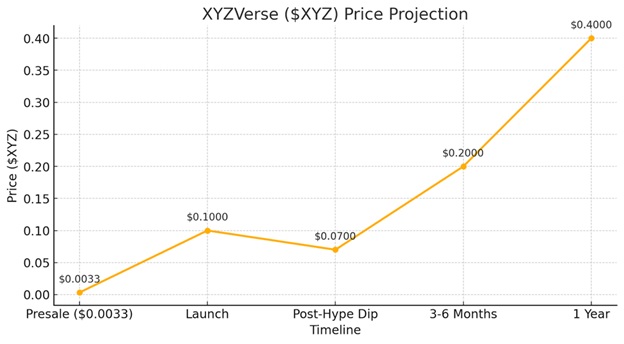
  • Current Presale Price: $0.003333
  • Projected Post-Presale Target: $0.10 (as per project’s estimates)
  • Potential ATH (First 1-2 Weeks Post-Launch): $0.15 – $0.25 (if demand surges and listings drive FOMO)
  • Long-Term Potential (6-12 Months): $0.20 – $0.40 (if the project secures major partnerships and listings)

Buy $XYZ Early to Increase Its Profit Potential 

Realistic Expectations: Will XYZ Hit $0.10?

A 30x jump from presale to $0.10 is possible but depends on:

  • Strong Exchange Listings – If XYZVerse lands on major CEX platforms like KuCoin, OKX, or Binance, its price could skyrocket on launch day.
  • Sustained Community Growth – Meme coins need viral momentum. If XYZVerse delivers on its sports influencer partnerships, it could drive massive social media engagement.
  • Market Conditions – If Bitcoin and altcoins remain bullish, speculation-driven assets like XYZVerse tend to benefit.

Is a 3000% Surge Possible for $XYZ?

XYZVerse has the ingredients for a strong launch, but its long-term success depends on execution. If the team delivers strong marketing, high-profile listings, and real community engagement, the $0.10+ target, which is around 3000% from the current price, could be achievable.

Invest in $XYZ Before It Surges

Chainlink: Connecting Smart Contracts to the Real World

Chainlink helps smart contracts access real-world data. Smart contracts are programs on a blockchain that run when certain conditions are met. But they can’t get data from outside the blockchain, like prices or weather reports. Chainlink fixes this by using oracles—special nodes that fetch data from external sources. These oracles bring the data to the blockchain, and Chainlink checks the information using multiple sources and a reputation system. This makes smart contracts more useful because they can now interact with real-world events.

Chainlink’s technology has great potential. By bridging blockchains and real-world data, it makes smart contracts much more powerful. The LINK token is central to this system. It’s used to pay for data services, reward data providers, and keep the network secure. In the current market, LINK’s real-world use may help it stand out. As more applications need reliable data, Chainlink’s role could grow. Compared to other coins, LINK offers practical utility, which might interest those looking for solid projects in this market cycle.

Avalanche: The Fast, Green Blockchain Shaking Up Crypto with AVAX

Avalanche is a new blockchain that’s getting a lot of attention. It’s fast, green, and affordable. With low fees and quick transactions, it can handle up to 4,500 transactions per second. That’s much faster than many other blockchains. One special feature is that users can create custom networks, called Subnets. This gives developers flexibility to build what they want. Avalanche uses a unique system to confirm transactions in less than two seconds.

AVAX is the coin that powers Avalanche. It’s used to pay fees, secure the network by staking, and run Subnets. This gives it real utility and value. In the current market, AVAX looks promising. Its technology sets it apart from other coins. While some blockchains struggle with speed or high fees, Avalanche offers a solution. With the rise of decentralized apps and smart contracts, a fast and easy-to-use network like Avalanche could become very popular. Compared to others, AVAX combines speed, eco-friendliness, and flexibility, making it an attractive option for developers and users.

Pi Network: Mining Cryptocurrency from Your Phone—The Future of Digital Money?

Imagine earning cryptocurrency without fancy hardware or draining your phone’s battery. That’s the promise of Pi Network—a mobile-first crypto-mining community launched in 2019 by Stanford graduates. Unlike Bitcoin’s energy-intensive mining, Pi allows users to mine by simply checking in daily on the app. By nominating trusted contacts to their security circle, users help create a global trust graph that secures the network without massive computing power. Pi uses the Stellar Consensus Protocol, making it energy-efficient and accessible to everyone.

As the crypto market evolves, Pi Network stands out with its focus on inclusivity and environmental sustainability. Since moving to its own Mainnet blockchain in December 2021, Pi requires users to complete identity verification before transferring their mined coins, ensuring a secure ecosystem. The project plans to open its network fully, which could position Pi as a significant player in the Web3 space. While traditional cryptocurrencies like Bitcoin face criticism for high energy consumption, Pi offers a greener alternative. Given current market trends favoring sustainable and user-friendly platforms, Pi Network presents an intriguing option for those looking to participate in the crypto world without heavy investment.

Is Toncoin the Next Big Thing? Exploring Its Future and Potential

Toncoin (TON) is the cryptocurrency of The Open Network, a fresh and open blockchain platform. It was first developed by Telegram, the popular messaging app, but they stopped working on it in 2020. Now, the TON Foundation and a community of enthusiasts are continuing the project. Toncoin uses a proof-of-stake system, making it faster and more scalable than many older blockchains. It aims to offer quick, secure payments with very low fees. Beyond that, Toncoin plans to provide decentralized storage, services, domain names, and private networking.

Price predictions suggest Toncoin could grow significantly in the next few years. By 2025, it might reach up to $30.30, a big increase from today. By 2030, it could be as high as $26.04. In the current market, Toncoin stands out due to its strong technology and big ambitions. Compared to other cryptocurrencies, it might be an attractive option for those looking for potential growth. As the crypto market evolves, Toncoin could be part of the next major trend.

Conclusion

While LINK, AVAX, PI, and TON are promising, XYZVerse (XYZ) stands out by uniting sports fans in a community-driven memecoin aiming for 20,000% growth.

You can find more information about XYZVerse (XYZ) here:

Site, Telegram, X