DD
MM
YYYY

PAGES

DD
MM
YYYY

spot_img

PAGES

Home Blog Page 1542

Coinbase with Backed Finance is Launching Tokenized Stocks on Avalanche

0

Tokenized Coinbase stock is coming to the Avalanche blockchain. Through a partnership with Backed Finance (BackedFi), Coinbase stock, represented as $bCOIN, is being brought on-chain alongside the S&P 500 index ($bCSPX). This move allows investors to gain exposure to traditional finance (TradFi) assets within the decentralized finance (DeFi) ecosystem on Avalanche, without the need for traditional brokerage accounts. Traders can invest in tokenized versions of Coinbase stock and the S&P 500 directly on Avalanche, leveraging blockchain’s 24/7 trading capabilities.

These assets can be traded on decentralized platforms like ParaSwap, with liquidity incentives offered through Pharaoh Exchange for liquidity providers. Chainlink’s Cross-Chain Interoperability Protocol (CCIP) enables swapping these tokenized assets across multiple blockchains, enhancing flexibility. This development is part of Avalanche’s broader push into real-world asset (RWA) tokenization, bridging traditional and digital finance. The $bCOIN token is fully backed 1:1 by Coinbase shares, ensuring its value reflects the real-world stock’s performance.

Tokenized stocks like $bCOIN allow users without access to traditional brokerage accounts—due to geographic, regulatory, or financial barriers—to invest in Coinbase stock via crypto wallets. This democratizes exposure to Tokenized assets. It could attract a new wave of retail investors into DeFi, especially those already familiar with crypto but not traditional markets. Integrating real-world assets (RWAs) like Coinbase stock into DeFi platforms (e.g., ParaSwap) expands the use cases for decentralized finance. Users can trade, lend, or use $bCOIN in ways not possible with traditional stocks.

This could accelerate the convergence of TradFi and DeFi, encouraging more institutions and developers to explore tokenized asset offerings on Avalanche and similar blockchains. Liquidity incentives on platforms like Pharaoh Exchange encourage users to provide liquidity for $bCOIN, potentially leading to tighter spreads and more efficient markets. Avalanche’s high throughput and low fees further enhance this. A liquid market for tokenized stocks could set a precedent for other assets (e.g., equities, bonds), making Avalanche a hub for RWA trading.

Chainlink’s CCIP enables $bCOIN to move across blockchains, increasing its utility and reach beyond Avalanche. Traders can swap it on other networks, potentially boosting its adoption. This strengthens the case for interoperable blockchain ecosystems, reducing fragmentation and fostering a more connected crypto economy. Tokenizing a publicly traded stock like Coinbase’s could draw attention from regulators (e.g., SEC in the U.S.), especially if retail investors bypass traditional securities frameworks.

Backed Finance’s 1:1 backing and compliance efforts will be key. The success or failure of $bCOIN could influence future regulatory approaches to tokenized RWAs, potentially shaping the legal landscape for blockchain-based securities. This move reinforces Avalanche’s position as a leader in RWA tokenization, leveraging its scalability and speed. It may attract more projects, developers, and capital to the network. Increased activity could drive up demand for AVAX (Avalanche’s native token), benefiting holders and validators while solidifying its competitive edge over Ethereum and other layer-1 blockchains.

As Coinbase is a major crypto exchange, tokenizing its stock might signal confidence in the crypto industry’s growth. It ties Coinbase’s performance more directly to DeFi, potentially amplifying its visibility. Positive sentiment could spill over to other crypto-related stocks or tokens, while any volatility in Coinbase’s stock might ripple through $bCOIN’s DeFi markets. Tokenized Coinbase stock on Avalanche could bridge traditional and decentralized finance, enhance liquidity, and grow the Avalanche ecosystem—while also posing regulatory and adoption challenges.

Exploring the Launch of Strategy’s New Series A Perpetual Strife Preferred Stock

0

Strategy (Nasdaq: MSTR; STRK) announced its intention to launch a new Series A Perpetual Strife Preferred Stock (STRF) offering. Subject to market and other conditions, the company plans to offer 5,000,000 shares in a public offering registered under the Securities Act of 1933. The proceeds from this offering are intended to be used for general corporate purposes, including the acquisition of additional Bitcoin and for working capital. The STRF stock will feature a fixed cumulative dividend rate of 10.00% per annum, payable quarterly starting June 30, 2025, provided the dividends are declared by Strategy’s board of directors.

If dividends remain unpaid, they will compound quarterly at an initial rate of 11% per annum, increasing by 1% each quarter up to a maximum of 18%. Each share will have an initial liquidation preference of $100, though this value may adjust daily based on market conditions. Strategy retains the option to redeem all outstanding STRF shares if the total number of shares falls below 25% of the originally issued amount or if specific tax events occur.

Additionally, holders of STRF can require the company to repurchase their shares in the event of a “fundamental change,” at a price equal to the stated amount plus any accumulated unpaid dividends. The offering is being managed by major financial institutions, including Morgan Stanley, Barclays, Citigroup, and Moelis & Company, acting as joint book-running managers.

The launch of Strategy’s new Series A Perpetual Strife Preferred Stock (STRF) carries several implications for the company, its investors, and the broader market. The proceeds are earmarked for acquiring more Bitcoin and supporting general corporate purposes. This reinforces Strategy’s ongoing strategy of heavily investing in Bitcoin as a treasury reserve asset, potentially increasing its exposure to cryptocurrency market volatility. The perpetual nature of the stock (no maturity date) provides Strategy with long-term capital without the immediate repayment obligations of debt.

However, the high dividend rate (10% annually, compounding up to 18% if unpaid) could strain cash flow if Bitcoin investments underperform or if market conditions deteriorate. The ability to redeem shares or face repurchase demands tied to specific triggers (e.g., a “fundamental change”) introduces some flexibility but also potential obligations, depending on future events. This could impact liquidity if large-scale redemptions or repurchases are triggered.

The 10% annual dividend, with the possibility of compounding at higher rates (up to 18%), offers an attractive yield compared to many traditional fixed-income investments. This could appeal to income-focused investors willing to accept the associated risks. Investors will bear significant risk tied to Strategy’s Bitcoin-heavy strategy. If Bitcoin’s value declines sharply, the company’s ability to sustain dividends or maintain the stock’s liquidation preference could be jeopardized.

The adjustable liquidation preference tied to market conditions adds further uncertainty. As a perpetual stock, STRF doesn’t offer a guaranteed return of principal, unlike bonds with a set maturity. Investors relying on redemption or repurchase triggers may face delays Mistico no payout if those conditions aren’t met. Strategy’s move underscores its bullish stance on Bitcoin, potentially influencing other corporations or institutional investors to consider similar treasury strategies. This could amplify Bitcoin’s adoption—or its volatility if sentiment shifts.

The STRF blends features of equity (perpetual, dividend-focused) and debt (fixed income-like returns, liquidation preference). Its success could inspire similar offerings, bridging traditional finance and crypto-centric strategies. Given Strategy’s stock (MSTR) already trades with a high correlation to Bitcoin, STRF’s performance may further tie the company’s fate to crypto markets, potentially amplifying volatility in both its equity and this new preferred stock.

The SEC registration and involvement of major banks like Morgan Stanley suggest compliance with current regulations, but Strategy’s Bitcoin focus might draw attention as regulators increasingly monitor crypto-related financial instruments. Launching in March 2025, amidst an evolving economic landscape (e.g., interest rates, inflation), the 10% dividend rate may reflect expectations of sustained high yields to attract capital.

The STRF launch is a bold move that doubles down on Strategy’s Bitcoin bet, offering high-reward potential for investors but with significant risks tied to cryptocurrency performance and the company’s ability to manage its obligations. Its success or failure could set a precedent for how corporations blend traditional finance with crypto strategies.

Elon Musk’s X Valuation Rebounds to $44 Billion Amid Financial Turnaround And Strategic Shift

0

Elon Musk-owned social media platform X, has reportedly seen its valuation rebound to $44 million, the same amount Musk acquired the platform in 2022.

This milestone marks a significant recovery for the platform which saw a drop in valuation below $10 billion in September 2024.

Despite ongoing revenue challenges since Musk’s takeover, the platform reported an impressive turnaround in 2024, generating $1.2 billion in adjusted earnings (EBITDA), matching its pre-acquisition revenue figures. However, there are conflicting assessments of X’s valuation.

According to a Bloomberg report, the company recently raised nearly $1 billion in a deal valuing it at approximately $32 billion, with Musk himself participating in the funding round.

Bloomberg wrote,

Elon Musk’s social network X has raised close to $1 billion in new equity from investors, according to people with knowledge of the matter a deal that gives the company a valuation in line with when Musk took it private in 2022. The company is considering using some of the proceeds to pay down its remaining debt load.”

Also, X is reportedly planning to raise an additional $2 billion through a new equity sale, primarily to pay off over $1 billion in junior debt tied to Musk’s original buyout. This fundraising effort signals a strategic push to stabilize the company’s financial position while continuing its transformation under Musk’s leadership.

It is however worth noting that since acquiring the platform, Musk has made several changes,  to improve the platform, including the controversial rolling back of content moderation policies, that led to an exodus of advertisers.

Fast forward to May 2023, amidst the fallout from Musk’s confrontational response to advertisers, he appointed Linda Yaccarino as CEO of X, with a primary focus on stabilizing the platform and winning back advertisers who had pulled their spending after Musk’s changes in content moderation policies

X witnessed efforts led by Yaccarino to mend relationships and entice advertisers back to the platform.  The CEO’s strategic move involved positioning X as a platform dedicated to ensuring the online safety of children, aligning its stance with proposed legislative measures.  Yaccarino’s efforts were aimed at reshaping X’s image and rebuilding trust with commercial partners, recognizing the vital importance of advertisers for the platform’s financial sustainability. 

However, X’s financial health improved after Musk transferred a 25% stake in his artificial intelligence startup, xAI, to the platform’s investors. The AI company, now valued at $45 billion, has provided additional financial security and bolstered X’s standing in the market. Meanwhile, major banks such as Morgan Stanley, Bank of America, and Barclays have offloaded most of the $12.5 billion in loans tied to Musk’s Twitter buyout, further reshaping the company’s financial landscape.

Beyond advertising, X is diversifying its revenue streams to align with Musk’s ambition of turning the platform into an “everything app.” A major step in this direction is the upcoming launch of X Money, a digital wallet and peer-to-peer payment system, which aims to integrate financial transactions directly into the platform for seamless money transfers and payments. The service is expected to roll out later this year in partnership with Visa.

Musk had previously disclosed that X would offer high-yield money market accounts, debit cards, checks, and loan services, to let users send money anywhere in the world instantly and in real-time.

With a renewed financial outlook and expanding business model, X appears to be entering a new phase of growth, despite the challenges that have shaped its evolution over the past three years.

Nigeria and Africa Must Learn from the EU Playbook on Big Tech

1

The European Union continues to collect: “On Wednesday, the European Commission, the EU’s executive arm, announced that Google’s parent company, Alphabet, was in breach of the Digital Markets Act (DMA), a landmark law designed to curb monopolistic practices in the technology industry. Regulators accused Google of engaging in self-preferencing within its Search and Google Play platforms—an unfair practice where its own services are favored over those of competitors. The EU also ruled that Google’s Play Store restricts developers from steering consumers toward alternative services, preventing them from offering cheaper payment methods outside of Google’s ecosystem.”

If you own a blog, you will agree that the most annoying “currency” is the traffic as measured by Google. Around 2018, if 1000 visitors  gave you say $20 per month, today you may need 10000 visitors for the same $20. In other words, that currency of traffic is devalued at multiples . Sure, blame competition but when you look at the profits of these big ICT utilities, you will agree that it is nothing but power positioning.

I support the work of the European Union on this because we cannot live in a world where ALL digital commerce powers are controlled by tiny fractions of companies.  The mindset of “onye aghana nwanne ya” [do not leave your brethren behind] is a developmental philosophy I admire, and it is time we find ways to make it global. 

Nigeria needs to push and demand changes because if we continue this way, nothing will change for our digital companies. Get other African countries and challenge the status quo as the EU is doing. See how hotels ng, wakanow, etc have all been disintermediated with jobs lost. I know that Nigerians are enjoying better technology but that is costing young people job opportunities. I am not against big tech but I want big tech with balance for the locals. The EU has a template and Nigeria must pick up and push for changes. 

I support these companies but I do not want them to destroy local companies. I do not eat data; fair game. But I do not like the idea that local companies cannot be discovered without them advertising. If we allow that, it is a locked system, and game over.  When they open bigtech travel services, local digital firms in that area go. That must change if we hope to have local jobs.

EU Defies Trump’s Tariff Threats with Crackdown on Google and Apple, Setting Stage for Major Showdown

EU Defies Trump’s Tariff Threats with Crackdown on Google and Apple, Setting Stage for Major Showdown

0

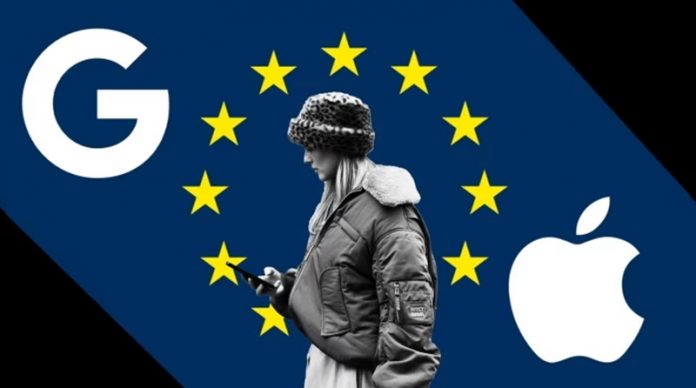
The European Union has taken a firm stance against U.S. tech giants, launching a major antitrust offensive against Google and Apple while signaling its willingness to retaliate against Donald Trump’s threats of tariffs.

The bloc’s actions come amid growing transatlantic tensions over digital regulation, with the EU asserting its authority despite warnings from Washington.

On Wednesday, the European Commission, the EU’s executive arm, announced that Google’s parent company, Alphabet, was in breach of the Digital Markets Act (DMA), a landmark law designed to curb monopolistic practices in the technology industry. Regulators accused Google of engaging in self-preferencing within its Search and Google Play platforms—an unfair practice where its own services are favored over those of competitors. The EU also ruled that Google’s Play Store restricts developers from steering consumers toward alternative services, preventing them from offering cheaper payment methods outside of Google’s ecosystem.

The Commission’s findings signal a major escalation in Europe’s long-running campaign against Silicon Valley’s dominance. The DMA was introduced to break the stranglehold that major firms like Google, Apple, Meta, and Amazon have on digital markets, and Wednesday’s action is the strongest enforcement yet under the new law.

In response, Google lashed out at the EU’s conclusions, warning that they would hurt consumers and businesses. The company claimed that changes made to comply with the DMA had already led to unintended consequences, including increased costs for users.

Oliver Bethell, Google’s EMEA director for competition, said in a blog post that the EU’s findings would force even more changes to search results, dismissing the Commission’s approach as “misguided”.

“The Commission’s findings require us to make even more changes to how we show certain types of Search results, which would make it harder for people to find what they are looking for and reduce traffic to European businesses,” he said.

Meanwhile, Apple was also put on notice by Brussels. The EU issued guidance instructing the iPhone maker to comply with interoperability obligations under the DMA. Regulators insist that Apple must allow third-party developers greater access to its iOS mobile operating system, making it easier for rival services to integrate with its software. The goal is to prevent Apple from locking users into its ecosystem by making it difficult to transfer data or use competing services.

Apple reacted strongly to the Commission’s guidance, accusing the EU of slowing down innovation and forcing it to hand over new features for free to companies that do not play by the same rules. In a statement, Apple said it would continue discussions with regulators to clarify its concerns but made it clear that it viewed the DMA’s enforcement as an unfair burden on its operations.

“[The moves] wrap us in red tape, slowing down Apple’s ability to innovate for users in Europe and forcing us to give away our new features for free to companies who don’t have to play by the same rules,” an Apple spokesperson said.

Defiance to Trump’s Tariff Threats

While Google and Apple battle with the EU over compliance, the broader implications of Wednesday’s regulatory assault extend beyond the tech sector. The move is an unmistakable challenge to the Trump administration, which has been warning the EU against excessive regulation of American technology firms.

Last month, Trump threatened to impose tariffs on European imports, claiming that the bloc was unfairly targeting U.S. companies with digital services taxes, fines, and regulatory restrictions. He denounced these policies as “overseas extortion”, arguing that they disproportionately affect American firms while allowing European tech players to operate with fewer constraints.

Brussels, however, has shown no intention of backing down. The EU has already signaled its readiness to retaliate against any tariffs Trump imposes, threatening to activate a new legal instrument that would allow it to take countermeasures against Washington’s economic coercion. Reports suggest that European leaders are preparing to hit back with their own trade restrictions, escalating a conflict that could disrupt global commerce and deepen the rift between the two economic powers.

The EU’s actions are a clear display of defiance against Washington’s pressure. By cracking down on Google and Apple just weeks after Trump’s threats, the bloc is sending a message that it will not be intimidated by U.S. trade policies. The European Commission, under President Ursula von der Leyen, has made it clear that it views regulation of Big Tech as a sovereign European matter, rejecting any attempts by the U.S. government to interfere in its policies.

The tech dispute is quickly morphing into a broader geopolitical standoff, with Google, Apple, and other Silicon Valley firms caught in the middle. The EU’s insistence on enforcing the DMA, despite U.S. warnings, could push Trump to escalate his tariff threats, dragging the transatlantic relationship into a full-blown economic confrontation. If the situation worsens, the tech industry could become the battleground for a trade war that would have far-reaching consequences for global markets and digital innovation.