DD
MM
YYYY

PAGES

DD
MM
YYYY

spot_img

PAGES

Home Blog Page 158

Why Zero Knowledge Proof (ZKP) Is Surpassing ASTER & TON as the Top Trending Crypto for 2025

0

Aster and Toncoin continue showing technical activity, yet these patterns alone do not define which project becomes the top trending crypto for 2025. This distinction emerges when comparing structural readiness rather than surface-level chart reactions. ASTER may be forming familiar bullish setups, and TON is trying to stabilize above an important support zone, but neither reflects the depth of preparation shown by one competitor already shaping a clearer path ahead of its presale auction.

Zero Knowledge Proof (ZKP) enters that picture with unusually strong groundwork completed before launch. With more than $100 million already deployed toward development, plus $17 million of finished hardware placed in inventory for immediate delivery, the project has built much of its ecosystem before accepting presale participation. That shift from reactionary building to pre-launch completion is why Zero Knowledge Proof (ZKP) is increasingly referenced in early discussions about the top trending crypto for 2025.

ASTER: Technical Structure Still Looking for Confirmation

ASTER has drawn attention due to its developing “Power of 3” setup, known for a sequence involving accumulation, a shakeout phase, and ideally a later expansion. This structure reflects volatility followed by a potential upward move, and recent trading between $1.52 and $2.28 suggested some early steps toward that cycle. However, the drop toward $1.10 raised questions about the sustainability of the pattern, prompting a closer look at the thresholds that matter most.

Analysts are watching the $1.80 level, which aligns with the 100-hour moving average. A close above that area could open a path toward $2.28 and possibly $3.41 if overall momentum strengthens. But failing to maintain support around $1.52 risks weakening the broader setup. This leaves ASTER in a transitional state: strong potential, but incomplete confirmation. For that reason, its standing in conversations about the top trending crypto for 2025 remains limited until clearer signals appear.

TON: Maintaining Support While Awaiting Direction

Toncoin finds itself in a similar scenario. It briefly slipped below the familiar $2.00 support level before recovering, indicating that active buyers remain present. That recovery pushed the price to roughly $2.12, though the move lacked force, reflecting lingering weakness in several indicators. With the price sitting beneath important moving averages, TON still requires a more decisive shift to change its trajectory.

The immediate focal point is $2.35. A strong close above that level could create the momentum needed to establish a new upward trend. Failure to do so, however, and a renewed break of $2.00 could send the price toward $1.85 or even lower. Despite a committed user base and a functioning network, TON continues to wait for a catalyst that could reposition it among the top trending cryptos for 2025. Until that spark appears, its chart suggests more consolidation than expansion.

Zero Knowledge Proof (ZKP): Built Ahead of Demand

Zero Knowledge Proof (ZKP) offers a contrasting model. The project has not yet opened its presale auction, and the whitelist is live while the auction itself is only days away. Yet discussions about the top trending crypto for 2025 are increasingly placing Zero Knowledge Proof (ZKP) ahead of several active tokens. The reason is simple: the project is launching with most of the work already complete.

Its team funded more than $100 million of development independently, choosing to construct the full system before inviting presale participation. This includes finalizing its infrastructure plan, preparing its Initial Coin Auction system, and ensuring that every participant enters through the same rules. With no private allocations, no insiders, and no discounted early rounds, the structure is designed to create a balanced entry environment.

Alongside that, over $17 million worth of Proof Pods, the hardware powering its AI compute operations, is fully manufactured and scheduled for global shipment within five days once the presale begins. This means Zero Knowledge Proof (ZKP) will launch with functional technology available from the outset, a scenario rarely seen in early-stage crypto ecosystems. This emphasis on readiness rather than speculation explains why it is consistently referenced among analysts discussing the top trending crypto for 2025.

The absence of token-based hype has not slowed attention. In fact, the preparedness of the system has made Zero Knowledge Proof (ZKP) more visible than many assets already trading on exchanges. With infrastructure complete and distribution rules finalized, it shifts the conversation from anticipation to execution, positioning it as a project shaping its trajectory rather than reacting to the broader market.

The Broader Outlook

What stands out across these comparisons is the difference between waiting for momentum and establishing it. ASTER and TON both exhibit technical setups that could develop into stronger trends, but each still depends on external confirmation before gaining broader traction. That dependency limits their long-term narrative until new catalysts emerge.

Zero Knowledge Proof (ZKP) approaches the timeline differently. By entering the market with real infrastructure, transparent allocation rules, and ready-to-ship hardware, it begins its presale phase with most foundational challenges already resolved. That level of preparation supports its position in conversations about the top trending crypto for 2025 and reinforces its role as a project building deterministically rather than reactively.

As the market progresses, the projects that shape their conditions rather than chase them are likely to set the tone for the next cycle. Zero Knowledge Proof (ZKP) is already demonstrating that shift, and its growing momentum reflects how preparation can drive early recognition in a crowded field.

Find Out More about Zero Knowledge Proof:

Website: https://zkp.com/
MicroStrategy ($MSTR) Stock Dips Below $200 First Time Since 2024 

0

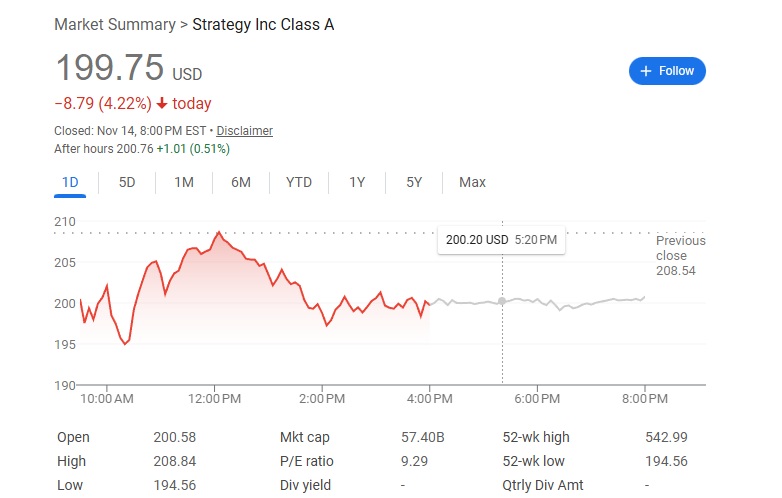
As of pre-market trading on November 14, 2025, MicroStrategy now rebranded as Strategy shares have fallen below $200 for the first time since early October 2024, when the stock traded around $180–$190 amid post-election volatility following Donald Trump’s victory.

The stock closed at $208.54 on November 13, down 7.15% for the day, and is extending losses today with pre-market bids around $195–$198. This marks a roughly 63% drawdown from its all-time high of $543 earlier in 2025, and a staggering 54% decline since mid-July.

MicroStrategy’s stock is essentially a leveraged bet on Bitcoin (BTC), holding over 397,000 BTC valued at approximately $70 billion (as of Q3 2025). The recent slide mirrors BTC’s pullback below $100,000—down 20% from its October peak—but MSTR has underperformed dramatically, decoupling from its crypto proxy role.

Historically correlated at 0.92 with BTC, MSTR has amplified downside due to its aggressive debt-fueled BTC acquisitions. BTC is only -20% YTD, while MSTR is -73% from its 2025 peak. The stock’s multiple-to-net-asset-value (mNAV) has collapsed to 1.06x from 2.7x last year, now trading near or briefly below the value of its BTC holdings per share adjusted for debt.

This erodes the “premium” investors once paid for CEO Michael Saylor’s strategy. The stock has experienced significant volatility in 2025, peaking at $543 in early November before a sharp correction. It is now trading about 62% below its all-time high, with the multiple-to-net-asset-value (mNAV) ratio—comparing stock price to Bitcoin holdings per share—compressing to around 1.22x, down from highs above 2.7x earlier in the year.

This narrowing premium has raised concerns about the sustainability of its “Bitcoin treasury” strategy, though CEO Michael Saylor has emphasized continued accumulation rather than sales. -29.22% underperforming the S&P 500’s ~20% gain.

These figures reflect a broader downtrend in crypto-related equities, with MSTR down over 10% in the past month alone as Bitcoin fell more than 10% from its recent peak.

MSTR’s stock has declined in tandem with Bitcoin’s drop to a six-month low, amplifying losses due to the company’s leveraged exposure via debt-financed BTC purchases. Despite this, Strategy recently added to its holdings, bringing total BTC to 641,692.

Analyst Sentiment: Of 15 analysts, 12 rate it “Strong Buy,” 1 “Moderate Buy,” 1 “Hold,” and 1 “Strong Sell.” The average price target is $523, implying over 155% upside potential from current levels.

RSI at 23.7 deeply bearish, price below the 200-day SMA ($342). Death cross confirmed: 50-day EMA crossed below 200-day EMA. Short interest up to 10% from 7% YTD low, with bears like Jim Chanos who recently closed his short warning of potential BTC liquidation if mNAV dips below 1x.

Inverse cup-and-handle pattern suggests further downside. Q3 earnings showed $2.8B net income from unrealized BTC gains, but core BI software revenue ~$480M TTM grows modestly at 5–7% YoY and remains unprofitable without crypto boosts.

High debt/equity (14%) creates negative carry but boosts ROE to 25.59%. Recent upsized stock offerings for BTC buys have sparked dilution fears, especially as passive funds post-2022 inclusion hold steady.

Further downside to $187–$190 next support, or even $180 if BTC tests $90K. Analysts see risk of BTC sales if mNAV <1x, potentially flooding the market. High-beta nature could drag it 80% from ATH as in 2022.

Oversold bounce if BTC reclaims $110K. Contrarians eye a 2023-like +1700% run if premium rebuilds to 2x+. Saylor’s playbook remains intact with $70B treasury, and passive inflows could stabilize.

Traders call it “brutal AF” and a “deep correction,” with some eyeing $180 targets, while others insist “$MSTR will never go below $200 again!” ironically, just before it did. If you’re holding or trading, watch BTC’s $100K level closely—it’s the linchpin.

Polymarket and UFC Announce Landmark Partnership

0

TKO Group Holdings – the parent company of the Ultimate Fighting Championship (UFC) and the upcoming Zuffa Boxing promotion—announced a multi-year partnership with Polymarket, designating it as the official and exclusive prediction market partner for both UFC and Zuffa Boxing.

This deal marks the first time major sports organizations have integrated prediction market technology directly into live events, aiming to enhance fan engagement by blending real-time crowd-sourced insights with traditional viewing experiences.

The multi-year deal between Polymarket and TKO Group Holdings UFC’s parent company positions prediction markets as a core element of combat sports entertainment. Announced on November 13, 2025, this first-of-its-kind integration blends blockchain-powered trading with live events, potentially reshaping fan interaction, market growth, and regulatory landscapes

Polymarket will introduce a real-time Fan Prediction Scoreboard during UFC broadcasts and live arenas, displaying evolving probabilities of fight outcomes based on user trades. This allows fans to track sentiment shifts round-by-round, treating predictions like tradable stocks for dynamic interaction.

Zuffa Boxing Tie-In: As the inaugural brand partner for Zuffa Boxing launching January 2026, Polymarket will feature similar activations, including in-arena experiences and custom social/digital content.

Starting in 2026, all U.S. UFC and Zuffa Boxing events will stream exclusively on Paramount+, with Polymarket data woven into commentary. A new digital series, Matchup Predictions – will launch on UFC’s social channels (Facebook, Instagram, Threads, X) to spark debates on future fights and drive new markets on Polymarket.

The partnership spans UFC’s premium assets, including events, broadcasts, and social media, positioning prediction markets as a complementary layer to regulated sports betting.

Ariel Emanuel, Executive Chair and CEO of TKO: “By partnering with Shayne and his team at Polymarket, we’re unlocking a new dimension of fan engagement. Integrating Polymarket with the UFC and Zuffa Boxing live experience will help fans interact with these events in real time, transforming passive viewership into active participation.”

Shayne Coplan, Founder and CEO of Polymarket: “Few sports generate emotion and debate like the UFC. By bringing prediction markets to the broadcast and arena, we’re giving fans a new way to be part of the action—not just watching outcomes but watching the world’s expectations evolve with every round.

What’s exciting is you can buy, sell, and trade just like a stock throughout the fight.” The announcement coincided with Polymarket’s team, alongside UFC’s Dana White and TKO executives, ringing the NYSE opening bell to celebrate TKO’s trading milestone and the partnership.

This follows Polymarket’s recent U.S. relaunch and partnerships with the NHL, PrizePicks, Google, Yahoo Finance, and DraftKings, signaling its push into mainstream sports and entertainment. For UFC, it taps into Polymarket’s blockchain-powered platform built on Polygon to reach hundreds of millions of global fans, potentially onboarding new users to crypto-adjacent tools.

On X, the news sparked excitement about mainstream adoption, with users highlighting how it could “put on-chain markets right in front of the mainstream world” and drive “massive influx of new users.”

This collaboration positions prediction markets as a novel engagement tool, distinct from betting, by emphasizing real-time, data-driven narratives around fan momentum.

The S&P Loses 1.6% as it is on Pace for its Worst November Since 2008

0

The S&P 500 closed sharply lower, dropping 1.66% to 6,737.49, extending a turbulent stretch for the benchmark index.

This marks the latest leg down in a broader market pullback that has the S&P on pace for its worst November performance since the 2008 financial crisis, when it plunged 7.5% amid the global meltdown.

The S&P 500’s 1.66% drop on November 14, 2025, capping a month-to-date decline of ~2.8% projected full-month loss of 4-5%, signals more than just a seasonal hiccup. This trajectory—the worst November since 2008’s -7.5% plunge—carries ripple effects across markets, the economy, and investor behavior.

Drawing from historical precedents, current data, and real-time sentiment, here’s a breakdown of the key implications. While earnings resilience offers a buffer, intertwined pressures like the government shutdown, Fed hawkishness, and tech valuation resets amplify risks, potentially extending volatility into Q4 and beyond.

Through the first 10 trading days of the month up to November 14, the index is down approximately 2.8% from its October 31 close of around 6,925, based on recent data showing a slide from highs near 6,850 earlier in the week. If the current trajectory holds—factoring in lighter holiday volume and lingering uncertainties—the full-month loss could approach 4-5%, the deepest since 2008’s rout.

The selloff reflects a confluence of factors weighing on investor sentiment. Technology stocks, which comprise over 30% of the S&P 500, led the decline, with the Nasdaq Composite falling 2.29% to 22,870.36.

Heavyweights like Nvidia (NVDA) shed 3.58%, Tesla (TSLA) tumbled 6.64% after breaking key support levels, and Disney (DIS) dropped 7.75%. Posts on X highlight this as a “tech tantrum,” with AI hype deflating and investors shifting to defensive sectors like energy (e.g., Exxon Mobil up 0.57%) and consumer staples.

Hawkish comments from Federal Reserve officials have slashed December rate-cut odds to just 49-53%, per market pricing. This comes as inflation concerns persist amid the U.S. government shutdown, now in its 45th day since October 1.

The shutdown—triggered by disputes over Affordable Care Act subsidies and budget extensions—has disrupted economic data releases and fueled fears of labor market strain. The VIX fear gauge surged 11.45% to 22.29, up 26% over five days, signaling heightened uncertainty.

Treasuries rallied as a safe haven, with the 10-year yield dipping 4 basis points to 4.08%. Crude oil bucked the trend, rising 1.60% to $59.63 on supply worries.

Historically, November has been a strong month for the S&P 500, averaging +1.4% gains since 1950. But downturns tied to macro shocks—like 2008’s credit freeze—can turn it brutal.

Despite the pain, some analysts see this as a “Black Friday sale” for long-term buyers, with support eyed around 6,630 the 50-day moving average. Earnings remain a bright spot: Q3 blended growth hit 10.7% year-over-year, led by the “Magnificent 7,” though Tesla and Meta disappointed.

FOMC minutes could clarify the Fed’s stance, while next week’s Nvidia earnings may either stem or exacerbate the tech bleed. Jobless claims and consumer confidence data will gauge shutdown impacts. Traders are split—some call it an “AI bubble burst,” others a “buying opportunity” in oversold names like TSLA near $400. High-volume distribution days suggest caution for bulls.

Markets are closed for Veterans Day on Monday, so watch for gap moves Tuesday. If you’re trading this volatility, consider protective puts or sector rotation into energy/defensives.

Sui Network Announces USDsui, A Native Stablecoin, As DUPE Token Rides High

0

The Sui Foundation unveiled USDsui, a fully fiat-backed, native stablecoin designed to anchor the Sui blockchain’s growing ecosystem.

Issued through Bridge’s Open Issuance platform a Stripe subsidiary acquired earlier in 2025, USDsui aims to capture yield from the network’s massive stablecoin activity while enabling seamless payments, DeFi, and real-world applications.

Pegged 1:1 to the US dollar, with reserves managed by major custodians like BlackRock, Fidelity, and Superstate in cash and U.S. Treasuries. It’s compliant with the GENIUS Act, allowing non-bank issuance under federal oversight for payment tokens.

USDsui isn’t just a stablecoin—it’s Sui’s bid to become the go-to rail for programmable money, blending Web3 innovation with TradFi reliability. With launch slated for late 2025, monitor integrations like DeepBook for early signals of traction. This could propel Sui from $7B to $15B+ market cap by 2026, but success hinges on execution amid regulatory flux.

Yield-Sharing Mechanism: Sui’s network processed over $412 billion in stablecoin transfers between August and September 2025—mostly third-party assets like USDC. By shifting to USDsui, the foundation can retain revenue from reserve yields (e.g., interest on Treasuries), which will be reinvested into ecosystem development and sustainability.

Works across Sui wallets, DeFi protocols (e.g., Deepbook DEX), gaming (e.g., EVE Frontier in-game economies), and payments. Cross-chain compatible with other Bridge-powered stablecoins on platforms like Phantom, Hyperliquid, and MetaMask.

“GENIUS-ready” for advanced features like AI agent transactions. Set to go live later in 2025, with immediate integration for developers building on Sui’s high-throughput architecture. USDsui addresses a key gap in Sui’s ecosystem by internalizing value from its high-frequency transactions (e.g., $7.08B in 24-hour volume as of the announcement).

This positions Sui as a leader in on-chain commerce, reducing reliance on external stablecoins and boosting network liquidity. As Sui’s native token (SUI) trades around $2.01 USD with a $7.29B market cap, USDsui could drive further adoption in DeFi and remittances.

The announcement of USDsui marks a pivotal evolution for the Sui Network, transitioning from a high-throughput Layer-1 blockchain to a robust financial infrastructure layer. By introducing a native, fiat-backed stablecoin issued via Bridge a Stripe subsidiary, Sui addresses longstanding challenges in liquidity, compliance, and real-world utility.

Sui has processed over $412 billion in stablecoin transfers between August and September 2025 alone, much of it via third-party assets like USDC.

USDsui shifts this volume inward, allowing the Sui Foundation to capture yields from reserves (e.g., interest on U.S. Treasuries held by custodians like BlackRock and Fidelity). These revenues will be reinvested into ecosystem grants, developer tools, and sustainability initiatives, creating a self-reinforcing flywheel for growth.

Early X discussions highlight this as a “foundation for sustainable in-game economies” and a way to “bootstrap liquidity” for DeFi protocols like DeepBook.

Liquidity Boost for DeFi and Payments: As a native asset, USDsui enables deeper liquidity pools, reducing slippage in high-volume trading and enabling efficient cross-border remittances or P2P transfers.

This could drive Sui’s DeFi TVL currently ~$1.2B higher by 20-50% in the coming months, per community estimates, by attracting yield farmers and institutional liquidity providers seeking compliant, low-fee alternatives.

By competing with USDC/USDT dominance, USDsui could fragment stablecoin market share, pressuring centralized issuers while promoting decentralized, chain-native options. This aligns with a “stablecoin explosion” trend, potentially increasing overall on-chain commerce volumes across L1s.

DUPE Token is Riding High Amid Market Red As Dupe App Reaches #1 Milestone

$DUPE is one of the rare bright spots today, bucking a broader crypto downturn where Bitcoin dipped below $98K and most alts are bleeding 5-15%. As of November 14, 2025, the token’s up 83.64% in the last 24 hours, trading at around $0.0273 with a market cap hovering near $27M circulating supply ~1B tokens.

Trading volume exploded to $18.4M, signaling serious inflows—net buying hit ~$700K just in the past day, per on-chain data.This pump ties directly to the Dupe app’s explosive launch.

Yesterday, it rocketed to #1 free app on the US App Store, dethroning ChatGPT in under 24 hours. That’s no small feat in the world’s toughest market, especially kicking off holiday shopping season.

The app’s AI-powered “dupe finder” scans thousands of stores for cheaper alternatives to pricey items such as fashion, furniture, etc., saving users up to 90%—think Amazon meets visual search on steroids.

It’s already boasting ~20M users and $100M+ GMV gross merchandise value, with real revenue funneled into $DUPE buybacks team locked in 24% of supply via a $2M treasury move.

The flywheel here is killer: App usage = revenue = token buybacks/burns = deflationary pressure. It’s not just hype—Dupe’s a revenue-generating beast raised $12M from VCs like a16z scouts, but trading like it’s undervalued AF.

Fresh ammo: They just onboarded TikTok’s ex-Head of Growth grew it to 100M users, plus a massive campaign with 3K+ influencers, TV spots, and ads everywhere. Solana’s spotlighting it too, calling it “AI + shopping colliding.”

1M+ monthly active users pre-launch; now scaling to billions in e-comm disruption. Brands love it for surfacing hidden gems to high-intent buyers.

ICM (Internet Capital Markets) Play: Bridges Web2 shopping ($5T market) to Solana/Web3. $DUPE powers payments/discounts in-app—utility that memes can’t touch.

Timing God-Tier: Holiday rush + app drop = perfect storm. Top holders piled in today; PnL shows whales holding unrealized gains.

Volatility’s wild and broader market fear could drag it. But with buybacks locked and expansion teased “You won’t believe what we’re doing next”, this feels like early innings. If macros flip green, $100M+ MC isn’t wild—billion-dollar business potential, per the team.

DUPE’s #1 App Store Milestone

The Dupe app’s rapid ascent to #1 free app on the US App Store—dethroning giants like ChatGPT in under 24 hours— isn’t just a viral win; it’s a catalyst for $DUPE’s tokenomics and broader ecosystem.

With ~20M users pre-launch and $100M+ GMV already in the bag, this surge up 83% in 24h to ~$0.027, $27M MC signals real traction in a $5T e-commerce market. But implications ripple across consumer behavior, token value, and crypto’s “Internet Capital Markets” (ICM) meta.

Dupe’s AI “dupe finder” democratizes deal-hunting, scanning thousands of sites (Amazon, Walmart, etc.) for 90% cheaper alternatives in seconds. Hitting #1 during holiday shopping season could onboard millions more, turning impulse buys into informed ones—potentially saving users billions annually.

Early data shows sticky retention, with 1M+ MAUs pre-launch. Underdog products get surfaced to high-intent buyers, boosting small sellers while forcing incumbents like Amazon to sharpen pricing or integrate similar tools.

It’s a “generative marketplace” flywheel: More usage = more revenue ~$75M sales tracked = better visibility for brands via $DUPE spends. US-first strategy 50% of users already international sets up continent-by-continent domination—Europe next, then Asia/LatAm. Localization + partners could explode GMV to $1B+ by mid-2026, per team hints.

App revenue directly funds $DUPE buybacks team already holds 24% of supply via $2M treasury. More downloads = more transactions = more burns, creating scarcity in a fixed 1B supply ecosystem. This isn’t meme hype—it’s utility.

Shoppers earn/spend $DUPE for discounts post-buyback, brands burn it for promo priority. At $27M MC down 54% from May 2025 ATH of $0.073, it’s “criminally undervalued” vs. $12M VC raise and real metrics.

Institutional inflows add legitimacy, stabilizing price amid volatility. Whales are accumulating; net buys hit $700K yesterday. Short-term, holiday momentum could push to $0.05+ ($50M MC) if volume sustains ($18M+ 24h).

Long-term forecasts vary—CoinCodex sees a dip to $0.008 by Nov 16 neutral sentiment, Extreme Fear at 22, but Bitget predicts $0.024 by Apr 2026 on adoption. With TikTok’s ex-Head of Growth onboard and 3K+ influencer campaigns, $100M+ MC feels conservative.

In a red market (BTC < $96K), $DUPE’s green run highlights resilient plays. No token relaunch needed migrated to independent DEXs like Raydium/MEXC via Meteora. But broader ICM risks loom—e.g., overhyping TGEs or supply dumps in peers like Momentum could taint sentiment.

This isn’t a pump-and-dump—it’s a revenue-backed bet on AI commerce colliding with crypto. $DUPE could 10x on global scale-up, but execution is key.