DD
MM
YYYY

PAGES

DD
MM
YYYY

spot_img

PAGES

Home Blog Page 16

France Moves to Ban Social Media for Under-15s as Global Trend Accelerates Following Australia’s Lead

0

French President Emmanuel Macron has fast-tracked plans to ban children under 15 from using social media, signaling a growing international trend in regulating digital access for minors amid mounting concerns about mental health, online safety, and the influence of global tech platforms.

In a video released Saturday by BFM-TV, Macron said he instructed his government to initiate an accelerated legislative procedure so that the bill could pass the Senate in time to take effect with the start of the new school year in September.

“The brains of our children and our teenagers are not for sale,” he said. “The emotions of our children and our teenagers are not for sale or to be manipulated. Neither by American platforms, nor by Chinese algorithms.”

The move comes as French health authorities continue to warn about the dangers of excessive smartphone use. According to the National Agency for Food, Environmental, and Occupational Health and Safety (ANSES), half of French teenagers spend between two and five hours a day on their devices. Nearly 90% of young people aged 12 to 17 access the internet every day via smartphones, and 58% use social networks regularly.

The agency’s December report highlighted the harmful effects of social media exposure, including lower self-esteem, higher anxiety, and increased vulnerability to content linked to self-harm, drug use, and suicide. Several French families have lodged complaints against TikTok, alleging that the platform’s algorithms contributed to teen suicides.

Macron emphasized that the legislation will create clear and enforceable rules: “We’re banning social networks for under-15s and we’re going to ban mobile phones in our high schools. Clear for our teenagers, clear for families, clear for teachers, and we are moving forward,” he said.

The bill, set for public examination on Monday, aims both to restrict social media use for minors under 15 and to enforce tighter mobile phone regulations in secondary schools.

France is not alone in exploring such measures. The United Kingdom recently signaled it is considering restricting social media access for young teenagers as part of broader online safety reforms. European policymakers are increasingly framing social media restrictions as a public health and child protection issue, rather than solely a technology regulation matter.

Australia’s experience has served as a reference point for France and other countries. Since imposing a ban on children under 16 from accessing social media platforms, Australian authorities have deactivated approximately 4.7 million accounts identified as belonging to minors. The policy has triggered debates over privacy, age verification, mental health, and digital rights, yet officials cite measurable improvements in youth well-being and engagement patterns as evidence of its effectiveness.

social media apps

The apparent success of Australia’s approach has catalyzed similar initiatives in Europe, creating a wave of social media regulation aimed at safeguarding children in the digital age.

Experts note that France’s proposed law also fits into the broader European strategy of asserting sovereignty over digital platforms. Macron framed the bill in terms of protecting citizens from foreign algorithms and the commercial exploitation of young users, aligning with EU-wide efforts to regulate technology, including the Digital Services Act. By emphasizing local rules and ethical considerations, France seeks to establish a model of child-centered regulation that other countries may emulate.

Implementation challenges remain, including robust age verification, enforcement mechanisms, and potential legal challenges over privacy and digital rights. Nonetheless, policymakers in France are moving decisively, reflecting a growing consensus that unrestricted social media access for teenagers is increasingly incompatible with public health and education priorities.

With the French bill poised to take effect in September, the global trend toward social media restrictions for teens is accelerating. From Australia to Europe, governments are re-evaluating the balance between digital freedom and child protection, suggesting that Macron’s push may not only reshape France’s schools but also contribute to a broader international shift in how societies regulate youth access to technology.

Nike Cuts 775 U.S. Warehouse Jobs as Automation Push Reshapes Its Supply Chain

0
Nike shoe

Nike is accelerating a sweeping overhaul of its supply chain, cutting 775 jobs across its U.S. distribution network as it leans more heavily on automation and advanced technology to revive margins and restore growth.

The latest layoffs, centered on large warehouses in Tennessee and Mississippi, deepen a workforce reduction that has become a defining feature of the company’s turnaround under CEO Elliott Hill.

The job cuts, first reported by CNBC, come in addition to the 1,000 corporate roles Nike eliminated last summer. Together, they point to a company retrenching after several years of slowing sales, rising costs, and a strategy shift that left parts of its logistics operation larger and more expensive than current demand can support.

In a statement, Nike said the layoffs primarily affect its U.S. distribution operations and are aimed at “reducing complexity” while building a more flexible and efficient business. The company said it is sharpening its supply chain footprint, expanding the use of automation, and investing in new skills to better serve consumers and athletes.

Behind that explanation lies a deeper strategic reset. Under former CEO John Donahoe, Nike aggressively pursued a direct-to-consumer strategy, prioritizing its own stores and digital platforms over wholesale partners. That approach drove heavy investment in distribution centers and staffing to handle higher volumes shipped directly to customers. As growth cooled and wholesale relationships weakened, those facilities were left with excess capacity.

People familiar with the matter say current volumes no longer justify the staffing levels built up during that period.

Hill, who took over as Nike grappled with shrinking margins and uneven demand, has moved quickly to reverse course. His strategy has focused on repairing ties with wholesale partners, clearing stale inventory, tightening spending, and reigniting product innovation. Distribution and logistics, once scaled for rapid direct sales growth, are now being streamlined to fit a leaner model.

Financial pressure has sharpened the urgency of those moves. When Nike reported earnings for its fiscal second quarter in December, the company said net income had fallen 32%. Management pointed to tariffs, turnaround-related costs, and a slowdown in China, one of Nike’s most important markets. Improving margins has become a central goal, and automation is increasingly seen as a key lever.

While Nike has not detailed the specific technologies being rolled out, its language signals a broader shift toward automated picking, sorting, and inventory management systems that can reduce reliance on human labor. It remains unclear how many total U.S. distribution jobs Nike employs, or how many roles could eventually be affected as automation expands further across its network.

Nike’s actions also sit within a much wider corporate trend. Across retail, logistics, and manufacturing, large employers are cutting warehouse and fulfillment roles as artificial intelligence and robotics move from pilot projects to core operations. Distribution centers, with their repetitive and process-driven tasks, are often at the front line of this transition.

UPS offered one of the clearest examples last year when it announced plans to cut 48,000 jobs, citing increased automation across its facilities. Amazon has steadily deployed robots and AI-driven systems in its warehouses, allowing it to process more orders with fewer workers per unit. Walmart and Target have invested billions of dollars in automated fulfillment centers designed to lower labor costs and speed up delivery times.

For workers and local economies, the shift carries real consequences. Distribution centers are major employers in many regions, particularly in the U.S. South, where states such as Tennessee and Mississippi have attracted logistics hubs with tax incentives and promises of stable jobs. As automation accelerates, those employment bases are becoming less secure, even as companies maintain or expand physical infrastructure.

But the challenge goes beyond cost-cutting for Nike. Automation can deliver efficiency and speed, but it also requires significant upfront investment and careful execution. A misstep could leave the company with expensive systems that fail to deliver expected savings or flexibility if demand patterns change again.

For now, management appears committed to pushing ahead. The 775 job cuts signal that Nike’s turnaround will involve difficult trade-offs, particularly for workers caught in the shift. They also underscore how deeply automation is reshaping corporate America’s supply chains, as even one of the world’s most powerful consumer brands retools its operations for a future that demands leaner costs, faster response times, and fewer hands on the warehouse floor.

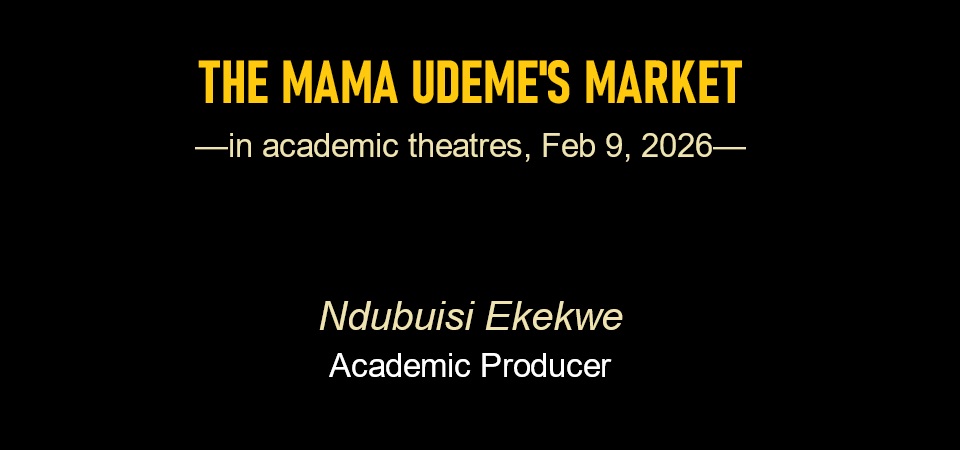
The Mama Udeme’s Market – In Academic Theatres, Feb 9; Reserve Your Seat

0

Mama Udeme: “Oga, buy from my market.”

Buyer: “How much is the corn?”

Mama Udeme: “200 naira.”

In that simple exchange lies one of the most profound philosophical constructs in the Igbo Nation: the conflation of product and market. To Mama Udeme, her product is her market. Her corn is not merely an item; it is an economy, a marketplace, a universe. This framing where “market” and “product” collapse into one is deeply rooted in Igbo worldview.

Among the Igbos, the market is not just a physical space. It is an existential metaphor. We say “uwa bu ahia”, the world is a marketplace. Literally, it speaks of buying and selling. But idiomatically, it speaks of life itself: a Stage where people come, transact their existence, and depart! And in metaphor, like the ancestral open markets of Oriendu Ovim or Nkwo Ezere. Markets open. Markets close. Life begins. Life ends!

Our ancestors communicated complex truths using the artefacts people understood, and those were markets, trade, exchange. The Aros, great merchants, diplomats, and system-builders, embedded themselves across geographies, exporting models of commerce and enterprise. They understood that everywhere is a market, and everything can become a market if properly understood.

In other words, the probability of everything in the world is anchored on the systems of markets, from power to prosperity to geopolitics. Today, Polymarket and Kalshi are built on the algorithms of those theses where every “event” is a market with probability outcomes!

So when Mama Udeme calls her corn a “market”, she is not wrong. Under the logic taught in my FUTO undergraduate days, this becomes valid:

If product = market

And market = world

Then product = world.

Meaning: her corn is her world. And if your product is your world, you become fanatical about improving it. You innovate because innovation sustains the world you live in. You differentiate because your survival depends on it. You push because stagnation is extinction.

And that is the message for entrepreneurs: whatever you sell is your world. Make that world better!

Beginning Feb 9 at Tekedia Mini-MBA academic theatres, I will open the sessions by exploring how entrepreneurs, from Mama Udeme to global category-kings, build, nurture, and transform their “markets” through innovation and excellence. Reserve a seat here.

$17M Proof Pods Shift Attention: Zero Knowledge Proof Steps Ahead of LINK and LTC Uncertainty

0

Market turning points are often quiet. Volatility cools, ranges tighten, and attention begins shifting from short-term price movement toward durability and design. That pattern is forming again as traders reassess which networks are built to hold attention when momentum fades.

Recent price action highlights this shift. The Litecoin price is hovering near key support after a sharp retracement, while the Chainlink price remains locked in consolidation despite signs of accumulation. As uncertainty builds, the conversation around the top crypto to buy is becoming less about chasing strength and more about understanding structure. It’s in this environment that Zero Knowledge Proof (ZKP) is drawing attention, not by reacting to market noise, but by committing capital and infrastructure through Proof Pods, daily presale auctions, and a live $5M giveaway that puts participation ahead of price.

Litecoin Tests Resolve Near Long-Term Support

Litecoin has pulled back sharply, retracing roughly 6.5% to trade near the $70 area after earlier security concerns unsettled sentiment. Despite the decline, institutional interest has remained present, with Litecoin recording about $2 million in ETF inflows over the past week. This contrast has placed the Litecoin price at the center of debate around whether confidence is returning beneath the surface.

Derivatives data shows increased engagement. Open interest has climbed to around $635 million, the highest level since mid-2025, while trading volume reached roughly $1.1 billion. At the same time, whale activity has picked up, with larger average order sizes suggesting positioning for a potential rebound. Retail participation, however, remains limited.

Technically, the Litecoin price is approaching a major weekly support zone near $52. Momentum indicators point to oversold conditions, raising the possibility of short-term stabilization. Until confirmation appears, Litecoin remains part of the broader top crypto to buy discussion, driven by positioning rather than conviction.

Chainlink Consolidates as Accumulation Builds Quietly

Chainlink is holding near long-term support as traders wait for a clearer direction. The Chainlink price is hovering around $12.60, with declining volume and muted participation reflecting hesitation rather than aggressive selling. Weekly performance remains negative, but structure on higher timeframes continues to attract attention.

Analysts point to a multi-year support base holding above key Fibonacci levels, including the 0.618 retracement near $9.88. On-chain data shows accumulation among top wallets below the $13 range, while retail activity has leaned toward selling during volatility. This divergence suggests a shift toward stronger hands, even as short-term momentum stays limited.

Derivative data reinforces the indecision. Open interest and volume have both declined, signaling reduced leverage appetite. For the Chainlink price, resistance between $25 and $31 defines the next expansion zone if participation improves. Until then, LINK remains range-bound, keeping it in view but not dominant in the top crypto to buy conversation.

ZKP Crypto Puts Infrastructure Before Price

ZKP crypto is built around participation and verifiable output rather than short-term valuation. At the center of this design is a daily, on-chain proportional presale auction that releases 190 million ZKP every 24 hours. There are no fixed prices, private allocations, or preferred entry points. Distribution is determined entirely by each participant’s share of the daily pool, ensuring transparent price discovery and open access.

That emphasis on structure extends into physical infrastructure through Proof Pods, with roughly $17 million invested to expand this hardware layer. Proof Pods are plug-and-play devices that carry out verifiable computation for the network. Instead of passive rewards, they earn ZKP tokens only by completing validated tasks. Payouts are calculated using the previous day’s presale auction closing price, aligning compensation with real contribution and current network conditions.

On the execution layer, ZKP supports EVM-compatible environments alongside WASM, allowing developers to deploy familiar smart contract tooling while operating inside a zero-knowledge secured framework. Computation and state validation can be confirmed without exposing inputs or sensitive data. This capability supports privacy-focused applications and decentralized AI workflows that require both verification and confidentiality.

Decentralized AI compute is reinforced through Proof of Intelligence, where AI tasks are verified using zero-knowledge proofs. Outputs can be trusted without revealing underlying models or datasets.

Complementing this system is a live $5 million giveaway, distributing $500,000 worth of ZKP tokens to each of ten participants who meet defined engagement requirements. Together, crypto presale auctions, Proof Pods, execution flexibility, and incentives position ZKP crypto as a participation-first network measured by contribution rather than price movement.

To Sum It Up!

As Litecoin and Chainlink work through periods of uncertainty, attention is increasingly drawn to networks making tangible commitments. The Litecoin price reflects a market testing support amid mixed signals, while the Chainlink price remains constrained by low participation. Both remain relevant, but neither currently defines the narrative.

ZKP crypto offers a contrasting path. By prioritizing infrastructure, transparent distribution, and verifiable output, it reframes the top crypto to buy debate around access and contribution rather than momentum. If this environment of caution persists, projects anchored in structure may continue to draw focus, even as established assets search for their next decisive move.

Explore Zero Knowledge Proof:

Website: https://zkp.com/

Buy: https://buy.zkp.com/

Telegram: https://t.me/ZKPofficial

X: https://x.com/ZKPofficial


Nigeria’s Central Bank Upgrades Major Fintechs to National MFB Status, Formalising Nationwide Operation

0

The Central Bank of Nigeria (CBN) has recently upgraded the operating licenses of several major fintech companies and microfinance banks (MFBs), including OPay, Moniepoint MFB, Kuda Bank, Palmpay, and Paga, to national status.

This allows them to formally operate nationwide, aligning their licenses with their existing operational footprint after meeting compliance requirements, e.g., higher capital thresholds, such as N5 billion for national MFBs, dedicated complaint resolution offices, and enhanced consumer protection measures.

The announcement was made by Yemi Solaja, Director of the Other Financial Institutions Supervision Department (OFISD) at the CBN, during the annual Committee of Heads of Banks’ Operations (CHBOs) conference in Lagos around late January 2026.

He said,

“Institutions like Moniepoint MFB, Opay, Kuda Bank, and others have already been upgraded. In reality, their activities are now all over the country. Most of their customers are informal people. They need to know where to report to when there is a problem”.

Before this upgrade, most of these fintechs operated under a State Microfinance Bank (State MFB) license. Under the CBN’s microfinance banking framework, a state MFB license allows an institution to operate within a single state or the Federal Capital Territory (FCT).

Despite this restriction, some of these fintechs had expanded their customer base nationwide through mobile platforms. Leveraging mobile applications, USSD channels, agent networks, and cloud-based infrastructure, these institutions were able to reach users in every part of the country without relying on traditional brick-and-mortar branches.

For example, Moniepoint MFB, licensed in Lagos State, grew into one of Nigeria’s most dominant business banking platforms. Its point-of-sale (POS) terminals and agency network became ubiquitous nationwide, serving SMEs and merchants in urban centers and remote communities alike, despite the institution formally holding a state microfinance license.

Similarly, Paga, one of Nigeria’s earliest fintech success stories, expanded aggressively through a nationwide agent network. Although its microfinance license was state-based, Paga’s agents facilitated payments, transfers, and financial access in communities across the country, positioning the company as a national financial services provider in practice.

What The CBN National MFB License Changes

With the new National Microfinance Bank license, these institutions are now legally permitted to operate in all states across Nigeria. However, this upgrade comes with significantly higher regulatory expectations.

Key requirements for National MFBs include:

•A minimum capital base of N5 billion

•Stronger corporate governance structures

•Dedicated customer complaint resolution offices

•Enhanced consumer protection and risk management frameworks

•Closer regulatory oversight by the CBN

By meeting these conditions, the affected fintechs demonstrated their readiness to operate at a national scale under stricter supervision.

Why the Upgrade Matters

The license upgrade is a major milestone for Nigeria’s fintech ecosystem. It:

• Eliminates regulatory grey areas around nationwide digital operations

• Strengthens consumer trust and protection

• Signals CBN’s recognition of fintechs as systemically important players in financial inclusion.

Outlook

The transition of major fintechs to National MFB status underscores the CBN’s broader effort to modernize financial regulation in response to Nigeria’s rapidly evolving digital finance landscape.

As fintechs continue to play a central role in expanding access to financial services, the transition to National MFB status marks a significant step in the maturation and regulation of Nigeria’s digital finance landscape.