DD
MM
YYYY

PAGES

DD
MM
YYYY

spot_img

PAGES

Home Blog Page 161

DOGE, SHIB, and Pepe Predictions Turn Bullish, But Ozak AI’s Outlook Feels Stronger

0

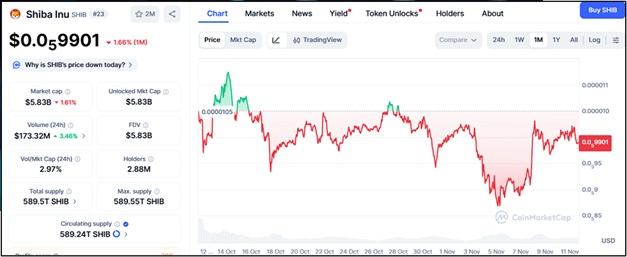
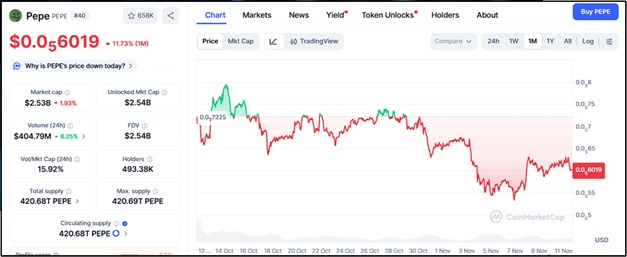
Crypto markets are entering another euphoric phase, and meme coins are once again leading the charge. Dogecoin (DOGE), Shiba Inu (SHIB), and Pepe (PEPE) are all gaining momentum as traders rotate back into high-volatility tokens that defined previous bull cycles. DOGE trades at $0.1782, SHIB at $0.000009901, and PEPE at $0.000006019, each showing renewed strength on social and technical indicators.

But while these tokens are riding a familiar wave of meme-fueled hype, the most compelling story in the market today isn’t another meme—it’s intelligence. Ozak AI (OZ), an AI-powered blockchain project, is rapidly emerging as the next big narrative, offering the potential for 100x growth and redefining what real utility looks like in crypto’s next evolution.

Dogecoin (DOGE) Overview
Dogecoin (DOGE) remains the most recognized meme coin in crypto history, a symbol of community-driven success. Currently trading around $0.1782, DOGE shows resistance at $0.194, $0.215, and $0.242, while support rests at $0.162, $0.145, and $0.129.

Dogecoin’s strength lies in its deep cultural influence and massive retail following. With major mentions by Elon Musk and potential integration for payments within the X ecosystem, DOGE retains powerful upside catalysts. Analysts believe that if market sentiment stays bullish, the coin could reach $0.25–$0.30, which would represent a substantial near-term gain.
owever, while Dogecoin’s meme momentum continues to thrive, its lack of evolving utility remains a limiting factor. Investors seeking long-term, technology-driven upside are increasingly turning to projects like Ozak AI, where real innovation—not hype—drives value.

Shiba Inu (SHIB) Overview

Shiba Inu (SHIB) is building its next phase of growth on substance, not just sentiment. Trading near $0.000009901, SHIB is testing resistance at $0.0000115, $0.0000138, and $0.0000162, while support levels sit at $0.0000087, $0.0000076, and $0.0000069.

The token’s evolution beyond its meme origins is evident through Shibarium, its Layer-2 scaling solution designed for faster, cheaper transactions, as well as ShibaSwap, its decentralized exchange. Combined with ongoing burn mechanisms to reduce supply, SHIB’s fundamentals are improving each quarter.
If Shibarium adoption accelerates and broader retail sentiment returns, analysts predict SHIB could 20x by 2026. Still, while it remains a strong community asset, its upside is capped by competition and market maturity—especially when compared to the disruptive potential of AI-based blockchain projects like Ozak AI.

Pepe (PEPE) Overview

Pepe (PEPE), the newest of the top meme coins, has shown resilience and speculative strength since its explosive debut. Now priced at $0.000006019, PEPE faces resistance at $0.0000069, $0.0000078, and $0.0000093, with support at $0.0000054, $0.0000048, and $0.0000041.

PEPE thrives on retail speculation and social media virality, often leading market rallies fueled by memes and trading volume surges. Many traders anticipate a potential 15x–25x run if meme mania peaks again. However, PEPE—like its predecessors—lacks long-term innovation, and its sustainability depends heavily on social hype rather than technological progress.

This contrast is exactly why investors and analysts alike are now turning their attention toward Ozak AI (OZ), a project that combines real-world AI utility with blockchain scalability, representing the next evolutionary leap beyond memes.

Ozak AI (OZ) Overview

Ozak AI (OZ) stands apart as a project redefining what “smart crypto” really means. Built at the convergence of artificial intelligence, predictive analytics, and blockchain automation, Ozak AI creates a self-learning decentralized ecosystem capable of analyzing data, predicting trends, and executing automated decisions.

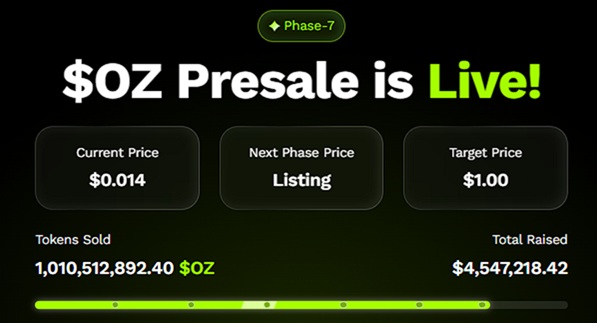
Currently in its 7th OZ presale stage, Ozak AI has already raised over $4.5 million and sold more than 1 billion OZ tokens, showing significant early investor confidence. Its ecosystem is powered by AI prediction agents—autonomous digital entities that process blockchain and off-chain data to drive actionable intelligence in DeFi, trading, and governance.

Ozak AI’s robust partnerships include:

  • Perceptron Network’s 700,000+ nodes for scalable AI computation.
  • HIVE’s 30 ms signal processing for ultra-fast predictive analytics.
  • SINT’s cross-chain AI agents and voice-driven systems for real-time interoperability.

Audited by CertiK and Sherlock, and listed on CoinMarketCap and CoinGecko, Ozak AI offers both credibility and transparency—a rare combination for a presale project. Analysts forecast that Ozak AI could reach $1 per token, translating to a 100x return from its current presale valuation of $0.012.

From Memes to Machines—The Market’s Next Big Rotation

While Dogecoin, Shiba Inu, and Pepe are once again generating headlines and short-term profits, Ozak AI represents the next major leap in crypto’s evolution—from viral communities to intelligent ecosystems. Meme coins thrive on emotion, but Ozak AI thrives on automation, intelligence, and data—the true drivers of the next bull cycle.

Investors who made fortunes flipping DOGE, SHIB, and PEPE are now looking for the next asymmetric play, and Ozak AI checks every box: cutting-edge tech, early entry, and long-term scalability. In 2021, memes defined crypto culture. In 2025, AI will define crypto’s future—and Ozak AI is leading that transformation.

About Ozak AI

Ozak AI is a blockchain-based crypto venture that offers a technology platform that focuses on predictive AI and advanced records analytics for monetary markets. Through machine learning algorithms and decentralized network technologies, Ozak AI permits real-time, correct, and actionable insights to help crypto fanatics and companies make the precise choices.


For more, visit:

Website: https://ozak.ai/

Telegram: https://t.me/OzakAGI

Twitter: https://x.com/ozakagi 
Solana Active Addresses Hit 12-Month Low Amid Fading Memecoin Hype, as FanDuel, CME Group Announce Partnership

0

The Solana blockchain has seen a notable slowdown in user activity, with daily active addresses dropping to approximately 3.3 million—a 12-month low and a roughly 67% decline from the January 2025 peak of over 9 million.

This metric, which tracks unique addresses signing transactions, reflects the network’s heavy reliance on speculative memecoin trading that drove explosive growth in late 2024 and early 2025.

As that frenzy subsided throughout the year, participation has normalized toward more sustainable levels, highlighting vulnerabilities in ecosystems tied to single-use cases like token launches. Despite the dip, Solana shows signs of resilience: DeFi TVL steady at ~$10B: Protocols like Jupiter, Kamino, and Jito continue to anchor liquidity and infrastructure.

Memecoin niche persists: Platforms such as Pump.fun still generate over $1M in daily volume, holding ~90% market share for token launchpads. Spot Solana ETFs like Bitwise’s BSOL and Grayscale’s GSOL recorded strong inflows last week, totaling $6.8M, outpacing Bitcoin and Ethereum funds.

Whale accumulation has also risen, with net spot inflows averaging $26M on major exchanges. This cooldown could ultimately benefit Solana by shifting focus to durable applications like payments, gaming, and real-world asset (RWA) tokenization.

However, it underscores the need for broader diversification to weather narrative shifts. As of November 13, SOL trades around $155, with key support at $148–152 and resistance near $172. Recent X discussions echo this sentiment, with users like Scottmelker highlighting the drop as a key metric and Inthecryptoflow noting it might improve the ecosystem’s long-term reputation by weeding out pure speculators.

a16z Leads $10M Round for Privacy L1 Seismic, Total Funding Hits $17M

In a contrasting tale of innovation, crypto startup Seismic has secured $10M in fresh funding to advance its privacy-focused Layer 1 blockchain, bringing total capital raised to $17M.

The round was led by a16z crypto, with participation from Polychain Capital, Amber Group, TrueBridge Capital, dao5, and LayerZero Labs. This follows an earlier $7M seed in March 2025, also led by a16z.

Seismic’s core offering is an encrypted blockchain infrastructure that enables app-level privacy for fintechs, allowing them to process crypto transactions (e.g., on/off ramps, card programs, stablecoin accounts) without exposing sensitive customer data.

Built with Rust and REVM for EVM compatibility, it abstracts complex cryptography like zero-knowledge proofs, making it developer-friendly for DeFi, payments, identity, and secure data sharing. Key features include: Modular SDKs/APIs for plug-and-play encryption.

TEE-secured channels to bridge public blockchain transparency with institutional confidentiality needs. Composable privacy primitives that avoid the pitfalls of local ZK-proof generation.

The timing aligns with rising demand: a16z’s “State of Crypto” report notes a 400% YoY surge in Google searches for “crypto privacy solutions” in 2025, driven by regulatory pressures and data leak concerns. Seismic has already partnered with fintechs like Brookwell stablecoin accounts and Cred private credit, routing transactions through private rails to comply with GDPR-like standards.

This investment signals a16z’s bet on privacy as a “must-have” for mainstream adoption, positioning Seismic to compete with projects like Cardano’s Midnight sidechain or Tempo. On X, founder lyronctk’s announcement post garnered many interactions, with community buzz around its potential for Web3-fintech integration.

These developments paint a maturing crypto landscape: Solana grapples with post-hype stabilization, while Seismic exemplifies targeted VC backing for unsolved problems like privacy. Both could catalyze broader ecosystem growth if they pivot toward utility over speculation.

FanDuel and CME Group Announce Prediction Markets Partnership

FanDuel has partnered with CME Group to launch a new prediction markets platform, marking a significant expansion into event-based trading. The collaboration was first announced in August 2025 and detailed further on November 12, 2025, with a planned launch in December 2025.

This move combines FanDuel’s expertise in user-friendly mobile gaming and its massive U.S. customer base over 17 million users with CME Group’s century-long leadership in regulated derivatives markets.

The new standalone mobile app, FanDuel Predicts, will debut in December 2025. It will be available nationwide in the U.S., with a focus on states without legal online sports betting, allowing broader access to financial-style trading.

Contracts on outcomes in football, basketball, hockey, and baseball (e.g., game winners, totals, or other event-based predictions). Non-sports markets including S&P 500 and Nasdaq-100 benchmarks, oil and gas prices, gold, cryptocurrencies, GDP, and CPI.

Users will buy and sell “event contracts” priced between $0.01 and $0.99, similar to binary options. Contracts settle based on real-world outcomes, with CME Group handling pricing, clearing, and settlement for regulatory compliance under the CFTC (Commodity Futures Trading Commission).

Requires standard KYC verification (birth date, SSN, address, banking info, ID). Includes educational resources on prediction markets, spending trackers, deposit limits/alerts, and self-exclusion options—mirroring FanDuel’s responsible gaming tools.

Operates as a non-clearing Futures Commission Merchant (FCM) to facilitate trades without direct clearing risks. As sports betting taxes and regulations intensify in states like Illinois up to 40% on revenue, FanDuel is diversifying into CFTC-regulated prediction markets.

This builds on Flutter Entertainment’s Betfair Exchange in the UK and aims to attract “a new generation” of traders, as noted by CME CEO Terry Duffy. Amy Howe, CEO of FanDuel: “We can’t wait to bring FanDuel’s proven approach to product innovation into this dynamic sector.

Our partnership with CME Group allows us to leverage their deep market expertise built over decades while delivering the seamless, accessible and trusted experience our customers expect.”  Terry Duffy, Chairman & CEO of CME Group: “Our new event contracts on benchmarks, economic indicators and now sports will appeal to a new generation of potential participants who are not active in these markets today.

This launch will dramatically expand our distribution and reach, connecting directly with FanDuel’s millions of registered U.S. customers.” This partnership positions FanDuel as a bridge between entertainment betting and sophisticated financial trading, potentially challenging platforms like Kalshi or Robinhood in the growing U.S. prediction markets space projected to expand amid rising interest in event-based speculation.

By structuring contracts as CFTC-regulated event trades binary options priced $0.01–$0.99, FanDuel can offer sports outcomes in the 40+ states without online sports betting legalization. This creates a federally compliant workaround to patchwork state laws, potentially unlocking millions in untapped revenue without needing new licenses or taxes.

However, sports contracts will phase out in states as betting legalizes to comply with dual regulations. The app mandates KYC verification and includes FanDuel’s responsible gaming tools deposit limits, self-exclusion, spending trackers, plus CME’s risk management for clearing and settlement.

This promotes safer trading but could deter casual users due to the SSN/ID requirements, blurring lines between “fun” betting and “serious” investing. As a non-clearing FCM model, this could accelerate CFTC approvals for similar platforms, encouraging sportsbooks to pivot from state-dependent models to federal derivatives.

Analysts, including Deutsche Bank, have upgraded CME Group’s stock outlook partly due to this growth driver, raising the price target to $300 from $266. Financial terms weren’t disclosed, but it underscores a trend of sportsbooks evolving into fintech hybrids.

End of the Longest U.S. Government Shutdown Marks a Relief to Crypto Operations

0

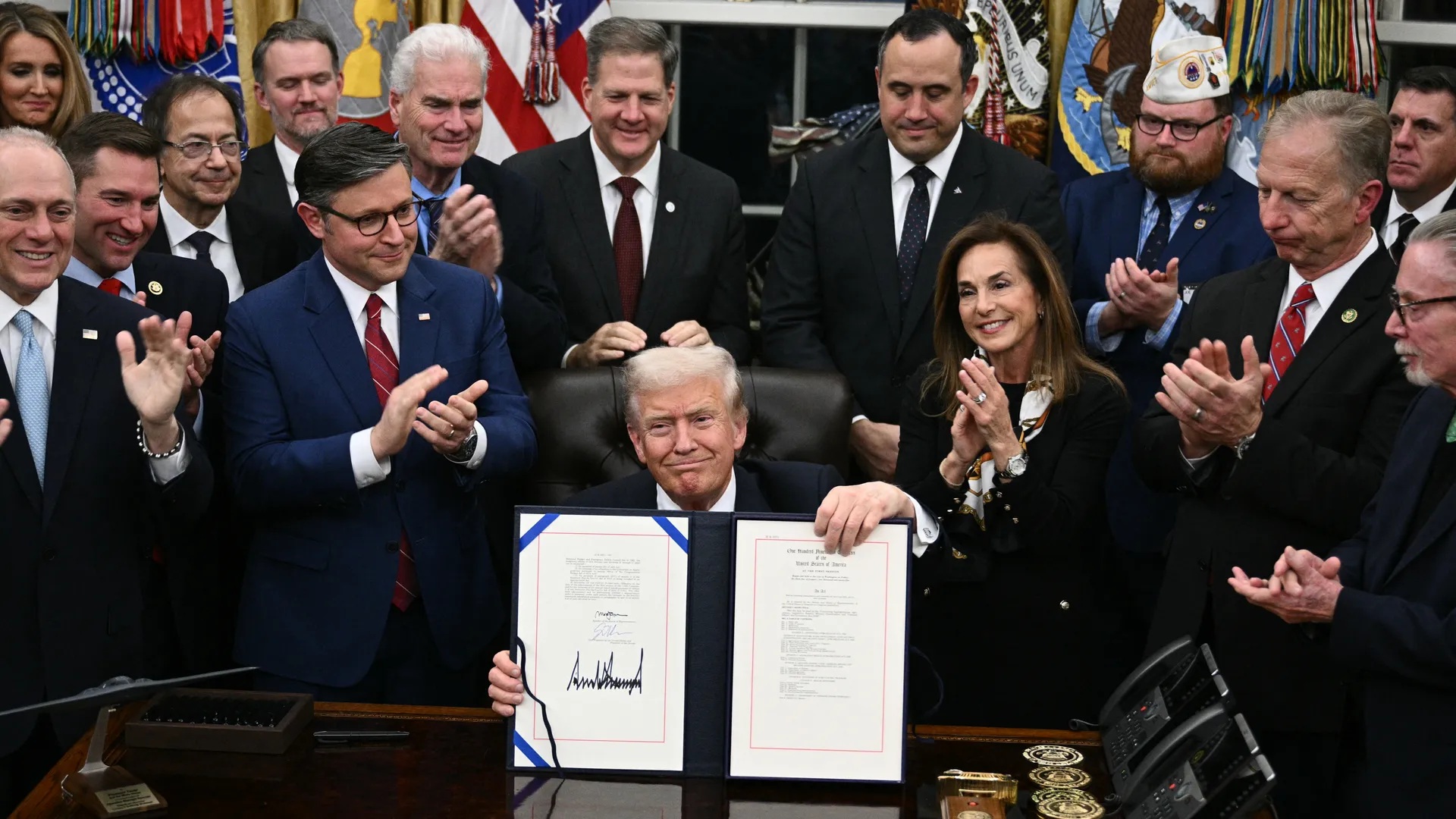
President Donald Trump signed a bipartisan funding bill into law, officially ending the 43-day government shutdown—the longest in U.S. history.

The shutdown began on September 30, 2025, when Congress failed to pass funding legislation before the fiscal year’s end, largely due to a standoff over Democratic demands to extend enhanced Affordable Care Act (ACA) subsidies set to expire at the end of 2025.

The US Treasury built up its TGA to around $1 trillion during the shutdown, absorbing ~$700 billion from broader markets. This reduced available capital for risk assets like crypto, as funds were funneled into government coffers instead of banks, money markets, or stablecoins. Bitcoin (BTC) and Ethereum (ETH) saw heightened volatility, with BTC dropping ~18% from its early October all-time high of ~$125,000 to ~$103,000 by November 13.

Shutdowns halt releases of critical reports (e.g., jobs, inflation), complicating Federal Reserve decisions. This fueled market jitters, as investors couldn’t gauge rate cut probabilities accurately.

Despite a 99% chance of an October rate cut per CME FedWatch, the lack of data prolonged uncertainty. Crypto’s high correlation with dollar liquidity 0.85 for BTC in 2025 exacerbated downside pressure.

Regulatory Stagnation: Agencies like the SEC and CFTC operated on skeleton crews, delaying ETF approvals (e.g., spot Solana and XRP products launched automatically but without full oversight), enforcement actions, and market structure bills.

The House’s Digital Asset Market Clarity Act missed a key October 20 markup deadline, pushing potential progress to late 2025 or 2026. This created a “regulatory vacuum,” deterring institutional inflows into altcoins while Bitcoin ETFs saw cautious gains.

Key Details of the Bill

The legislation, passed by the Senate on November 10 60-40 vote, with eight Democrats crossing the aisle and the House on November 12 222-209 vote, with six Democrats joining Republicans, provides: Short-term funding extension.

Most federal agencies funded at current levels through January 30, 2026, averting another immediate cliff. For the Department of Agriculture, military construction, and legislative branch agencies. Food assistance continuity.

Full funding for the Supplemental Nutrition Assistance Program (SNAP, or food stamps) through September 2026, benefiting over 40 million low-income Americans who faced disruptions during the shutdown.

Worker protections: Back pay for furloughed or unpaid federal employees estimated at 800,000 workers, reinstatement of laid-off staff, and a temporary halt to further reductions in force (RIFs) through January.

No ACA subsidy extension: A major Democratic concession; Republicans agreed to a Senate vote on the subsidies in December, but House passage remains uncertain. The bill’s passage came after weekend negotiations between moderate Senate Democrats and Republicans, breaking a filibuster.

Trump signed it in a late-evening Oval Office ceremony, criticizing Democrats for using the shutdown as “political leverage” and vowing, “We can never let this happen again.”

Impacts of the Shutdown

The impasse caused widespread disruptions: Economic toll: Estimated GDP loss of 0.1-0.2 percentage points per week, or about $10-20 billion total, though much is recoverable. Federal debt continued rising at ~$1.8 trillion annually.

Affected services: Halts to air traffic control leading to flight cuts, Smithsonian museums and National Zoo closures, delayed IRS tax refunds, and SNAP payment interruptions that left some families without food aid.

Hundreds of thousands of federal workers (e.g., TSA agents, park rangers) went unpaid; some resorted to food banks or loans. The Trump administration’s court battles over SNAP funding highlighted the strain.

Democrats, reeling from 2024 election losses, used the shutdown to spotlight healthcare access, tying it to ACA subsidies aiding 20 million Americans. Republicans, controlling Congress, resisted, viewing it as a “hostage” tactic.

The compromise sets up future battles: Trump has pushed to eliminate the Senate filibuster for budget bills, and the ACA issue looms large in December. Polls showed Trump’s approval dipping during the crisis, but the quick resolution may blunt long-term damage.

Federal operations are resuming as early as November 13, with full back pay processing expected within weeks.

Taiwan’s Central Bank Initiates Study on Bitcoin as Strategic Reserve

0

Recent developments confirm that Taiwan’s Central Bank (CBC) and the Executive Yuan have agreed to formally study the inclusion of Bitcoin (BTC) as a strategic reserve asset. This move, announced on November 12, 2025, marks a significant step toward diversifying Taiwan’s national reserves away from heavy reliance on the U.S. dollar and traditional assets like U.S. Treasuries.

If implemented, it could position Taiwan as one of the first Asian nations to pilot sovereign Bitcoin holdings. The proposal is led by Legislator Dr. Ju-chun Ko of the Kuomintang party, who has highlighted risks from the New Taiwan Dollar’s (TWD) volatility (e.g., 5% daily swings in 2025), global inflation, U.S. tariff uncertainties, and geopolitical tensions in the region.

Ko argues that Bitcoin’s decentralized nature offers a hedge against these issues and reduces overdependence on USD-denominated assets. In May 2025, Ko urged the CBC to evaluate BTC, citing examples like the U.S. Strategic Bitcoin Reserve established earlier in the year.

The CBC will conduct a comprehensive review of Bitcoin’s feasibility as a reserve, including risk models, legal frameworks, anti-money laundering compliance, and wallet security. A full research report is expected before the end of 2025.

Initial BTC holdings will use seized cryptocurrency from criminal cases valued at around $146 million in 2024, currently awaiting auction. This low-risk approach allows testing without immediate market purchases.

Pro-Bitcoin regulations are in development to support broader integration, building on Taiwan’s crypto-friendly policies (e.g., allowing professional investors to buy foreign BTC ETFs since 2024).

No timeline for full adoption has been set, and concerns around BTC’s volatility and custody remain. Taiwan’s reserves are currently concentrated in U.S. Treasuries, with the CBC intervening heavily (e.g., $10.12 billion purchase in May 2025) to stabilize the TWD.

This initiative aligns with global trends: El Salvador adopted BTC as legal tender in 2021, Argentina explored it in 2024, and 73% of central banks anticipate declining USD shares in reserves.

Taiwan’s move could accelerate institutional BTC adoption in Asia, where neighbors like Japan and South Korea are monitoring closely, while Singapore focuses on stablecoins. Bitcoin’s price dipped below $101,000 amid this week’s volatility, but such nation-state interest often boosts long-term sentiment.

This is still in the exploratory phase—no formal policy is enacted yet—but the commitment to pilots and studies signals strong momentum. The U.S. Strategic Bitcoin Reserve (SBR) represents a landmark policy shift, formalizing Bitcoin (BTC) as a national reserve asset akin to gold or oil stockpiles.

Established via Executive Order on March 6, 2025, by President Donald Trump, it centralizes government-held BTC to position the U.S. as a leader in digital assets. This initiative builds on campaign promises to make America the “crypto capital of the world” and counters perceived regulatory overreach from prior administrations.

As of November 2025, the reserve remains in its early implementation phase, with ongoing legislative pushes and global ripple effects. Bitcoin is viewed as “digital gold” due to its fixed supply of 21 million coins, decentralization, and unhackable blockchain—never breached in its history.

Proponents argue it hedges against inflation, dollar debasement, and geopolitical risks, diversifying reserves beyond U.S. Treasuries and gold. Trump highlighted strategic advantages in holding BTC early, especially amid U.S.-China tensions in tech and finance.

The U.S. government has accumulated BTC primarily through seizures from criminal cases (e.g., Silk Road, ransomware). Past sales (e.g., ~195,000 BTC sold for $366 million over a decade) are now criticized as missed opportunities, worth ~$17 billion today.

The SBR prevents future sales, treating BTC as a long-term store of value. For non-BTC cryptos also from seizures, for orderly management. A full audit of federal holdings was mandated within 30 days, completed by April 2025. White House AI & Crypto Czar David Sacks described it as a “digital Fort Knox.”

Budget-neutral—sourced from ~198,000-207,000 seized BTC valued at $17-18 billion in March 2025, now higher amid BTC’s rise above $100,000. Agencies transferred holdings; ~55% from one case (Bitfinex hack) was returned, netting ~86,000 BTC initially.

Approximately 198,000 BTC as of establishment, post-audits and returns. Valued at ~$17 billion in March 2025; by November 2025, with BTC near $101,000-$115,000, this equates to $20-23 billion. Treasury and Commerce are developing “budget-neutral” methods for more BTC, such as:Partnerships with U.S. miners.

Potential sales of gold reserves (~$800 billion) to fund purchases. No taxpayer costs; avoids direct market buys to prevent volatility. BTC rose ~35% post-2024 election. Experts like KBW call it a “pivotal moment,” boosting institutional adoption (e.g., Brown University’s $4.9M BTC ETF stake).

Sparks “game theory” race—Russia, Bhutan exploring reserves. U.S. dominance could stabilize dollar while pressuring rivals like China. Polymarket odds for full reserve by year-end: ~65% per trader bets.

CryptoPunk Hoodie Sale Hits $628K Milestone As Canary Files for MOG ETF

0

In the ever-vibrant NFT market, a rare “Hoodie” attribute CryptoPunk has fetched an impressive $628,000 in a recent transaction, underscoring the enduring appeal of these pixelated icons from the Larva Labs collection.

CryptoPunks with the Hoodie trait—depicting a simple blue hoodie over the character’s head—have long been among the most coveted subsets due to their scarcity only about 3% of the 10,000 total punks feature it and cultural cachet in the crypto art world.

This sale adds to a legacy of high-profile Hoodie Punk trades, including past deals exceeding $2 million each during the 2021 bull run. While exact details on the specific Punk ID and buyer weren’t immediately disclosed, such transactions typically occur on platforms like OpenSea, reflecting renewed interest amid broader NFT market stabilization in late 2025.

Canary Capital Breaks Ground with MOG ETF Filing

Hot on the heels of spot Bitcoin and Ethereum ETFs, asset manager Canary Capital has taken a bold step into meme coin territory by filing for the first-ever U.S. exchange-traded fund (ETF) tracking MOG Coin ($MOG), a cat-themed memecoin on the Ethereum blockchain.

The S-1 registration submitted to the SEC on November 12, 2025, proposes the Canary MOG ETF as a spot product that would hold actual MOG tokens, allowing traditional investors to gain exposure through brokerage accounts without directly managing crypto wallets.

MOG, launched in 2023 as a playful “mogging” meme— internet slang for outshining others, lacks utility beyond community hype but has built a fervent following with over $500 million in market cap at filing time.

The ETF’s structure mirrors approved crypto funds: up to 5% in ETH for transaction fees, custodied by institutions like U.S. Bancorp, and designed to track MOG’s spot price minus fees.

This filing follows Canary’s aggressive altcoin push, including recent approvals for XRP and HBAR ETFs, signaling regulators’ growing openness to non-mainstream tokens. Post-announcement, MOG’s price surged ~15% intraday to around $0.0000025, highlighting the market’s enthusiasm for ETF-driven liquidity.

Approval isn’t guaranteed—meme coins’ volatility and lack of fundamentals could draw scrutiny—but if greenlit, it could pave the way for DOGE or SHIB equivalents, further blurring lines between TradFi and crypto.

Implications of the CryptoPunk Hoodie Sale at $628K

This transaction, while not shattering all-time records (e.g., a CryptoPunk sold for $56.3 million in 2024), signals a subtle thaw in the NFT market’s prolonged winter. CryptoPunks remain a prestige asset class, with rare traits like the Hoodie commanding premiums even as overall NFT trading volumes have plummeted 90%+ from 2021 peaks.

This sale—equivalent to roughly 250 ETH at current prices—highlights sustained demand from high-net-worth collectors viewing them as “digital trophies” rather than speculative flips. It contrasts sharply with recent high-profile losses, like the $10M hit on an Alien Punk sale in April 2025, underscoring that scarcity and cultural cachet can buffer against ETH’s volatility down ~60% YTD.

In a sector where floor prices for Punks hover around $65K down 43% in Q3 2025, a $628K trade injects optimism, potentially lifting secondary volumes Punks generated $16.7M in the last 30 days pre-sale.

It could encourage “diamond-hand” holders to list more inventory, improving liquidity on platforms like OpenSea, but risks inflating short-term hype without fundamentals—echoing past wash trades that briefly spiked prices via flash loans.

This reinforces Punks’ role as a benchmark; similar sales often correlate with upticks in related projects. However, with NFT activity at historic lows, it won’t single-handedly revive the market—regulatory clarity on digital assets and integrations like Visa’s USDC pilots could amplify it.

For investors, it’s a reminder: Treat these as illiquid art, not quick trades, given the 57% ETH drop exacerbating past losses. In short, it’s a win for NFT OGs, proving enduring value in rarity, but the sector needs macro tailwinds to scale.

Filing for the first U.S. spot ETF on a memecoin like MOG— a $150M market cap Ethereum token born from “mogging” memes—pushes the boundaries of TradFi-crypto convergence.

With over 155 crypto ETF applications pending, this isn’t isolated; it’s part of a wave following SEC’s September 2025 generic listing standards. Approval would let retail and institutional investors buy MOG exposure via brokerage accounts (e.g., Fidelity), bypassing wallets and gas fees—mirroring Bitcoin/ETH ETFs that drew $50B+ inflows.

The structure direct MOG custody, up to 5% ETH for fees, U.S. Bancorp oversight democratizes a “cultural artifact” with no utility beyond hype, potentially exploding its holder base currently 39K wallets, 53% whale-controlled.

Post-filing, MOG spiked 15-20% to $0.0000025, with trading volume surging—hinting at “ETF alpha” for low-cap alts. Memecoins down 78% YTD could see a renaissance; if greenlit, it paves the way for DOGE/SHIB/PEPE funds, blending viral trends with regulated products.

Canary’s altcoin spree XRP ETF launching Nov 13, HBAR/LTC live reflects a strategy targeting niches, but MOG’s ranking (#339) and volatility raise red flags—expect scrutiny on manipulation risks.

Fuels liquidity $524M BTC ETF inflows Tuesday alone, but amplifies speculation in a risk-on environment, with Trump’s crypto-friendly SEC pick (Paul Atkins) accelerating reviews post-shutdown.

No guarantees—meme coins’ “social sentiment” pricing lacks Howey Test clarity, and SEC could demand more on decentralization. If approved potentially Q1 2026, it blurs lines between gambling and investing, drawing in normies but risking crashes.

For the ecosystem, it’s bullish: Elevates Ethereum’s role, spurs competitors (e.g., Solana memes), and could hit $500M+ cap on hype alone. Overall, these events spotlight crypto’s maturation: NFTs as legacy art, memecoins as mainstream bets. Bullish for adoption, but volatility reigns—position accordingly.