
DD
MM
YYYY

PAGES

DD
MM
YYYY

spot_img

PAGES

Home Blog Page 17

What a Pinoy Tongits App Download Says About How You Play

0

Today, as players search for a Pinoy Tongits app download to enjoy the classic card game, they aren’t just looking for a way to pass the time. They’re searching for something that feels familiar, trustworthy, and respectful of the game’s character.

Mobile gaming has made Tongits accessible to more people than ever before. A few taps can recreate what once required a deck of cards and a shared table. But convenience, while welcome, has also introduced a new dilemma.

With so many download options available, such as official apps, altered installers, and modified files, the act of choosing where to play has become part of the strategy itself.

Tongits teaches players to think ahead. To weigh outcomes. To avoid unnecessary risks. Yet many abandon those instincts the moment they reach the download button.

In doing so, they invite problems that have nothing to do with the game and everything to do with how it’s delivered.

A Tongits experience shaped by instability, privacy concerns, or unfair mechanics loses its essence. What remains may look like the game, but it no longer behaves like one.

This feature explores why the way you download Tongits matters, why shortcuts quietly erode the experience, and why some players are choosing environments that reflect the values the game has always stood for.

Because Tongits doesn’t reward haste. It rewards discernment.

The Quiet Assurance of Official Platforms

There’s a reason official app stores still matter, even in a digital culture obsessed with alternatives. For players seeking a reliable Pinoy Tongits app download, the Google Play Store continues to offer something rare: accountability.

Apps listed on the Play Store exist within a system designed to protect users. Developers are identifiable. Updates are mandatory.

Security protocols are enforced. These aren’t just technical requirements but safeguards that preserve trust between the game and the player.

Well-known Tongits titles such as Tongits Go, Tongits Star, Tongits ZingPlay, and other variants operate within this framework. They’re maintained, patched, and adjusted over time, ensuring that the game evolves without breaking.

This consistency becomes especially important as devices and operating systems change. An app downloaded from an official platform adapts alongside those changes. Bugs are addressed. Performance improves.

Players aren’t left wondering whether a sudden crash or error signals the end of their progress.

Transparency also plays a key role. Official Tongits apps clearly outline how progression works, how rewards are earned, and what in-game currencies represent. There are no hidden alterations quietly shifting the balance of play.

Equally important is restraint. Official apps request only the permissions they need to function. In an era where phones store personal conversations, financial information, and daily routines, that restraint matters.

Choosing an official Pinoy Tongits app download is not about limiting options. It’s about preserving the stability and fairness that allow Tongits to remain what it has always been, a game of judgment, not chance.

The False Promise of Modified APKs

Modified Tongits APK files often present themselves as solutions. They promise speed, abundance, and advantage. Unlimited coins. Faster progress. Enhanced features. To an impatient player, the appeal is obvious.

But Tongits has never favored impatience.

APK files distributed outside official platforms bypass the safeguards that protect users from malicious code. Security risks are immediate and often invisible.

Malware, spyware, and intrusive advertising software can be embedded directly into the app, operating quietly once installed.

Privacy risks follow close behind. Many modified apps request permissions unrelated to gameplay, such as access to contacts, storage, microphones, or cameras. Granting these permissions opens doors that cannot easily be closed.

Even from a purely gameplay perspective, the experience becomes fragile. Accounts may be flagged or banned without warning. Progress can vanish after updates.

Apps may stop functioning entirely when official versions change. With no support and no accountability, players are left to fend for themselves.

What makes this especially unnecessary is that official Tongits apps already offer flexibility. Offline modes, daily rewards, adjustable betting, and steady progression are standard features.

There is no real-world value tied to in-game currency, removing the urgency to chase artificial advantages.

In choosing an APK shortcut, players trade certainty for illusion. They gain speed at the cost of stability and convenience at the expense of control.

Tongits, by its nature, punishes that kind of trade.

When These Pinoy Tongits App Download Tips Become Tedious

For some players, the discussion around downloads eventually reaches a different conclusion. Instead of choosing between official apps and risky alternatives, they begin looking for an environment that treats Tongits with greater seriousness.

This is where platforms like GameZone enter the conversation.

Rather than focusing on installation, GameZone focuses on experience. It offers Tongits in a regulated, competitive environment where players face real opponents under transparent systems.

There are no altered files, no hidden mechanics, and no ambiguity about how outcomes are determined.

Here, Tongits feels deliberate again. Every move carries weight. Every decision reflects skill and timing rather than artificial boosts. The tension comes from competition, not from uncertainty about the system.

Security is embedded into the platform itself. Transactions follow regulatory standards. Responsible gaming tools are in place to help players stay in control.

Instead of worrying about device safety or unstable downloads, players can focus entirely on the game.

For those who see Tongits as more than a casual diversion, this approach restores its identity. It honors the discipline and judgment the game demands while embracing the advantages of digital play.

Sometimes, the most thoughtful alternative to a Pinoy Tongits app download is choosing a platform that removes risk before play even begins.

What Your Pinoy Tongits App Download Ultimately Reveals

How a player approaches Tongits often reveals how they approach decisions in general. The game rewards patience, observation, and restraint. It quietly discourages shortcuts.

The same values apply to how Tongits is played today. Whether through official apps or structured platforms like GameZone, the best experiences come from choices grounded in trust and intention.

In a digital landscape filled with promises of speed and abundance, Tongits remains stubbornly traditional. It asks players to slow down, to think, and to choose carefully.

That may be why it has endured.

FAQ

Q: What is Tongits?
A: Tongits is a Filipino rummy-style card game focused on meld formation, discard management, and strategic timing.

Q: Do Tongits apps change how the game is played?
A: Most apps follow the same core rules, with differences mainly in rewards, matchmaking, and progression.

Q: What is an APK file?
A: An APK is an Android app installation file used outside official app stores.

Q: Why are APK files discouraged?
A: They carry risks such as malware exposure, excessive permissions, unstable gameplay, and account bans.

Q: What is GameZone?
A: GameZone is a regulated online platform offering Tongits matches against real players.

Q: How can I start playing on GameZone?
A: Players can register directly on the platform and complete standard verification steps.
The Physics of Startup Value: Mastering the Smiling Curve

1

In the restless pursuit of growth and market relevance, many startups fall into what I call the value paradox. They build, they hustle, they sweat under the scorching sun of effort, yet the margins remain thin and true wealth creation stays far from their fingertips. The issue is not effort; it is positioning. And when positioning is flawed, no amount of brilliance in execution will rewrite the trajectory.

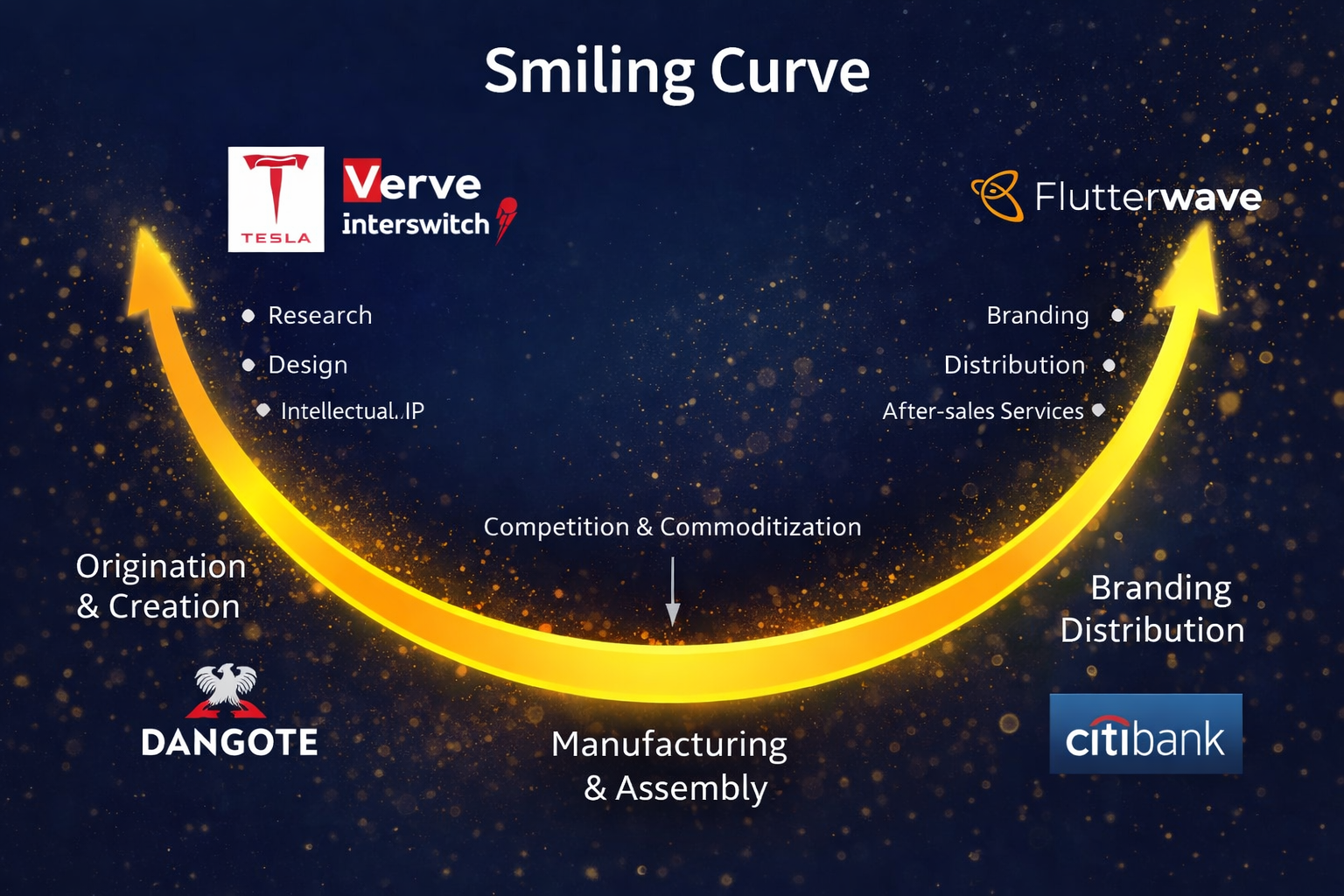
This takes us back to a powerful construct in the physics of markets: The Smiling Curve. It is a simple diagram but a deep thesis. At the center (the bottom of the smile) sits traditional manufacturing, assembly, delivery, and operational centralization. At the edges, both upstream and downstream, sit the domains where asymmetric value is created and captured: origination, creation, discovery, aggregation, branding, distribution, and IP.

In other words: Where you play in the value chain determines how much of the value you capture. If you remain at the center of the curve, the world forces you into commoditization. Competition becomes rabid. Margins evaporate. You are easily replaceable. But when you move to the edges, where ideas are conceived or where customer relationships are owned, you begin to touch the golden reservoirs of value.

Yet, you can build a business to cover all domains on the curve. For example, Dangote Cement plays everywhere and Elon Musk’s Tesla captures value from R&D, software, batteries, branding, distribution, and after-sales data, not just the car factory. These category-kings understand a core equation of modern markets: value = f(position, control, IP, distribution), not just effort. (In engineering, “f” is a function as used therein).

Consider a bank. It holds the accounts, deploys huge capital, and carries the regulatory burdens. It operates at the center. But a card network like Interswitch Verve, sitting at the origination edge of payments, captures asymmetric value without carrying the full burden of the ecosystem. Meanwhile, a fintech aggregator like Flutterwave sits at the opposite downstream edge, aggregating demand through APIs. Both capture superior value relative to the bank because they hold leverageable positions along the curve. Of course, innovative banks now play at the center and at the edges at the same time.

Good People, in the physics of business, just like in physics I first learned in Junior Secondary in Integrated Science class, where you apply force determines what you move! Position well.

Zhipu (AI Tiger) Shares Rise on Hong Kong Debut as China’s AI Sector Tests Public Markets

0

Shares of Knowledge Atlas Technology JSC, widely known as Zhipu, edged higher on their Hong Kong trading debut on Thursday, as the Beijing-based artificial intelligence firm became the first of China’s so-called “AI tigers” to test public markets.

The stock rose as much as 15% above its offer price of 116.20 Hong Kong dollars ($15), after the company raised about $558 million in the offering. Roughly 37.4 million shares were sold, valuing the startup at around HK$4.3 billion and placing the listing among the more sizable AI flotations globally in recent years.

While the first-day gains were measured rather than explosive, the debut was closely watched by investors, policymakers, and competitors. Zhipu’s listing is being read as a referendum on whether Chinese large language model developers — operating under tightening U.S. export controls and rising geopolitical risk — can still attract capital, scale globally, and commercialize frontier AI technologies.

Founded in 2019 by researchers from one of China’s top universities, Zhipu has grown into a flagship player in Beijing’s artificial intelligence strategy. It is regarded as one of the country’s “AI tigers,” a label used to describe a small group of startups developing large language models intended to rival Western leaders such as OpenAI and Anthropic.

Unlike many consumer-facing AI firms, Zhipu’s rise has been closely intertwined with state priorities. The company is widely viewed as strongly backed by Beijing, both financially and politically, and sits at the center of China’s effort to reduce reliance on foreign AI technology while accelerating domestic innovation.

Its IPO, therefore, carries significance beyond the company itself. It represents the first time a major Chinese large language model developer has gone public via an initial offering, setting a precedent for peers that have so far relied on private funding rounds, state-linked investors, and strategic partnerships.

Among those peers is DeepSeek, another member of the “AI tiger” group, which rattled markets early last year with the release of one of its models. That launch challenged assumptions that U.S. export controls would sharply slow China’s progress in advanced AI, triggering renewed debate in Washington and elsewhere over the effectiveness of technology restrictions.

Zhipu, though less visible internationally than DeepSeek, has earned recognition at the highest levels of the global AI industry. Last year, OpenAI described the company as a notable competitor operating on the “front line” of China’s race to lead in artificial intelligence — an acknowledgment that underscored both Zhipu’s technical progress and the intensifying rivalry between U.S. and Chinese AI ecosystems.

The company has also pursued an unusually broad overseas footprint for a Chinese AI firm operating under sanctions. Zhipu reportedly maintains offices in the United Kingdom, Singapore, and Malaysia, alongside operations across the Middle East. It has established joint “innovation center” projects in Southeast Asia, including Indonesia and Vietnam, aligning with China’s broader push to deepen digital and technological ties across emerging markets.

Those international ambitions have advanced despite mounting regulatory obstacles. In January last year, the U.S. Commerce Department placed Zhipu on its Entity List, citing allegations that the firm was working with China’s military. The designation sharply restricted Zhipu’s access to advanced U.S. semiconductors, AI tooling, and certain forms of technical collaboration.

Like other Chinese AI developers, Zhipu has had to contend with U.S. controls limiting access to high-end chips and expertise needed to train and run large-scale models. These constraints have raised costs, complicated supply chains, and forced firms to rely more heavily on domestic alternatives, which often lag the most advanced foreign hardware.

Still, Zhipu has continued to invest heavily in model development. According to its prospectus, about 70% of the IPO proceeds will be directed toward research and development of its general-purpose large AI models, underscoring a strategy that prioritizes technical capability over near-term profitability.

The company reported revenue of 312.4 million yuan in 2024, a figure that highlights both rapid growth and the early stage of monetization for large language models in China. Industry-wide, revenue generation remains uneven, with firms experimenting across enterprise services, cloud deployments, customized models, and government contracts.

Zhipu’s public debut also comes at a moment when Chinese capital markets are selectively reopening to technology firms aligned with national priorities. In recent months, several AI chipmakers and semiconductor-related companies have listed, suggesting regulatory support for areas viewed as strategically vital to economic and national security.

Market participants see Zhipu’s IPO as a test case for whether investor confidence can extend beyond hardware into software-driven AI models, particularly those facing external sanctions and internal policy scrutiny.

The listing may soon be followed by others. Rival Chinese AI startup MiniMax is expected to launch its own offering on Friday, after submitting a confidential filing last year. A successful debut could signal a broader wave of public listings from China’s AI sector, while a weak showing could reinforce doubts about the sector’s commercial readiness and risk profile.

However, Zhipu’s restrained but positive first-day performance points to cautious optimism. Investors appear to be weighing the company’s strategic importance, state backing, and technical progress against persistent uncertainties surrounding geopolitics, export controls, global competition, and the high capital demands of training large-scale AI models.

In that sense, Zhipu’s IPO is not just about one company’s market debut. It is a live experiment in how far China’s AI ambitions can travel in public markets at a time when technology, capital, and geopolitics are increasingly inseparable.

Apple Taps JPMorgan as New Apple Card Issuer, Ending a Costly Chapter With Goldman Sachs

0
Apple continues to move to services for revenue

Apple on Wednesday confirmed that JPMorgan Chase will become the new issuer of the Apple Card, formally ending its high-profile but troubled partnership with Goldman Sachs and handing the largest U.S. bank a major foothold in Apple’s consumer finance ecosystem.

The move is seen as a decisive turning point in its consumer finance strategy and draws a clear line under Goldman Sachs’ costly experiment in mass-market banking.

The transition, which Apple says could take up to 24 months, will be deliberately gradual. Apple stressed that nothing changes for customers in the near term: the card will continue to run on the Mastercard network, existing cardholders do not need to take any action, and new applicants can continue to apply under the same terms. That emphasis on continuity reflects Apple’s sensitivity to user experience, a defining feature of the product since its launch in 2019.

Behind the scenes, however, the economics and strategic implications are significant. JPMorgan said the deal will bring more than $20 billion in Apple Card balances onto its books, instantly making it one of the largest co-branded card wins in the U.S. market in recent years. For the country’s biggest bank, the appeal lies not just in volume but in access to Apple’s affluent, digitally engaged customer base, many of whom are already embedded in the iPhone and Apple Pay ecosystem. JPMorgan has deep experience running large credit card programmes and absorbing portfolios, giving it a scale advantage that Goldman never had in consumer lending.

But the exit underscores how far Goldman Sachs’ ambitions in consumer banking have been rolled back. The firm entered the Apple partnership as a bold attempt to diversify away from its traditional reliance on trading and dealmaking. Instead, the card became emblematic of the challenges Goldman faced in retail finance: higher-than-expected credit losses, operational missteps, and intense regulatory scrutiny over billing practices and customer complaints.

The financial cost of the divorce is steep. The Wall Street Journal reported that Goldman is offloading the Apple Card balances at a roughly $1 billion discount, crystallizing losses that had been building for years. Goldman has already said it expects a $2.2 billion provision for credit losses in the fourth quarter of 2025 linked to the forward purchase commitment, a reminder that even unwinding the partnership comes with a heavy price tag.

The Apple Card itself was designed to challenge industry norms. When it launched in 2019, Apple and Goldman pitched it as a consumer-friendly alternative, with no late fees, no penalty interest rates, and daily cash-back rewards seamlessly integrated into the iPhone Wallet app. The product aligned neatly with Apple’s broader push into services, which now spans payments, savings accounts, and buy-now-pay-later offerings.

Yet that same design philosophy also constrained profitability. The absence of penalty fees, combined with Apple’s insistence on tight control over the user interface and customer communications, limited Goldman’s ability to manage risk and maximize returns in the way traditional card issuers do. Over time, those tensions became harder to ignore, especially as losses mounted and regulators took a closer look at Goldman’s consumer operations.

JPMorgan’s entry suggests Apple has recalibrated its approach. Rather than retreating from credit cards, Apple appears to be choosing a partner with the balance sheet, compliance infrastructure, and card-lending expertise to make the economics work at scale. Some analysts believe the deal complements its dominant position in U.S. consumer banking and reinforces its strategy of embedding itself deeper into everyday digital payments.

The drawn-out transition period also denotes the complexity of moving millions of customer accounts, data systems, and regulatory obligations without disrupting service. Such migrations are fraught with operational risk, and both Apple and JPMorgan have strong incentives to ensure a smooth handover that preserves trust in the Apple brand.

More broadly, the shift highlights a recurring theme in Big Tech’s relationship with finance. Technology companies can design compelling, user-centric financial products, but the underlying business of lending remains capital-intensive, highly regulated, and unforgiving of missteps. Apple’s experience with Goldman shows that brand power alone does not guarantee success in consumer credit.

Now, all eyes will be on how JPMorgan can turn the Apple Card into a consistently profitable franchise, and whether Apple continues to expand its financial services ambitions. Goldman, on the other hand, is expected to close the chapter, absorb the losses, and refocus on its core businesses after one of the most expensive detours in its history.

Peter Schiff Slams Bitcoin’s Venezuela-Fueled Rally – “Dont Believe The Hype, Sell And Buy Gold”

0

Gold advocate and strong Bitcoin critic Peter Schiff has once again taken aim at the world’s largest cryptocurrency, dismissing Bitcoin’s recent Venezuela-fueled rally as little more than speculative hype.

In a post on X, Schiff urged investors to book profits from Bitcoin and rotate into traditional safe-havens like gold, noting that there’s lots of BS from the pumpers spinning this news as being bullish for Bitcoin.

He wrote,

“Bitcoin has been caught up in the Venezuela-inspired rally. It’s back above $94.5K. There’s lots of BS from the pumpers spinning this news as being bullish for Bitcoin. Don’t believe the hype. Just take advantage of the rally to sell and use the proceeds to buy real gold instead.”

In a follow-up post, Schiff pointed to Bitcoin’s quick drop from $94,000 to around $92,000, reiterating his call to sell during rallies and invest in gold, aligning with his long-standing view that Bitcoin lacks intrinsic value compared to precious metals.

Schiff’s comment was however met with reactions largely mocking his bearish stance on Bitcoin, with many highlighting his history of inaccurate predictions, while the event underscores Bitcoin’s role as a hedge in geopolitical crises. Though gold has outperformed it over the past decade with a 150% return versus Bitcoin’s volatility-driven gains.

Recall that on Monday, Bitcoin traded higher, climbing as high as $94,750 following the U.S capture and extradition of Venezuela President Nicolas Maduro. The rally came after the crypto asset had long ranged between the $80,000 to $90,000 price zone.

Singapore-based digital asset trading firm QCP Group said in a note that the move coincided with equity gains and weaker oil prices after the U.S operation in Venezuela.

“Crypto’s recent alignment with broader risk assets may signal a regime shift and the strengthening of bullish narratives to start the year”, the firm wrote, adding that the Venezuela shock “could serve as a near-term catalyst for BTC”, partly due to the disinflationary impulse from lower oil prices”.

The rally wasn’t isolated to Bitcoin; altcoins and related assets followed suit, amplifying the momentum. Analysts attributed this to a combination of factors such as renewed optimism in global trade, easing inflationary pressures from lower energy costs, and speculative fervor in the crypto space.

Today, the price of Bitcoin dipped below $90,000, trading as low as $89,265. Several factors contributed to this reversal. Cooling U.S. economic data, including softer-than-expected job reports and manufacturing indices, dampened the risk-on sentiment.

Several traders were reportedly caught off guard, with Coinglass data showing that the move triggered the liquidation of roughly $128 million in long positions. This highlights the risks faced by leveraged traders amid a tight trading range.

The sell-off follows significant outflows from US spot Bitcoin ETFs, with data from SoSoValue showing $486 million in net redemptions (outflows) on Wednesday, marking the largest single-day outflow since November 20.

Additionally, the initial excitement over the Maduro capture gave way to uncertainty, as questions arose about Venezuela’s political transition, potential legal challenges to the U.S. action, and its long-term impact on oil supplies. Crypto markets, known for their sensitivity to macroeconomic shifts, amplified these concerns, leading to increased selling pressure.

Despite the BTC price decline, some analysts caution against reading weakness into the crypto asset price action.

“Bitcoin isn’t weak; it’s mechanically suppressed. Dealer hedging—selling rallies and buying dips to stay neutral—has pinned price in a tight $90K–$95K range, defining the $90K support and the $100K resistance wall,” said analyst Crypto Rover, in a post on X.

At the time of writing this report, Bitcoin has reclaimed the $90,000 zone, trading as high as $90,816. Thursday’s initial flash crash illustrates the ongoing tension between institutional hedging, retail positioning, and macroeconomic factors in shaping Bitcoin’s price.

As markets digest these developments, investors are left pondering the fragility of hype-driven rallies. Schiff’s commentary, while polarizing, offers a cautionary tale: chase short-term gains at your peril. For those heeding his advice, physical gold dealers report increased inquiries, suggesting some are indeed diversifying away from crypto.

Outlook

Whether Bitcoin rebounds or continues its slide remains to be seen. But in Peter Schiff’s view, the writing is on the wall, digital assets may glitter, but they aren’t gold. As geopolitical shifts continue to unfold, the true test of value will be endurance, not excitement.

The $100,000 level remains the psychological and technical target for many traders. Still, experts agree that time and market structure will dictate the next meaningful breakout.