DD
MM
YYYY

PAGES

DD
MM
YYYY

spot_img

PAGES

Home Blog Page 172

Zero Knowledge Proof (ZKP) Whitelist Live: The World’s Largest Upcoming ICO to Use Daily Auctions! Here’s How to Participate

0

When the Zero Knowledge Proof (ZKP) crypto’s largest blockchain presale in history opens, it won’t resemble any you’ve seen before. There’s no fixed price, no private round, and no insider discounts. Instead, Zero Knowledge Proof (ZKP) will use an on-chain daily auction system in its upcoming presale, releasing 200 million tokens every 24 hours and distributing them proportionally among contributors.

This new model is what sets ZKP apart, a transparent, contribution-based mechanism designed for fairness at scale. With the whitelist now live, early participants are studying the system to gain a strategic advantage before the first auction cycle begins. Understanding how this auction works and how to optimize participation is key to positioning for what many are calling the best crypto to buy in 2025.

Why Auctions? A Fairer Model for the Biggest Presale

Traditional ICOs operate on fixed pricing. That creates chaos: bots snipe allocations, gas wars erupt, and whales dominate. ZKP’s upcoming auction system will eliminate those problems entirely.

Here’s how it works:

  • Every 24-hour cycle, the protocol will release 200 million ZKP tokens from the total 90 billion presale allocation.
  • Participants can contribute in ETH, USDT, USDC, BNB, or over 20 supported cryptocurrencies.
  • At the end of the 24 hours, the total contribution pool will determine the token price for that day.
  • Tokens will then be distributed proportionally based on each contributor’s percentage of the pool.

No rush, no bidding frenzy. Just transparent allocation through open participation. It’s how large-scale crypto distribution was always meant to work.
Step-by-Step: How to Join the Upcoming ZKP Auction

Getting started is simple, but preparation ensures success.

Step 1: Join the Whitelist

Head to the ZKP website and register with your wallet. Whitelisted users gain early access to the first auction cycles and priority token allocation.

Step 2: Set Up a Compatible Wallet

ZKP supports MetaMask, Trust Wallet, and WalletConnect.

  • For desktop users, MetaMask is recommended for seamless transaction confirmation.
  • Mobile users can use Trust Wallet or WalletConnect to link directly to the auction interface.

Ensure your wallet is funded in one of the supported currencies and connected to the correct blockchain network before the presale starts.

Step 3: Participate in Daily Auctions

Once the presale is live, each 24-hour auction will display:

  • Total contributions received.
  • Your contribution share (percentage).
  • Real-time token allocation estimate.

You can contribute at any time during the 24 hours, but strategy matters,  timing, and total pool size directly affect your token yield.

Strategic Advantage: Timing Your Contributions

Because ZKP’s system is contribution-based, your share of tokens depends on how many others participate during the same 24-hour window. Early in the day, total contributions will often be lower, meaning you might secure a higher token ratio if demand hasn’t spiked yet. As the auction nears closing and the pool size grows, each new contribution dilutes the share.

Smart investors will track auction trends, watch contribution volumes, and identify low-competition windows to maximize their allocation. Over time, as demand surges, the effective price per token is expected to rise naturally, mirroring the early ETH presale advantage that rewarded strategic participants.

Token Math: How to Calculate Your Expected Allocation

Let’s break down a simplified example. If you contribute $1,000 USDC in a 24-hour period where the total contributions equal $10 million, you hold 1% of the pool. At the end of that cycle, you receive 1% of the 200 million tokens allocated for that day,  meaning 2 million ZKP tokens.

If on another day total contributions reach $20 million, the same $1,000 contribution would yield 1 million tokens. This proportional structure is what makes ZKP’s model fair; no matter how large or small your investment, everyone competes under identical math, verified on-chain.

Wallet Preparation: Securing Smooth Participation

Ahead of launch, participants should ensure:

  • Sufficient gas fees in the network currency (ETH, BNB, etc.).
  • Stable wallet connection through MetaMask or WalletConnect.
  • Transaction verification is enabled to confirm participation immediately after the contribution.

While the system supports multiple currencies, it’s advisable to select one primary contribution method and pre-fund your wallet before each auction cycle begins.

Pro tip: Set a reminder for auction resets every 24 hours to plan contributions in optimal cycles.

Why This System Matters

By using daily auctions instead of fixed pricing, ZKP is reinventing presale economics. This isn’t about hype, it’s about fair market discovery. Every participant gets tokens at a fair, market-determined rate, and all allocations are public.

The world’s largest ICO has chosen transparency over manipulation,  an approach that mirrors the ethos behind its Zero Knowledge Proof (ZKP) technology: verification without trust. This design ensures that ZKP’s status as the best crypto to buy isn’t based on speculation, but on fair access and verifiable distribution,  values that align with institutional expectations and retail protection alike.

Whitelist Advantage: Learn Before the World Joins

The current whitelist phase is more than early access; it’s a strategic preparation phase. By joining now, you can familiarize yourself with the auction dashboard, understand token math, and test wallet connections before the global presale rush begins.

When the auctions open publicly, demand will spike. Those who understand the system beforehand will dominate allocation windows and position themselves for higher yield.

Whitelist members get:

  • Early technical access.
  • Real-time guidance.
  • Priority eligibility for hardware integration (Proof Pods).

If Ethereum’s early days taught one lesson, it’s this: understanding the system before launch creates opportunity when markets open.

Conclusion: Participate Smarter, Not Harder

ZKP’s daily auction model is not just a presale innovation; it’s a statement on what blockchain fairness should look like. With over $100 million invested pre-launch, $20 million in running infrastructure, and a transparent, decentralized auction system, ZKP is proving that credibility and scale can coexist.

As the whitelist continues to fill, this is the moment for strategic participants to prepare,  to understand, test, and plan before the first 24-hour auction begins. The world’s largest ICO is coming. Don’t just watch it happen, master it. By join the whitelist today, investors can secure their position in what could be the best crypto to buy in 2025.

Explore Zero Knowledge Proof (ZKP):

Website: zkp.com
Tekedia Capital Welcomes Duranium, a US-Based Rare Earth Metal Producer

0

Tekedia Capital is excited to announce our investment in Duranium, a US-based rare earth metal production and processing company. But this is beyond producing and processing metals, the key component is Duranium’s novel reactor technology which slashes emissions, and reduces costs, making it possible to compete with any producer anywhere.

Deploying a modernized carbochlorination metallurgy with a reactor that recycles its byproducts into feedstock (CO) and creates a highly valuable coproduct (hypochlorite), Duranium is unlocking the full potential of proven carbochlorination methods for Titanium, Magnesium, Aluminum, Zirconium, and Hafnium via co-production.

With their novel technology, the company projects to achieve best in class profitability at Chinese-level pricing without U.S. subsidies. Led by a McKinsey alum and the guy who built the only U.S. pilot magnesium electrolyzer in the last 20+ years, we expect this company to be part of the mix as the world looks for ways to reduce dependence on China for these special materials.

At Tekedia Capital, we invest in companies around the world, fixing frictions and advancing prosperity.

Nvidia Denies $1bn Investment Announcement After Nuevo León Governor Touts AI Project

0

Nvidia has firmly denied claims that it planned to invest $1 billion in a new “green” artificial-intelligence data center in the northern Mexican state of Nuevo León, hours after Governor Samuel García publicly celebrated what he described as a landmark deal for the region.

The confusion began early Wednesday when García released a video message on social media announcing that Nvidia would build a data center focused on AI and powered by renewable energy. He appeared in the video flanked by people presented as Nvidia representatives, and he described the project as a major push that would place Nuevo León at the forefront of technological development in Latin America.

Within hours, Nvidia issued a statement to Reuters distancing itself entirely from the claim. The U.S. chipmaker said, “Nvidia does not have financial investment plans in Nuevo León.” The company added that its involvement in Latin America remains limited to collaboration projects, research, and talent-development programs — not capital investment.

The governor’s office then shifted its position. Local media reported that García later clarified the announcement, acknowledging that the planned investment would actually come from CIPRE Holding, a Mexican group, and not from Nvidia. The proposed data center, according to officials, would use Nvidia technology but would not be funded by the company.

Nuevo León’s Subsecretary of Investment, Emmanuel Loo, offered a more direct explanation, saying the misunderstanding arose from the nature of Nvidia’s business model. He explained that the company sells the chips and systems that power data centers, but does not typically finance or build such facilities. Loo said: Nvidia “sells technology” to companies that operate data centers and is not the investor in the project being promoted by the state government.

The investment, which García originally pitched as a pillar of Nuevo León’s ambition to establish itself as a regional AI hub, is now described as driven by CIPRE Holding and AI-GDC, entities that plan to incorporate Nvidia’s hardware and software into the facility. State documents outlining the project explained that it is designed as a “green” data center that would rely on sustainable energy sources and advanced cooling systems to minimize environmental impact. Construction, according to the governor’s early brief, is expected to begin in 2026 and proceed through multiple phases, ending around 2030.

The episode has drawn attention not only to the state government’s aggressive push to attract tech-focused investment but also to the risks of premature public declarations in a highly scrutinized industry. The appearance of individuals identified as Nvidia representatives standing with García in the announcement video added to the confusion for observers, since Nvidia later declined to say who those individuals were or why they did not challenge the governor’s claims during the broadcast.

For Nuevo León, the project would still represent a significant undertaking even without direct Nvidia investment. The state recently created a new Subsecretariat for Investment, Innovation, and Artificial Intelligence to position itself as a center for AI research and advanced digital infrastructure. Officials argue that a data center capable of handling large-scale AI workloads would attract technology firms, research institutions, and specialized talent.

What remains unclear is whether the data center’s business model, financing, and rollout will proceed smoothly after the public correction. Questions linger over the exact role of Nvidia’s technology, the scale of the procurement, and whether the project can maintain momentum now that the state’s original announcement has been contradicted by the company at the center of the story.

For now, the official position is that Nuevo León will host a $1 billion green AI data center — but the money is coming from Mexican investors, not Nvidia, and the project will rely on Nvidia chips rather than Nvidia capital. Officials in the state say more details about the structure of the investment and the timeline of the project will be released as planning progresses.

Total Crypto Market Capitalization Drops 7% and $1B+ in Liquidations

0

The crypto market is experiencing a sharp correction today, November 14, 2025. The total market capitalization has plummeted approximately 7% over the last 24 hours, erasing over $200 billion in value and bringing the overall cap to around $3.2–3.26 trillion—down from peaks near $3.5 trillion earlier this week.

This downturn has been exacerbated by cascading liquidations totaling over $1 billion in leveraged positions, primarily from long (bullish) bets that got wiped out as prices fell.

Over 300,000 traders have been liquidated, with longs accounting for ~90% of the $1B+ total. This creates a feedback loop—forced sales push prices lower, triggering more liquidations. Bitcoin and Ethereum bore the brunt, with BTC dipping below $96K and ETH testing $3,100 lows not seen since early October.

Broader market jitters are spilling over. U.S. ETF outflows hit $869 million for Bitcoin alone, signaling reduced institutional appetite amid rising recession fears, U.S.-China trade tensions, and disappointing corporate earnings.

The Crypto Fear & Greed Index has plunged to 22, down from greed levels last week. Whale activity is mixed—some large holders are accumulating at these dips (e.g., BTC whales buying ~10K coins), but overall exchange inflows suggest profit-taking and rotation into stables like USDT reserves up ~$1B.

Bitcoin dominance has slipped to 59%, hinting at altcoin weakness amplifying the cap drop. Traders are calling it a “weird day” with BTC dominance falling, speculating on a shift away from Bitcoin toward alts.

Alerts highlight the $869M ETF outflows and liquidity crunch pushing the market cap to $3.2T, with ETH mirroring BTC’s pain but showing whale support.

Weekly recaps note BTC’s 5.38% drop and rising liquidations in the $400–500M range per session, with funding rates turning negative—signaling a potential reset.

Broader chatter blames macro headwinds for dragging the market below $100K support, with calls for buyers to step in at current levels. This looks like a healthy deleveraging after the post-halving rally pushed BTC to $110K+ highs earlier in Q4. Support levels to watch.

BTC at $95K could trigger another $500M wave if broken and ETH at $3,000. Upside catalysts include potential Fed rate cut signals next week or renewed ETF inflows. If you’re holding, this dip has historically been a buy signal—20 of the last 25 extreme fear readings led to 20%+ rebounds within a month.

But with leverage still elevated, volatility could persist. If this is your portfolio taking a hit, hang tight; crypto’s “Cambrian explosion” means survivors thrive post-shakeout.

Extreme Fear (0-24) often signals panic selling, undervaluation, and capitulation—classic contrarian buy zones, as popularized by Warren Buffett’s “be fearful when others are greedy” mantra. Historically, these lows have preceded sharp rebounds, with data showing that markets frequently recover as fear dissipates and buyers return.

Based on aggregated historical analysis, out of ~25 instances of Extreme Fear since the index’s inception in 2018, 20 (80%) led to Bitcoin price gains of 20%+ within one month, and 16 (64%) saw 50%+ rallies within three months.

Average rebounds: +15% in 1 week, +35% in 1 month, and +65% in 3 months post-low. These patterns hold across bull and bear cycles, though deeper macro downturns (e.g., 2022) can delay full recovery.

The index itself typically rebounds to Neutral (25-49) within 7-14 days and Greed (50+) within 1-2 months. Not every low leads to immediate gains—e.g., 2022’s June event extended the bear market—but 80%+ do rebound positively within 1 month.

With the index at 22—its lowest since April 2025—this setup mirrors past winners like March 2020 or August 2024. Watch for catalysts like Fed signals or ETF reversals to ignite the rebound. If history rhymes, expect volatility but a likely +30-50% BTC lift by year-end.

Entrepreneurship education in the Global South is undergoing a significant shift

0
The AABS 2025 African Deans and Directors Forum has wrapped up but with lasting impact on business education in the Global South.

The AABS African Deans and Directors Forum is a prestigious event designed to bring together decision-makers from business schools and related entities across Africa and globally. The primary objective of this forum is to foster collaboration and innovation among leaders in the academic and business sectors. Attendees participate in a masterclass where they engage in meaningful discussions about future impactful initiatives and effective problem-solving strategies. This forum not only provides a platform for insightful dialogue but also facilitates the creation of a robust network among participants. As part of the AABS membership, this event offers invaluable opportunities for professional growth and the development of new ventures in the African market.

The Hosts for AABS 2025 are Woxsen University, a private university located in Hyderabad, Telangana, established in 2014 as a School of Business and granted university status in 2020 and two partners: GRLI — Globally Responsible Leadership Initiative Impact Partner [Impact Partner], and CLADEA — The Latin American Council of Management Schools [Regional Partner]. Here are my curated reflections on how the meeting wrapped up today, Friday, 14 November 2025.

As Anne Wilson of SABSA -South African Business Schools Association posted on LinkedIn, “Entrepreneurship education in the Global South is undergoing a significant shift, and today’s panel at the AABS conference in India highlighted this evolution.”

The discussion explored how business schools can prepare innovators who are locally rooted, globally capable and socially responsible-while building ecosystems that enable meaningful impact.

The panel featured the likes of Prof Bernard Obeng, Dean of GIMPA Business School (Accra, Ghana), and Jordi Rey, Director of International Partnerships at Geneva Business School (Switzerland), and member of the CLADEA Steering Committee. A few powerful themes emerged:

  • Partnerships as catalysts: Cross-border collaboration, regional networks and industry linkages expand access, accelerate innovation and strengthen inclusion.
  • Mindset over content: Modern entrepreneurship education must prioritise problem-solving, adaptability, ethical reasoning and experiential learning-not only theory.
  • Global perspective, local relevance: Global insights gain real power when applied to local socio-economic challenges in Africa, India, Latin America and beyond.
  • Human-centred innovation: As AI and technology advance, emotional intelligence, ethics, values and sustainability must remain at the core of entrepreneurial practice.
  • Preparing graduates for life: Entrepreneurial thinking and responsible leadership equip students to create value wherever they choose to work or build ventures. The conversation reinforced how partnerships, purpose and values-based innovation can shape a more inclusive and impactful future for the Global South.

In a related development “Deep Dive | The Future of Research and Knowledge Creation in the Global South” the AABS reported:

A forward-looking deep dive into how Global South institutions can lead in generating knowledge that shapes global relevance.

Nicolas ARNAUD, Dean of UIR Rabat Business School, and Manuel Ortiz de Zevallos, Executive Director of CLADEA?—?Consejo Latinoamericano de Escuelas de Administración, discussed collaborative research networks, elevating local impact internationally, and rebalancing global knowledge flows.

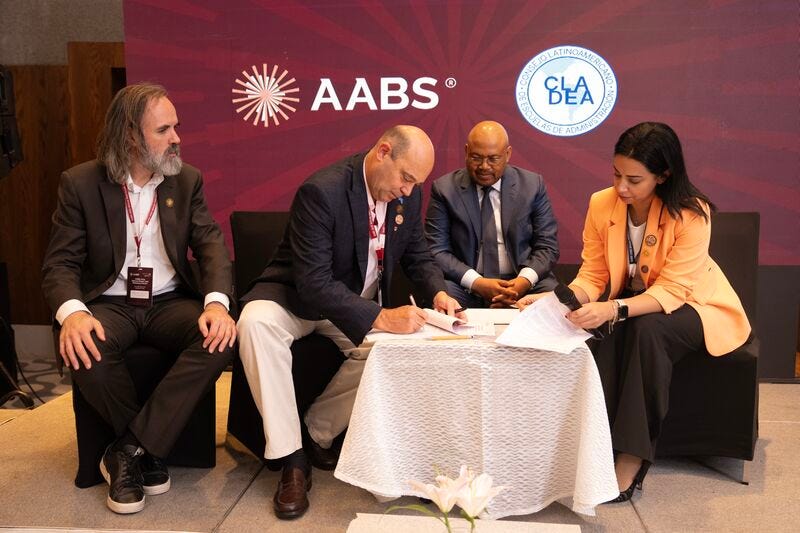
The session […] emphasized the opportunity for Global South scholarship to reshape management thinking worldwide. For example, the Association of African Business Schools (AABS) and CLADEA — Consejo Latinoamericano de Escuelas de Administración signed a landmark cooperation agreement to strengthen collaboration between Africa and Latin America in advancing business education.

Press enter or click to view image in full size

This partnership establishes a shared framework for joint initiatives, academic exchange, and capacity building, reflecting a commitment to developmentsustainability, and ethics in business education. The agreement reinforces that both associations will collaborate in harmony with their social environments while advancing mutual objectives.

A decisive step toward expanding global collaboration and amplifying new voices shaping the future of business education.

And finally…

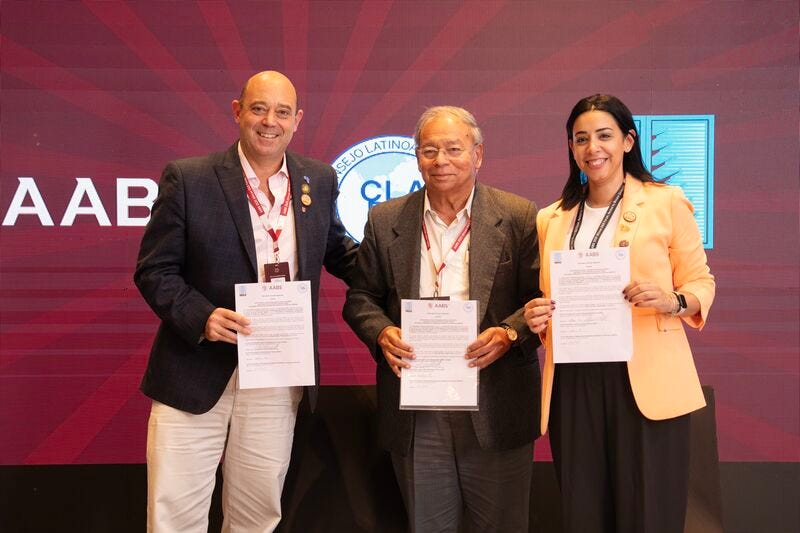
The Association of African Business Schools, CLADEA — Consejo Latinoamericano de Escuelas de Administración, and AMDISA — Association of Management Development Institutions in South Asia have signed a collaborative agreement to strengthen cooperation across Africa, Latin America, and South Asia.

Press enter or click to view image in full size

The parties will identify opportunities of common interest, including academic information exchange, joint events, and communication of relevant activities through their respective platforms. Collaborative actions, such as conferences, research projects, or training programs, will be developed and approved collectively, with no membership fees or financial commitments implied. Each association will assume its own costs for jointly agreed initiatives.

A strategic partnership expanding academic exchange and building bridges across three dynamic regions shaping the future of global business education.


Originally published at https://www.linkedin.com.