DD
MM
YYYY

PAGES

DD
MM
YYYY

spot_img

PAGES

Home Blog Page 173

Taiwan Edges Toward 6% Growth as AI-Fueled Tech Demand Powers a Stunning Economic Upswing

0

Taiwan is riding an economic wave unlike anything it has experienced in years, and the force behind it is unmistakably an explosive global appetite for artificial intelligence technology.

The island’s economy, long anchored by its role in the semiconductor supply chain, is now accelerating so quickly that officials say full-year growth could come close to 6%, a level few had envisioned even months ago.

The surprising momentum became impossible to ignore after Taiwan posted a 7.64% year-on-year expansion in the third quarter, a figure that stunned both policymakers and private-sector economists. The Directorate-General of Budget, Accounting and Statistics (DGBAS) admitted it had expected growth of only around 1% for the July–September period. Instead, the economy caught a powerful updraft from the global AI boom and soared far above the 6.0% growth forecast in a Reuters poll.

That performance pushed the agency to revise full-year projections upward. Minister Chen Shu-tzu told lawmakers the economy now appears capable of exceeding 5.5% and could approach 6% if current conditions hold. The strength of Q3 effectively forced a rethink of the year’s entire trajectory.

The reason for the jump is straightforward: Taiwan has become indispensable to the world’s AI push. Its export-oriented economy has absorbed massive orders for high-performance chips and components that power everything from advanced data centers to generative AI models. At the heart of this surge is Taiwan Semiconductor Manufacturing Company (TSMC), whose chips sit inside the systems built by global giants such as Nvidia. TSMC has already reported record profits and raised its sales outlook, pointing to “very strong” demand coming directly from AI-related customers.

That tide has lifted the island at a moment of increasing external pressure. The United States, under the Trump administration, imposed a 20% tariff on many Taiwanese exports. While semiconductors are exempt from the duty, several other categories have been hit. Taiwan is still in discussions with Washington to roll back the tariffs, but for now, the tech sector’s unprecedented upswing has absorbed much of the impact.

The semiconductor boom is rippling across the broader economy. Recent export data shows some of the fastest gains seen in 15 years, driven almost entirely by AI-chip orders. Major international banks and research firms have noted the scale of the shift, with Morgan Stanley and others projecting that global tech firms will spend hundreds of billions of dollars this year on AI infrastructure alone. A sizeable portion of that spending is landing in Taiwan’s factories, labs, and packaging facilities.

The surge has also highlighted an emerging challenge: electricity. Taiwan’s power grid, while modern and reliable, is now being pushed to prepare for the immense energy requirements of next-generation chip fabrication and data-center expansion. Analysts have warned that Taiwan will need to significantly increase power availability if it intends to keep pace with global AI demand in the coming decade. The government has already begun planning for this, but the scale of the anticipated load is sparking new national conversations about energy supply.

The tech boom does not erase risk. Exchange-rate pressures remain a lingering concern for manufacturers, especially as the New Taiwan dollar fluctuates. TSMC has already noted that currency movements and the high costs associated with expanding overseas — particularly in the United States — could affect its margins.

However, those same challenges underscore the strategic weight Taiwan now holds. Few places on earth are as central to the AI revolution. From GPU-grade silicon to advanced packaging and next-generation memory integration, Taiwan is embedded in nearly every layer of global production. That concentration of expertise is one reason its economy is expanding while others cool.

The next milestone arrives on November 28, when the DGBAS unveils the final growth forecast for 2025 and a fresh outlook for 2026. Analysts will watch closely for signs of how sustainable this current boom might be, and whether structural issues — tariffs, power constraints, and global supply cycles — could shape the next phase of Taiwan’s economic story.

For now, though, the numbers speak for themselves. A quarter that was expected to grow only modestly instead delivered a surge strong enough to redefine the year.


Shiba Inu (SHIB) Seller Exhaustion Could Trigger 300% Relief Rally, While One New Meme Coin Flashes 18371% Profit Opportunity

0

After months of sideways price action, investors across the meme coin market are beginning to notice a major shift: capital is rotating into lower-cap, high-upside tokens, and Little Pepe (LILPEPE) is emerging as one of the strongest beneficiaries of that trend. The project’s presale continues to accelerate, with over $27.5 million raised so far and tokens in Stage 13 priced at $0.0022, already showing gains of 120% for the earliest buyers. This surge in investor interest comes at the same time that larger meme coins like Shiba Inu (SHIB) appear to be losing momentum. SHIB is currently trading near $0.0000124, and while on-chain data shows signs of seller exhaustion, meaning a potential 300% relief rally is still possible, many traders are asking whether SHIB can realistically deliver the kind of exponential gains it once did. The growing consensus is that while SHIB may recover, the higher upside may now lie in emerging projects like LILPEPE.

Little Pepe (LILPEPE) Presale Reaches Stage 13, Surpassing $27.5 Million Raised

The ongoing Little Pepe (LILPEPE) presale, launched in June 2025, continues to accelerate as investor interest grows. The project has now raised over $27.5 million, with more than 16.6 billion tokens sold from its 100 billion total supply, demonstrating strong and sustained market confidence and community enthusiasm.

The presale follows a structured 19-stage rollout with gradual price increases at each stage to reward early participants and maintain consistent momentum. Stage 1, priced at $0.001, sold out in three days, raising nearly $500,000. Stage 2, priced between $0.0011 and $0.0015, generated over $1.23 million. By the completion of Stage 10, the token price had risen to $0.0019, with 12.75 billion tokens sold and a cumulative $19.32 million raised. Stage 13 tokens are currently priced at $0.0022, and Stage 14 will launch at $0.0023. The confirmed exchange listing price is $0.0030, offering early participants the potential for gains of approximately 120%.

A major factor driving Little Pepe’s growth is its vibrant and rapidly expanding community. The team has launched a $777,000 presale giveaway, awarding ten winners $77,000 worth of LILPEPE tokens each, with a minimum contribution of $100 required to qualify. In addition, a Mega Giveaway spanning Stages 12 through 17 is distributing a total of 17.5 ETH in rewards. The largest buyer will receive 5 ETH, followed by 3 ETH and 2 ETH for the second- and third-largest buyers respectively. Fifteen randomly selected participants will each receive 0.5 ETH. These tiered giveaways are designed to incentivize both large and small investors, encourage continued participation, and sustain presale momentum.

Community Growth Fuels Little Pepe’s Rapid Momentum

The Little Pepe (LILPEPE) token operates on a custom-built Layer 2, EVM-compatible blockchain engineered for high-speed transactions, near-zero fees, and scalability. The network offers near-instant confirmations, zero trading taxes, and robust protection against sniper bots and exploit attempts to ensure fair presale participation. Built-in holding incentives and reward mechanisms foster long-term engagement, strengthen investor confidence, and maximize token utility. Together, these technical and community-driven initiatives have created a secure, fast, and highly engaging ecosystem that continues to attract investors ahead of exchange listings and full-scale ecosystem development.

Little Pepe has now raised over $27.5 million during its presale, with more than 16.6 billion tokens sold from a total supply of 100 billion. Stage 13 tokens are priced at $0.0022, while Stage 14 will rise to $0.0023, offering early investors significant upside before the confirmed exchange listing at $0.0030. With a vibrant community, structured giveaways totaling $777,000, and a fast, fee-free Layer 2 blockchain, LILPEPE combines utility, engagement, and growth potential. Investors seeking the next high-upside meme coin should act before the presale advances to later stages.


For more information about Little Pepe (LILPEPE) visit the links below:

Website: https://littlepepe.com

Whitepaper: https://littlepepe.com/whitepaper.pdf

Telegram: https://t.me/littlepepetoken

Twitter/X: https://x.com/littlepepetoken

$777k Giveaway: https://littlepepe.com/777k-giveaway/

Gold Retreats After Brief Surge as Market Turbulence Follows U.S. Government Reopening

0

Gold prices slipped on Thursday after touching their highest level in three weeks, caught in a sweeping market downturn that followed the end of the record-long U.S. government shutdown.

The reopening removed a major source of uncertainty for investors, triggering a broad sell-off that hit everything from metals to equities to digital assets.

Spot gold was down 1.1% at $4,151.86 per ounce by 02:16 p.m. EST (1916 GMT). U.S. gold futures for December delivery settled 0.5% lower at $4,194.50. The downturn came only hours after bullion climbed to $4,244.94, a level last seen on October 21.

Silver followed a similar arc. After rising to its strongest price since October 17, spot silver reversed course and dropped 2.3% to $52.18.

The sharp swing in sentiment emerged as Washington finally restarted federal operations following a 43-day shutdown. The agreement funds government agencies through January 30, ending the longest closure in U.S. history and unlocking economic data that had been frozen for more than a month.

That sudden shift in the political landscape sparked a wide retreat across markets.

“Precious metals are caught in a widespread selloff, where stocks, bonds, the dollar, and crypto are all under pressure and in the red,” said independent metals trader Tai Wong. “It’s a classic buy-the-rumor, sell-it-all after the U.S. government re-opens.”

Before the sell-off began, traders had pushed gold higher on expectations that the release of delayed economic statistics would show a weakening labor market. Analysts believed such weakness could push the Federal Reserve toward at least one more interest-rate cut in December.

“Gold and silver markets rallied on the expectation that economic data released after the end of the shutdown will reveal U.S. labor market weakness and push the Fed toward at least one December rate cut,” said Jim Wyckoff, senior analyst at Kitco Metals.

However, the mood shifted as investors reassessed the Fed outlook. Several policymakers have signaled they want to see firmer evidence of cooling before supporting additional easing. Inflation concerns remain unresolved, and private sector surveys have pointed to labor softening without painting a clear picture.

The central bank has already trimmed rates twice this year, and the most recent cut came in the previous month. Still, Fed Chair Jerome Powell said further reductions this year are not assured, stressing that the shutdown created major gaps in key datasets the bank normally relies on.

Lower borrowing costs tend to help gold because the metal yields no income and becomes more attractive when interest rates fall. That dynamic helped fuel the multi-month rally in bullion earlier this year, but the current landscape has grown more complicated as investors juggle inflation risks, patchy economic information, and uncertainty about the timing of future Fed decisions.

The volatility spread across the precious metals complex. Platinum slipped 2.8% to $1,569.65, while palladium sank 3.7% to $1,419.75.

Analysts say gold could remain choppy in the short term as markets digest the coming wave of economic releases and weigh their implications for U.S. monetary policy. The return of federal data over the next several weeks could provide clearer signals on inflation trends, consumer spending, and the labor market — all of which will shape the Fed’s next move and determine whether bullion stabilizes or faces renewed turbulence.

DOGE, SHIB, and Pepe Predictions Turn Bullish, But Ozak AI’s Outlook Feels Stronger

0

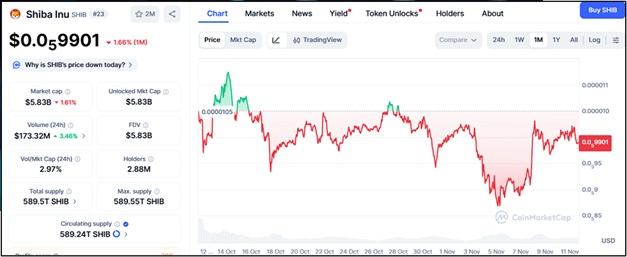
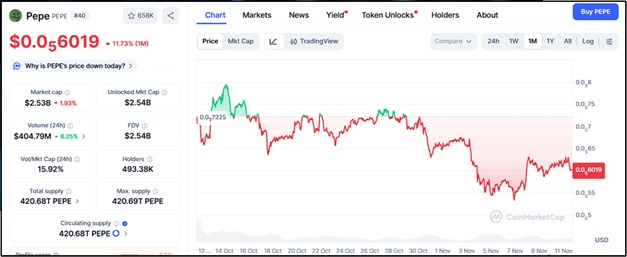
Crypto markets are entering another euphoric phase, and meme coins are once again leading the charge. Dogecoin (DOGE), Shiba Inu (SHIB), and Pepe (PEPE) are all gaining momentum as traders rotate back into high-volatility tokens that defined previous bull cycles. DOGE trades at $0.1782, SHIB at $0.000009901, and PEPE at $0.000006019, each showing renewed strength on social and technical indicators.

But while these tokens are riding a familiar wave of meme-fueled hype, the most compelling story in the market today isn’t another meme—it’s intelligence. Ozak AI (OZ), an AI-powered blockchain project, is rapidly emerging as the next big narrative, offering the potential for 100x growth and redefining what real utility looks like in crypto’s next evolution.

Dogecoin (DOGE) Overview

Dogecoin (DOGE) remains the most recognized meme coin in crypto history, a symbol of community-driven success. Currently trading around $0.1782, DOGE shows resistance at $0.194, $0.215, and $0.242, while support rests at $0.162, $0.145, and $0.129.

Dogecoin’s strength lies in its deep cultural influence and massive retail following. With major mentions by Elon Musk and potential integration for payments within the X ecosystem, DOGE retains powerful upside catalysts. Analysts believe that if market sentiment stays bullish, the coin could reach $0.25–$0.30, which would represent a substantial near-term gain.

owever, while Dogecoin’s meme momentum continues to thrive, its lack of evolving utility remains a limiting factor. Investors seeking long-term, technology-driven upside are increasingly turning to projects like Ozak AI, where real innovation—not hype—drives value.

Shiba Inu (SHIB) Overview

Shiba Inu (SHIB) is building its next phase of growth on substance, not just sentiment. Trading near $0.000009901, SHIB is testing resistance at $0.0000115, $0.0000138, and $0.0000162, while support levels sit at $0.0000087, $0.0000076, and $0.0000069.

The token’s evolution beyond its meme origins is evident through Shibarium, its Layer-2 scaling solution designed for faster, cheaper transactions, as well as ShibaSwap, its decentralized exchange. Combined with ongoing burn mechanisms to reduce supply, SHIB’s fundamentals are improving each quarter.

If Shibarium adoption accelerates and broader retail sentiment returns, analysts predict SHIB could 20x by 2026. Still, while it remains a strong community asset, its upside is capped by competition and market maturity—especially when compared to the disruptive potential of AI-based blockchain projects like Ozak AI.

Pepe (PEPE) Overview

Pepe (PEPE), the newest of the top meme coins, has shown resilience and speculative strength since its explosive debut. Now priced at $0.000006019, PEPE faces resistance at $0.0000069, $0.0000078, and $0.0000093, with support at $0.0000054, $0.0000048, and $0.0000041.

PEPE thrives on retail speculation and social media virality, often leading market rallies fueled by memes and trading volume surges. Many traders anticipate a potential 15x–25x run if meme mania peaks again. However, PEPE—like its predecessors—lacks long-term innovation, and its sustainability depends heavily on social hype rather than technological progress.

This contrast is exactly why investors and analysts alike are now turning their attention toward Ozak AI (OZ), a project that combines real-world AI utility with blockchain scalability, representing the next evolutionary leap beyond memes.

Ozak AI (OZ) Overview

Ozak AI (OZ) stands apart as a project redefining what “smart crypto” really means. Built at the convergence of artificial intelligence, predictive analytics, and blockchain automation, Ozak AI creates a self-learning decentralized ecosystem capable of analyzing data, predicting trends, and executing automated decisions.

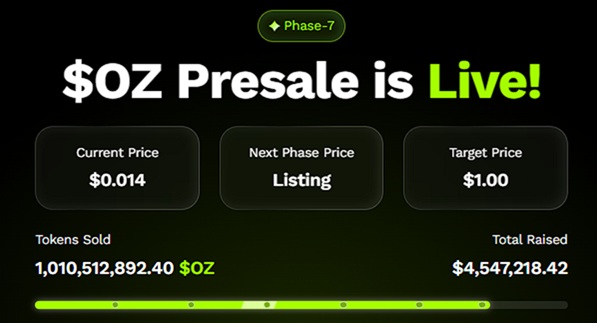
Currently in its 7th OZ presale stage, Ozak AI has already raised over $4.5 million and sold more than 1 billion OZ tokens, showing significant early investor confidence. Its ecosystem is powered by AI prediction agents—autonomous digital entities that process blockchain and off-chain data to drive actionable intelligence in DeFi, trading, and governance.

Ozak AI’s robust partnerships include:

  • Perceptron Network’s 700,000+ nodes for scalable AI computation.
  • HIVE’s 30 ms signal processing for ultra-fast predictive analytics.
  • SINT’s cross-chain AI agents and voice-driven systems for real-time interoperability.

Audited by CertiK and Sherlock, and listed on CoinMarketCap and CoinGecko, Ozak AI offers both credibility and transparency—a rare combination for a presale project. Analysts forecast that Ozak AI could reach $1 per token, translating to a 100x return from its current presale valuation of $0.012.

From Memes to Machines—The Market’s Next Big Rotation

While Dogecoin, Shiba Inu, and Pepe are once again generating headlines and short-term profits, Ozak AI represents the next major leap in crypto’s evolution—from viral communities to intelligent ecosystems. Meme coins thrive on emotion, but Ozak AI thrives on automation, intelligence, and data—the true drivers of the next bull cycle.

Investors who made fortunes flipping DOGE, SHIB, and PEPE are now looking for the next asymmetric play, and Ozak AI checks every box: cutting-edge tech, early entry, and long-term scalability. In 2021, memes defined crypto culture. In 2025, AI will define crypto’s future—and Ozak AI is leading that transformation.

About Ozak AI

Ozak AI is a blockchain-based crypto venture that offers a technology platform that focuses on predictive AI and advanced records analytics for monetary markets. Through machine learning algorithms and decentralized network technologies, Ozak AI permits real-time, correct, and actionable insights to help crypto fanatics and companies make the precise choices.


For more, visit:

Website: https://ozak.ai/

Telegram: https://t.me/OzakAGI

Twitter: https://x.com/ozakagi 

Solana Active Addresses Hit 12-Month Low Amid Fading Memecoin Hype, as FanDuel, CME Group Announce Partnership

0

The Solana blockchain has seen a notable slowdown in user activity, with daily active addresses dropping to approximately 3.3 million—a 12-month low and a roughly 67% decline from the January 2025 peak of over 9 million.

This metric, which tracks unique addresses signing transactions, reflects the network’s heavy reliance on speculative memecoin trading that drove explosive growth in late 2024 and early 2025.

As that frenzy subsided throughout the year, participation has normalized toward more sustainable levels, highlighting vulnerabilities in ecosystems tied to single-use cases like token launches. Despite the dip, Solana shows signs of resilience: DeFi TVL steady at ~$10B: Protocols like Jupiter, Kamino, and Jito continue to anchor liquidity and infrastructure.

Memecoin niche persists: Platforms such as Pump.fun still generate over $1M in daily volume, holding ~90% market share for token launchpads. Spot Solana ETFs like Bitwise’s BSOL and Grayscale’s GSOL recorded strong inflows last week, totaling $6.8M, outpacing Bitcoin and Ethereum funds.

Whale accumulation has also risen, with net spot inflows averaging $26M on major exchanges. This cooldown could ultimately benefit Solana by shifting focus to durable applications like payments, gaming, and real-world asset (RWA) tokenization.

However, it underscores the need for broader diversification to weather narrative shifts. As of November 13, SOL trades around $155, with key support at $148–152 and resistance near $172. Recent X discussions echo this sentiment, with users like Scottmelker highlighting the drop as a key metric and Inthecryptoflow noting it might improve the ecosystem’s long-term reputation by weeding out pure speculators.

a16z Leads $10M Round for Privacy L1 Seismic, Total Funding Hits $17M

In a contrasting tale of innovation, crypto startup Seismic has secured $10M in fresh funding to advance its privacy-focused Layer 1 blockchain, bringing total capital raised to $17M.

The round was led by a16z crypto, with participation from Polychain Capital, Amber Group, TrueBridge Capital, dao5, and LayerZero Labs. This follows an earlier $7M seed in March 2025, also led by a16z.

Seismic’s core offering is an encrypted blockchain infrastructure that enables app-level privacy for fintechs, allowing them to process crypto transactions (e.g., on/off ramps, card programs, stablecoin accounts) without exposing sensitive customer data.

Built with Rust and REVM for EVM compatibility, it abstracts complex cryptography like zero-knowledge proofs, making it developer-friendly for DeFi, payments, identity, and secure data sharing. Key features include: Modular SDKs/APIs for plug-and-play encryption.

TEE-secured channels to bridge public blockchain transparency with institutional confidentiality needs. Composable privacy primitives that avoid the pitfalls of local ZK-proof generation.

The timing aligns with rising demand: a16z’s “State of Crypto” report notes a 400% YoY surge in Google searches for “crypto privacy solutions” in 2025, driven by regulatory pressures and data leak concerns. Seismic has already partnered with fintechs like Brookwell stablecoin accounts and Cred private credit, routing transactions through private rails to comply with GDPR-like standards.

This investment signals a16z’s bet on privacy as a “must-have” for mainstream adoption, positioning Seismic to compete with projects like Cardano’s Midnight sidechain or Tempo. On X, founder lyronctk’s announcement post garnered many interactions, with community buzz around its potential for Web3-fintech integration.

These developments paint a maturing crypto landscape: Solana grapples with post-hype stabilization, while Seismic exemplifies targeted VC backing for unsolved problems like privacy. Both could catalyze broader ecosystem growth if they pivot toward utility over speculation.

FanDuel and CME Group Announce Prediction Markets Partnership

FanDuel has partnered with CME Group to launch a new prediction markets platform, marking a significant expansion into event-based trading. The collaboration was first announced in August 2025 and detailed further on November 12, 2025, with a planned launch in December 2025.

This move combines FanDuel’s expertise in user-friendly mobile gaming and its massive U.S. customer base over 17 million users with CME Group’s century-long leadership in regulated derivatives markets.

The new standalone mobile app, FanDuel Predicts, will debut in December 2025. It will be available nationwide in the U.S., with a focus on states without legal online sports betting, allowing broader access to financial-style trading.

Contracts on outcomes in football, basketball, hockey, and baseball (e.g., game winners, totals, or other event-based predictions). Non-sports markets including S&P 500 and Nasdaq-100 benchmarks, oil and gas prices, gold, cryptocurrencies, GDP, and CPI.

Users will buy and sell “event contracts” priced between $0.01 and $0.99, similar to binary options. Contracts settle based on real-world outcomes, with CME Group handling pricing, clearing, and settlement for regulatory compliance under the CFTC (Commodity Futures Trading Commission).

Requires standard KYC verification (birth date, SSN, address, banking info, ID). Includes educational resources on prediction markets, spending trackers, deposit limits/alerts, and self-exclusion options—mirroring FanDuel’s responsible gaming tools.

Operates as a non-clearing Futures Commission Merchant (FCM) to facilitate trades without direct clearing risks. As sports betting taxes and regulations intensify in states like Illinois up to 40% on revenue, FanDuel is diversifying into CFTC-regulated prediction markets.

This builds on Flutter Entertainment’s Betfair Exchange in the UK and aims to attract “a new generation” of traders, as noted by CME CEO Terry Duffy. Amy Howe, CEO of FanDuel: “We can’t wait to bring FanDuel’s proven approach to product innovation into this dynamic sector.

Our partnership with CME Group allows us to leverage their deep market expertise built over decades while delivering the seamless, accessible and trusted experience our customers expect.”  Terry Duffy, Chairman & CEO of CME Group: “Our new event contracts on benchmarks, economic indicators and now sports will appeal to a new generation of potential participants who are not active in these markets today.

This launch will dramatically expand our distribution and reach, connecting directly with FanDuel’s millions of registered U.S. customers.” This partnership positions FanDuel as a bridge between entertainment betting and sophisticated financial trading, potentially challenging platforms like Kalshi or Robinhood in the growing U.S. prediction markets space projected to expand amid rising interest in event-based speculation.

By structuring contracts as CFTC-regulated event trades binary options priced $0.01–$0.99, FanDuel can offer sports outcomes in the 40+ states without online sports betting legalization. This creates a federally compliant workaround to patchwork state laws, potentially unlocking millions in untapped revenue without needing new licenses or taxes.

However, sports contracts will phase out in states as betting legalizes to comply with dual regulations. The app mandates KYC verification and includes FanDuel’s responsible gaming tools deposit limits, self-exclusion, spending trackers, plus CME’s risk management for clearing and settlement.

This promotes safer trading but could deter casual users due to the SSN/ID requirements, blurring lines between “fun” betting and “serious” investing. As a non-clearing FCM model, this could accelerate CFTC approvals for similar platforms, encouraging sportsbooks to pivot from state-dependent models to federal derivatives.

Analysts, including Deutsche Bank, have upgraded CME Group’s stock outlook partly due to this growth driver, raising the price target to $300 from $266. Financial terms weren’t disclosed, but it underscores a trend of sportsbooks evolving into fintech hybrids.