Baidu, a Chinese multinational technology company specializing in Internet services and Artificial Intelligence, has unveiled two new AI models as it intensifies efforts to strengthen its position in China’s highly competitive AI landscape.
The two new models are Ernie 4.5, the latest version of the company’s foundational model first released two years ago, and a new reasoning model, Ernie X1.
The roll-out of these models, marks a shift in Baidu’s strategy, with the company embracing an open-source approach to keep pace with emerging players.
Baidu claims that Ernie X1’s performance is “on par with DeepSeek R1 at only half the price,” and it touts Ernie 4.5’s “high EQ,” allowing the model to understand memes and satire. Both models have multimodal capabilities, allowing them to process video, images, and audio, as well as text.
Recall that Ernie Bot garnered one million downloads within 19 hours of its release, and Baidu’s shares rallied by over 4% on the day of release. This positive response signified the potential of Baidu’s AI initiatives, which were expected to drive more traffic to its search engine and boost ad revenues, however, the momentum wasn’t sustained as it struggled to keep up with the intense competitive AI space.
Industry analysts see the launch of Baidu’s two new AI models as a necessary move for the company, which has struggled to maintain dominance and widespread adoption, since the launch of its AI chatbot Ernie in 2023. Once positioned as China’s answer to OpenAI’s ChatGPT, Ernie has since been outpaced by offerings from innovative startups like ByteDance (TikTok parent company), Alibaba, and Deep Seek, amongst others.
“Baidu has been slow to adapt to market shifts, allowing rivals to gain ground,” said Wei Sun, an Al analyst at Counterpoint Research. “The success of its new models will depend on whether they truly deliver better performance and cost efficiency.”
One of Baidu’s key challenges has been its reliance on proprietary Al development, a contrast to competitors who have embraced open-source methodologies. Unlike closed-source models that are developed in isolation, open-source Al benefits from community contributions, accelerating improvements and adoption.
“Baidu initially resisted the open-source movement, believing its proprietary approach would offer a competitive edge,” said Kai Wang, a senior equity analyst at Morningstar. “However, companies like DeepSeek have demonstrated that open models can be just as powerful, if not more so while being significantly cheaper to develop.”
Regulatory pressures have also slowed Baidu’s Al advancements. The company has had to navigate government policies while securing funding in a fast-evolving market, diverting resources away from innovation.
In response to these setbacks, Baidu recently announced plans to open-source its next-generation Ernie model starting June 30.
This shift aligns it with major Chinese tech firms like Alibaba, Tencent, and DeepSeek, all of which have already embraced open Al development. “Baidu is now following the path of its competitors,” said Lian Jye Su, chief analyst at Omdia. “It remains to be seen whether this pivot will be enough to restore its standing in China’s Al race.”
As the competition between artificial intelligence (AI) chatbots intensifies, several companies and researchers in China are making progress on building Chinese-language AI models.
With growing competition from domestic and international AI firms, Baidu aims to solidify its position through continuous innovation. This latest launch of two new AI models could help it regain relevance provided its new models live up to expectations.
There is a growing consensus among crypto analysts that the next FOMC meeting—scheduled to take place later this week—could ignite a fresh relief rally across the market.
The basis of their bullish predictions is grounded on the latest estimates of the CME Group’s FedWatch tool—which shows a 99% probability that the Fed will keep the rates steady.
If the Fed eventually keeps the current rates intact without delivering any hawkish surprises, it might possibly trigger a natural market reset—which could translate into much upward momentum for Bitcoin and altcoins. This makes it important for smart money investors to find the best crypto to buy as soon as possible.
In this article, our team of experts have curated a list of the top six crypto projects that are worth considering for outsized returns as the market heads into FOMC day with optimism.
Best Crypto To Buy Now For Excellent Returns
BTC BULL
The current market volatility has done nothing to shake the bullish conviction of Bitcoin investors. According to data from Coinglass, the open interest (OI) in the premier cryptocurrency has been experiencing a noticeable increase over the past few weeks, sitting at approximately $50 billion at press time.
While its sideways movement since February has created short-term concerns, the persistent surge in its OI shows that more people are betting on immense growth for BTC in the future. And with the growing expectation that the next FOMC meeting could mark a bullish turnaround for the market, there’s no better time than now for bulls to consolidate a stronger community around BTC than now.
This explains why new projects like BTC Bull are dominating headlines. Marketed as the unstoppable movement pushing Bitcoin to the $1 million mark, the goal of this project is to provide an avenue for bulls to speculate on BTC’s growth potential while earning multiple perks.
Its major selling points? Free BTC airdrops and continuous token burns as Bitcoin achieves each of the milestones spelt out in its roadmap.
Whenever Bitcoin reaches $125k, $150k, $175, $200k, and $250k, BTC Bull holders can expect either Bitcoin airdrops or token burns. The project’s strong connection to Bitcoin’s growth is further complemented by a staking option, which still offers an APY reward of approximately 110%.
This feature, alongside the allure of free BTC airdrops, has been commended by popular crypto analysts like Nass Crypto, who said the project could make early movers millionaires in 2025.
Solaxy
Solaxy has been in high demand since arriving on presale, thanks to its meme-like appeal and meaningful utility. Advertised to the world as the first L2 solution on Solana, this project aims to deal with the congestion issues affecting the Layer-1 mainnet through its rollup architecture.
Near “infinite” scalability is the goal in which Solaxy has set out to achieve, and by functioning as an off-chain scaling solution, it is well-positioned to help Solana perform optimally even during peak cycles.
However, unlike most L2 solutions, Solaxy is not limited to one chain alone—its advanced rollup architecture benefits both Solana and Ethereum users, optimizing transaction speeds and streamlining asset transfers across the two blockchains. This particular feature of Solaxy, according to experts, could make it easier for developers to build multi-network applications within its ecosystem.
In addition to its Layer-2 functionality, Solaxy has also come up with a staking model that rewards early supporters for their contributions to the security of the network. At press time, staking on Solaxy guarantees a three-digit APY reward, making it a valuable source of passive income for those who believe in its long-term potential.
In spite of the increasing downside volatility in the market, Solaxy has managed to raise close to $27 million, indicating strong investor interest. And as the demand for projects that thrive at the intersection of scalability and real-world usability continues to grow, Solaxy could be a key player in the ever-evolving blockchain landscape.
Meme Index
While the cumulative market cap of meme coins has dropped drastically from its recent high, that does not mean that the meme coin narrative has weakened by any means. Most investors still believe strongly in the potential of meme coins to deliver massive returns when the market outlook flips bullish.
However, considering the unpredictable nature of the sector, finding the next big meme coin can be difficult. Meme Index streamlines the process by introducing an index fund-style approach to navigating the market volatility, allowing investors to bet on a basket of top-performing meme tokens instead of a single asset.
What makes Meme Index more special than other existing indices is its versatility. It plans to launch four indices that will cater to every class of investors, offering a structured way to capitalize on the market. Those seeking to invest in high-cap meme coins can pick the Meme Titan Index. Next is the Moonshot Index, which curates assets that have strong communities but yet to reach the $1 billion benchmark.
Riskier assets, particularly the ones within the $250 million to $500 million market cap category, make up the Midcap Index, while meme coins with the highest level of risk will be featured in the Frenzy Index.
The project’s decentralized model means the four indices will be rebalanced through community feedback, which is another reason why experts consider it an intriguing option for those aiming to take the most advantage of the meme coin market.
It is only a matter of days before the presale comes to a close and experts are already projecting a strong start for the meme coin.
Best Wallet Token
The dramatic swings in crypto prices has brought more eyes to projects offering a combination of practical utility and long-term returns in one distinctive package. Best Wallet Token—a multi-utility crypto powering Best Wallet—can be considered one of the few projects in this category.
As an integral component of the rapidly growing wallet solution, this crypto plays a huge role in enhancing all the features embedded in the platform. From facilitating reduced transaction fees and higher staking opportunities to providing early access to many high-potential presales and governance rights, Best Wallet Token ticks all the right boxes to deliver an unparalleled investment experience.
With the trust in CEX fading away, especially after the recent Bybit hack, decentralized platforms—which allows users to take full control of their assets—have gained traction. However, Best Wallet offers something extra by leveraging heavyweight tools such as Fireblocks to make crypto storage more accessible and secure than before.
An additional highlight is its intuitive facility, which makes it possible to buy and sell thousands of crypto assets using fiat currency. Other notable features include cross-chain swaps, iGaming, token launchpad, staking perks, and many more, making it an all-around destination for everything crypto.
The rapid adoption of the wallet is evident in the surging demand for Best Wallet Token. With over $11 million raised in its presale, the project has already demonstrated strong momentum, and once the token launches, its utility-driven demand could further drive its price to the moon, making it a suitable hold for those seeking tangible returns this year.
Mubarak
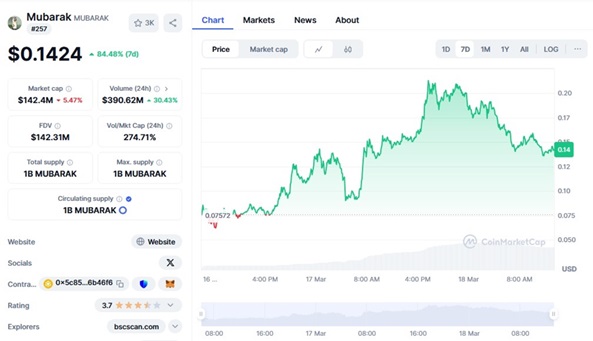
As the broader market gears up for another bullish phase, Mubarak—a new Binance Smart Chain meme coin—has made experts’ lists of the best crypto to watch closely. Its origin could be traced to last week’s X post by Binance co-founder Changpeng Zhao—where he used the Arabic word “Mubarak,” meaning “blessings.”
This viral post resulted in the creation of the meme coin on Four-Meme—the first-ever meme coin launch platform on the BNB chain. Since its debut, Mubarak has been on fire, jumping from its initial market cap of $6,000 to $150 million.
The FOMO vibe around the BSC meme coin intensified after CZ himself bought about $600 worth of MUBARAK tokens. CZ’s involvement, coupled with the token’s listing on Binance Alpha and other notable CEXs like Gate.io and MEXC, elevated its visibility among degen investors and pushed its market cap to $200 million before a brief reversal.
As the Mubarak price surged, one trader who dived in very early with just $232 made an astonishing 4,860x returns, according to data from Lookonchain. At press time, it is still one of the few cryptos trading in the green, exchanging hands around $0.142.
And now that the momentum is showing no signs of going away anytime soon, crypto analysts are predicting even more growth for the meme coin, making it a suitable option for those seeking short-term returns.
MIND of Pepe
Prominent publications including Cryptonomist, Bitcoinist, and NFT Evening have already mentioned MIND of Pepe as one of the best crypto projects that could bring huge returns to early investors. Developed by Elvora Labs, this project is marketed as an autonomous AI agent embodying the personality of Pepe and the utility of an advanced trading bot.
What makes MIND of Pepe particularly interesting right now is its fusion of the cultural relevance of Pepe with the cutting-edge technological innovation of AI, making it a top contender in both niches. The project’s whitepaper has already highlighted many use cases but the one generating the most attention is its “holder exclusive trading alpha.”
This simply means those who hold its native token—MIND—will be able to enjoy premium access to distinct AI-generated signals and insights into some of the best early-moving opportunities on the market.
More so, as a self-evolving agent, MIND of Pepe has been designed in such a way that allows it to track social media trends, analyze market sentiment, interact with people on social media, and even generate its own opinion. It will also act as a launchpad for other new tokens, which is one reason experts believe it could appeal to a larger pool of investors.
An additional highlight is the staking perks currently offered by the project, which serves as an avenue for early investors to amplify their returns.
So far, $7.4 million has been raised in its ongoing presale, making it one of the most sought-after utility-driven crypto presales on the market. With demand surging each day, ClayBro says MIND could be poised for an explosive debut.
Bottom Line
With various indications suggesting that the Fed will keep the interest rates steady when it meets later this week, there is a growing possibility that the crypto market might be heading towards a more stable condition soon. This possibility has created a rush to find the best crypto to buy now.
To help with this, our experts have already provided a list of crypto coins that could capitalize on the current market’s volatility to deliver outsized returns. Investors should pick the ones that suit their requirements, but only after doing due diligence.
It is always advisable to take a closer look at the vehicle’s history whenever purchasing a used car in order not to have bad surprises. A VIN check tells you a little about its past, like its accident record, ownership history, and possible title problems. While it conventionally depends on static databases, the process for conducting a VIN check has begun to change with AI, becoming much faster, more accurate, and more accessible.
AI and Big Data: A Game-Changer for VIN Checks
Artificial intelligence now powers VIN lookups in real-time by drawing on a vast range of vehicle data. Rather than simply fetching records from a single database, these AI-driven systems cross-reference details from multiple sources, uncover inconsistencies, and identify potential fraud. For instance, they can flag suspicious odometer readings if discrepancies arise across different reports. Using tools like VinInspect, buyers can be confident that they have accurate, up-to-date information about a vehicle’s history before making a purchase. Learn more about decoding the VIN.
How AI Detects Hidden Vehicle History Issues
AI-powered VIN check systems go beyond basic record retrieval. They use predictive analytics and pattern recognition to detect issues that might go unnoticed in traditional reports. Here’s how:
Fraud Detection: AI can flag cases of VIN cloning, a scam where stolen cars are given false identities.
Accident Analysis: Machine learning models analyze accident reports and repair records to estimate the severity of past damage.
Title Verification: AI scans multiple databases to verify if a car has a salvage, rebuilt, or lemon title—even if a seller tries to hide it.
By leveraging these technologies, AI makes VIN checks more precise and comprehensive, helping buyers make informed decisions.
AI-Powered Mobile VIN Checks
And nowadays, with the rise of the AI-driven mobile application, scanning has become a no-brainer. Instead of manually typing that 17-character code, buying agents can simply run their smartphone camera lines to run the VIN barcode. AI draws it all out, instantly analyzes car history, and in real time renders a risk assessment in probability.
This immediate access to vehicle information lets buyers make swift yet informed decisions, even when physically inspecting a car.
The Role of AI in Predicting Future Vehicle Issues
AI doesn’t just analyze a car’s past but also predicts the potential future mechanical issues. By evaluating service records, mileage trends, and past accidents, AI can estimate:
The likelihood of engine or transmission failure
Potential safety risks based on recall data
Expected maintenance costs over time
This forward-looking approach helps buyers avoid unreliable vehicles and choose options that are likely to remain trouble-free.
Why AI-Enhanced VIN Checks Matter for Used Car Buyers
AI-driven VIN checks offer numerous advantages for car buyers:
Greater Accuracy – AI minimizes human errors in data processing.
Time Efficiency – AI-powered tools provide instant results, cutting down research time.
Cost Savings – Avoiding cars with hidden problems helps buyers save thousands in repairs.
The Future of AI in VIN Checks
As AI technology keeps on rising, even smarter features have to greet VIN checks. Some of their possible future aspects might include the following:
Integration with blockchain for tamper-proof vehicle history reports
AI-driven vehicle inspections using augmented reality (AR)
Voice-activated VIN lookups for hands-free car history searches
A combination of AI with VIN decoding is going to make buying a used car safer, smarter, and more transparent.
Final Thoughts
AI has revolutionized the VIN checks with much more confidence and security regarding the purchase of used cars. On the other hand, buyers using systems powered by AI, such as those from Vingurus, would be able to identify the possibility of odometer fraud, know the accident history, and rest assured that it’s really what it looks like with only a few clicks.
As the technology of AI evolves, so may expectations for even more innovative ways that we can conduct or have vehicle history checks assessed and verified. If buying a used car, embracing AI-powered VIN checks is a step toward smarter and safer buying decisions.
In today’s location-driven world, businesses and developers rely on precise geolocation data to enhance mapping services, optimize logistics, and deliver targeted content. Utilizing a robust geocode api can significantly improve the accuracy of converting addresses into geographic coordinates. In this blog post, we explore various strategies to improve accuracy when using a geocoding API. We will discuss the importance of reliable data sources, best practices for structuring address queries, methods for handling ambiguous or incomplete location data, and ways to refine results with additional parameters.
Understanding the Role of Data Sources in Geocoding API
The accuracy of geocoding largely depends on the quality and diversity of the underlying data sources. Reliable data sources ensure that the geocoding API can correctly interpret and translate address information into accurate coordinates. Here are some key aspects to consider:
Comprehensive Databases:
The best geocoding APIs integrate data from extensive and up-to-date geographic databases. These databases include official postal records, mapping datasets, and even crowd-sourced contributions that improve coverage in less-documented areas.
Data Validation:
Effective geocoding systems cross-reference multiple data sources to validate the accuracy of an address. This layered approach helps in reducing errors caused by outdated or inaccurate records.
Regional Specificity:
Some databases offer more detailed information for specific regions. Selecting a geocoding service that emphasizes data quality for your target region can result in better performance and higher accuracy.
Regular Updates:
Geographic data is constantly evolving with new developments, changes in street names, or modifications in postal codes. Services that frequently update their data repositories are better equipped to deliver precise results.
By understanding the role and quality of data sources, developers can select and configure geocoding APIs that provide reliable and accurate location data.
Best Practices for Structuring Address Queries Correctly
The way address queries are structured plays a crucial role in the effectiveness of a geocoding API. Clear and well-formatted queries reduce ambiguity and enhance the likelihood of accurate matches. Consider the following best practices:
Standardize Address Formats:
Use a consistent format when submitting address queries. For example, include street names, numbers, cities, postal codes, and countries in a structured manner.
Example Format: “123 Main Street, Springfield, IL, 62704, USA”
Avoid Abbreviations:
Unless widely recognized (like “USA” for the United States), avoid abbreviations that could lead to misinterpretation. Spelling out terms fully can enhance accuracy.
Utilize Known Data Fields:
Where possible, structure queries using distinct fields for each component (street, city, state, etc.). This can be achieved through APIs that support multi-field inputs or by pre-processing addresses into individual components.
Input Validation:
Implement validation checks in your application to catch common formatting errors before they are sent to the API. This helps in reducing errors and improving the quality of the data submitted.
Following these practices ensures that the geocoding API receives clear and precise queries, which significantly increases the chances of obtaining accurate geographic coordinates.
How to Handle Ambiguous or Incomplete Location Data
Not all address queries are created equal—ambiguous or incomplete data can pose challenges for geocoding systems. Here are several strategies to manage such situations:
Fallback Mechanisms:
If an address query is ambiguous, consider implementing a fallback process that asks the user for additional details. This can be done through interactive forms or prompt dialogs that guide the user to provide missing information.
Confidence Scores:
Many geocoding APIs return a confidence score along with the result, indicating how certain the system is about the match. Use these scores to determine if further verification is needed before using the data.
Partial Matches:
When faced with incomplete data, the API might return multiple potential matches. Present these options to the user so they can select the correct one, or use additional heuristics to choose the most likely match automatically.
Error Handling:
Design your application to handle cases where no match is found gracefully. Provide clear feedback and, if appropriate, suggestions on how to refine the input.
Data Enrichment:
Enhance incomplete addresses by leveraging external databases or services that can fill in missing details. This might include consulting postal code directories or local administrative data sources.
Implementing these strategies ensures that even when the initial input is less than perfect, the geocoding process remains robust and user-friendly.
Using Additional Parameters to Refine Geocoding API Results
To further improve the precision of geocoding results, many APIs offer additional parameters that allow for more granular control over the query process. Here are some common parameters and how to use them effectively:
Bounding Boxes:
Specify a geographic area (bounding box) within which the address is expected to lie. This is particularly useful when the same street name exists in multiple regions.
Language Settings:
Set the preferred language for the returned results, which can be crucial for international applications. This ensures that the address components are returned in a format that is familiar to the user.
Region Biasing:
Bias the search towards a specific region or country to avoid irrelevant matches. This can be particularly useful in countries with many similar address patterns.
Result Limits:
Define the maximum number of results returned for ambiguous queries. This helps in managing the volume of data and ensuring that only the most relevant matches are processed.
Custom Filters:
Some APIs allow custom filtering based on data attributes such as the type of location (residential, commercial, etc.) or the presence of specific landmarks. Using these filters can further narrow down the results to the most accurate match.
By leveraging these additional parameters, you can fine-tune your geocoding requests to meet the specific needs of your application, resulting in faster and more accurate outcomes.
In conclusion, improving accuracy with a geocoding API requires a combination of quality data sources, well-structured address queries, effective handling of ambiguous or incomplete data, and the use of additional parameters to refine results. By understanding and applying these best practices, developers can significantly enhance the reliability and performance of location-based services in their applications. Whether you’re developing a mapping tool, enhancing logistics operations, or building a location-aware mobile app, these strategies provide a solid foundation for accurate and efficient geocoding. More about “advanced geocoding techniques” you can read here and follow the recommended guidelines to keep your application running at peak performance in today’s data-centric environment.
Embarking on your journey into the world of Instagram API can seem daunting at first, but with the right guidance and resources, it becomes a manageable and rewarding endeavor. Whether you’re a developer looking to integrate Instagram features into your application or a marketer aiming to harness social data, a well-documented API is your key to success. For a comprehensive overview of the Instagram API, you might find resources like https://data365.co/instagram useful. This resource provides a gateway to understanding the essentials without implying any affiliation with the tool itself. In this post, we’ll take a deep dive into the basics of Instagram API documentation, discuss how to set up a developer account, clarify the concepts behind API keys and authentication methods, explore basic endpoints for data retrieval, and highlight best practices for making API requests.
Setting Up Your Developer Account for Instagram API
Before you can interact with the Instagram API, you need to set up a developer account. This initial step ensures that you have the proper credentials and access to Instagram’s developer tools. Here’s a general overview of what you need to do:
Registration:
Sign up for an account on the Instagram developer platform. This usually involves verifying your email and providing some basic information about yourself or your application.
Application Setup:
Once registered, create a new application within the developer dashboard. This is where you’ll manage your API usage, set permissions, and access keys.
Review Policies:
Familiarize yourself with Instagram’s developer policies and guidelines. These documents ensure that your usage complies with best practices and legal requirements.
Sandbox Mode:
Many platforms offer a sandbox mode where you can test your application without affecting real users or live data. Utilize this feature to experiment and understand the API’s behavior before going live.
By following these steps, you lay the foundation for a secure and effective integration with Instagram. Each platform may have slight variations in their registration process, so it’s important to consult the latest documentation for any updates or additional requirements.
Understanding API Keys and Authentication Methods
API keys and authentication methods are the backbone of secure API interactions. They ensure that only authorized applications can access and modify data. Here’s an overview of the key concepts:
API Keys:
An API key is a unique identifier that allows you to make requests to the Instagram API. It’s typically included in your HTTP headers or as a query parameter in your requests. Think of it as a digital pass that verifies your application’s identity.
Authentication Protocols:
Instagram typically uses OAuth 2.0, a robust authentication framework that provides secure authorization without exposing user credentials. OAuth 2.0 involves:
Authorization Code Flow:
This is a multi-step process where users grant permission to your application, which then exchanges an authorization code for an access token.
Access Tokens:
Once authenticated, the API issues an access token, which must be sent with every request to verify that you have the necessary permissions.
Permission Scopes:
When setting up authentication, you specify what kind of data your application can access. This is controlled by permission scopes, which may include access to user profiles, media, insights, and more.
Security Considerations:
Ensure that you store your API keys securely. Avoid hardcoding them into your applications and use environment variables or secure vaults to manage sensitive credentials.
Understanding these elements not only secures your application but also enhances its reliability when interacting with Instagram’s services.
Exploring Basic Endpoints for Data Retrieval
Once you’ve set up your developer account and familiarized yourself with authentication, the next step is to explore the API endpoints available for data retrieval. Endpoints are the URLs where you send your API requests, and they provide access to specific data types. Some commonly used endpoints include:
User Information:
Retrieve basic profile data, such as username, profile picture, and bio.
Media Endpoints:
Access posts, images, videos, and associated metadata. This can include comments, likes, and timestamps.
Insights:
For business accounts, endpoints provide detailed analytics on reach, impressions, and engagement rates.
Hashtags and Mentions:
Fetch data related to specific hashtags or mentions, which can be useful for tracking trends and audience engagement.
By experimenting with these endpoints, you can build applications that pull in the exact data you need. For example, creating a dashboard that displays real-time social media metrics or a tool that automates content curation based on user interactions. The versatility of these endpoints allows you to tailor your application to meet a variety of needs.
Best Practices for Making API Requests
Making API requests efficiently and securely is crucial for the stability and performance of your application. Here are some best practices to consider:
Rate Limiting Awareness:
Many APIs impose rate limits to prevent abuse. Always monitor your request counts and design your application to handle scenarios where you might hit these limits. Consider implementing exponential backoff strategies for retrying requests.
Error Handling:
Develop a robust error-handling mechanism. This should include checking for common error codes such as 400 (bad request), 401 (unauthorized), and 429 (too many requests). Handling these errors gracefully can significantly improve the user experience.
Caching Responses:
To reduce the number of API calls and improve performance, cache responses where appropriate. This not only saves on request quotas but also speeds up data retrieval for end-users.
Optimizing Requests:
Only request the data you need by using query parameters and filtering options. This minimizes the payload size and enhances response times.
Logging and Monitoring:
Keep logs of your API requests and responses. This helps in debugging issues and tracking down potential problems quickly.
More about “API request optimization” you can read here and follow the recommended guidelines for a smoother integration process.
In conclusion, getting started with Instagram API documentation involves a series of well-defined steps—from setting up your developer account and understanding API keys and authentication to exploring basic endpoints for data retrieval and implementing best practices for making API requests. By taking the time to understand these fundamental aspects, you not only secure your application but also unlock the full potential of Instagram’s rich data and functionality. Whether you’re building a new app or integrating social media features into an existing platform, these guidelines provide a solid foundation to ensure that your journey into API integration is both successful and secure. Embrace the learning process, experiment with different endpoints, and continuously refine your implementation strategies to stay ahead in the ever-evolving landscape of digital development.