DD
MM
YYYY

PAGES

DD
MM
YYYY

spot_img

PAGES

Home Blog Page 177

India Faces Dual Energy and Aviation Crisis as Middle East Tensions Escalate

0

India is confronting a mounting dual crisis stemming from escalating Middle East tensions, with soaring oil prices threatening to inflate the country’s already substantial energy import bill. At the same time, airspace closures and flight disruptions severely impact airline operations and passenger travel.

India imports nearly 85% of its crude oil requirements — roughly 4.2 million barrels per day — making it highly sensitive to global price movements, said Pankaj Srivastava, senior vice president at energy research firm Rystad Energy.

“Even a few dollars’ increase in prices can materially affect [the country’s] energy economics,” he told CNBC. “Rising [oil] prices will weigh on the balance of payments and could put further pressure on the rupee.”

Brent crude prices surged 9.3% on Monday to reach $79.40 per barrel, a new 52-week high, driven by U.S. and Israeli strikes on Iran that began over the weekend. The strikes, which targeted nuclear and military facilities, resulted in the death of Iran’s Supreme Leader Ayatollah Ali Khamenei, triggering retaliatory attacks by Tehran on U.S. military bases across the Gulf region.

Strait of Hormuz Disruptions and Supply Shock Fears

Oil traffic through the Strait of Hormuz — the critical chokepoint linking major producers (Saudi Arabia, Iran, Iraq, UAE) to global markets and responsible for ~20% of the world’s seaborne oil — has effectively halted due to skyrocketing insurance rates amid Iran’s attacks on U.S. bases, experts said. Vessel tracking data indicates that around half of India’s crude imports currently transit the strait, according to Nomura’s Sunday report.

Analysts now forecast Nigerian Bonny Light crude — a sweet (low-sulfur) grade ideal for gasoline and jet fuel production — to surpass $80 per barrel, and possibly climb higher, as buyers seek alternatives less exposed to Hormuz risks.

Morgan Stanley warned Sunday that every sustained $10/bbl rise in oil prices could shave 20–30 basis points off Asia’s GDP growth, with India particularly vulnerable due to its wide oil and gas balance. The country’s current account deficit (1.2% of GDP) would widen by ~50 basis points for every $10/bbl increase, the analysts said.

The Middle East conflict has triggered widespread airspace closures, severely disrupting westbound flights from India that traditionally overfly Iran and the Arabian Peninsula, according to a CNBC report.

Sajay Lazar, CEO of Indian aviation consultancy Avialaz Consultants, told CNBC: “The Middle East corridor is India’s largest westbound corridor, and this [disruption] will impact Indigo and Air India heavily.”

With Pakistani airspace already closed to Indian carriers, many flights to Europe and the U.K. have been cancelled or rerouted, adding up to four hours to flight times and significantly increasing fuel and operational costs. IndiGo (InterGlobe Aviation) said Monday that “the temporary suspension of select international flights operating through parts of the Middle Eastern airspace has been extended.”

Shares opened nearly 5% lower.

Air India (Tata Group/Singapore Airlines) cancelled all flights to/from the UAE, Saudi Arabia, Israel, and Qatar on Monday, plus some European routes from New Delhi. The airline stated many other Europe/North America flights would operate “using alternative routings over available airspaces.”

Aviation expert Mark D. Martin of Martin Consulting estimated the weekly impact on Indian and international airlines flying to/from India at a conservative ?875 crore (~$96 million), with the airspace situation unlikely to improve for at least one week. If tensions escalate further, India may seek Chinese airspace access from the north — overflying the Commonwealth of Independent States into Europe — as a contingency, Martin said.

Russian Oil Dilemma Amid U.S. Scrutiny

India imported 1.16 million bpd of Russian oil until a week ago, down from a 2025 average of 1.71 million bpd, after replacing it with Middle East supplies now disrupted. Ellen Wald, president of Transversal Consulting, told CNBC’s “Inside India”: “India’s oil purchases will be under the microscope” if it resumes larger Russian volumes.

Under an interim trade deal last month, the U.S. removed a 25% punitive tariff on Indian exports (previously tied to Russian oil purchases) and reduced the baseline to 18%, contingent on India ending direct/indirect Russian oil imports. Washington has warned it will monitor compliance, and any resumption could trigger renewed punitive tariffs.

Despite the risk, Wald suggested: “I have a feeling no one’s going to really fault them [India] for doing what they need to do to get through the next month.”

Rystad’s Srivastava noted significant volumes of appropriate-grade Russian crude are already available on water, making resumption a likely scenario if Middle East supply remains constrained.

The combination of higher oil prices and aviation disruptions poses a multi-front challenge for India:

  • Balance of payments pressure — Widening current account deficit and rupee weakness.
  • Inflation risk — Pass-through from higher crude costs to fuel, transport, and consumer prices.
  • Airline profitability — Increased fuel burn from longer routes, plus revenue loss from cancellations.
  • Fiscal strain — Potential need for subsidies or relief measures amid budget pressures.

India’s 2026 budget assumes $64.85/bbl crude and 1.84 million bpd production — both now at risk of undershoot if prices stay elevated and output remains below target.

The coming weeks will test India’s energy security and aviation resilience. Sustained Middle East disruptions could force a difficult choice: resume discounted Russian imports (risking U.S. tariffs) or absorb higher costs from alternative sources. Aviation rerouting and cancellations are likely to persist until airspace reopens, with significant cost implications for carriers.

Currently, New Delhi faces a classic emerging-market dilemma that requires balancing energy affordability, fiscal stability, and geopolitical alignment in a volatile global environment.


HealthTech Beyond Hospitals: Why Direct-to-Consumer Wellness Platforms Are Attracting Investment

0

For much of the past two decades, health technology innovation was closely associated with hospital systems, insurance networks, and enterprise-grade infrastructure. Investment flowed toward electronic health records, revenue cycle optimization, and large-scale platforms designed to improve institutional efficiency. The underlying assumption was straightforward: meaningful disruption in healthcare had to originate inside hospitals.

That assumption is steadily evolving.

Today, a growing share of venture capital is targeting direct-to-consumer (DTC) wellness platforms, digital services that operate beyond hospital walls and engage individuals earlier in their health journeys. Rather than competing with emergency departments or surgical centers, these companies focus on everyday determinants of long-term health: nutrition, stress management, sleep quality, and chronic symptom support. For investors, this shift reflects not only changing consumer behavior, but a structural recalibration of how healthcare value is created.

The Economics of Preventive Engagement

Global healthcare systems remain largely reactive. Spending is concentrated on late-stage intervention and chronic disease management. Yet many long-term conditions, cardiovascular disease, metabolic disorders, stress-related complications, develop gradually and are heavily influenced by lifestyle patterns.

Direct-to-consumer platforms position themselves upstream in this cycle.

Digital nutrition services illustrate this clearly. Instead of waiting for a referral or navigating complex appointment systems, individuals can now consult a dietitian online through secure, structured platforms that connect them directly with licensed professionals. What once required coordination through primary care channels can now occur in flexible digital environments built around accessibility and continuity.

This reduction in friction matters. The earliest decision point, when someone recognizes a dietary challenge but has not yet escalated into a medical crisis, is often where traditional systems lose engagement. DTC wellness platforms capture that moment.

From an investment perspective, preventive engagement supports compelling unit economics. Subscription models, recurring consultations, and structured program bundles generate predictable revenue streams. Without the overhead of physical facilities, these platforms scale more efficiently than brick-and-mortar care providers. Geographic expansion becomes a function of digital reach rather than physical footprint.

At a macro level, preventive wellness aligns with broader economic incentives. Employers face rising insurance premiums. Governments contend with aging populations. Consumers increasingly shoulder healthcare costs directly. Solutions that help reduce downstream expenditure by encouraging early intervention are strategically positioned within this environment.

Changing Consumer Expectations in Healthcare

The momentum behind DTC wellness is not purely financial, it is behavioral.

Consumers now expect immediacy across industries. They manage investments through mobile apps, pursue education online, and interact with professionals via video conferencing. Healthcare is adapting to these expectations, particularly in areas that do not require physical examination or procedural intervention.

The rapid normalization of telehealth reinforced this shift. Many individuals discovered that lifestyle-focused services, nutrition counseling, behavioral coaching, and structured follow-ups, translate effectively to digital formats. Flexibility enhances adherence. Scheduling becomes more compatible with hybrid work environments. Geographic barriers diminish.

As expectations evolve, digital wellness no longer feels experimental. It feels aligned with how modern consumers manage other aspects of their lives.

For investors, this normalization reduces adoption risk. What was once perceived as niche has become increasingly mainstream.

The Emergence of Precision Wellness Ecosystems

As the DTC sector matures, differentiation is becoming more important than sheer availability. Early wellness platforms often offered generalized advice. Today, specialization is defining competitive advantage.

Investors are observing the rise of targeted ecosystems built around specific concerns rather than broad lifestyle inspiration. Educational platforms such as Flewd, for example, provide structured content addressing stress-related discomforts, including guidance for individuals navigating symptoms like restless leg syndrome. This model reflects a broader market evolution toward precision wellness, where curated, condition-specific knowledge replaces one-size-fits-all messaging.

This specialization aligns closely with modern search behavior. Consumers increasingly seek detailed, nuanced answers tailored to their exact experiences. Platforms that organize credible information in accessible formats build deeper engagement than generic content libraries.

For venture capital firms, specialization enhances defensibility. Niche authority can create stronger brand loyalty and more durable user retention, particularly when supported by consistent, high-quality educational frameworks.

Trust, Compliance, and Sustainable Growth

Lower barriers to entry in digital health do not eliminate competitive pressure. In fact, they intensify it. As more platforms enter the market, trust becomes the primary differentiator.

Health-related claims operate within regulatory boundaries. Sustainable DTC wellness companies emphasize professional credentials, transparent communication, and clearly defined service limitations. They avoid exaggerated promises and position themselves as complements to traditional healthcare rather than substitutes.

This strategic positioning reduces regulatory exposure and strengthens long-term brand credibility. Platforms that encourage users to seek medical evaluation when appropriate demonstrate maturity and responsibility, qualities increasingly scrutinized by investors.

In this environment, compliance architecture is not a peripheral concern. It is central to enterprise value.

Venture Capital Logic and Recurring Revenue Models

The capital flowing into direct-to-consumer wellness is guided by clear strategic logic.

Distribution channels are more direct than enterprise healthcare procurement processes. Digital marketing enables measurable acquisition strategies and iterative optimization. Founders can test messaging, refine user journeys, and adjust pricing structures with greater agility than institutional vendors.

Recurring revenue models add further appeal. Subscription-based nutrition programs, structured wellness memberships, and digital consultation packages create predictable cash flow. Strong retention metrics compound enterprise valuation over time.

Ethically managed data aggregation also contributes to long-term value. Usage patterns, when anonymized and handled responsibly, inform product refinement and expansion into adjacent services. The ability to continuously iterate enhances competitive positioning.

Importantly, DTC wellness platforms can serve as acquisition targets for larger healthcare organizations seeking digital capabilities. A well-positioned platform with engaged users represents a strategic asset within an evolving healthcare ecosystem.

Corporate Wellness as a Growth Channel

Image by rawpixel.com on Freepik

Another factor strengthening investor confidence is the integration of DTC wellness into employer-sponsored benefits.

As remote and hybrid work structures become entrenched, organizations are reassessing how they support employee well-being. Traditional in-office wellness initiatives no longer address distributed teams effectively. Digital platforms provide scalable alternatives.

Employers can incorporate online nutrition consultations, stress-management resources, and specialized educational platforms into benefit packages. This hybrid approach blends consumer-driven engagement with business partnerships, diversifying revenue streams for wellness companies and reducing dependence on a single acquisition channel.

For investors, diversified distribution mitigates risk while expanding total addressable market potential.

A Structural Shift in Healthcare Delivery

The growth of direct-to-consumer wellness platforms signals a broader structural transformation in healthcare.

Acute and high-complexity care will remain institution-centered. Surgical procedures, emergency services, and advanced diagnostics require physical infrastructure. Yet preventive engagement and lifestyle optimization increasingly occur outside traditional systems.

Healthcare is fragmenting into interconnected layers: institutional care for critical intervention, hybrid models for chronic disease management, and digital-first platforms for preventive and lifestyle support.

Direct-to-consumer wellness occupies a foundational position within that third layer.

Investors allocating capital to this space are recognizing that health decision-making begins long before hospitalization. It begins when individuals search for dietary guidance, explore stress-management strategies, or seek clarity about persistent symptoms.

As digital infrastructure continues to mature and consumer expectations solidify, platforms that combine credible expertise with accessible design will likely shape a meaningful share of the next healthcare economy.

HealthTech innovation is no longer confined to hospital corridors. Increasingly, it unfolds in the digital environments where individuals make daily choices about their well-being, and where scalable platforms meet them at that critical first step.

The Competitive Edge in Live Gaming Decisions

0

Live game shows in online casinos are exciting. Fast spins, flashing wheel segments, bonus rounds – it’s a rush. But that rush can mess with judgment. Many players chase the next big hit and end up making hasty choices. Today, top players look for ways to keep a cool head while the action moves fast. One way to do that is by using real data and tools that give clear numbers to follow. Knowing what just happened – not guessing – is a huge advantage in games where every second counts.

Games in live casino shows differ from ordinary slots. They blend vivid visuals, real dealers, and tight timing. Without good insights, players often rely on gut feelings and emotions. That rarely leads to better choices. Instead, having access to live statistics and structured data lets a player pause and think before the next bet.

Using Live Feedback to Support Smarter Decisions

In fast-paced live casino games, the rush can often cloud a player’s judgment, leading to impulsive bets and hasty decisions. But with real-time tracking and up-to-date outcomes, players are given the tools to make more thoughtful, measured choices. Instead of just relying on gut feelings or the excitement of the moment, you have clear statistics and patterns to guide your decisions.

One platform that helps in this area is Crazy Time. It provides players with live data that enhances decision-making by tracking statistics like spin frequency, multipliers, and bonus round occurrences. With this information, players can make informed choices, adjusting their strategies as needed. This helps avoid the temptation to bet impulsively after a loss or jump on a rare bonus rush.

This approach helps players slow down their thinking. Instead of rushing bets after a loss or jumping on a rare bonus rush, you see clear tables of what just happened. For veteran players, that shift in mindset matters. You start making decisions based on what you know instead of what you feel. Sure, the wheel is still random and every round is independent – there’s no magic formula to win. But having live statistics right in your view gives you a competitive edge when setting bet sizes or timing your moves.

Tracking outcomes this way is especially useful in games that combine multiple mini-games or bonus features. With quick live stats, you can spot when certain events happened more frequently and prepare for next moves without reacting emotionally. For instance, if you notice a specific bonus round showing up every few spins, you can adjust your betting strategy accordingly. This doesn’t guarantee a win, but it shifts your mindset away from pure luck and toward a more measured, informed approach.

Understanding the Game: Real Time Stats and Patterns

One of the biggest shifts in recent years is how players approach games with solid numbers, not noise. Take programs that track live game data like segment hits, bonus triggers, and multiplier trends. These tools compile 24?hour spin histories and show patterns that are easy to read. Players can see how often segments like 1, 2, 5, or 10 hit, how often different bonus rounds show up, and what multipliers appeared most recently. This kind of info doesn’t predict the next result – randomness still rules – but it helps players understand what’s been happening so far.

Tracking outcomes this way is especially useful in games that combine multiple mini-games or bonus features. With quick live stats, you can spot when certain events happened more frequently and prepare for next moves without reacting emotionally. This doesn’t guarantee a win, but knowing recent trends gives players an edge in decision-making.

In fast-paced environments, understanding trends allows you to pace yourself, avoid impulse bets, and wait for the right moment to place a bet. The constant information stream helps you stay level-headed and not get caught up in the excitement of the game, which is crucial for long-term success.

Strategies Grounded in Numbers, Not Impulse

If you want to stay calm in a live casino game, the trick isn’t to predict outcomes. It’s to manage your reactions. Real-time data helps by removing surprises and replacing them with observable trends. For example:

  • seeing how often a certain segment hit in the last 30 spins might slow you down;
  • knowing bonus rounds develop at measurable frequencies keeps you from overspending;
  • watching multipliers appear on a chart lets you choose when to bet higher or lower.

Players who stick with statistics often make fewer rash decisions and lose less to emotional swings. Combining live stats with a personal base strategy gives you structure. That structure, in turn, helps you play longer with a clearer head.

Wrapping Up: Calm Play Is Smarter Play

Live casino games are meant to be fun first. They can be unpredictable and intense. But players who slow the pace and look at facts instead of feelings often have better experiences. Tools that collect live results, show recent patterns, and make that info readable give anyone a clearer lens. That leads to calmer decisions at the table, and ultimately more strategic play. It’s not about winning every spin. It’s about not losing your cool when the action gets wild.

Bybit Release its UAE Safety and Contingency Plan Amid Sharp Escalation in the Middle East

0

Bybit, the major cryptocurrency exchange headquartered in Dubai, UAE, has announced a series of safety and contingency measures for its operations and staff in the UAE.

This follows heightened geopolitical tensions in the Middle East, including recent military escalations and attacks over the weekend, which led to regional alerts, temporary airspace closures, and disruptions in the Gulf area. The measures appear to be a proactive “safety plan” or emergency response framework rather than a direct reaction to a cyberattack on Bybit itself.

Bybit suffered a massive ~$1.5 billion hack in February 2025 attributed to North Korean-linked actors, but that’s unrelated to the current events. Conducting case-by-case safety assessments for employees based in the UAE. Designating backup managers for each key position to ensure continuity if disruptions occur.

Activating a cross-regional support mechanism involving global teams to maintain uninterrupted business operations (critical for 24/7 trading). Equipping UAE office facilities with power backup systems capable of sustaining operations for at least 8 hours during emergencies power outages from regional instability.

Postponing all planned employee relocations to the UAE until further notice, amid the elevated risks. These steps aim to prioritize employee welfare while safeguarding operational resilience in a volatile environment.

This reflects Bybit’s emphasis on business continuity in its key hub (UAE), especially as the exchange has pursued regulatory approvals there and positioned Dubai as a global base. No indications suggest platform trading or user funds were directly impacted—focus is on physical and operational safety for staff and offices.

These attacks targeted multiple Gulf states, including the UAE, in response to prior U.S.-Israeli strikes on Iran. Impacts included debris damage in Dubai; to prominent sites like airports and buildings, injuries, at least a few fatalities in the region, airspace closures, flight cancellations, remote work mandates, school closures, and temporary halts in capital markets in places like Abu Dhabi and Dubai.

This context has prompted major crypto firms with UAE hubs—such as Bybit, Binance, and others—to implement precautionary measures for staff and operations, reflecting the broader disruption to the region’s sense of stability.

Bybit is conducting case-by-case safety assessments for its UAE-based employees, potentially assisting those in higher-risk areas near airports or sensitive sites with relocation or support. This signals a proactive stance on personal security amid risks like missile debris, explosions heard over cities, and general instability.

Broader UAE directives; remote work encouragement, limiting outdoor exposure align with this, but Bybit’s individualized approach shows tailored risk management. The plan emphasizes redundancy to maintain 24/7 trading and services: Designation of backup managers for every key position in the UAE.

Activation of cross-regional support from global teams; other offices worldwide stepping in if needed. Installation of power backup systems ensuring at least 8 hours of uninterrupted operations during potential outages (critical in scenarios involving infrastructure hits or blackouts).

These steps highlight crypto exchanges’ vulnerability to physical disruptions in a hub like Dubai, where many firms including Bybit have established regulatory footholds and large teams. No evidence suggests trading, user funds, or platform availability were directly affected—focus remains on preventing downtime from local events.

Bybit has postponed all planned employee relocations to the UAE indefinitely. This could slow expansion in a key market where the exchange has pursued licenses via VARA in Dubai and positioned itself as a regional leader. It reflects caution about moving more staff into a now-volatile area, potentially shifting hiring or transfers toward safer locations temporarily.

In the longer term, sustained tensions could challenge the UAE’s appeal as a crypto-friendly hub, though the emirates’ quick condemnations of attacks and diplomatic responses aim to project control. Similar measures from peers like Binance issuing stay-indoors notices indicate the crypto sector is treating this as a serious physical risk event, not just market volatility.

It underscores how geopolitical shocks can ripple into digital finance, especially in concentrated hubs. While the plan demonstrates maturity in crisis response, prolonged escalation could raise insurance costs, complicate compliance, or prompt diversification away from the Middle East.

User confidence appears unaffected so far, with no reported platform issues or mass withdrawals tied to this event. Bybit’s plan is a measured, defensive response to protect people and uptime in an acute crisis. It reinforces Dubai’s role as a crypto center while exposing its exposure to regional conflicts.

Register for Tekedia Mini-MBA (June 8 – Sept 5, 2026) | $170 or N120,000

0

Invent, innovate and drive organizational transformation, performance, and growth. Capture emerging opportunities in changing markets while optimizing innovation and profitability. Digitally evolve your business or functional area, turning digital disruption into a competitive capability and advantage. Master the concepts of building category-king companies, and thrive.

Registration for another edition of Tekedia Mini-MBA opens. Tekedia Mini-MBA, from Tekedia Institute, is an innovation management 12-week program, optimized for business execution and growth, with digital operational overlay. It runs 100% online. The theme is Innovation, Growth & Digital Execution – Techniques for Building Category-King Companies. All contents are self-paced, recorded and archived which means participants do not have to be at any scheduled time to consume contents. Our programs are designed for ALL sectors, from fintech to construction, healthcare to manufacturing, agriculture to real estate, etc.

More so, the sector- and firm-agnostic management program comprises videos, flash cases, challenge assignments, labs, written materials, webinars, etc and is delivered by a global faculty coordinated by Prof Ndubuisi Ekekwe. When we finish, we will issue a certificate from the Tekedia Institute, Boston USA.

Register and join us. You will emerge transformed with tools and capabilities that engineer confidence, performance and growth.  Accelerate your leadership ascent with us! Here are our programs and costs.

Program Cost 

How To Register

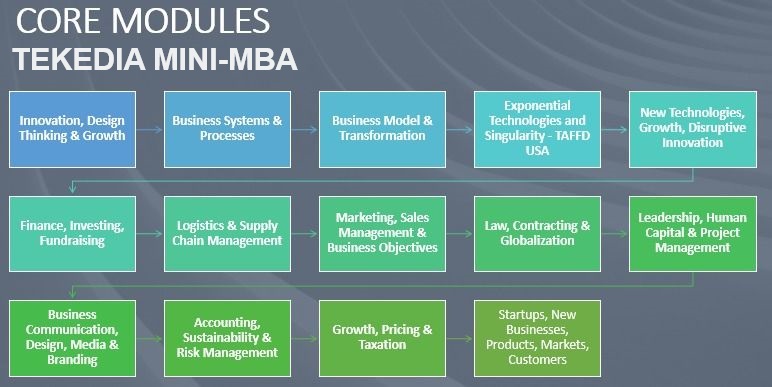
Curriculum for Tekedia Mini-MBA


Unlock Your Potential: Enroll in Tekedia Institute

From Lead Faculty

Welcome! Unleash your leadership potential, master business excellence, and embrace transformation with Tekedia Mini-MBA. Join us and experience a cutting-edge business management & leadership program: online, self-paced, and world-class. At Tekedia Institute, we co-learn with thousands of professionals and students, from many countries, on the mechanics of business, connecting innovation, growth and operational execution, across market territories and industrial sectors.

Our faculty members come from Microsoft, Google, Shell, Flutterwave, Nigerian Breweries, NNPC, Jobberman, Coca Cola, PwC, BUA Cement, and other great organizations. Besides pre-recorded courseware, thrice weekly, we hold live Zoom sessions (Tue, Thur and Sat at 7pm WAT) – Prof Ndubuisi Ekekwe, Tekedia Institute Lead Faculty.

More Early Registration Benefits 

Capstone Program

Here are the 12 tracks:

The program is completely capstone-based. Tekedia capstone is a research paper or a case study exploring a topic, market, sector or a company. It is the project component of Tekedia Min-MBA.

ALL Tekedia Programs and Costs Here

Selected Tekedia Mini-MBA Corporate Clients


Tekedia Mini-MBA Syllabus

Theme: Innovation, Growth & Digital Execution – Techniques for Building Category-King Companies

Introduction

Over the last few decades, digital technology has emerged as a very critical element in organizational competitiveness. It has transformed industrial sectors and anchored new business architectures, redesigning markets and facilitating efficiency in the allocation and utilization of factors of production. The impacts have been consequential: continents like Africa are moving towards knowledge-based economic structures and information societies, comprising networks of individuals, firms and states that are linked electronically and in interdependent relationships. In this program, we will examine this redesign within the context of fixing market frictions and deploying growth business frameworks in a world of perception demand where meeting needs and expectations of customers are not enough.

Program Time: June 8 – Sept 5, 2026

Venue & Format: Online via videos, articles, webinars, and flash cases. Program is self-paced which means you consume the materials at your own time and pace. It is completely online. Where you live or your time zone would not be an issue as program is not live-delivered.

Cost: US$170 (N120,000 naira). We have a payment plan, i.e. installment payment plan (email us for details)

Target Audience: This program is designed for professionals and students across functional areas like sales, marketing, technology, administration, legal, strategy, finance, etc across all business sectors and domains. The program is designed for:

  • Ambitious mid-level managers seeking to advance their careers by acquiring essential business knowledge and skills.
  • Busy professionals who value continued education but require a flexible alternative to a traditional MBA program.
  • Experienced professionals aiming to broaden their business acumen, enhance leadership capabilities, and explore new career opportunities.
  • Professionals in transition, committed to staying informed about business trends and developing skills for continuous professional growth.
  • Mid-level managers and executives across industries, driven to accelerate career growth and take on increased responsibilities.
  • Technology and innovation-focused professionals looking to strengthen business acumen and strategic thinking.
  • Aspiring entrepreneurs seeking a solid foundation in business management and growth strategies.
  • Consultants and advisors aiming to expand their knowledge base and provide comprehensive solutions to clients.
  • Professionals transitioning into new roles or industries, recognizing the value of upskilling for success.
  • Students and recent graduates seeking a competitive edge in the job market by combining academic qualifications with practical business skills.

Tekedia Mini-MBA program offers a flexible and comprehensive learning experience tailored to the needs of ambitious professionals, providing the tools and knowledge necessary to thrive in today’s dynamic business landscape. Participants will have the opportunity to acquire knowledge that has value and can be used in everyday business activities.

Learning Objectives: To innovate is to set a new basis of competition in an economy, business sector or market. Sometimes, it results in disruption. This program is designed for private (large, SMEs, startups, sole businesses), public and government institutions, and individuals. Participants will:

  • Master the mechanics of growth – the reward of innovation – through frameworks, cases and evolving strategies.
  • Understand how to undergo transformation journey that is fully aligned with corporate objectives through measurable and realizable benchmarks.
  • Acquire business capability tools that do not just RUN their firms but can TRANSFORM them.
  • Design corporate growth experiments in Lab sessions based on One Oasis Strategy, Aggregation Construct, Double Play Strategy, Accumulation of Capability Construct, and more.
  • ETC

Why Tekedia Institute

Interactive Online Learning: Engage with industry experts and fellow professionals through our state-of-the-art online learning platform, where you can access course materials, participate in discussions, and collaborate on real-world case studies.

Comprehensive Curriculum: Gain a deep understanding of key functional areas such as strategy, marketing, finance, operations, and more, equipping you with the knowledge and skills to excel in any business environment.

Practical Case Studies: Apply your learning to real-world scenarios through hands-on case studies and projects, allowing you to develop critical thinking and problem-solving skills.

Flexibility and Convenience: Access the program online from anywhere at your own pace, fitting your studies into your busy schedule without compromising your professional and personal commitments.

Expert Faculty: Learn from renowned industry practitioners and thought leaders who bring their expertise and real-world insights to the program, ensuring you receive the most relevant and up-to-date knowledge.

Benefits of Tekedia Mini-MBA

Enhance Your Leadership Potential: Unlock your leadership capabilities and develop the skills to lead teams, drive innovation, and navigate complex business challenges with confidence.

Master Business Excellence: Gain a holistic understanding of business functions, strategies, and best practices, enabling you to make informed decisions and contribute to organizational success.

Embrace Digital Transformation: Stay ahead of the curve by embracing digital technologies and leveraging them to transform your business and stay competitive in the digital age.

Accelerate Your Career: With the Tekedia Mini-MBA on your CV, you’ll stand out to employers, demonstrating your commitment to continuous learning and your readiness to take on new responsibilities.

Network and Collaboration: Connect with a diverse community of professionals, expand your network, and foster collaboration opportunities that can lead to future partnerships and career advancements.

Cost-Effective Investment: Enjoy the benefits of a comprehensive business education at a fraction of the cost of traditional MBA programs, maximizing the return on your investment.

Tekedia Institute offers the best business education in Nigeria and Africa you can get for value/

Tekedia Live Sessions

We run optional three Live Zoom sessions (two weekdays and one Saturday). This provides a way for our members to ask our Faculty and experts live questions and get feedback.

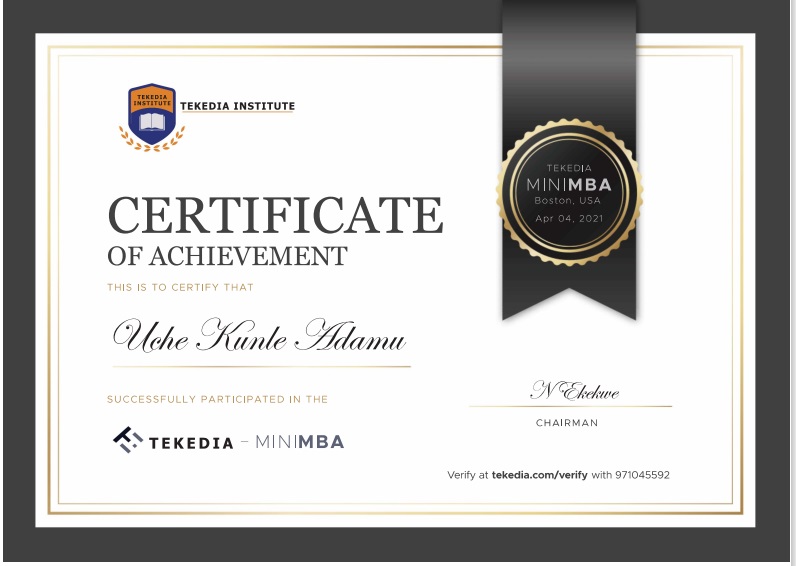
Tekedia Mini-MBA certificate sample

Tekedia Institute offers certificates at the end of all programs.

Our Contact Email: info@tekedia.com

Refund policy is full refund within 6 days from start of a program; after that, none, but we can defer as requested.

Lead Faculty of Tekedia Institute

Prof Ndubuisi Ekekwe is the Lead Faculty of Tekedia Institute

  • PhD, Electrical & Computer Engineering, Johns Hopkins University, USA
  • MBA, University of Calabar, Nigeria
  • BEng Electrical & Electronics Engineering ( Federal University of Technology, Owerri, Nigeria)

Prof Ndubuisi Ekekwe invented and patented a robotic system which the United States Government acquired assignee rights. Dr Ekekwe holds two doctoral and four master’s degrees including a PhD in engineering from the Johns Hopkins University, USA. He earned undergraduate degree from FUT Owerri where he graduated as his class best student. While in Analog Devices Corp, he co-designed an accelerometer for the iPhone. A recipient of IGI Global “Book of the Year” award, a TED Fellow, IBM Global Entrepreneur and World Economic Forum Young Global Leader, Prof. Ekekwe has held professorships in Carnegie Mellon University and Babcock University, and served in the United States National Science Foundation Committee.

The South African press called him “a doctor of innovation” for helping organizations on the mechanics of business innovation, strategy, and growth. Since 2009, the Chairman of Fasmicro Group which controls many startups and entities has been writing in the Harvard Business Review. He was recognized by The Guardian as one of 60 Nigerians Making “Nigerian Lives Matter” on Nigeria’s 60th Independence Day (Oct 1, 2020).

Enroll in Tekedia Mini-MBA today

Selected Faculty & Testimonials

We have more than 250 Faculty members; see the full list here.  For selected testimonials on our program, click here.