DD
MM
YYYY

PAGES

DD
MM
YYYY

spot_img

PAGES

Home Blog Page 18

Federal Reserve July FOMC Minutes Set the Stage for the Next Policy Decision

0

The U.S. Federal Reserve is preparing to release the minutes of its July Federal Open Market Committee meeting, offering investors a detailed look at the debate among policymakers over interest rates, inflation, employment and the broader economic outlook.

The July 28–29 meeting was closely watched because monetary policy remains at the center of financial-market expectations, with investors searching for clues about the timing and pace of future rate adjustments.

The Federal Reserve’s official calendar confirms that the July meeting took place on July 28–29 and that its minutes are scheduled for release three weeks after the policy decision.

The minutes are important because the Federal Reserve’s policy statement provides only a summary of the committee’s position. The detailed record can reveal how strongly officials disagreed, which economic risks received the most attention and what conditions could influence the next decision.

For markets, these details can be more consequential than the headline interest-rate decision itself. A major focus is likely to be inflation. The Federal Reserve has maintained price stability as one of its central objectives while also attempting to avoid unnecessarily weakening economic activity.

Persistent inflation can encourage policymakers to maintain restrictive monetary policy for longer, while convincing evidence of cooling price pressures could provide greater flexibility to reduce borrowing costs.

Employment conditions will also be closely examined. The labor market is an important component of the Fed’s dual mandate, and policymakers must balance the risk of inflation remaining elevated against the possibility that restrictive interest rates eventually weaken hiring and economic growth. Any discussion in the minutes about unemployment, wage growth or labor-market resilience could therefore influence expectations for future policy.

The economic projections associated with FOMC meetings also matter because they provide insight into policymakers’ expectations for growth, inflation and unemployment. However, not every regular meeting is accompanied by a new Summary of Economic Projections.

The Federal Reserve’s 2026 schedule identifies the June, September and December meetings as those associated with projections, meaning the July meeting did not include a fresh set of official projections.

Financial markets will consequently pay particular attention to the language surrounding risks and the policy path.

Interest-rate expectations influence Treasury yields, the U.S. dollar, equities and risk assets such as cryptocurrencies. A more hawkish interpretation could push yields higher and reduce appetite for speculative assets, while signals that officials are becoming more comfortable with easing could support risk-taking.

The minutes also arrive during an important transition for the Federal Reserve. The central bank’s 2026 leadership structure includes Kevin Warsh as chairman, while Jerome Powell remains listed among the FOMC members. The Federal Reserve says the committee meets regularly to assess economic and financial conditions and determine the appropriate monetary-policy stance.

The July minutes are unlikely to provide a simple prediction of what the Fed will do next. Instead, they will show the range of views policymakers considered and the economic developments that could move them in either direction. Investors will therefore examine every reference to inflation, employment, financial conditions and policy risks.

The release reinforces a broader reality for global markets: monetary policy remains highly dependent on incoming data. Until inflation demonstrates a convincing and sustained path toward the Fed’s objective, policymakers are likely to remain cautious.

For investors, the July minutes will provide another piece of the puzzle as markets attempt to determine whether the next major shift in U.S. monetary policy will be toward easing, continued restraint or a prolonged period of uncertainty.

Tekedia Capital Invests in Apollo Atomics and the Compact Nuclear Energy Revolution for the AI Age

0

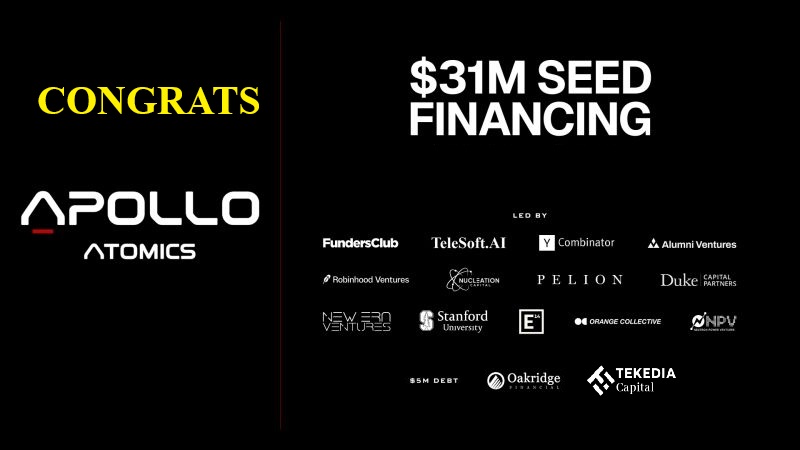
The age of compact nuclear energy is emerging, and Apollo Atomics is entering the arena with an oversubscribed $31 million seed round to accelerate the commercialization of its next-generation nuclear reactors.

An MIT spinoff, Apollo Atomics is redesigning the pressurized water reactor, not by abandoning proven nuclear science, but by improving its economics, scale and deployment architecture. The company uses commercially available fuel, established supply chains and familiar regulatory pathways while seeking to reduce plant size by 80% without sacrificing power output.

Its steam systems are approximately 20 times smaller than those used in conventional plants. Its fuel has achieved criticality at full power, and the company is pursuing commercial approval from the U.S. Nuclear Regulatory Commission. Apollo is targeting deployment in fewer than two years, compared with the 10 years or more commonly associated with conventional nuclear projects.

That matters because the AI economy has an energy problem. Data centres, advanced manufacturing facilities, university campuses and industrial operations need abundant, reliable and always-available electricity. Solar and wind will remain important, but the modern digital economy also requires dependable baseload power.

Apollo is working to provide that capability through reactors that can be deployed faster, occupy substantially less space and cost far less to prototype than competing systems. The technology is supported by more than 15 years of MIT research and testing, while prospective demand has already reached 20 gigawatts across data-centre developers, universities and industrial customers.

This is the playbook of consequential innovation: preserve what science has validated, redesign what economics has constrained, and build a better system for the needs of a new era. Upon this thesis, Tekedia Capital joined many global investors to invest in the company.

Nuclear energy is being reconstructed for the age of AI, and Apollo Atomics wants to lead that redesign.

Congratulations to the Apollo Atomics team. The mission is bold, the opportunity is massive, and a new energy category is emerging.

U.S. Treasury Yields Retreat As Debt Buyback Eases Pressure On Long-Term Bonds

0

U.S. Treasury yields retreated sharply on Wednesday from multi-year highs after the Treasury Department announced plans to double the size of its government debt buybacks, providing support to longer-dated bonds following a global selloff driven by concerns over rising public debt, inflation and higher borrowing costs.

The 30-year Treasury yield fell nearly 9 basis points to 5.196%, while the benchmark 10-year yield declined about 6 basis points to 4.647%. The 30-year yield had climbed above 5.33% earlier this week, reaching its highest level in nearly two decades.

The reversal was concentrated at the long end of the yield curve, where investors have been demanding higher compensation to hold government debt amid concerns about the U.S. fiscal outlook and the risk that persistent inflation could keep interest rates elevated for longer.

The Treasury said it would increase the size of its buyback operations, a move designed in part to improve liquidity and market functioning in longer-dated securities.

The announcement helped ease some of the pressure on long-term bonds, but it does not reduce the amount of U.S. government debt outstanding.

“I’m assuming this supply will be replaced by more issuance on the shorter end, particularly bills. This is NOT a debt paydown, it is just a rearrangement of the maturity schedule of Treasuries,” said Peter Boockvar, chief investment officer at One Point BFG Wealth Partners.

Treasury buybacks can improve liquidity by purchasing older or less actively traded securities and can support prices in targeted parts of the market. But they do not eliminate the underlying fiscal challenge facing the U.S. government.

The U.S. fiscal deficit reached $432.3 billion in July, the largest monthly shortfall since March 2021, pushing the cumulative deficit for the year to almost $1.8 trillion. The cost of servicing the debt has also become a growing burden. Interest payments on the nearly $40 trillion national debt have reached about $1.2 trillion this year, increasing pressure on the federal budget as borrowing costs remain elevated.

The latest move in Treasury yields also comes amid a broader global bond selloff.

Japan’s 10-year government bond yield reached its highest level in three decades, while Germany’s 30-year Bund yield climbed to its highest since 2011. France’s 30-year borrowing cost reached its highest level since 2008.

The synchronized rise in long-term yields points to a broader reassessment by investors of sovereign debt risks rather than a problem confined to the United States.

Higher oil prices are adding another layer of uncertainty. Rising energy costs could feed into consumer inflation and make it more difficult for central banks to ease monetary policy. That prospect has encouraged investors to demand higher yields on longer-term bonds to compensate for the risk of persistent inflation.

The U.S. Federal Reserve’s policy outlook will receive additional attention later Wednesday with the release of minutes from its latest Federal Open Market Committee meeting.

The minutes are of the essence because the July meeting exposed unusually strong disagreement among policymakers. Three officials voted for a 25-basis-point rate increase, while the majority opted to keep rates unchanged. Investors will look for clues about the arguments behind those dissenting votes and whether concerns about inflation could prevent the Fed from cutting rates in the months ahead.

The combination of elevated inflation risk, heavy government borrowing and uncertainty over monetary policy has created a challenging environment for the Treasury market. Long-term yields matter well beyond government bonds because they influence corporate borrowing costs, mortgage rates and the valuation of equities.

Therefore, analysts see Wednesday’s retreat as marking a reprieve rather than a resolution. Treasury buybacks can provide additional liquidity and help stabilize longer-dated securities, but they do not address the underlying forces that pushed yields higher in the first place.

With the U.S. running large fiscal deficits, debt-servicing costs rising and energy prices threatening to reignite inflation, investors are expected to continue scrutinizing the government’s borrowing needs and the Fed’s willingness to tolerate higher inflation.

SK Hynix Unveils $28.6bn Buyback as AI Boom Fuels Record Cash, Investor Pressure

0

SK Hynix will return a much larger share of its cash to investors, announcing a 40 trillion won ($28.61 billion) share buyback and cancellation programme as the world’s leading supplier of high-bandwidth memory seeks to reassure shareholders that the artificial intelligence boom still has room to run.

The South Korean chipmaker said on Wednesday it will buy back and cancel up to 24 million treasury shares between August 20 and November 19. It will also allocate more than 50% of the free cash flow generated between 2025 and 2027 to shareholder returns, expanding on its previous commitment to use up to half of cumulative free cash flow for that purpose.

The scale of the programme is notable because it comes at a time when investors are beginning to question whether the extraordinary spending on AI infrastructure can continue at its current pace. SK Hynix shares fell nearly 10% during Wednesday’s session before recovering some ground in post-market trading. The stock had reached record highs in June, but has since come under pressure as investors reassess the durability of AI-related demand and the valuations of companies exposed to the sector.

The buyback therefore serves two purposes. It directly returns capital to shareholders while also signaling management’s confidence that the current strength in memory pricing and demand is not about to reverse sharply.

“A commitment to its own shares on this scale over the next three months indicates SK Hynix does not think memory pricing is about to roll over,” said Josh Gilbert, an analyst at trading platform eToro.

SK Hynix is in an unusually strong position within the AI hardware supply chain. Its high-bandwidth memory chips are critical components in Nvidia’s advanced AI accelerators, which are used to train and run sophisticated models. The rapid expansion of AI data centers has driven demand for HBM and helped transform the economics of the memory industry after years of severe cyclicality.

That strength has generated substantial cash. SK Hynix said its net cash position stood at about 69 trillion won at the end of the second quarter, giving it considerable room to fund both shareholder distributions and the capital-intensive expansion needed to maintain its lead in AI memory.

The company is attempting to strike that balance carefully. It is pursuing an aggressive investment programme to expand chip manufacturing capacity in South Korea as customers seek more HBM to support the next generation of AI accelerators. At the same time, investors have become increasingly vocal about ensuring that the extraordinary profits generated by the AI boom are not absorbed entirely by expansion spending.

The new policy could help address that concern. SK Hynix said it would continue to pursue an expanded shareholder-return programme covering buybacks, share cancellations and dividends, with additional measures expected to be announced alongside its third-quarter results.

“The 40 trillion won buyback should satisfy investor expectations, particularly as more buybacks and special dividends could be announced at a later stage,” said Sanjeev Rana of CLSA.

The move also puts pressure on SK Hynix’s major Korean rival, Samsung Electronics, to offer greater clarity on its own capital-return plans. Samsung has said it intends to announce details of its shareholder-return policy for this year and beyond “very soon.”

U.S. memory-chip maker Micron has gone even further, pledging to return 100% of its excess cash to shareholders, highlighting the intensifying competition among leading memory producers for investor support.

For SK Hynix, however, returning cash cannot come at the expense of its position in a market where technological leadership is increasingly determined by the ability to finance enormous capacity expansions.

The company is committing hundreds of billions of dollars to new chip facilities in South Korea as demand for HBM grows. Those investments are designed to preserve its advantage as Nvidia and other AI-chip developers move toward increasingly powerful processors that require larger quantities of advanced memory.

The company’s labor costs are also part of the equation. SK Hynix agreed last year to share 10% of annual operating profit with employees under a 10-year arrangement. The company and its South Korean labor union are also finalizing the wording of a preliminary wage agreement that could involve paying part of employee bonuses in shares. That creates a broader capital-allocation challenge. SK Hynix must simultaneously finance new factories, reward employees, maintain technological leadership and return increasing amounts of capital to shareholders.

The buyback is seen as an indication that management believes its current financial position is strong enough to accommodate all four.

More importantly, the decision sends a message about management’s assessment of the AI memory cycle. A company committing 40 trillion won to repurchases over just three months would risk destroying significant shareholder value if it believed a major downturn in HBM demand or pricing was imminent. The programme therefore marks not only a capital-return decision but also a sizeable bet on the persistence of AI infrastructure spending.

The market’s initial reaction shows why that confidence matters. SK Hynix’s sharp share-price decline indicates that investors remain focused on a central question hanging over the entire AI semiconductor complex: will enormous investments by hyperscalers and AI developers continue generating enough demand and returns to justify the industry’s current spending trajectory?

Anthropic Prepares $10bn Credit Line, Signaling Growing Debt Appetite Ahead of IPO

0

Anthropic is preparing to expand its borrowing capacity beyond a targeted $10 billion, adding another layer of financing to the artificial intelligence boom as the Claude maker lays the groundwork for a potential blockbuster initial public offering.

The company is in discussions with banks over a revolving credit facility that could exceed its original $10 billion target, according to people familiar with the matter cited by Bloomberg. The final size has not been determined and could still remain at $10 billion or be reduced, the sources said.

The move would give Anthropic access to a substantial pool of capital that it could draw, repay, and borrow again as needed, providing liquidity as it continues to spend heavily on computing infrastructure, model development, and other costs associated with scaling its AI business.

The financing discussions also carry significance for Wall Street banks. Lenders seeking a place in Anthropic’s expanded credit facility could improve their prospects of securing roles in what could become one of the largest technology IPOs in years. Morgan Stanley, Goldman Sachs and JPMorgan are reportedly working with Anthropic on the planned listing, while the company has recently held discussions with prospective investors.

Anthropic previously secured a $2.5 billion five-year revolving credit facility from a group of lenders including Morgan Stanley, Barclays, Citigroup, Goldman Sachs, JPMorgan, Royal Bank of Canada and Mitsubishi UFJ Financial Group. Expanding that facility would substantially increase the company’s financial flexibility ahead of a potential public offering.

Anthropic is entering the public markets at a point when investors are paying closer attention to how AI companies finance their extraordinary growth. Unlike more mature software companies, leading AI developers require enormous amounts of computing capacity, much of it backed by expensive Nvidia processors and data-center infrastructure.

A larger credit facility could therefore serve as a bridge between Anthropic’s current private-market funding model and the deeper capital markets available after an IPO. It could also provide the company with additional liquidity without requiring it to immediately issue more equity.

There is precedent for the strategy. SpaceX expanded its credit facility with several banks involved in its planned IPO roughly a month before its June public offering. Such arrangements can strengthen relationships between companies and investment banks at a critical stage of the IPO process.

The broader financing environment shows why Anthropic’s borrowing needs are becoming increasingly significant. JPMorgan estimates AI-related debt financing could reach $4.1 trillion through 2030, up from its previous forecast, as hyperscalers, data-center operators and chip buyers seek to finance the infrastructure required to support AI workloads.

AI-related debt issuance has already surpassed $300 billion in 2026, according to the bank, making data-center financing one of the most important sources of new corporate borrowing this year.

JPMorgan also expects AI capital expenditure to reach $5.5 trillion through 2030, up from its previous estimate of $5.1 trillion. The revised forecast is based partly on expectations that global data-center capacity will expand by 138 gigawatts by the end of the decade, compared with an earlier estimate of 122 gigawatts.

That spending boom is forcing companies across the AI ecosystem to look beyond traditional equity financing. Developers are increasingly using structures such as behind-the-meter power agreements, bring-your-own-power arrangements and more efficient computing systems to overcome constraints on electricity and infrastructure.

For Anthropic, the challenge is more than simply securing enough money to fund growth. The company must convince prospective public-market investors that the revenue generated by its AI models will eventually grow faster than the enormous cost of computing, training, and inference.

That makes the proposed credit facility an important signal of the capital intensity behind the AI race. A multibillion-dollar borrowing capacity would give Anthropic greater room to invest before an IPO, but it would also increase the financial obligations attached to a business whose long-term profitability is still being established.

The potential facility therefore indicates that in the AI industry, the race to build powerful models is becoming not only a technology competition but also a massive financing exercise. That is why banks, private credit investors and public-market investors are increasingly being asked to fund the infrastructure required to sustain it.