DD
MM
YYYY

PAGES

DD
MM
YYYY

spot_img

PAGES

Home Blog Page 19

ByteDance in Advanced Talks to Sell ‘Mobile Legends’ Maker Moonton to Saudi’s Savvy Games for Up to $7bn

0

ByteDance’s potential $6–$7 billion sale of Moonton would mark a strategic exit from large-scale gaming as Saudi Arabia deepens its push into global interactive entertainment.

ByteDance is in advanced discussions to sell Shanghai Moonton Technology, the studio behind the global mobile hit Mobile Legends: Bang Bang, to Saudi Arabia’s Savvy Games Group in a deal valued between $6 billion and $7 billion, according to two sources with knowledge of the matter who spoke to Reuters.

One source said the transaction could be finalized as soon as this quarter. The companies have reached an initial agreement on broad terms, the second source said

A Strategic Retreat From Gaming

A sale would represent a decisive shift for ByteDance, which in recent years sought to diversify beyond its core short-video business into gaming.

ByteDance acquired Moonton in 2021 through its gaming subsidiary Nuverse in a deal that valued the studio at about $4 billion. The purchase formed part of an effort to build an international gaming portfolio capable of challenging established players in mobile and online gaming.

In 2023, however, ByteDance announced it would restructure its gaming business following a strategic review, signaling a recalibration of priorities. The company has since reduced investment in several game development projects and scaled back its broader gaming ambitions.

A sale at up to $7 billion would crystallize a substantial gain on its original acquisition, reflecting the sustained commercial performance of Mobile Legends and the premium attached to proven global IP.

The move would also allow ByteDance to reallocate capital and management focus toward its core growth drivers — including TikTok, advertising technology, and artificial intelligence initiatives — sectors that align more closely with its long-term strategy.

Founded in 2014, Moonton has grown into a major player in mobile multiplayer online battle arena (MOBA) gaming. The company says it employs more than 2,000 people and operates across Southeast Asia, Latin America, and China.

Its flagship title, Mobile Legends: Bang Bang, has recorded more than 1.5 billion installations and over 110 million monthly active users, according to the company’s website. The game consistently ranks among the top 10 most played titles in more than 80 countries.

The title’s strength lies not only in downloads but in its live-service model, which generates recurring revenue through in-game purchases, seasonal content updates, and cosmetic items. Its deep integration into Southeast Asia’s e-sports ecosystem further enhances monetization through sponsorships, media rights, and branded tournaments.

For an acquirer, the combination of scale, brand recognition, and recurring revenue streams makes Moonton an attractive strategic asset in a consolidating market.

Saudi Arabia’s Expanding Gaming Strategy

For Savvy Games Group, the acquisition would reinforce Saudi Arabia’s ambition to establish itself as a global hub for gaming and e-sports.

Savvy is owned by the Public Investment Fund and has pursued rapid expansion through acquisitions and investments. In 2023, it acquired Scopely for $4.9 billion. Earlier this year, Scopely acquired the games division of Niantic for $3.5 billion.

Adding Moonton would expand Savvy’s footprint in Asia and strengthen its position in the highly competitive mobile gaming segment. Southeast Asia represents one of the fastest-growing gaming markets globally, driven by smartphone penetration, youthful demographics, and increasing digital payment adoption.

The acquisition would also support Saudi Arabia’s broader Vision 2030 economic diversification program, which aims to reduce reliance on oil revenues by developing entertainment, media, and technology industries.

The proposed deal is seen as part of the ongoing consolidation in the global video game industry. Rising development costs, higher marketing expenditures, and intense competition for user attention have increased the strategic value of established franchises with durable engagement metrics.

In recent years, large publishers and investment groups have sought to secure high-performing IP that can generate predictable cash flows and cross-platform expansion opportunities. Mobile gaming, in particular, has proven resilient due to its lower hardware barriers and global reach.

A valuation of $6 billion to $7 billion implies confidence in Moonton’s ability to sustain user growth, expand monetization, and maintain relevance in an increasingly crowded market. It also suggests that premium mobile IP continues to command significant multiples, especially when paired with strong regional e-sports ecosystems.

The divestment discussions come amid strong financial performance at ByteDance. Reuters has reported that the company’s revenues in the first and second quarters of 2025 exceeded those of Meta Platforms, making ByteDance the world’s largest social media company by sales during those periods.

In the third quarter, ByteDance launched an employee share buyback program valuing the company at more than $330 billion, up 5.5% from its previous buyback valuation in March, according to sources.

Against that backdrop, the Moonton sale appears less about liquidity and more about strategic discipline. By exiting a capital-intensive and competitive gaming segment, ByteDance could sharpen its focus on areas where it holds structural advantages — algorithmic content distribution, advertising monetization, and AI-driven personalization.

If completed, the transaction is expected to mark two broader shifts in the global technology industry.

First, Chinese consumer internet giants are increasingly concentrating on core competencies rather than pursuing diversified expansion at any cost. Second, Gulf sovereign wealth funds are accelerating their acquisition of global entertainment and digital assets, aiming to build long-term influence in high-growth sectors.

However, the sale would close a chapter in ByteDance’s efforts to build a gaming empire, while it would represent another step by Savvy Games Group in assembling a globally competitive portfolio anchored by proven intellectual property.

The 10/10 Crash Has Reshaped Market Structure, Sentiment and Liquidity

0

The “$19B in liquidations” refers to the massive October 10, 2025, event often called “10/10”, widely seen as the largest single-day wipeout in crypto history.

On that day, leveraged positions across exchanges got obliterated to the tune of roughly $19 billion with some estimates slightly higher, mostly longs as Bitcoin plunged from highs around $126K toward $100K–$110K levels in a rapid cascade.

Over 1.6 million traders were liquidated, and it triggered a broader market drawdown that’s lingered into 2026, with BTC recently hovering much lower amid ongoing volatility. Binance’s Co-CEO Richard Teng recently addressed it at Consensus Hong Kong and in interviews pushing back hard against accusations that Binance caused or amplified it through platform issues, API locks, or internal mechanics.

His line: it was driven by macro shocks—specifically U.S.-China trade tensions, new tariffs announced by Trump, rare-earth export controls from China, and a broader risk-off sentiment that also hammered equities; $1.5T lost in U.S. stocks that day, with $150B in stock liquidations.

He emphasized the liquidations hit every major exchange (CEXs and DEXs alike), not just Binance, around 9 p.m. ET, and compared crypto’s smaller scale to tradfi’s pain. Traders and skeptics aren’t buying it fully—your “dog ate my homework” analogy popped up directly in reactions.

Many see it as exchanges finger-pointing: “It wasn’t us, it was the macro,” while downplaying how extreme leverage— 50x–125x on some platforms, thin liquidity, and automatic deleveraging mechanics turned a macro trigger into a full meltdown.

Some accuse specific platforms of outages, forced liquidations at worst prices, or benefiting from the chaos via fees. It’s a fair meme because crypto’s leverage culture + centralized platforms make these cascades feel engineered or at least enabled internally, even if the spark was external geopolitics.

The real lesson: High leverage in volatile assets means macro sneezes can cause crypto pneumonia—and everyone points elsewhere when the bodies hit the floor. The October 10, 2025 (“10/10”) liquidation event—with roughly $19 billion in leveraged positions wiped out across exchanges—had profound and lingering impacts on the crypto market, extending well into 2026.

It wasn’t just a one-day flash crash; it reshaped market structure, sentiment, liquidity, and price dynamics. Bitcoin plunged from highs around $126,000 to lows near $104,000–$102,000 intraday down ~15–20%, with Ethereum dropping ~12–21% and altcoins like Solana suffering 30–40%+ drawdowns.

Total crypto market cap shed $350–400 billion in a day, the largest single-day drop on record. Over 1.6 million traders got rekt, with longs dominating ~83–90% of the wipeout. This created a vicious cascade: forced sells thinned order books (bid-ask spreads exploded, depth dropped 90%+ on some venues), amplifying volatility and contagion across assets.

The macro trigger (Trump’s 100% tariff threat on Chinese imports, plus China’s rare-earth export controls) hit equities too—U.S. stocks lost ~$1.5–2 trillion that day. Crypto, as a high-beta risk asset, amplified the pain due to extreme leverage (often 50x+).

Exchanges saw API issues, network congestion; Ethereum gas spikes delaying arbitrage), and temporary halts/withdrawal freezes on some platforms. This fueled blame games, with accusations of glitches or internal mechanics worsening the cascade.

BTC has yet to reclaim its October highs, trading significantly lower; recently in the $60,000s–$78,000s range, down 40–50% from peak. The event marked a structural shift from leverage-fueled bull to deleveraging-driven correction.

Futures open interest cratered from peaks >$90B to much lower levels, volatility persistence stayed high, and forced liquidations distorted price discovery for months. Market makers got “stuffed” with coins post-crash, leading to the thinnest liquidity since 2022.

Trading slowed, bid depth evaporated, and recovery became choppy/sideways. This extended consolidation, with some analysts predicting BTC stuck in ranges until mid-2026 or later. Fear & Greed Index plunged to extreme lows post-event.

Retail trauma lingered (“nothing has been the same after 10/10”), killing demand for high-leverage plays. Institutions pulled back on exposure, ETF inflows slowed/reversed in spots, and confidence in centralized platforms eroded amid ongoing exchange feuds.

It exposed fragility in leverage mechanics, cross-asset contagion (stronger than 2018 trade war spillovers), and geopolitical macro risks. Calls grew for dynamic margin buffers, cross-exchange circuit breakers, and better macro-prudential tools. Some see it as accelerating a shift toward spot/HODL over perps.

Smaller liquidation waves continued into 2026; $2–3B+ in early February, showing heightened sensitivity to risk-off events. Cumulative liquidations since 10/10 likely exceed $70–120B+, deepening the drawdown. In essence, 10/10 acted like a “great deleveraging” purge—painful but arguably necessary to clear over-leveraged excess.

Yet the recovery has been slow and uneven, with macro/geopolitical shadows (trade tensions) and structural scars (thin liquidity, shaken trust) keeping the market fragile. It’s turned what could have been a quick dip into a multi-month grind, with many viewing it as the true start of a bear phase rather than a bull correction.

Solana Kicked Off the Graveyard Hackathon 

0

Solana has just kicked off the Graveyard Hackathon, an online global event starting February 12, 2026, with the theme of reviving “dead” or overlooked on-chain categories that the crypto space has largely moved on from.

The core idea is captured in their announcement: “Crypto elites and the trenches left these for dead. But the best time to build is when everyone else has left.” It’s positioned as an opportunity to resurrect sectors like NFTs, on-chain social, gaming, DAOs, digital art, and more—areas that saw massive hype in past cycles but have since cooled off, yet still hold potential for innovation on Solana’s high-performance network.

Hacking period runs from February 12 to February 27, 2026. Submissions Due: February 27. Winners will be announced around March 5, 2026. Total prize pool of $75,000 USD. Overall prizes: $30,000 for top 3 projects ($15K for 1st, $10K for 2nd, $5K for 3rd).

$45,000 distributed across 10 specialized tracks, with sponsors including partners like ExchangeArt (for Art), Drip Haus (NFTs), Tapestry (Onchain Social), MagicBlock (Gaming), Realms (DAOs), and others covering areas like Ticketing, Loyalty, Metaverse, DeSci, and Migrations.

This is a fully online hackathon, open to builders worldwide, and it’s part of Solana’s ongoing push through platforms like Colosseum to foster new projects and startups. The event coincides with other Solana hackathons like ones focused on mobile or AI agents, making early 2026 a busy season for Solana ecosystem development.

It’s an intriguing contrarian bet—focusing on “graveyard” categories when much of the attention is elsewhere could uncover some real gems. No public recaps, prize distributions, or revived category success stories have emerged because development is actively underway right now.

This hackathon is designed as a contrarian push to breathe new life into “graveyard” on-chain sectors that lost hype after previous bull cycles. By focusing on overlooked areas when mainstream attention has shifted elsewhere like AI agents, mobile, or high-frequency DeFi, it could have several ripple effects on the Solana ecosystem.

Tracks explicitly target NFTs (via DRiP), on-chain social (Tapestry), gaming (MagicBlock), DAOs (Realms), digital art (ExchangeArt), metaverse (Portals), DeSci (BIO), ticketing (KYD Labs), loyalty (Torque), and migrations (Sunrise). If strong prototypes emerge, this could spark renewed developer interest, tooling improvements, and user experimentation in these spaces—potentially leading to composable building blocks that integrate with Solana’s current strengths (speed, low fees).

Solana’s hackathons run via Colosseum or directly consistently drive participation. Past ones like Radar (1,359 projects from 10,000+ participants) or others have surfaced breakout ideas that evolve into funded startups or ecosystem tools. Graveyard could do the same for contrarian verticals, attracting builders who see opportunity in low-competition areas.

With $75K total; $30K overall + $45K across 10 sponsor-backed tracks, it’s a solid incentive for quick prototypes. Sponsor involvement means winning projects often get extra visibility, integrations, or follow-on support—amplifying potential real-world adoption.

Hosting this amid other 2026 Solana events like recent AI agent or mobile hackathons shows the foundation/Colosseum pushing diverse innovation. It counters narratives of Solana being “one-trick” by encouraging bets on resurrection themes.

Right now, activity is likely ramping up on Discord, X, and Colosseum’s arena platform—teams forming, ideas brainstorming, early repos popping up. Early impacts are mostly inspirational/motivational for builders ignoring crowded trends.

Once winners drop on March 5, we’ll see concrete projects and any immediate traction Until then, the biggest “impact” is the bet itself: proving that graveyard categories aren’t truly dead—they’re just waiting for the right cycle and execution on a chain like Solana.


Impacts of Tokenized Gold Surpassing $6 Billion Market Capitalization

0

The tokenized gold sector has surpassed $6 billion in market capitalization as of mid-February 2026, marking a significant milestone in real-world asset (RWA) tokenization.

This growth reflects strong investor demand for digital exposure to physical gold amid broader market volatility, with the sector adding over $2 billion year-to-date (YTD). Key drivers include major tokens like Tether Gold (XAUT) (around $3.6B+ dominance) and PAX Gold (PAXG) around $2.3B, which together account for the vast majority of the market.

Over 1.2 million ounces of physical gold back these assets, and the broader tokenized commodities category has hit similar highs around $6.1B+. This surge positions tokenized gold as one of the fastest-growing segments in crypto RWAs, appealing as a stable, on-chain alternative to traditional bullion—especially during periods of uncertainty in equities and crypto.

Meanwhile, U.S. spot Bitcoin ETFs recorded substantial net outflows of $410 million approximately $410.37M per reports on February 12, 2026—the second consecutive day of redemptions, bringing two-day totals to around $686M. Leading the exits were BlackRock’s IBIT ($157M outflow), Fidelity’s FBTC ($104M), and others like Grayscale’s GBTC.

No major ETF saw inflows that day. These outflows coincide with:A major $2.5B Bitcoin options expiry on February 13. Broader bearish sentiment, including analysts from Standard Chartered slashing BTC targets citing macro pressures, weaker risk appetite, and fading Fed cut expectations.

Bitcoin’s price under pressure, with ETF assets under management dropping sharply from 2025 peaks from ~$170B to around $80-85B range in some trackers. Weekly and monthly flows have turned negative in 2026 so far, testing institutional commitment despite long-term cumulative inflows remaining strong over $50B+ historically.

Tokenized gold’s rise could signal a rotation toward more stable RWAs in uncertain times. This milestone with tokenized commodities hitting $6.1–$6.126B, up 53% in recent weeks and over 360% year-on-year underscores accelerating adoption of real-world asset (RWA) tokenization, particularly gold-backed tokens like Tether Gold (XAUT) ($3.6B) and PAX Gold (PAXG) (~$2.3B), which dominate >95% of the segment and back over 1.2 million physical ounces.

Safe-haven rotation and demand driver — Amid gold’s rally (spot prices around $4,965–$5,114/oz, with records above $5,000+), investors are flocking to on-chain gold for its liquidity, instant settlement, fractional ownership, and blockchain benefits (no physical storage hassles).

This positions tokenized gold as a “digital gold” alternative that’s outperforming volatile crypto in risk-off environments. Tokenized commodities’ boom contributes to the tokenized assets sector (total ~$328B+), signaling mainstream integration of blockchain with traditional finance.

Analysts project explosive upside, potentially to trillions in tokenized RWAs by 2028–2030. High concentration (two issuers control most), custody/regulatory uncertainties, and potential liquidity mismatches if redemptions spike could test resilience, especially with physical gold price volatility.

Even crypto-native figures e.g., early Bitcoin supporters buying millions in PAXG reflect tactical moves toward stability. This growth reflects flight to tangible, low-volatility assets during uncertainty.

Impacts of Bitcoin ETF Outflows ($410M Daily)

The $410M+ outflows led by BlackRock’s IBIT ~$158M, Fidelity’s FBTC ~$104M marked continued pressure, part of multi-day/week redemptions amid broader negative flows like $686M+ over two days earlier, billions cumulatively since late 2025 peaks.

BTC traded around $65,000–$68,000 down sharply from 2025 highs near $126,000–$127,000, a ~50% drop in some views, exacerbated by macro headwinds, a $2.5B BTC options expiry (February 13), and fading Fed cut hopes. Standard Chartered slashed its 2026 BTC target to $100,000; warning of dips to $50,000 before recovery, citing capitulation risks.

Outflows signal reduced risk appetite among large allocators not just retail panic, with ETFs losing billions recently. This tests Bitcoin’s “digital gold” narrative—it’s behaving more as a high-beta risk asset correlated with equities/liquidity, not a consistent hedge like physical gold.

Contributes to bearish vibes, with ETF AUM drops, miner selling, and leverage unwinds amplifying downside. Weekly/monthly crypto fund flows turned heavily negative, contrasting gold’s inflows. While historical inflows remain strong overall, persistent exits question institutional conviction in BTC during prolonged uncertainty.

Investors rotating from high-volatility Bitcoin exposure into stable, tokenized safe havens like gold. Gold and its digital versions absorbs “fear trade” demand amid tariffs, policy shifts, geopolitics, and macro risks, while Bitcoin faces capitulation as a liquidity-sensitive asset.

This could: Accelerate RWA/tokenized gold adoption as a bridge between crypto and tradfi. Pressure BTC short-term (potential further downside to $50K–$60K levels per some forecasts) but set up rebounds if macro stabilizes or liquidity returns. Highlight evolving portfolio strategies: Gold for defense, BTC for growth/speculation.

It underscores 2026’s theme—safe-haven preference trumping risk assets in turbulent times, with tokenized gold emerging as a key winner in the digital economy.

Japan Seeks to Reshape the Rare Earth Landscape

0

The Japanese government relies on new energy technologies and advanced materials science to secure its industrial future and address what it sees as national security vulnerabilities.

A Japanese research team has successfully collected seabed samples containing rare earth elements at a depth of 6000 meters in the Pacific Ocean, near Minamitorishima Island. And if this initiative comes to fruition, we could see another big player in the rare earths sector, with potential repercussions on the USDJPY chart.

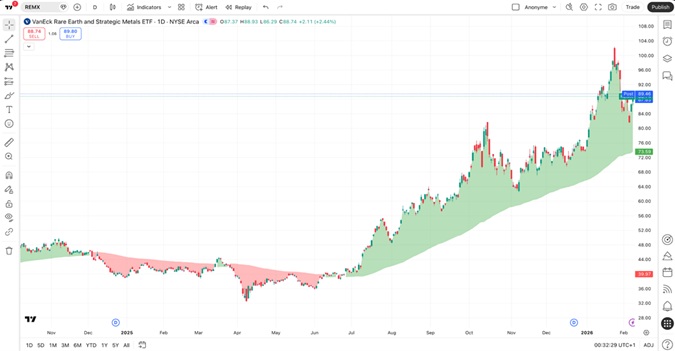
The dispute over rare earths has become far more serious amid escalating geopolitical tensions, as indicated by some charts, such as REMX, which has been rising sharply since mid-2025.

The Japan Agency for Marine-Earth Science and Technology (JAMSTEC) team used the deep-sea scientific drill ship Chikyu to achieve their first successful continuous lift operation, which involved retrieving material from extreme ocean depths.

The samples will undergo analysis to determine their total volume and mineral content, which will be conducted before the 2027 full-scale testing phase. Many advanced industries, such as electric vehicles, renewable energy, robotics, computing, and defense technology, whose companies are frequently featured on the premarket movers list, require rare earths, including dysprosium, neodymium, terbium, and gadolinium.

Rare earth elements are not as rare as they seem. Their extraction is just economically draining, because those elements exist in nature at very low concentrations. For the moment, China largely dominates global production, with more than 90% of refined rare earths worldwide.

Japanese industries (like those in many other countries) have been highly dependent on Chinese suppliers. In 2024, more than 60% of Japan’s imported rare hearts were from China. This is a disadvantage, especially in tense moments.

China imposed restrictions on rare-earth material exports to Japanese businesses from late 2025 to early 2026 as part of a diplomatic dispute, following Tokyo’s statements on regional security matters. The new controls created supply chain disruptions, impacting TDK and other major manufacturers, and TDK indeed reported difficulties obtaining materials after export restrictions took effect.

In February 2026, China granted Japan a small number of rare-earth export permits, despite strict export controls. Japan’s deep-sea mining effort — if successfully commercialized — could substantially reduce this dependency, and erode one of China’s most significant geopolitical levers.

Japan can achieve greater economic self-protection and international market strength by developing its own domestic mineral supply chain. The United States and other allies could easily form international partnerships to support Japan’s efforts to diversify its supply sources in line with the country’s broader strategic plan.

 Toward a new Industrial Paradigm?

With the deep-sea rare-earth mining project (and the space-based solar power initiative), Japan demonstrates its determination toward technological independence — securing diverse resource security.

The success of these frontier technologies could weaken China’s longstanding dominance of critical rare earths and make Japan a new leader in sustainable energy innovation. But from what we know so far, the path to commercial viability on deep-sea extraction requires long-term investments and key international partnerships.

Geopolitical uncertainty is likely the foundation for those strategic decisions, as Japan bases its supply chain and energy system renovations on cutting-edge technological developments. This might be a way to boost its future economic performance and its positions in international markets.