DD
MM
YYYY

PAGES

DD
MM
YYYY

spot_img

PAGES

Home Blog Page 19

SpaceX Eyes a Trillion-Dollar 2026 IPO, Setting the Stage for a Market Earthquake, and a Massive Surge in Musk’s Fortune

0

Elon Musk’s SpaceX is preparing the kind of market debut that could reshape global capital markets for years, with early planning pointing to an initial public offering in 2026 that aims to raise more than $25 billion and potentially value the company above $1 trillion, a person familiar with the talks told Reuters.

The discussions with banks are underway, and advisers say SpaceX is eyeing a June or July listing window, though the company has not commented publicly on the plan.

Such a valuation would place SpaceX among the most valuable companies ever to go public. It would be the first U.S. IPO to cross the trillion-dollar threshold, and only the second globally. Saudi Aramco remains the sole company to debut at that scale after its $1.7 trillion listing in 2019.

Musk already holds a dominant stake in SpaceX, which means a public listing on these terms could dramatically expand his personal fortune. Analysts who follow the private-market valuations of SpaceX say that a trillion-dollar IPO would push Musk’s net worth sharply higher, because so much of his wealth is tied to SpaceX’s privately held equity.

While there is no precise public calculation of how much his wealth might increase, the sheer size of the offering — and the potential jump from an $800 billion private-market valuation to a $1 trillion or even $1.5 trillion public-market valuation — would significantly escalate the value of his holdings. For a private startup that has never been publicly listed, moving into the trillion-dollar range would instantly reprice Musk’s ownership at levels that could rival or surpass his Tesla-derived wealth.

The IPO discussions are unfolding at a pivotal moment. After three years of stagnation, the U.S. IPO market is showing signs of life in 2025, and Wall Street executives are optimistic that 2026 will be the strongest listing year since before the pandemic. Samuel Kerr, head of equity capital markets at Mergermarket, said SpaceX “has been on the dream-list of several investors for years,” adding that the sector is now viewed as essential to defense, satellite expansion, and the emergence of orbital data infrastructure.

Starlink, the satellite broadband service built inside SpaceX, is at the heart of these expectations. The company is rolling out direct-to-mobile connectivity while scaling its satellite constellation globally. At the same time, SpaceX is moving ahead with Starship, its massive next-generation rocket intended for lunar landings and eventual Mars missions. These two engines of growth underpin projections that SpaceX could generate about $15 billion in revenue in 2025, rising to between $22 billion and $24 billion in 2026, according to a person familiar with internal forecasts.

A trillion-dollar valuation is not just a symbolic milestone. It would effectively catapult SpaceX into the top tier of U.S. publicly traded companies, sitting alongside Apple, Microsoft, Nvidia, and Alphabet. For many institutional investors, particularly those that missed the early private rounds, a public listing would be the first chance to buy a stake in a company that dominates the commercial launch market, controls a fast-growing global broadband network, and is evolving into a strategic infrastructure provider for multiple governments.

Interest in a listing intensified last week after a report suggested SpaceX was preparing a secondary share sale at an $800 billion valuation. Musk publicly rejected that report, calling it inaccurate, but private-market demand remains deep. SpaceX is currently the world’s second most valuable private startup after OpenAI, according to Crunchbase. OpenAI and rival Anthropic are also exploring potential listings, creating the possibility of an AI-and-space-powered IPO wave in 2026.

Steve Studnicky, UBS Group AG’s co-head of Americas ECM, said a SpaceX debut could shatter the narrative that highly valued startups no longer need to go public.

“A lot of people over the last few years have felt the super high-value private companies don’t need to go public and maybe they’d never go public,” he said. “Now, these companies are coming forward saying there is a path to a public listing and that’s helpful for a lot of companies and investors who want to see them lead the way.”

If SpaceX proceeds with a blockbuster offering, the implications for Musk’s wealth would be unavoidable. For years, much of his fortune has been difficult to value precisely because it has been tied up in private equity. A public listing would create a transparent market price for SpaceX shares for the first time. Given the size of the valuation under discussion, that revaluation would likely be enormous. It is this shift — from private-market estimates to public-market pricing — that analysts say could generate one of the largest single-year increases in the wealth of any corporate founder in modern history.

Even so, the offering is expected to trigger questions about corporate governance. Musk already leads Tesla, SpaceX, X (formerly Twitter), and several experimental ventures. Dan Coatsworth, head of markets at AJ Bell, said pressure would intensify after the listing.

“If SpaceX did float, expect growing pressure on Musk to commit to only one of his listed entities – Tesla or SpaceX,” he said. “It’s hard to see how one individual could run two $1 trillion+ companies at the same time.”

The broader space race adds another dimension. Several billionaires, including Jeff Bezos, are pouring vast sums into rockets, satellites, and lunar exploration. NASA is leaning more heavily on commercial partners, and defense spending in the United States is rising, turning space into a strategic battleground for technology, national power, and data infrastructure.

If SpaceX goes public in mid-2026, the deal could be the market’s gravitational center for the entire year. A single offering that raises more than $50 billion — which bankers say is possible — would exceed the annual U.S. IPO volume in eight of the past thirteen years, excluding SPACs and closed-end funds, according to Bloomberg data. Rob Stowe, Barclays’ head of Americas ECM, said “large deals have their own gravity,” and a SpaceX listing would be the kind of event that pulls global markets into its orbit.

For Musk, it would be more than a liquidity event. It would be the first time the public markets place a definitive price on the company that has defined his reputation in aerospace and technology. And if SpaceX lands at the trillion-dollar level analysts are contemplating, that valuation alone could reshape not only market history but also the financial standing of its founder, whose fortune is already one of the largest in the world.

How Delta Exchange Helps You Trade Crypto Derivatives With Low Fees

0

Trading fees don’t look like a big deal at first, but they quietly shape your overall returns in the crypto derivatives market. If you’re a regular trader or adjust positions in fast-moving markets, you’ve probably felt how charges stack up over time.

Many traders lose a chunk of their gains without realising that frequent order placements, multi-leg setups, and hedges all trigger extra costs. This is where a cost-friendly platform like Delta Exchange makes a real difference.

In this post, we’ll discuss how this leading Indian crypto exchange helps you trade with confidence, whether you’re just starting out or already active in crypto F&O trading.

Market Insights and Delta Exchange’s Ecosystem

India already leads the global crypto population, and the growth ahead is set to be even stronger. The AltIndex report projects that the country’s crypto user base will grow by 21% to reach almost 330 million by 2028. The report also states that by 2028, every third crypto user worldwide will likely be from India.

With such a huge audience stepping into trading, access and affordability matter a lot. Many traders here want a smooth entry into crypto derivatives, and what better way than to rely on an Indian crypto exchange that keeps things simple.

Delta Exchange – One of the leading Indian crypto exchange

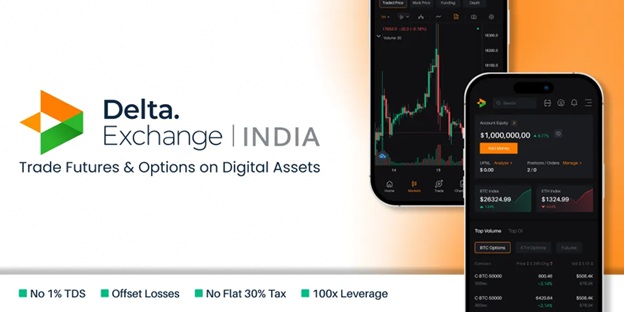
Delta Exchange fits well into this shift by offering crypto F&O and trackers with low trading fees, clean tools, and an app experience that suits all levels of users. It brings a practical setup that helps you trade without feeling weighed down by costs or complexity.

Why Worry So Much About Crypto F&O Trading Fees

High trading fees quietly eat into your profits. You notice it the most when you’re an active trader and rely on quick entries and exits. Even small cuts on every order add up over time.

Here’s where it matters:

  • Scalping multiple times a day, where each trade can cut your gains.
  • Multi-leg options setups that need several orders to build and adjust.
  • Regular hedging on platforms without low trading fees.
  • Active users on the Delta Exchange app who want flexibility without expensive trades.

When your fee outflow grows faster than your profit inflow, your crypto trading strategy stops feeling worth the effort. Delta Exchange solves this issue with a structure that supports frequent crypto F&O trading without draining your pockets.

Delta Exchange’s Transparent and Low Trading Fee Structure

Delta Exchange’s transparent fee structure helps you make apt trading decisions. Here are all the details you need to know about the crypto derivatives trading fees:

1. Maker and taker fees

  • Futures:05% taker and 0.02% maker fees.
  • Options:015% maker and taker fees – capped at 5% of option premium.
  • Trackers:05% maker and taker fees.

2. Liquidation fees

  • For futures: BTC 0.05%, ETH 0.10%.

Other altcoin liquidation fees range from 0.10% (100x leverage) to 1% (10x leverage).

  • For options:

When an options position on Delta Exchange gets liquidated, the platform charges a fee proportional to the notional size:

  • BTC: 20% of the premium and 0.05% of the notional size
  • ETH: 20% of the premium and 0.10% of the notional size.

A GST of 18% is also applicable to these liquidation fees on the platform.

3. Small lot sizes

  • BTC contracts start at ~?5000.
  • ETH contracts are available from ~?2500.

4. No hidden charges

You benefit from low trading fees if you scalp, adjust options often, or test strategies on the Delta Exchange app. The structure makes active trading on an Indian crypto exchange feel smoother and more cost-efficient without surprise deductions.

5. Deposit and withdrawal fees

Another benefit of Delta Exchange is that you don’t have to pay any deposit or withdrawal fees on the platform.

Extra Features That Support Efficient Crypto Derivatives Trading

Apart from the low trading fees on an Indian crypto exchange, you want tools that help you avoid errors, place cleaner trades, and test ideas without stress.


Delta Exchange’s API integration

The Delta Exchange app keeps your entire process smooth with features like:

  • INR deposits and withdrawals: You can move funds in and out in INR without currency conversions and keep your crypto F&O flow stable.
  • Demo account: If you want to try a new setup or learn crypto derivatives trading with zero pressure, the demo account gives you space to test freely.
  • Strategy builder and payoff charts: These tools show you how a multi-leg setup may behave. With payoff charts, you can readjust trades and enter the market more confidently.
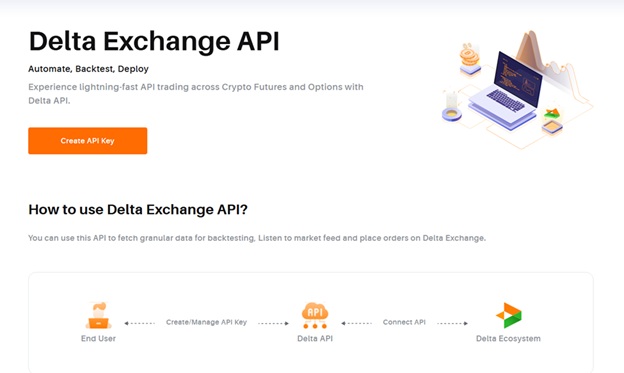
  • Automated and API-based trading: You get tools to automate trades through the Delta API, run backtests, and deploy algo trading bots – reducing manual effort.
  • Mobile trading through the Delta Exchange app: You can download the mobile app for quick order placement and position checks to trade from anywhere, any time.

Final Thoughts: Should You Trade on Delta Exchange?

If you’ve ever felt your profits shrinking because of charges applied across trades, you’re not alone. To stand out, Delta Exchange has kept its fee structure transparent and lower than most competitors.

The low trading fees give you more breathing space, especially if you adjust positions often or run multi-leg ideas in crypto derivatives. With small lot sizes, INR access, and the Delta Exchange app, your bitcoin trading experience becomes smoother without extra effort.

Disclaimer: Cryptocurrency markets are subject to high risks and volatility. Kindly do your own research before investing.

FUTUROMiNing offers XRP, BTC, and SOL holders the opportunity to earn $1,000 per day.

0

As the global cryptocurrency market continues to fluctuate, more and more XRP, BTC, and SOL holders are seeking a way to expand their digital asset portfolios that is “unaffected by market fluctuations and sustainably appreciates in value.”

Among numerous cloud mining platforms, FUTUROMiNing has rapidly risen to become one of the fastest-growing cloud mining platforms globally, thanks to its stable income model, highly available data centers, and transparent operating mechanisms.

Now, FUTUROMiNing’s new mining system allows cryptocurrency holders to easily earn $1000 in passive income daily, attracting a surge of users worldwide.

Why are global investors flocking to FUTUROMiNing?

For many investors, the crypto market is fraught with uncertainty:

  • High price volatility
  • Long investment cycles
  • High technical barriers
  • Expensive equipment costs

Cloud mining offers a completely new solution to this problem.

On FUTUROMiNing, users don’t need to purchase mining rigs, have server rooms, or possess specialized technical skills. Simply select a contract to start automatic mining, with daily earnings automatically settled by the system, eliminating the risk of market fluctuations.

Get started in just 3 steps: Register ? Select Contract ? Automatic Mining

About FUTUROMiNing

FUTUROMiNing is one of the world’s leading cloud mining platforms, providing secure, efficient, and environmentally friendly cryptocurrency computing power services to over 2 million users from 100+ countries.

The platform is renowned for its high standards of transparency and strong compliance, and has become a trusted passive income tool for global investors.

FUTUROMiNing’s Core Advantages

  1. Compliance & Security & High Transparency

Headquartered in a compliant regulatory environment, adhering to global financial and data security standards, ensuring the safety of every user’s assets.

  1. Zero Equipment Cost, No Technical Skills Required

Users can start mining without mining rigs or technical knowledge, truly achieving zero barriers to entry.

  1. Automated Profit Distribution

Daily profits are automatically settled and distributed to user accounts by the system, and can be withdrawn at any time.

  1. Green and Environmentally Friendly Computing Power Services

Global data centers use clean energy for power, achieving environmentally friendly, efficient, and low-cost green mining computing power.

How to Get Started? Only 1 Minute

  • Visit the Official Website:  https://futuromining.com/
  • Create an Account
  • Register with your email address – simple and secure.
  • Get a $18 Free Reward

New users receive $18 upon registration, which can be used directly to start a free mining contract.

  • Choose a Mining Contract

Choose a suitable plan based on your budget and timeframe.

  • Activate the Contract

Supports deposits of mainstream assets such as BTC, ETH, XRP, and DOGE.

  • Automated Mining

Stable daily profit distribution.

  • Withdraw Anytime

Withdrawals are available to your personal wallet once your account reaches $100.

Contract Name Investment Duration Total Return (Principal + Interest)
Free Mining Experience $18 1 day $18.72
New User Experience $100 2 days $106
WhatsMiner M66S $500 7 days $547.25
WhatsMiner M60 $1,200 14 days $1,443.6
Bitcoin Miner S21 $2,600 20 days $3,380
Bitcoin Miner S21 XP Immersion $5,700 24 days $7,820.4
ALPH Miner AL1 $9,800 28 days $14,190.4


For more details, please visit the official website: https://futuromining.com/

Conclusion: Why is now the best time to join FUTUROMiNing?

In today’s uncertain global cryptocurrency market, stable-yield mining models are becoming a new trend for global investors.

FUTUROMiNing, with its:

  • Zero-risk equipment investment
  • Stable daily returns
  • Automated mining
  • High compliance and high security
  • Trust and support from global users

is the best choice for XRP, BTC, SOL, and other cryptocurrency holders to enhance asset value.

Register now to receive a $18 bonus and start your daily passive income for free!

Official website: https://futuromining.com/

Contact us: info@futuromining.com

Bitcoin “After Dark” ETF Filing Reveals Potential Strategy for Alpha, as Leveraged ETFs Hit Record $239 Billion in AUM

0

A new exchange-traded fund (ETF) proposal has emerged targeting Bitcoin’s (BTC) price movements outside U.S. trading hours, where historical data shows much of the cryptocurrency’s gains occur.

On December 9, 2025, Tidal Trust II filed a Form N-1A registration statement with the U.S. Securities and Exchange Commission (SEC) for the Nicholas Bitcoin and Treasuries After Dark ETF. This fund would adopt a unique timing strategy.

The ETF would acquire Bitcoin exposure via futures, options, or other U.S.-listed Bitcoin ETPs/ETFs around 4:00 p.m. ET when U.S. markets close, holding positions through the night. Positions would be unwound by 9:30 a.m. ET when markets reopen, with assets rotating into short-term U.S. Treasuries to minimize daytime volatility.

The rationale stems from analysis showing that a significant portion of Bitcoin’s 2024 price appreciation happened post-U.S. close, potentially allowing this ETF to outperform traditional spot Bitcoin funds by capturing “overnight returns” while sidestepping intraday dips often linked to U.S. equity market flows.

Bloomberg ETF analyst Eric Balchunas noted this could yield “better returns,” though it introduces timing risks and execution costs. This filing reflects the maturing Bitcoin ETF market, which has amassed over $118 billion in assets despite recent outflows like $3.48 billion in November 2025.

If approved, it would join a lineup of specialized products, signaling innovation amid BTC’s push toward $94,000 as of December 9. Currently, BTC trades around $92,000, up from recent lows but facing volatility amid Fed rate speculation.

Spot BTC ETFs saw $4 billion in outflows in November 2025 but rebounded with $287 million inflows on December 9. With $118 billion in BTC ETF assets under management, this filing reflects maturation in the space. Issuers are innovating beyond plain-vanilla spot/futures products to target niches like time-based strategies.

If approved, it could inspire similar “microstructure-engineered” ETFs, enhancing options for risk-averse investors. However, approval isn’t guaranteed—SEC scrutiny on crypto products remains high, especially post-2024 election shifts.

Next StepsThe SEC will review the filing, with a decision timeline potentially spanning 75 days. Investors should watch for updates on tidaletfs.com or SEC filings. This proposal underscores Bitcoin’s 24/7 nature clashing with traditional finance’s 9-to-5 model, potentially offering a “sleep-easy” way to bet on overnight edges.

Vivek Ramaswamy’s Strive Raises $500M for Bitcoin Expansion

In parallel, Strive Asset Management—co-founded by entrepreneur and former presidential candidate Vivek Ramaswamy—announced a $500 million “at-the-market” (ATM) preferred stock offering to bolster its Bitcoin treasury strategy.

The proceeds from selling Series A Perpetual Preferred Stock will primarily fund Bitcoin acquisitions. Purchasing additional BTC and related products, building on Strive’s current holdings of 7,525 BTC valued at ~$694–695 million, ranking it as the 14th-largest corporate holder.

Working capital, debt repayment, share buybacks, and investments in income-generating assets. This move emulates MicroStrategy’s (MSTR) playbook under Michael Saylor, using equity raises to amass BTC without dilution or heavy debt reliance.

Strive pivoted to a full Bitcoin treasury model in May 2025 via a reverse merger with Asset Entities and further expanded in September through acquiring Semler Scientific, a medical device firm with substantial BTC reserves.

CEO Matt Cole recently advocated for index providers like MSCI to include Bitcoin-holding firms in passive funds. The announcement drove Strive’s common stock up over 3% to $1.02, reflecting investor enthusiasm despite an 18% unrealized loss on its BTC stash.

If fully deployed at current prices ~$92,000/BTC, the raise could add ~5,400 BTC, potentially elevating Strive into the top 13 corporate holders. These developments underscore surging institutional Bitcoin adoption in late 2025, with ETFs innovating for niche strategies and corporates treating BTC as a balance-sheet staple.

Amid BTC’s volatility testing $92K–$94K, they signal confidence in long-term upside, though regulatory hurdles and market risks remain.

Leveraged ETFs Hit Record $239 Billion in AUM

Assets under management (AUM) in U.S. leveraged ETFs reached a new all-time high of $239 billion as of the end of Q3 2025.

This marks a significant surge, reflecting heightened investor appetite for amplified market exposure amid ongoing bull market momentum, AI-driven growth in tech sectors, and expectations of further Fed rate cuts.

The figure represents roughly 0.2% of the total U.S. stock market capitalization ~$125 trillion, but it underscores a broader trend of risk-on behavior. Leveraged ETFs, which use derivatives and debt to deliver 2x or 3x the daily performance of underlying indices like the S&P 500, Nasdaq-100, or sectors like semiconductors, have benefited from 2025’s equity rebound.

The S&P 500 and Nasdaq hit fresh highs in Q3, fueled by tech and defense stocks. For instance, gold miners and aerospace/defense leveraged funds like Direxion Daily Aerospace & Defense Bull 3X (DFEN) posted triple-digit gains earlier in the year.

Net inflows into leveraged products accelerated in H2 2025, with investors rotating from low-yield money market funds which crossed $8 trillion AUM in November. This aligns with broader ETF trends: Vanguard’s S&P 500 ETF (VOO) saw $20.8 billion in November inflows alone, the second-highest monthly figure in four years.

Top leveraged ETFs by AUM as of late 2025 include: ProShares UltraPro QQQ (TQQQ): ~$27 billion (3x Nasdaq-100). Direxion Daily Semiconductor Bull 3X (SOXL): ~$9.7 billion (3x semiconductors). Direxion Daily TSLA Bull 2X (TSLL): ~$6.5 billion (2x Tesla stock). ProShares Ultra QQQ (QLD): ~$7.7 billion (2x Nasdaq-100).

These funds saw strong trading volumes like TQQQ averages 95 million shares daily and performance, with SOXL up 19% in early 2025. This ATH signals peak optimism but also elevates risks. Leveraged ETFs amplify volatility: a 1% index drop can mean 2-3% losses or more due to daily resets and compounding.

In downturns, forced liquidations can exacerbate selloffs—similar to the October 2024 crypto flash crash that wiped $19 billion in leveraged positions. Analysts like those at Goldman Sachs note parallels to pre-dot-com bubble levels in AI valuations, with the top 10 S&P 500 stocks now comprising 40% of the index.

Leveraged ETFs are short-term tools; daily resets cause “volatility decay,” eroding long-term returns in choppy markets. At 0.2% of the $125 trillion U.S. stock market cap, they’re small but amplify sentiment—liquidations during corrections like October’s crypto flash crash wiped $19 billion can exacerbate downturns.

Combined with high valuations S&P 500 P/E ~28x and concentration top 10 stocks = 40% of index, this setup echoes pre-dot-com vibes. If the bull run continues, AUM could push $300 billion by mid-2026. But a 5% pullback—overdue after 159 days—might trigger forced selling, turning a dip into a rout.

Leveraged ETFs suit tactical traders, not buy-and-hold investors. Volatility decay is the hidden performance drag that causes leveraged (and inverse) ETFs to lose value over time — even when the underlying index ends exactly where it started — whenever the market is volatile.

It is the single most important concept to understand before ever touching a 2× or 3× ETF for more than a few days. Daily Reset + Compounding AsymmetryA 3× leveraged ETF does NOT deliver 3× the return of the index over weeks or months.

It delivers exactly 3× the daily return, every single day, and then compounds those daily returns. This daily re-leveraging creates the decay because percentage gains and losses are asymmetric.

Central banks’ gold buying 634 tonnes in 9 months and $324 trillion global debt add to the macro caution. If you’re trading these, stick to short-term horizons— they’re tools for tactical bets, not buy-and-hold. For broader exposure, consider unleveraged ETFs like VOO amid the inflows.

Implications of Amazon’s $35 Billion Investment Commitment in India

0

Amazon ($AMZN) has officially announced plans to invest more than $35 billion across its businesses in India through 2030. This commitment was revealed on December 10, 2025, at the sixth edition of the Amazon Smbhav Summit in New Delhi.

The investment builds on the company’s existing nearly $40 billion poured into the country since 2010, positioning Amazon as India’s largest foreign direct investor in e-commerce and a major job creator.

The funds will prioritize three strategic pillars aligned with India’s national priorities. Expanding AI capabilities, including cloud infrastructure via AWS, to benefit 15 million small businesses and hundreds of millions of consumers. This includes democratizing AI access and providing AI literacy programs for 4 million government school students by 2030.

Quadrupling cumulative e-commerce exports enabled by Amazon from $20 billion as of 2024 to $80 billion by 2030, supporting “Made-in-India” products going global. Generating an additional 1 million direct, indirect, induced, and seasonal jobs by 2030.

This builds on Amazon’s current support for about 2.8 million jobs in 2024 across technology, operations, logistics, retail, and creative services. According to an Economic Impact Report by Keystone Strategy, released at the summit, the investments will enhance logistics infrastructure, digitize over 12 million small businesses, and accelerate India’s digital transformation toward an “Atmanirbhar” and “Viksit” economy.

Amit Agarwal, Amazon’s Senior Vice President for Emerging Markets, emphasized the company’s long-term vision: “We have invested at scale in growing the physical and digital infrastructure for small businesses in India, creating millions of jobs, and taking Made-in-India global.

Looking ahead, we’re excited to continue being a catalyst for India’s growth, as we democratize access to AI for millions of Indians, create 1 million job opportunities, and quadruple cumulative ecommerce exports enabled to $80 billion by 2030.”

This pledge comes amid a wave of tech investments in India, including Microsoft’s $17.5 billion commitment for AI and cloud infrastructure announced December 9, 2025 and Google’s $15 billion for AI data centers over five years.

It underscores Amazon’s bet on India’s booming digital economy, which is projected to be one of the fastest-growing AI markets globally. As of December 10, 2025, $AMZN shares showed modest gains in pre-market trading, up about 0.5-1% following the announcement, reflecting investor optimism about emerging market expansion amid U.S. slowdown concerns.

This could diversify Amazon’s revenue streams, with India contributing significantly to AWS growth already a key driver. Analysts view it as a positive signal for sustained international revenue, potentially boosting EPS through cost efficiencies in logistics and AI scaling.

Amazon aims to democratize AI access for millions, including tools for 15 million small businesses, enhanced shopping experiences for hundreds of millions of customers, and education programs reaching 4 million government school students through curriculum support, teacher training, and hands-on learning.

The company plans to quadruple cumulative e-commerce exports enabled from India to $80 billion by 2030, up from $20 billion to date, via a new “Accelerate Exports” program. This will support an additional 1 million direct, indirect, induced, and seasonal jobs by 2030, bringing the total to 3.8 million, building on 2.8 million jobs supported in 2024.

Infrastructure investments will include expansions in fulfillment centers, transportation networks, data centers particularly for Amazon Web Services, and digital payments, with a heavy emphasis on cloud and AI capabilities.

This pledge surpasses recent commitments from competitors like Microsoft’s $17.5 billion for AI and cloud infrastructure by 2029 and Google’s $15 billion for AI data centers over five years. It also exceeds Amazon’s own 2023 announcement of $26 billion by 2030, reflecting accelerated growth in India’s digital economy—now boasting over a billion internet users and rapid e-commerce expansion.

Amazon’s efforts have already digitized 12 million small businesses in India. However, execution risks include regulatory hurdles in India’s e-commerce sector and competition from local players like Flipkart. If you’re considering investing based on this, note that past performance isn’t indicative of future results—consult a financial advisor.