DD
MM
YYYY

PAGES

DD
MM
YYYY

spot_img

PAGES

Home Blog Page 2

Wall Street Heads Into High-Stakes Earnings Week as Markets Price in Sharp Swings – JPMorgan Warns

0

Wall Street is approaching the busiest stretch of the earnings season with a degree of caution that contrasts with the optimism underpinning recent record highs. Nearly half of the companies in the Russell 1000, representing about 93% of U.S. market capitalization, are scheduled to report, compressing a significant volume of market-moving information into a narrow window.

Strategists at JPMorgan Chase say derivatives markets are already reflecting that concentration risk.

“Options are pricing above-average earnings volatility this quarter. Implied moves are elevated,” the bank said, a signal that investors are bracing for sizeable price swings regardless of direction.

Equity markets have climbed steadily in recent weeks, with the S&P 500 and the Nasdaq Composite hovering near record levels, even as the Iran conflict continues to inject uncertainty into global energy markets. Oil prices near $100 per barrel are beginning to test corporate cost structures, raising questions about margins, pricing power, and the resilience of consumer demand.

Earnings strength faces a macro test

Early results have offered a measure of reassurance. A little over a third of S&P 500 companies have reported so far, with a higher proportion beating both revenue and profit expectations compared to the previous quarter. Earnings growth is tracking in the mid-teens, suggesting that corporate America has, for now, absorbed higher input costs and tighter financial conditions.

The question for investors is whether that resilience can be sustained as the reporting calendar intensifies. Elevated energy prices, rising wage pressures, and a still-fragile global trade environment could begin to show up more clearly in forward guidance, particularly for companies with global supply chains or heavy fuel exposure.

The spotlight this week falls squarely on the largest technology companies, whose performance has been central to the market’s rally. Alphabet Inc., Amazon, Microsoft, and Meta Platforms are all scheduled to report on the same day, creating a concentrated test of investor confidence in the artificial intelligence trade.

Options markets suggest investors are preparing for notable moves. Meta is expected to swing by more than 7%, while Amazon and Microsoft are priced for moves of roughly 6% to 6.5%. Alphabet’s expected move is closer to 4%, reflecting its more diversified revenue base.

Apple Inc., reporting a day later, is seen as comparatively stable, with an implied move of about 2.2%. Still, its results carry added weight as the company navigates a leadership transition following the naming of John Ternus as successor to Tim Cook — a development that could shape investor perceptions of long-term strategy.

These companies collectively account for a significant share of index performance. Any divergence from expectations, particularly on AI-related spending, cloud growth, or advertising demand, could have an outsized impact on broader market direction.

Pockets of heightened risk

Beyond mega-cap technology, several segments of the market are flashing signs of potential volatility. Shares of Avis Budget Group are expected to move by nearly 30% following earnings, underscoring the fragility of sentiment in stocks that have experienced sharp rallies and pullbacks.

Semiconductor-related names such as SanDisk and Seagate Technology are also under scrutiny. Their recent gains have been driven by optimism around data center demand and AI infrastructure, but stretched valuations leave little room for disappointment.

In the consumer and internet space, companies including Roblox, Reddit, and Etsy are expected to see double-digit moves, indicating uncertainty around discretionary spending trends. Consumer brands such as Estée Lauder and Crocs face similar scrutiny as investors assess the durability of demand in a higher-cost environment.

The broader issue confronting investors is valuation. Equity markets are trading at levels that assume continued earnings growth and a gradual easing of macro risks. That leaves a limited margin for error if corporate guidance signals caution or if geopolitical tensions escalate further.

The Iran conflict remains a key variable. Disruptions to shipping routes and uncertainty around the Strait of Hormuz, a critical artery for global oil supply, have already introduced a risk premium into energy prices. Prolonged instability could feed through into inflation, complicating monetary policy and weighing on equity multiples.

JPMorgan’s assessment indicates that the coming days will be less about the direction of the market and more about the scale of its reaction to new information. With such a large share of companies reporting in quick succession, price discovery is likely to be abrupt.

However, some analysts believe the week represents a critical test of the market’s underlying narrative: that strong corporate earnings, particularly from technology leaders, can continue to offset geopolitical shocks and macroeconomic headwinds.


Western Union Enters Crypto, Announces Plan to Launch USDPT Stablecoin on Solana Next Month

0
An IMTO

Western Union, a global financial services company specializing in money transfers, is making a bold entry into the crypto space with plans to launch its own U.S. dollar-backed stablecoin, USDPT on the Solana blockchain next month (May 2026).

The announcement was made by Western Union CEO Devin McGranahan during the company’s Q1 2026 earnings call, noting that the proposed Stablecoin aims to bridge the digital and fiat worlds, enabling real world utility for digital assets.

Announcing the launch via a press release, Western Union wrote,

“The Western Union Company today announced its plan to launch U.S. Dollar Payment Token (USDPT), its new stablecoin, and an innovative Digital Asset Network designed to bridge the digital and fiat worlds, enabling real world utility for digital assets. Built on Solana and issued by Anchorage Digital Bank, Western Union aims to launch USDPT, expanding the ways to move money for customers, agents and partners, and to support the company’s treasury capabilities.

“This brings together Western Union’s global digital footprint, Solana’s high-performance blockchain technology, and Anchorage Digital’s industry-leading federally regulated stablecoin issuance platform and digital asset custody solutions. Western Union will provide users with access to digital assets, and will enable the ability to send, receive, spend and hold USDPT through a seamless user experience supported by the company’s global compliance and risk capacities.”

Speaking on the launch of its USDT Stablecoin, CEO of Western Union Devin McGranahan said,

“We are committed to leveraging emerging technologies to empower our customers and communities. As we evolve into the digital assets space, Western Union’s USDPT will allow us to own the economics linked to stablecoins. Separately, we are excited to announce our Digital Asset Network, a solution for the last mile of the crypto journey by partnering with wallets and wallet providers to provide customers with seamless access to cash off-ramps for digital assets by leveraging our global network. Our Digital Asset Network and USDPT will be an enabler in achieving our mission to make financial services accessible to people everywhere.”

Why Solana?

Western Union selected Solana for its high speed, near-instant transaction finality, and extremely low fees critical advantages for high-volume, cross-border remittances. The stablecoin will be issued by Anchorage Digital Bank, a federally regulated U.S. digital asset bank, ensuring strong compliance and institutional-grade security.

By integrating with partners who aim to provide institutional grade security measures and compliance protocols, Western Union aims to ensure safety and reliability are core to the customer experience and that the company fosters trust and confidence among users around the world.

Notably, this move allows Western Union to process settlements 24/7, including weekends and holidays, significantly improving efficiency over legacy banking rails.

Significance for the Industry

Western Union move, represents one of the most notable examples of mainstream institutional adoption of stablecoins by a traditional payments company. The company handles billions in remittances annually and serves roughly 100 million users.

By bringing stablecoin technology in-house, the payment giant aims to defend its margins against rising fintech competitors like Wise and Stripe while modernizing its infrastructure. Western Union’s USDPT will allow us to own the economics linked to stablecoins,” CEO Devin McGranahan previously stated when the project was first announced in late 2025.

The news has been well-received in crypto circles, with many viewing it as further validation of Solana’s infrastructure for real-world financial applications. While USDPT starts as an internal tool, its integration with Western Union’s vast payout network could eventually bring stablecoin utility to millions of users worldwide.

Western Union reported adjusted Q1 revenue of $983 million, with branded digital revenue growing 6% year-over-year, signaling continued strength in its digital transformation efforts. The company anticipates that USDPT will be available in the first half of 2026, with plans for users to access USDPT via partner exchanges, allowing broad accessibility and ease of use.

What Artemis II’s Success Means for Private Space Companies

0

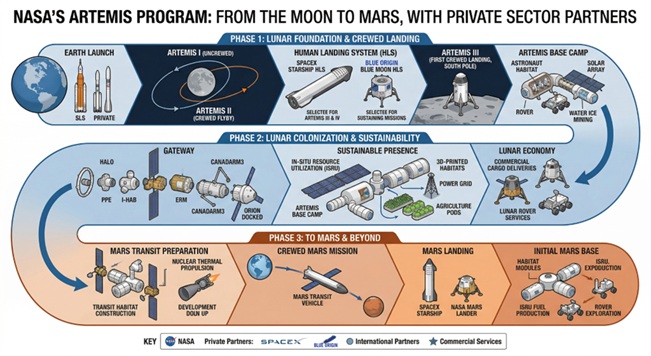
NASA’s Artemis II mission, which successfully concluded its 10-day lunar flyby on April 11, 2026, has officially cleared the path toward establishing permanent human operations on the Moon. As the first crewed lunar expedition since 1972, it was both a significant scientific milestone and a driver for reshaping the space industry by providing new business opportunities to private firms like SpaceX and Blue Origin.

Artemis II — the first mission of NASA’s extended lunar exploration program — was a 10-day mission to the Moon. Unlike future operations, it did not include a landing, but aimed to test essential systems and validate the Orion spacecraft and life-support technologies for future Moon landing missions. As a whole, the program had two main goals: bring humans back to the Moon and create a permanent lunar base that will later serve for future Mars missions. This serves as a vital link between previous uncrewed missions and upcoming landing operations.

The successful execution of Artemis II has provided the architectural validation necessary to move from experimental flights to advanced mission phases, including lunar landings and base construction operations. The mission represented a fundamental transformation in the space industry, affecting all aspects of space research activities.

It operated through NASA’s Space Launch System (SLS) and Orion spacecraft, built by traditional aerospace contractors. These systems faced criticism as their launch costs reached between $2 billion and $4 billion and depended on non-reusable equipment. The situation became critical, highlighting how existing systems rely on outdated methods, while new commercial systems opt for reusable components to reduce operational costs — creating an opportunity for private players to step in.

The Artemis program gave significant advantages to SpaceX and Blue Origin within the operational framework, as these firms have essential functions for future missions. NASA has already awarded contracts to these companies to develop lunar landing systems, making them essential partners for the next program development stages. Given this strategic support and industry leadership, Musk’s company may effectively appear on market and premarket movers lists once it completes its IPO, which is expected later this year.

The Artemis II mission demonstrated spacecraft design for permanent Moon operations, enabling private companies to enhance their capabilities across transportation activities, cargo handling tasks, and infrastructure building.

The implications are far-reaching. Artemis II reflected how space exploration has evolved from a government-exclusive domain into a new system in which private companies play a leading role. By showing what traditional systems can achieve and where their limits lie, the mission provided evidence that commercial providers should receive greater operational control over space activities. This development will potentially intensify competition across the industry, resulting in lower costs and creating a lunar economy that involves multiple business partners.

The system confirms NASA’s current technological capabilities while accelerating the integration of commercial partners into the project, thereby creating a new era of cooperation between government and private companies aimed at expanding human presence beyond Earth.

How Nordic Casino Sites Keep Up With New Web Trends

0

Nordic casino sites once felt like wood cabins in deep snow. Locals played a quick round there after work. Now they feel like bright online halls that stay open day and night on every screen. That change did not come in one rush. It grew from better tech and faster web speed. Users also wanted games near them on the bus or late at night. Many people who search for Revolut Casino picks read reviews on norge-casino.com first. Those reviews help them check fees and bonus deals before they try poker plans. Site teams watch how users sign in, pay in, and chat with friends. That gives them a view of what feels easy, safe, and fun. This piece looks at four shifts: phone design, new pay tools, smart data use, and fair rules. Put them side by side, and you can see how a cold region stays hot in online play.

The Shift To Phone First Design

Back in 2013, a Nordic casino lobby on a phone felt slow and awkward. Users had to zoom in on tiny keys and wait for loud ads to load. Now the same lobby opens fast and fits the hand with less fuss. Sites in Sweden, Norway, and Finland are now built for small screens first. Then they scale the look up for large screens. Icons stay big for a thumb. Menus fold into clean bars. Game tiles fit tall phone screens and do not hide the prize size. Teams now use HTML5, not old plug-ins, so a phone does not lose charge so fast. Push notes matter too. Users get soft alerts when a weekend event starts. They also get them when a loved slot hits a top mark. These steps do more than look new. They help users stay, because three easy taps feel far better than one bad minute.

Using New Local Ways To Pay

Fast and known ways to pay matter almost as much as the games. Nordic users like tools that move at the same pace as local bank apps. Casino sites saw that need and moved with it. Cards still have a place. Many sites now add fast bank moves through Trustly and phone wallets like Vipps. Some Finnish sites test e-ID tools that check the user and payment at once. That cuts forms and keeps key data safe. Revolut and other new banks also gain ground. They let users hold more than one cash type in one app. They also trim swap fees on bets across borders. When sites link open bank tools to the cash desk, users see funds in seconds. Some also get cash out by the next cup of coffee. That speed builds trust fast. Sites pair it with fraud checks that spot odd acts, like a late spree from a new phone.

Using Data To Shape The Visit

Luck may rule a spin, yet data shapes the trip that leads to it. Nordic casino sites track liked games and stay time. Some also note the sound level each user likes best. Then they use that view to shape the next visit. Instead of a flat wall of random slots, the lobby may show the user’s top games first. It may also add a new game with a close feel. These match tools work a bit like film apps. They study what many users pick and find links in those moves. Bonus deals follow the same path. A live blackjack fan may get free chips for the next live table. That works better than a weak slot gift. Sites still keep data care near the top. Nordic lands take data rights with care. Sites hide names in files and let users turn off tracking with one click. That leaves users seen, not chased, and the visit feels fresh, fair, and fun.

Safe Play And The Rules Ahead

Online growth brings new duties. Nordic law teams keep changing rules so quick play does not bring quick harm. Casino sites answer by putting safe play tools deep in the site from the first step. Pay caps, time notes, and fast self-ban keys show up at sign-up. Users do not need to hunt through menus to find them. Some sites test mood checks that read mouse speed and key slips to spot stress. When risk goes up, the site stops the game and gives the user a short break. That pause can save cash before a bad run gets worse. Ad rules have changed as well. Sweden now limits bonus deals and blocks loud pop-up ads that may push calm users too hard. Norway also blocks pay paths from sites with no local right to serve users. To sum up, these rules may feel strict, yet they build trust that lasts. Many experts now expect shared Nordic rules, plus fair checks and game logs users can test in seconds.

How Distributed Energy Systems Are Reshaping Everyday Infrastructure

0

Energy systems are changing in ways that are no longer limited to large power plants or utility networks. Today, energy is increasingly generated, stored, and used at the household level, creating what is known as distributed energy systems. These systems include technologies like rooftop solar, battery storage, and solar-powered hot water, solutions that are quietly transforming how homes operate.

In Australia, this shift is particularly visible. With abundant sunlight and strong policy support for renewables, households are becoming active participants in energy production rather than just consumers. This transformation is not only reshaping infrastructure but also redefining how everyday systems inside the home function.

What Distributed Energy Systems Actually Mean

Distributed energy systems refer to energy sources that are located close to where the energy is used, rather than being generated at a central location and transmitted over long distances. In practical terms, this means homes producing their own energy through solar panels or storing energy in systems like batteries and hot water tanks.

This approach reduces reliance on the traditional grid while improving efficiency. Instead of energy being lost through transmission, it is used directly where it is generated.

In Australia, this model is becoming increasingly common, especially in suburban areas where rooftop solar installations are widespread. It represents a shift toward more resilient and self-sufficient homes.

How Solar Hot Water Fits Into This Shift

One of the most practical examples of distributed energy in everyday life is solar hot water. Unlike traditional systems that rely entirely on electricity or gas, solar hot water uses sunlight to heat water directly, reducing both energy costs and environmental impact.

For homeowners exploring ways to upgrade their systems, choosing to use solar hot water brisbane is not just about efficiency, it reflects a broader move toward integrating renewable energy into daily routines. These systems operate quietly in the background, yet they significantly reduce reliance on external energy sources.

In regions like Queensland, where sunlight is abundant, solar hot water systems have become a practical and widely adopted solution.

Turning Everyday Systems Into Energy Assets

One of the most interesting developments in distributed energy is the idea that everyday household systems can act as energy storage. Hot water systems, for example, can store energy in the form of heat, which can be used later when needed.

Research supported by the Australian Renewable Energy Agency shows that smart hot water systems can be used to absorb excess solar energy during the day and reduce strain on the electricity grid.

This means that something as routine as heating water can play a role in stabilising energy supply and improving overall efficiency. It transforms everyday infrastructure into an active part of the energy system.

Reducing Costs and Environmental Impact

Photo by Red Zeppelin on Unsplash

One of the main drivers behind distributed energy adoption is cost. Systems like solar hot water significantly reduce energy bills by using renewable energy instead of grid electricity or gas.

In Australia, where water heating accounts for a large portion of household energy use, switching to solar can lead to substantial savings over time. Studies show that solar hot water systems can reduce water heating costs by a large margin while also lowering greenhouse gas emissions.

Beyond financial benefits, these systems contribute to a broader reduction in environmental impact. Lower reliance on fossil fuels means fewer emissions and a smaller carbon footprint for households.

Designing Homes Around Decentralised Energy

As distributed energy becomes more common, homes are increasingly designed with these systems in mind. Instead of adding solar or storage solutions as upgrades, new builds are integrating them from the start.

This includes positioning roofs for optimal solar exposure, incorporating efficient plumbing layouts, and ensuring compatibility with energy storage systems. The goal is to create homes that are not only energy-efficient but also capable of adapting to future technologies.

In Australia, this approach is becoming part of modern building practices, particularly in regions where sustainability and energy independence are priorities.

The Future of Infrastructure Starts at Home

The shift toward distributed energy is changing the definition of infrastructure itself. Instead of relying solely on large-scale systems, energy is now being generated and managed at the household level.

This decentralisation creates a more flexible and resilient system overall. Homes can reduce their dependence on the grid, manage their own energy use, and even contribute to stabilising the broader network.

As technologies continue to evolve, the role of everyday systems, like solar hot water, will become even more important. What was once considered a simple household function is now part of a much larger transformation.

In the end, distributed energy systems are not just about technology, they are about changing how homes interact with energy. By integrating these systems into daily life, households are shaping a future where infrastructure is smarter, more efficient, and built around the needs of everyday living.