DD
MM
YYYY

PAGES

DD
MM
YYYY

spot_img

PAGES

Home Blog Page 2

ZKP’s Presale Pulled in $2.23M in Record Time While Solana Price Tests Support & Shiba Inu Price Drops

0

Crypto investors are constantly searching for coins that can turn tiny investments into huge wealth. The crypto market offers endless opportunities, but the right time to make a decision is everything. While established tokens show steady movements, new early-stage projects often deliver the most dramatic gains.

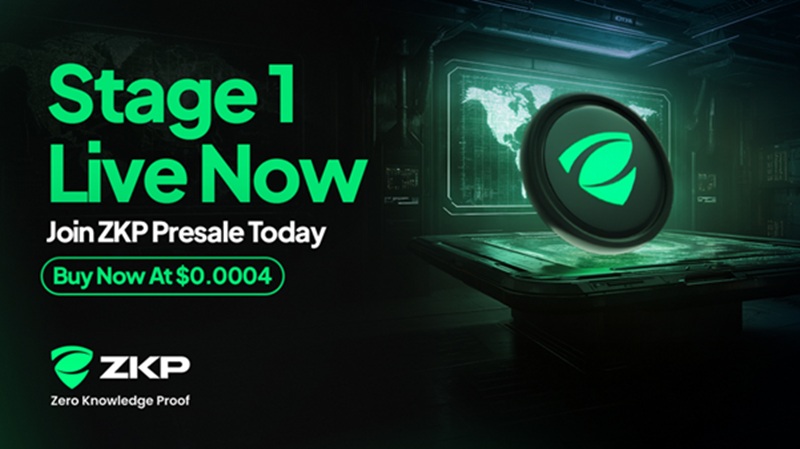
Current chart movements show the Solana price navigating a critical support level, while the Shiba Inu price struggles under heavy technical pressure as it tests critical support near $0.00000481. Meanwhile, investors looking for top crypto gainers are rushing into the ZKP presale, which has already raised over $2.23 million in record time. With ZKP coins still available at just $0.0004 in stage 1, smart investors are securing early allocations right now before this current presale stage closes and prices rise sharply in the upcoming round.

Solana Price Tests Critical $73 Support

The Solana price is currently hovering near $73.90, testing an important support level close to $73. This price area has held buyers since June, but overhead selling pressure keeps short-term gains limited below $77.

If buyers can push the token above $77, it could move toward resistance targets between $80 and $84. However, failing to hold the $73 level opens up serious downside risks.

A breakdown below $73 could push the token down toward the $68 to $64 liquidity zone, or even down to its June low near $60. While long-term charts point to higher targets if support holds, the current structure remains at risk if selling pressure continues.
Shiba Inu Price Struggles Below Resistance Level

The Shiba Inu price has dropped toward $0.0000052 after experiencing recent market volatility. High trading activity on South Korean exchanges previously added short-term momentum, but broader selling pressure continues to weigh on the asset.

The token currently trades below major technical levels, including its 20-day and 200-day moving averages. Chart analysis suggests near-term price action will likely stay trapped in a narrow range between $0.00000481 and $0.00000559.

While a jump above $0.00000544 could allow for a minor recovery, the overall technical setup remains cautious. If buyers fail to defend the critical $0.00000481 support mark, the token faces the clear risk of deeper losses in upcoming sessions.

Zero Knowledge Proof (ZKP): The Next Big Wealth Generator

A massive shift is happening right now in the world of artificial intelligence and blockchain technology. Zero Knowledge Proof (ZKP) is building a private AI network that lets people own the actual tech infrastructure instead of giant corporations. Smart investors are already jumping in, causing the ZKP presale to blow past $2.23 million in record time. Missing an early opportunity like this rarely happens twice, and early backers are securing their share before the general public catches on.

What makes the project truly special is its plug-and-play ZKP Miner, a $249 physical device that users can set up at home in minutes. This hardware device processes real AI computing tasks, secures the network with zero-knowledge proofs, and automatically mints ZKP coins directly into the user’s wallet. It transforms complex tech into an effortless passive income machine that turns daily compute power into real, mintable wealth for its active community members.

Right now, ZKP coins are available in the presale stage 1 for a low price of just $0.0004 per coin. However, this entry point will not last long, as the current presale stage is filling up fast and the price will jump in the next round. As more participants explore the project’s technology and potential, ZKP is gaining attention among the top crypto gainers being watched by investors looking for emerging opportunities.

Final Call

While the Solana price continues testing key support levels near $73 and the Shiba Inu price consolidates under technical pressure around $0.00000481, Zero Knowledge Proof (ZKP) offers an unrivaled growth trajectory. By merging private AI computing with real, daily passive income, ZKP stands apart from older tokens tied to uncertain price swings.

Its presale momentum has already broken records by raising over $2.23 million, positioning the project firmly among the top crypto gainers. With ZKP coins priced at just $0.0004 for a very short window, securing an early allocation now ensures maximum exposure before the current stage closes and higher token prices take effect.

Explore ZKP:

Website: https://zkp.com/

Buy: https://purchase1.zkp.com/

Telegram: https://t.me/ZKPofficial
X: https://x.com/ZKPofficial

The Future of AI Depends on Human Wisdom and Ethical Leadership

0

Artificial intelligence is advancing at a remarkable pace, transforming industries, accelerating scientific discovery, and reshaping how people work, communicate, and solve problems.

Modern AI systems can analyze enormous datasets, generate human-like language, compose music, write software, and assist in medical research.

These achievements often create the impression that intelligence alone is the defining measure of progress.

Yet beneath the excitement lies a profound truth: intelligence and wisdom are not the same. Humanity’s greatest strength has never been its ability to calculate faster than machines, but its capacity to seek meaning beyond what can be measured.

Human beings possess a unique ability to connect with the transcendent—the mysteries of existence that lie beyond logic, algorithms, and empirical data. Whether expressed through spirituality, philosophy, art, love, or moral reflection, this connection cannot be fully explained by computation.

It is the source of purpose, compassion, creativity, and resilience. While AI can identify patterns and optimize decisions, it cannot genuinely experience awe, faith, hope, or the moral responsibility that accompanies human choice. These qualities emerge from consciousness, lived experience, and the search for meaning rather than from statistical prediction.

Artificial intelligence excels at processing information because it is built upon data and mathematical models. It can become extraordinarily intelligent within the boundaries of its design.

However, intelligence is fundamentally the ability to acquire and apply knowledge. Wisdom is something deeper. Wisdom requires judgment, ethical reasoning, humility, empathy, and an understanding of long-term consequences.

It recognizes that the correct answer is not always the most humane answer and that numbers alone cannot determine what is right. This distinction is reflected in the very name of our species. The Latin phrase Homo sapiens does not simply mean “intelligent human.” It means “wise human.”

The term reminds us that humanity’s defining characteristic is not merely cognitive ability but the pursuit of wisdom. Throughout history, civilizations have flourished not because they possessed superior information but because they cultivated values, justice, and shared purpose.

Great leaders, philosophers, and spiritual teachers are remembered less for their intelligence than for their wisdom in navigating uncertainty and inspiring others.

The words of writer and biochemist Isaac Asimov remain especially relevant today: “The saddest aspect of life right now is that science gathers knowledge faster than society gathers wisdom.”

Decades after he spoke those words, technological progress has accelerated beyond anything he could have imagined. Every breakthrough in AI expands our access to knowledge, yet it also magnifies the consequences of poor judgment.

Deepfakes challenge trust, algorithms influence public opinion, and autonomous systems raise difficult ethical questions. These are not technical problems alone; they are moral challenges requiring wisdom rather than greater computational power.

As AI becomes increasingly integrated into daily life, the question is no longer whether machines will become smarter. The more important question is whether humanity will become wiser. Education, therefore, must extend beyond technical skills to include ethics, philosophy, history, and emotional intelligence.

Innovation should be guided by principles that protect human dignity instead of pursuing efficiency at any cost. Technology must remain a tool that serves humanity rather than a force that defines it.

Our greatest superpower is not intelligence but wisdom. It is our ability to love, forgive, imagine, believe, and seek truths that cannot be reduced to data points or algorithms. AI may continue to surpass humans in countless intellectual tasks, but wisdom remains rooted in the human spirit.

In an age increasingly shaped by intelligent machines, preserving that wisdom may be the most important challenge—and the greatest opportunity—of our time.

YouTube Purges 130,000 AI Spam Channels to Improve Content Quality

0
A picture shows a You Tube logo on December 4, 2012 during LeWeb Paris 2012 in Saint-Denis near Paris. Le Web is Europe's largest tech conference, bringing together the entrepreneurs, leaders and influencers who shape the future of the internet. AFP PHOTO ERIC PIERMONT (Photo credit should read ERIC PIERMONT/AFP/Getty Images)

YouTube has reportedly removed more than 130,000 channels in one of its largest enforcement actions against low-quality, AI-generated content, often described as AI slop.

The sweeping crackdown reflects a growing effort by the platform to protect viewers, advertisers, and legitimate creators from an explosion of spam-like videos that have flooded the internet since generative artificial intelligence became widely accessible.

The term AI slop refers to content produced almost entirely by artificial intelligence with little or no meaningful human input.

These videos typically rely on synthetic voices, recycled visuals, misleading thumbnails, and automatically generated scripts designed primarily to exploit YouTube’s recommendation algorithm. Many exist solely to maximize advertising revenue through mass production.

The rapid advancement of AI tools has made it possible for virtually anyone to generate hundreds of videos in a short period. While AI itself is not the problem, the misuse of the technology has created a wave of repetitive, inaccurate, and often deceptive content.

This has made it increasingly difficult for viewers to distinguish genuine creators from automated content farms. YouTube’s reported removal of approximately 130,000 channels sends a clear message that scale alone will no longer guarantee visibility or monetization.

Instead, the platform appears to be placing greater emphasis on originality, authenticity, and value. This approach aligns with broader efforts across the technology industry to improve content quality as AI-generated media becomes more common.

The crackdown serves the interests of advertisers. Brands invest billions of dollars each year in digital advertising and expect their campaigns to appear alongside trustworthy, engaging content.

If advertisements are repeatedly displayed on low-quality or misleading videos, advertiser confidence can decline, threatening a significant source of revenue for platforms like YouTube.

Cleaning up AI-generated spam therefore benefits not only users but also the platform’s long-term business model. Many have complained that AI-generated channels have saturated search results and recommendations, making it harder for original work to gain visibility.

By removing thousands of spam channels, YouTube may create a healthier ecosystem where creativity, expertise, and storytelling receive greater recognition. The crackdown should not be interpreted as a rejection of artificial intelligence itself.

Many successful creators use AI responsibly to edit videos, generate subtitles, translate content, brainstorm ideas, or enhance production quality. These tools can significantly improve efficiency while leaving human creativity at the center of the production process.

The distinction lies between AI as a creative assistant and AI as a replacement for meaningful content creation. The broader significance of YouTube’s actions extends beyond a single platform.

As AI-generated content proliferates across social media, regulators, technology companies, and consumers are increasingly demanding higher standards for transparency and authenticity.

Similar enforcement measures may soon emerge across other digital platforms seeking to maintain user trust. YouTube’s reported deletion of 130,000 AI-generated channels represents more than a routine moderation effort.

It marks an important turning point in the evolving relationship between artificial intelligence and online media. The future of content creation is unlikely to be defined by whoever can generate the most videos the fastest.

But by those who combine AI’s efficiency with genuine human insight, originality, and credibility. In the age of generative AI, authenticity is becoming the internet’s most valuable currency.

ZKP Presale Just Hit $2.23M and its Only Getting Started: The Next Crypto to Explode While SHIB Fades & TAO Bleeds

0

The crypto market keeps splitting winners from losers, and this week the gap is loud. The Shiba Inu price just slipped after a Korean-driven pump ran out of steam, while the Bittensor TAO price is struggling under falling momentum and heavy resistance overhead. Both stories point to the same lesson: hype alone does not hold value for long.

That is why smart money is racing into Zero Knowledge Proof (ZKP) at its Stage 1 price of just $0.0004. With $2.23 million already raised and a $0.04 listing target locked in the roadmap, ZKP is being called the next crypto to explode a rare 100x setup hiding in plain sight

Bittensor TAO Price Struggles Under Heavy Resistance

The Bittensor TAO price is trading around $188, and buyers are running low on strength. The token tried to break above $214 but got rejected hard. Now it sits below every key moving average; the 20-day, 50-day, 100-day, and 200-day EMA all sit above the price, which shows the trend is weak across every timeframe.

Analysts believe the $167 support could get tested soon. If TAO does not reclaim $214, CoinCodex predicts the Bittensor TAO price could drop another 25% and reach $147 within the next 30 days.

Trading volume jumped 51% today, but open interest fell almost 10%. That mix hints that traders are closing bets rather than opening new ones. For those searching for the next crypto to explode, TAO is not sending a clear signal right now.

Shiba Inu Price Falls After Korean Buying Fades

The Shiba Inu price dropped 10% in a single day and is trading around $0.0000046 after a fast rally lost steam. South Korean traders on Upbit had pushed heavy buying pressure the day before, and the SHIB pair against Korean Won made up over 10% of global volume. But no product launch or big news backed the pump, so the move faded almost as quickly as it started.

Right now, SHIB trades above its 20-day and 50-day moving averages but stays under the 200-day line. That mix signals short-term strength and long-term weakness at the same time. The RSI is overbought at 77, hinting the coin is stretched.

Support sits near $0.000005. If that breaks, the Shiba Inu price could slide further. For anyone tracking the next crypto to explode, SHIB still runs mostly on hype and speculation.

Zero Knowledge Proof (ZKP): Real Utility Backed by Real Hardware

While SHIB burns out on hype and TAO fights its own charts, Zero Knowledge Proof (ZKP) is quietly building something different. This Layer 1 project has already pulled in $2.23 million during its live presale, with early buyers grabbing coins at just $0.0004 each. With a listing target of $0.04, the built-in upside sits at a clean 100x. Some analysts even project potential returns of 5,000x to 10,000x if adoption scales after mainnet, making ZKP the next crypto to explode in the eyes of early movers.

ZKP wants to take AI power away from Big Tech and hand it back to regular people. AI is growing fast, but so are the risks. Fake outputs, leaked training data, and unchecked models have cost businesses billions this year alone.

Security is no longer a bonus feature; it is the base layer every AI system now needs. ZKP tackles this problem head-on. It uses zk-SNARKs and AES-256 encryption to prove every computation is done correctly, without ever exposing the raw data behind it. That means private AI that is still fully verifiable.

The real hook is the ZKP Miner. For a one-time $249 cost, the plug-and-play device runs AI tasks for the network and pays $ZKP straight to the owner’s wallet. That turns a home device into a passive income stream, with rewards drawn from the 55% coins set aside for miners, the largest slice of the entire tokenomics.

The consensus model is also unique. ZKP uses a hybrid of Proof of Intelligence and Proof of Space, cutting the energy waste seen in older Proof-of-Work chains. With hardware shipping now and mainnet on the way, buyers are rushing in early, treating ZKP as the next crypto to explode before its wider exchange listings.

Conclusion

The Shiba Inu price and Bittensor TAO price tell the same story from different angles: momentum without a strong base rarely holds. SHIB might reward quick meme traders in short bursts, and TAO could pay off long-term if it reclaims $214, but both are walking on thin technical ice.

ZKP is running a completely different play. Stage 1 is live at just $0.0004, over $2.23 million is already raised, and every day pushes the token closer to a price jump.

With a listing target of $0.04 (a clean 100x) and analyst projections stretching as high as 5,000x to 10,000x, the entry gap here is one of the widest in the market. That is why buyers are rushing in early, treating ZKP as the next crypto to explode before Stage 1 seals shut.

Explore ZKP:

Website: https://zkp.com/

Buy: https://purchase1.zkp.com/

Telegram: https://t.me/ZKPofficial

X: https://x.com/ZKPofficial


Leopold Aschenbrenner’s Hedge Fund and Amazon’s AI Reset Reveal a New Reality

0

The struggles surrounding Leopold Aschenbrenner’s hedge fund and Amazon’s decision to overhaul its artificial intelligence strategy illustrate a harsh truth: intelligence alone is not enough.

In both investing and technology, execution, adaptability, and market timing ultimately determine success. Leopold Aschenbrenner gained widespread recognition for his influential writings on the future of artificial intelligence.

His essays on AI safety, economic transformation, and geopolitical competition earned praise from researchers, investors, and policymakers. His reputation as a visionary naturally raised expectations when he entered the investment world.

However, Wall Street operates according to a different set of rules. Financial markets reward consistent returns rather than intellectual prestige.

History is filled with examples of brilliant economists, mathematicians, and scientists who struggled to outperform the market. Investing is not simply an academic exercise. It demands emotional discipline, risk management, portfolio construction, and the ability to react to unpredictable events.

Even the most sophisticated models can fail when markets move on sentiment, geopolitical shocks, or unexpected macroeconomic developments. Aschenbrenner’s hedge fund serves as another reminder that financial markets are relentless meritocracies.

Investors ultimately judge managers by performance, not credentials or theoretical insights. This reality explains why some of the industry’s most successful investors prioritize process and discipline over intellectual complexity. Wall Street values results above all else.

At the same time, Amazon has demonstrated that even technology giants must remain flexible. Reports that the company is winding down many of its flagship AI models represent a significant shift in strategy.

Rather than pursuing numerous competing foundation models, Amazon appears to be focusing its resources on areas where it can achieve stronger commercial advantages and better returns on investment.

This decision reflects the increasingly competitive nature of the AI industry. Building state-of-the-art language models requires enormous investments in computing infrastructure, specialized talent, and energy resources.

Companies such as OpenAI, Anthropic, Google, and Meta have intensified the race, making it difficult for every participant to maintain leadership across every segment of artificial intelligence. Instead of trying to win every battle, Amazon seems to be concentrating on integrating AI into its broader ecosystem.

Its strengths lie in cloud computing through AWS, enterprise software, logistics, retail, and consumer services. By embedding AI capabilities into these businesses rather than competing head-on in every model category, Amazon may strengthen its long-term competitive position.

The parallel between Aschenbrenner’s experience and Amazon’s strategic shift is striking. Both cases demonstrate that success depends less on possessing exceptional intelligence and more on making practical decisions under real-world constraints.

Markets reward adaptability, efficient capital allocation, and operational excellence far more than impressive ideas alone. Entrepreneurs, and AI researchers, these developments carry an important lesson.

Innovation remains essential, but execution determines outcomes. Brilliant theories must survive market realities, competitive pressures, and changing customer demands.

Companies and individuals who recognize when to pivot often outperform those who remain committed to ideas that no longer fit evolving conditions. Wall Street does not hand out rewards for being the smartest person in the room.

It rewards those who consistently deliver results. Likewise, the AI race will not necessarily be won by those with the boldest ambitions, but by organizations capable of translating technological breakthroughs into sustainable products, profitable businesses, and enduring competitive advantages.