DD
MM
YYYY

PAGES

DD
MM
YYYY

spot_img

PAGES

Home Blog Page 2

Energy, Marginal Cost, and Nigeria’s Limits in the AI Era

1

Comment: “Sir, comment on this statement that Nigeria is going to leapfrog in the AI era.”

My Response: That belief is comforting, but it is largely an illusion. Nations do not leapfrog into epochs; they build into them. And the defining input of the AI era is not talent, ambition, or even code. It is energy. AI is an energy-hungry system, and the countries that will dominate the Acceleration Society which include America, China, and a few others are those that can produce, optimize, and deploy massive, reliable, and cheap energy at scale. Nigeria is not there, unfortunately. Please, I am not against any person, and this is not a political statement. I am just a village guy doing my thing on my lane.

As I have argued in my works, societies move from the invention era to the innovation era, and then into the acceleration era. Each transition demands more energy than the previous one. Nigeria has not yet built the energy systems required for the invention society, talk less of the innovation society that produces the foundation utilities for AI and autonomous systems. Without energy, AI remains a slide deck, not an industry.

So, when someone tells you that Nigeria will participate productively in AI, at the upstream, value-creating layer, you must ask a simple question: with what power? Servers do not run on optimism. Data centers do not scale on narratives. Energy will define national competitiveness in the coming decade, and today, Nigeria is structurally outside that arena.

There is another, less discussed constraint: AI economics. In traditional software (SaaS), scale is merciful. As customers increase, marginal cost declines. The curve bends downward, approaching zero within a finite space. My Further Mathematics teacher in secondary school called that an asymptotic relationship. That is why software companies love scale. AI is different.

AI has persistent inference costs. Every additional user consumes compute. As you scale, costs can rise sharply, sometimes faster than revenues. The marginal cost curve does not collapse the way SaaS does. Reaching an optimal cost point requires enormous capital, infrastructure, and patience. Yes, an inflection point exists but getting there is expensive and unforgiving. This is where Nigeria and indeed sub-Saharan Africa face a structural mismatch.

Our dominant playbook across our country is not “scale at all costs.” It is reach profitability early, protect cash flows, and pay dividends. That mindset works in many industries, but it collides with AI’s economics. I do not see many publicly listed African companies willing or able to absorb years of elevated AI inference costs in pursuit of distant scale advantages.

This does not mean Africa will not use AI. We will. We already do. But using AI is not the same as producing AI at the frontier. Participation is not leadership. Get it from me: In the AI era, energy is destiny. Until Nigeria fixes energy at scale, reliability, and price, our role will remain downstream. And pretending otherwise may feel good, but it does not change the physics of progress.


The Architecture of Speed: Why BlockDAG’s 10,000 TPS Outpaces a Congested Solana

0

The digital asset market punishes stagnation. While Solana previously dominated the speed rankings, the network is now faltering. Users frequently encounter failed transactions, heavy congestion, and expensive priority fees. The former “Ethereum Killer” is transforming into the very problem it sought to solve: a sluggish and costly ecosystem.

As traditional giants struggle, a superior infrastructure powerhouse has emerged. BlockDAG is debuting a hybrid network featuring 10,000 transactions per second (TPS). This system is faster, more robust, and significantly more affordable. With the presale concluding in mere hours, the industry recognizes that the next-generation internet is priced at $0.0005, but only for a fleeting moment.

Solving the Speed Crisis: Why Solana is Falling Behind

Solana enjoyed massive success, but mainstream adoption has revealed its flaws. Under heavy load, the network stalls. We witness outages, significant lag, and a user experience resembling old dial-up internet rather than modern finance. Participants are frustrated by paying premium fees just to process a single transaction. The industry demands a scalable alternative that delivers consistent results.

BlockDAG provides that solution. It avoids the bottlenecks typical of single-chain systems by utilizing a Directed Acyclic Graph (DAG). This architecture enables the simultaneous creation of multiple blocks.

Such parallel processing power facilitates the 10,000 TPS benchmark. It represents the evolution from a narrow road to a massive superhighway. For developers and users tired of delays, BlockDAG is the necessary transition. This technical edge makes it the top crypto to buy today.

Evaluating Potential: The Logic for 1000x Growth

History provides a roadmap for understanding this massive potential. When Solana first launched, it traded for tiny fractions of a dollar. It eventually surged beyond $200, creating significant wealth for early adopters. That expansion occurred because it provided better infrastructure than existing options. BlockDAG occupies that exact position now, but with superior technology and a more accessible entry price.

Infrastructure projects consistently maintain the highest ceilings in this space. Assets that power the underlying network hold more value than individual applications. BlockDAG is launching at $0.0005. Capturing even a small portion of Solana’s market share would result in an astronomical price increase. A shift from $0.0005 to $0.50 represents a 1000x return. This is a mathematical reality of early infrastructure acquisition. With analysts forecasting launch prices between $0.30 and $0.43, the path toward a 1000x move is already visible.

Analyzing the Shift in Large-Scale Capital

Market leaders prioritize profit over loyalty. Currently, capital is rotating out of mature, slow-growth assets and into BlockDAG. This occurs because Solana’s growth potential is now limited. It would require trillions in new capital to achieve a 10x move. Conversely, BlockDAG is a compressed spring ready to release.

Sophisticated participants understand that the base layer holds the ultimate value. By entering BlockDAG prior to the public launch, they are acquiring the foundation of the new digital economy for a nominal cost.

They recognize the 10,000 TPS capability, the 312,000 holders, and the vulnerabilities of competitors. This movement of funds is a primary indicator that BlockDAG is the top crypto to buy before the general public reacts.

Final Opportunity Alert

The presale is reaching its absolute conclusion. The chance to access BlockDAG at $0.0005 expires in a few hours. No extensions will be granted. Once the timer ends, the supply is finalized, and the next opportunity will be on Tier 1 exchanges at significantly higher valuations.

The window to acquire the next infrastructure giant for a fraction of a cent is closing. The technology is functional, demand is high, and the valuation is poised for movement. Avoid the regret of missing this pivotal moment. Control the infrastructure of the future before the presale finishes today.

Key Insights

Solana had its era, but the market is transitioning toward more efficient technology. BlockDAG provides 10,000 TPS and the reliability of Proof-of-Work at a minimal entry cost. The prospect of a 1000x increase is supported by a low starting point and powerful technical foundations. With the presale ending in hours, this is the final opportunity. Enter the top crypto to buy and lead the next era of infrastructure growth.

Presale: https://purchase.blockdag.network

Website: https://blockdag.network

Telegram: https://t.me/blockDAGnetworkOfficial

Discord: https://discord.gg/Q7BxghMVyu

SpaceX Seeks Approval for One Million-Satellite Orbital Data Center Powered By Solar

0

SpaceX has taken an extraordinary step toward redefining both space infrastructure and global computing, seeking approval from the U.S. Federal Communications Commission for a satellite constellation of unprecedented scale that would function as an orbital data center powered largely by the sun.

In a filing submitted late on January 30, the company proposed deploying up to one million satellites in low Earth orbit, a figure that dwarfs any constellation previously contemplated. The satellites would operate at altitudes ranging from 500 to 2,000 kilometers, spread across 30-degree and sun-synchronous inclinations designed to maximize exposure to sunlight and, by extension, solar power generation.

SpaceX framed the project as a response to the mounting constraints facing terrestrial data centers, where energy costs, grid limitations, and environmental concerns are increasingly colliding with explosive demand for computing power driven by artificial intelligence.

“By directly harnessing near-constant solar power with little operating or maintenance cost, these satellites will achieve transformative cost and energy efficiency while significantly reducing the environmental impact associated with terrestrial data centers,” the company said in the filing.

The language of the application goes well beyond near-term commercial logic. SpaceX described the constellation as “a first step toward becoming a Kardashev Type II civilization,” a reference to a theoretical stage of technological development in which a civilization can harness the full energy output of its star. In more practical terms, the company argues that space-based computing could support AI-driven applications for billions of people while advancing its long-term vision of humanity as a multiplanetary species.

Even by the standards of an industry accustomed to bold plans, the scale is enormous. For comparison, China filed plans with the International Telecommunication Union in December for two constellations totaling nearly 200,000 satellites. Rwanda, in 2021, submitted ITU filings for constellations exceeding 300,000 satellites, linked to proposals by startup E-Space, which no longer appears to be pursuing systems of that magnitude. SpaceX’s proposal would exceed both by a wide margin.

Despite the headline number, the filing offers relatively few technical specifics. Details such as satellite size, mass, and precise orbital configurations were largely absent. SpaceX said it intends to place the spacecraft in “largely unused orbital altitudes” within the proposed range, an assertion likely to draw scrutiny as congestion, debris risk, and space traffic management become central regulatory concerns.

The operational concept relies heavily on intersatellite optical links, allowing the satellites to communicate with one another and with SpaceX’s existing Starlink broadband constellation. Data would be routed through space before being relayed to the ground, reducing dependence on continuous ground station connectivity. Ka-band communications would serve primarily as a backup for telemetry, tracking, and command, operating on what SpaceX described as a “non-interference, unprotected basis,” which underpins its request for regulatory flexibility.

One notable omission is any clear deployment timeline or cost estimate. SpaceX asked the FCC to waive standard milestone requirements that typically mandate deployment of half a licensed constellation within six years and full deployment within nine. The company argued that those rules are meant to prevent spectrum warehousing and should not apply because the Ka-band spectrum would be used on a non-interference basis.

The proposal arrives as SpaceX and its founder, Elon Musk, increasingly emphasize space-based computing as a solution to the AI industry’s surging appetite for power and processing capacity. That narrative has also been tied to SpaceX’s long-anticipated initial public offering, which could come as early as this summer and potentially raise tens of billions of dollars. Analysts see AI infrastructure, alongside Starlink, as a key pillar of the company’s long-term valuation story.

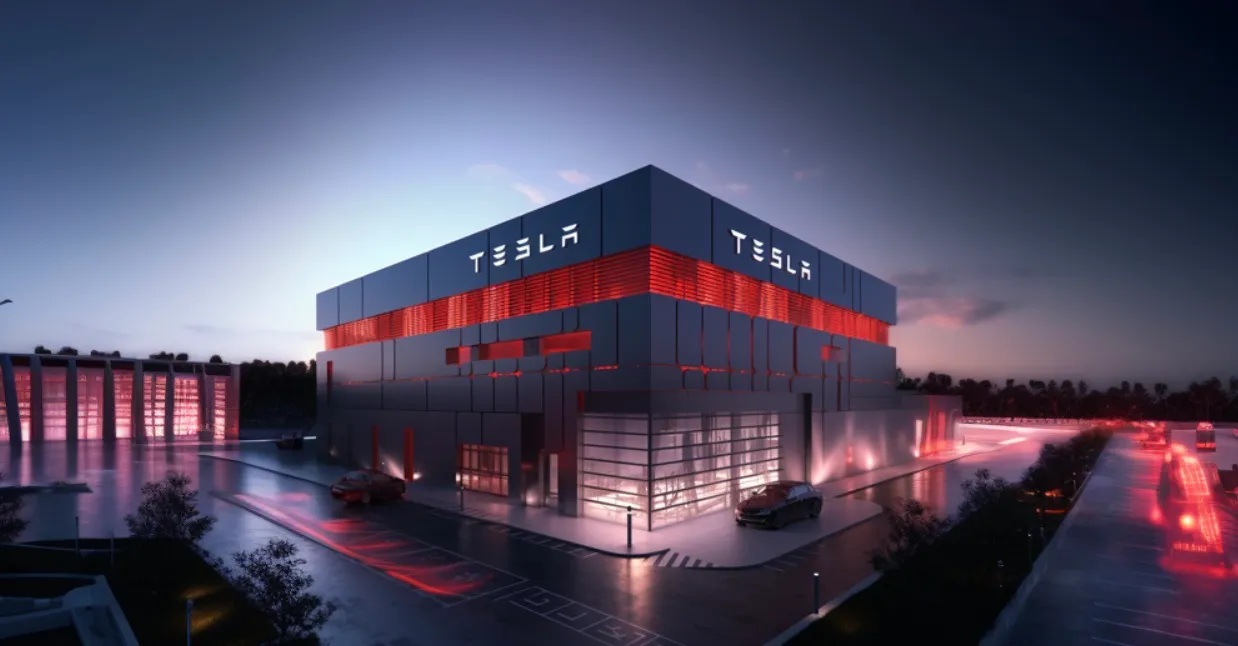
Speculation has also intensified around Musk’s broader corporate ecosystem. Recent reports suggest he has explored merging SpaceX with xAI, his artificial intelligence and social media venture, or even combining SpaceX with Tesla, which has invested heavily in AI for autonomous driving and robotics. An orbital data center network would fit neatly into such a vertically integrated vision, spanning energy generation, launch, connectivity, and compute.

In its filing, SpaceX leaned heavily on the economics of falling launch costs and rising terrestrial constraints. The company argued that as demand for AI accelerates, Earth-based data centers are becoming more expensive and politically contentious, particularly where they strain power grids and water resources. In contrast, SpaceX claimed that space-based computing could soon undercut terrestrial alternatives.

“Freed from the constraints of terrestrial deployment, within a few years the lowest cost to generate AI compute will be in space,” the company said, predicting advances in AI models at “unprecedented speeds and scales.”

Central to that claim is Starship, SpaceX’s next-generation launch vehicle, which the company plans to use to deploy both future Starlink satellites and the proposed orbital data center constellation. SpaceX said Starship’s ability to deliver massive payloads to orbit could allow space-based computing capacity to exceed the electricity consumption of the entire U.S. economy, without the need to overhaul Earth’s already strained power infrastructure.

Still, the proposal raises profound questions. A constellation of one million satellites would intensify debates over orbital congestion, collision risk, astronomical interference, and regulatory oversight at a time when governments are already struggling to adapt rules to far smaller systems. It also challenges assumptions about where the future of computing should reside, shifting it from land-based facilities to a permanently orbiting infrastructure.

Register for Tekedia AI Lab, Next Edition Begins March 14

0

We are excited to announce that Tekedia Institute has opened registration for the next edition of Tekedia AI Lab: from Technical Design to Deployment. In this program, you will learn how to build AI agents such as WinSupport, WinJob, WinLearn, etc. You will also master how to deploy such in your personal domain like mywebsite.com. 

Tekedia AI Lab: From Technical Design to Deploymentis a hands-on program designed to empower learners with the practical skills needed to design, develop, and deploy AI systems and agents. Moving beyond theoretical concepts, the AI Lab focuses squarely on tangible implementation, ensuring participants gain real-world experience in bringing AI innovations to life. It has four-Saturday practical Zoom sessions and an 8-week business component running simultaneously.

Program Date: Next edition begins March 14, 2026 

It has four-Saturday practical Zoom sessions and an 8-week business component running simultaneously. The Live Zoom sessions are held on Saturdays at 3-6pm WAT, on four Saturdays from March 14, 2026 to April 4, 2026.

How To Register and Pay

The cost is $500 or N350,000 and you can pay at the program website here. We support Naira bank transfer, PayPal, Stripe, Zelle, etc. 

In this program, we will teach how you can deploy agents on your local computer; such will include:

  • AI chatbot
  • Web SEO keyword & title page analyzer
  • Structured data classifier
  • Web content summarizer
  • Essay writer and story planner

More so, Tekedia will educate you on how you can create a personal AI chatbot on your computer, and how to deploy agents in virtual private servers. Every knowledge you need to connect AI foundation models like Google Gemma 3, DeepSeek, etc to power codes your local machine and VPS environments, you will learn. No coding or programming experience is required and this is not a coding program. The full program syllabus is here.

While the AI Lab focuses on code-based, open source model framework, Tekedia AI in Business Masterclass which comes at no additional cost for registration has case studies on how to use no-code, natural language prompting to create AI agents.  With our two programs, you will have the knowledge needed to thrive in this AI era.

Upon completion, we award Advanced Diploma in AI Technical Design and Deployment, and Advanced Diploma in Artificial Intelligence (AI) in Business certificates.

Business Lesson from Elisha’s Double Portion and Radical Commitment to Mission

1

In corporate leadership, the most challenging moment is not the rise of power; it is the transfer of it. Many organizations fail not because the founder was weak, but because the successor was unprepared, or worse, uncommitted. The Bible offers a timeless business case in the relationship between Elijah and Elisha, a masterclass in mentoring, succession planning, and leadership seriousness.

When Elisha asked Elijah for a “double portion,” he was not asking for comfort, title, or ceremonial inheritance. In the Hebrew context, the double portion is the share of the firstborn, the one expected to carry continuity, responsibility, and growth. Elisha was effectively saying: I do not want to merely maintain what you built; I want the capacity to exceed it. That is ambition with accountability.

Elijah did not resist that request. He prepared Elisha. He walked with him, exposed him to the work, and allowed him to observe leadership in motion. This is active succession, not accidental handover. Great leaders do not disappear; they deliberately develop successors.

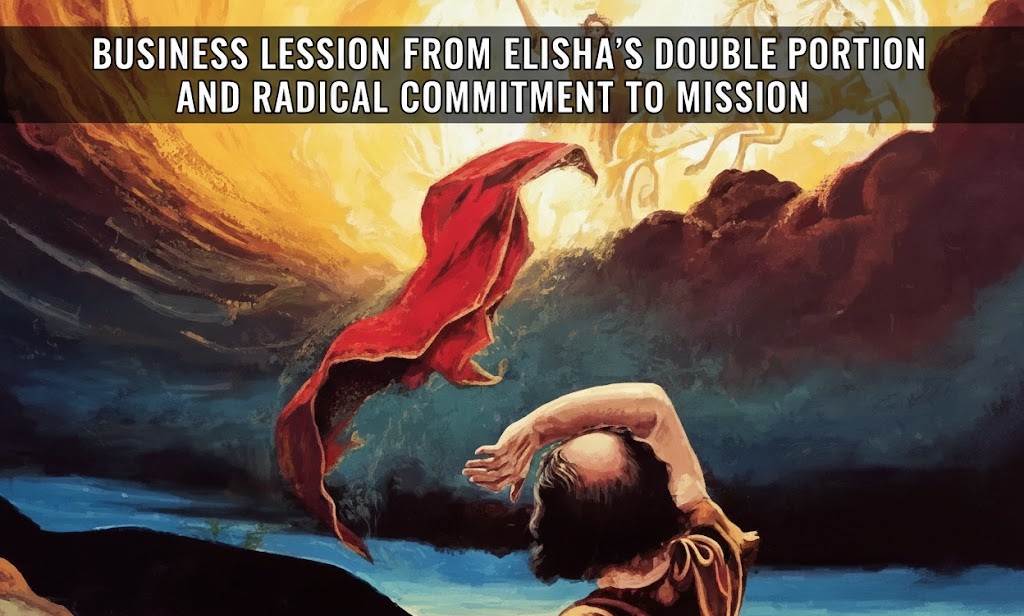
Before leaving, Elijah gave Elisha the mantle, a visible symbol that authority had been transferred. In modern organizations, this looks like a departing CEO staying on as an advisor, signaling continuity, confidence boosting, and institutional memory. The leader may be stepping aside, but the system is not abandoned.

Yet symbols alone do not solve problems. Elisha proved readiness when he used the mantle to part the River Jordan. He did not frame it, announce it, or debate its meaning. He deployed it. Leadership authority is validated not by possession, but by problem-solving. Power that cannot be used is not power; it is decoration.

But note this, long before that moment, Elisha had already demonstrated something rarer: absolute commitment to the mission. When Elijah first called him, Elisha burned his plowing equipment and slaughtered his oxen. This was not emotion; it was strategy. He eliminated the option of retreating. No side hustle. No fallback plan. No divided attention. He severed his past to fully enter his future. That act alone explains why he could carry the double portion because he had the capacity to carry weight.

Good People, most of the CEOs we hail make uncommon personal sacrifices, as they hold the mantle in the firm. They sign up for things we cannot commit to with adical dedication to the Firm.

In our world, people ask for authority, campaign for power, negotiate titles, but when authority arrives, they become distracted. Elected to the Senate but treating it as a part-time role. Appointed CEO but mentally invested in the side hustle. Power is requested, but mission is optional. Nations fade because of that. And it destroys companies.

Elisha teaches a lesson: if you want authority, you must be ready to deploy it, and deploy it on the assignment for which it was given