DD
MM
YYYY

PAGES

DD
MM
YYYY

spot_img

PAGES

Home Blog Page 2

Europe Pushes “Made in Europe” Strategy to Shield Industries from Chinese Imports

0

As the European Union grapples with intensifying competition from subsidized Chinese imports, EU Industry Commissioner Stéphane Séjourné has rallied over 1,100 CEOs and business leaders in a high-profile op-ed calling for a bold “Made in Europe” strategy to prioritize local production in strategic sectors.

Published across major European newspapers on February 1, 2026, the piece warns that without an “ambitious, effective, and pragmatic industrial policy,” the EU risks becoming a mere “playground” for rivals like China and the United States.

This push comes ahead of the European Commission’s delayed proposal for the Industrial Accelerator Act, now slated for February 25, 2026, which aims to introduce preferences for EU-made products in public procurement and state aid to counter unfair global competition.

Séjourné, a French centrist and the Executive Vice President for Prosperity and Industrial Strategy, framed the initiative as essential for sovereignty: “We must establish, once and for all, a genuine European preference in our most strategic sectors. It is based on a very simple principle: Whenever European public money is used, it must contribute to European production and quality jobs.”

He drew parallels to “Made in China” and “Buy American” policies, arguing that Europe’s open market has left it vulnerable to distorted competition.

The op-ed garnered signatures from a diverse array of industry titans, spanning steel (ArcelorMittal, Tata Steel, Thyssenkrupp Steel Europe), pharmaceuticals (Novo Nordisk, Sanofi), automotive components (Continental, Michelin, Pirelli), aviation (Air France-KLM), and energy (Engie), among others.

Thyssenkrupp CEO Marie Jaroni, a signatory, invoked Canadian Prime Minister Mark Carney’s warning, saying: “Those who are not sitting at the table now will end up on the menu… Steel is inextricably linked to this.”

The backdrop is Europe’s mounting alarm over Chinese dominance in critical sectors like clean energy, semiconductors, batteries, and electric vehicles, where state subsidies enable dumping at below-market prices.

Chinese customs data show EU imports from China rising 14.8% over the past year, with spikes of 15.5% in Germany, 17.5% in France, and 25.4% in Italy.

The EU has responded with provisional anti-dumping duties on Chinese EVs and investigations into subsidies for wind turbines and other goods. Former ECB President Mario Draghi, in a 2025 report, warned Europe must federate to avoid being “picked off one by one” by China and the U.S., advocating for strategic autonomy.

However, the “Made in Europe” push has ignited fierce internal divisions. France, Italy, and Spain champion the approach as vital to counter unfair trade, while Germany, the Netherlands, Sweden, and the Czech Republic oppose it, fearing deterred foreign investment, inflated public tender costs, and reduced global competitiveness.

A December 2025 letter from nine EU nations urged “extreme caution” on buy-European policies.

The automotive sector, notably absent from signatories, has been vocal in opposition due to reliance on global supply chains. Ford of Europe President Jim Baumbick told Reuters: “Ford supports strengthening Europe’s industrial base, but the planned ‘Made in Europe’ rules must remain open to trusted partners like the UK and Turkey… excluding them would weaken production inside the EU itself.”

Bosch CEO Stefan Hartung cautioned the rules should address “level-playing field issues” rather than compensate for disadvantages. Mercedes-Benz CEO Ola Källenius warned such requirements risk “driving up inflation and shrinking the market,” advocating a “scalpel” approach.

The Industrial Accelerator Act, initially dubbed the Industrial Decarbonization Accelerator Act but renamed for a broader scope, is now expected on February 25, 2026—delayed from December 2025 due to these splits. A leaked draft emphasizes accelerating decarbonization in energy-intensive industries like steel, streamlining permitting, mobilizing investments, and creating stockpiling centers for critical raw materials to enhance supply chain resilience. It includes a carbon intensity label for steel products and focuses on priority sectors for climate objectives and economic resilience.

The proposal integrates with the EU’s Net-Zero Industry Act, Critical Raw Materials Act, and upcoming 2028-2034 budget negotiations, where local content could influence funding. BusinessEurope and the European Round Table for Industry urge a balance to avoid disrupting global chains.

Against the backdrop of the bloc’s different interests, the “Made in Europe” debate tests its unity in a multipolar world, weighing protectionism against openness. With the Act’s proposal imminent, the EU faces a fundamental choice: double down on strategic autonomy through targeted preferences or risk alienating trade partners and investors in pursuit of self-sufficiency.


Oracle’s Shares Rise 5% Following Plan of $50bn Capital Raise for Data Centers

0

Oracle’s shares rose 5% in premarket trading on Monday after the company disclosed plans to raise as much as $50 billion to expand data center capacity.

The company said it aims to raise between $45 billion and $50 billion in gross proceeds during the 2026 calendar year through a combination of debt and equity. The funds will be used to build additional capacity to meet what Oracle described as “contracted demand” from its cloud customers, which include Nvidia, Meta, OpenAI, AMD, TikTok, and xAI. Those customers sit at the heart of the global AI boom, where demand for computing power has surged far faster than supply.

The move underscores both the scale of the artificial intelligence buildout underway and the growing financial risks companies are taking to stay competitive.

Oracle’s announcement comes as hyperscalers and infrastructure providers race to lock in land, power, and financing for data centers capable of supporting large language models and other compute-intensive AI systems. Data center deals reached a record $61 billion in 2025, reflecting the speed at which capital is being deployed across the sector as companies try to avoid capacity bottlenecks that could slow AI development.

For Oracle, the fundraising plan marks a deepening of a strategic shift that has transformed the company from a traditional enterprise software provider into a major AI infrastructure player. In recent years, Oracle has leaned heavily into cloud computing, pitching its data centers as a cost-effective alternative to those run by Microsoft, Amazon, and Google, particularly for customers with massive, predictable workloads.

That repositioning became more explicit in September, when Oracle raised $18 billion through a bond sale and announced a landmark agreement with OpenAI valued at up to $300 billion. Under that deal, Oracle committed to providing large-scale computing resources to support OpenAI’s expanding model training and deployment needs, tying Oracle’s fortunes more closely to the trajectory of the AI sector.

Yet the scale and speed of Oracle’s investments have also heightened investor unease. The company’s stock has fallen roughly 50% from its September peak, reflecting concerns that aggressive capital spending and debt issuance could pressure its balance sheet before returns fully materialize. Shares dropped 11% in December after Oracle reported quarterly revenue that narrowly missed expectations, reinforcing worries that near-term financial performance may lag behind long-term ambitions.

The reaction to Oracle’s plans mirrors a broader pattern across big tech, where markets have become more sensitive to execution risks even as companies commit extraordinary sums to AI. Last week, Microsoft shares fell 10% after growth in its Azure cloud business came in slightly below expectations, despite the company’s dominant position in AI through its partnership with OpenAI. By contrast, Meta’s shares jumped 8% after it reported heavy AI spending, suggesting investors are still willing to reward companies that show clear momentum and confidence in monetizing AI over time.

Oracle’s move also highlights the capital-intensive nature of the AI era. Building modern data centers requires not just advanced chips from suppliers like Nvidia and AMD, but also long-term access to power, cooling infrastructure, and high-speed networks. Securing those inputs at scale increasingly demands billions of dollars upfront, often years before the full revenue benefits are realized.

Investors have flagged that Oracle’s reliance on both debt and equity to fund its expansion could dilute shareholders or strain cash flows if AI demand softens or if competition intensifies. At the same time, Oracle argues that long-term contracts with major customers reduce the risk of overbuilding, positioning its capacity expansion as a response to confirmed demand rather than speculative growth.

The company’s disclosure that the funds will be raised in 2026 also suggests Oracle is trying to pace its financing with the rollout of projects already in the pipeline, rather than flooding the market with new debt immediately. Even so, the headline figure reinforces how far the AI infrastructure race has pushed spending expectations beyond historical norms.

However, Oracle’s $50 billion plan stands as another marker of how central data centers have become to economic and technological competition. The challenge for Oracle will be to convert its bold investment push into sustained revenue growth while convincing investors that the risks it is taking today will not outweigh the rewards promised by an AI-driven future.

Deepsnitch AI Price Prediction: Bed Bath & Beyond Pivots to RWA and Top Coins Crash, But Smart Investors Are Buying DeepSnitch AI for Maximum Alpha

0

Bed Bath & Beyond has signed an agreement to acquire Tokens.com, indicating a massive push into real estate finance and tokenized real-world assets (RWAs). As more tokens crash in the market, smart investors are accumulating DeepSnitch AI.

Now in Stage 5 with a price of $0.03830, DeepSnitch AI has surged more than 153% from its opening, proving that AI token analysis and superior market intelligence are the only safe harbors in a storm. The current Deepsnitch AI price prediction suggests that this intelligence ecosystem is poised to outperform many other projects.

Bed Bath & Beyond’s crypto bet

Bed Bath & Beyond is transforming from a home goods retailer into a financial technology investor. The company’s acquisition of Tokens.com is part of a strategy to develop a platform focused on real estate finance and tokenized securities.

By integrating blockchain systems with regulated financial services, the retailer aims to aggregate traditional and tokenized assets into a single interface. This platform will allow users to view ownership, estimated values, and liquidity options for RWAs, supported by Bed Bath & Beyond’s existing stakes in blockchain businesses like tZERO and GrainChain.

The best gem to invest in the market decline

Deepsnitch AI Price Prediction: The green candle in a red market

While the rest of the market searches for a bottom, the DSNT growth outlook is overwhelmingly bullish. The project has raised over $1,470,000 and is defying the global crash by consistently hitting higher highs in its presale stages. Currently priced at $0.03830, DeepSnitch AI represents a sanctuary for capital fleeing the volatility of public markets.

The bullish Deepsnitch AI price prediction is driven by its utility, as it has AI agents that provide trading intelligence to investors. In a crashing market, traders need answers. They need to know if a drop is a buying opportunity or a death spiral.

DeepSnitch AI provides these answers through real-time data analysis and risk scoring. Smart investors are buying DeepSnitch AI now, and they can also earn passive income with over 33 million tokens staked.

The high demand for its tools suggests a listing price target potentially exceeding $1.00 in 2026. That’s why the DeepSnitch AI price prediction is very bullish, with many investors buying as much as they can before TGE.

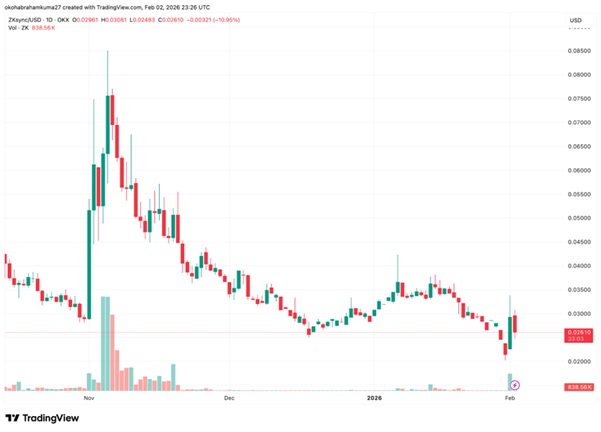
ZKsync ($ZK) price prediction

ZKsync ($ZK) is currently caught in the crossfire of the market sell-off. The token has declined by 6% in the last seven days as of February 2nd. While this is a loss, it is technically outperforming the global crypto market, which is down 10%.

The sentiment for ZKsync is bearish with a Fear & Greed Index of 14. Volatility is very high, making it a risky hold for short-term traders. The long-term forecast sees ZKsync hitting $0.05323 by the end of 2026, a 101% gain. However, waiting for a 2x return while enduring extreme volatility is a difficult proposition. The DeepSnitch AI price prediction offers a superior risk-reward profile. By investing in the presale, you lock in a fixed price and avoid the daily anxiety of watching charts bleed.

Ondo ($ONDO) price prediction

Ondo ($ONDO) should theoretically benefit from the Bed Bath & Beyond news, as it is a leader in the RWA space. However, the market is irrational. Ondo has declined by 15% in the last week as of February 2nd, underperforming both the global market and its peers.

The RSI is at 27.10, indicating the asset is oversold, but in a crash, oversold conditions can persist for weeks. While Ondo is forecasted to recover to $0.5859 by the end of 2026, DeepSnitch AI is ready for immediate post-launch growth.

Final thoughts

The market is crashing, but your portfolio doesn’t have to. DeepSnitch AI is the green lifeboat in a sea of red. Hence, keeping an eye on the Deepsnitch AI price prediction matters most. It is a project that has the potential to deliver massive profits for investors.

Visit the official DeepSnitch AI website, join Telegram, and follow on X for more updates.

FAQs

What is the Deepsnitch AI price prediction for 2026?

The Deepsnitch AI price prediction for 2026 is highly bullish, with targets exceeding $1.00 post-listing.

How does the Bed Bath & Beyond news affect AI token analysis?

The entry of major retailers into tokenized assets increases market complexity. This validates the need for AI token analysis platforms like DeepSnitch AI.

What makes the Deepsnitch AI price forecast better than Ondo’s?

The Deepsnitch AI price forecast is superior because it is an early-stage asset with a huge growth potential of more than 100x.

Rethink Sales

0
Good People, if you truly believe you have the best products and services, then silence is not humility; it is neglect. Not telling people about them is not modesty; it is unfairness. I carry a simple business philosophy: when you have something that improves human welfare, you have a moral obligation to let the world know. Value hidden is value denied.
 
In Igbo wisdom, good things do not sell themselves unless they are shown. If you do not speak for your product, you have already voted against it. When I tell you about our products, do not see it as noise; see it as social good. Why should people be denied access to the best simply because the producer chose to be quiet? Lol.
 
Many people misunderstand marketing and sales. They think selling is begging. It is not. Selling is education. It is helping people make better choices. I often say: if your product is truly superior, then not promoting it is an injustice to the market.
 
That is why I ask leaders to reframe sales in their minds. Invite me to speak with your marketing team. I have studied how to overcome sales inertia, that invisible force that keeps customers stationary even when value is right in front of them. Like in physics, motion does not happen without energy. Sales teams fail not because products are weak, but because motivation is misdirected.
 
Why deny the world the best products if you believe you have them? When we accelerate people’s confidence to market boldly, we unlock growth. Advertising is not deception when the product is excellent; it is public service. Do not be apologetic. Be responsible. Inform customers that better options exist.
 
In Igbo land, I learned this early. As a young boy in Oriendu Market, Ovim, I would shout, “bia z?? ji nnenne m!”; buy my grandmother’s yam. That was not arrogance; it was fairness. It would have been wrong to deny customers the chance to buy the best yam in the market!!!
 
Change your attitude to sales, and you will change your business. See selling as a call to duty, a higher-purpose assignment to improve lives by making people aware of the best products.
 
But this message comes with a condition: I hope you truly have the best products!
 
(At Tekedia Mini-MBA, we have improved thousands of businesses across Africa with a business education that delivers a motion of growth & success. Next edition begins on Feb 9)

Steps Brain Injury Victims Should Take to Protect Their Rights

0

Brain injuries can change a person’s life in ways that are difficult to predict. Even a mild injury can affect memory, concentration, and emotional health. Severe injuries can lead to long-term physical, cognitive, and emotional challenges. Beyond medical recovery, brain injuries often involve complex legal matters, especially when the injury was caused by another person’s negligence or a defective product. Taking the right steps early can protect both your health and your legal rights. Seeking legal help for brain injury victims can ensure proper guidance throughout this challenging process.

Understanding the impact of a brain injury is the first step in protecting your rights. Brain injuries can range from concussions and mild traumatic brain injuries to severe trauma resulting in long-term disability. Each injury can affect a person differently. Physical effects may include headaches, dizziness, or motor skill problems. Cognitive issues can affect memory, focus, and problem-solving, while emotional changes might involve anxiety, depression, or mood swings. These effects can influence your daily life, work, and relationships. Because of the lasting consequences, brain injuries often have legal implications. Compensation may be necessary to cover medical bills, ongoing care, lost income, and reduced quality of life.

Step 1: Seek Immediate Medical Attention

The first and most important step for anyone injured is to seek immediate medical care. Even if symptoms appear mild, a proper evaluation can prevent further complications and ensure that the injury is fully documented. Detailed medical records are crucial for supporting any legal claim. They serve as official evidence of the injury’s severity, the treatment provided, and the ongoing care required. Early medical attention also helps establish a clear timeline, which can be important in legal proceedings.

Step 2: Preserve Evidence

Evidence plays a central role in any brain injury claim. It is important to collect and preserve all documents related to the incident. This includes:

  • Medical records
  • Accident reports
  • Witness statements
  • Photographs of the injury or accident scene
  • Any devices or equipment involved in the injury

Proper documentation can prove liability and support the extent of your damages. Without evidence, it is difficult to hold the responsible party accountable and secure fair compensation.

Step 3: Document Daily Challenges and Symptoms

Keeping a personal journal of daily challenges and symptoms is highly recommended. Record:

  • Physical pain
  • Cognitive difficulties
  • Emotional changes
  • Limitations in daily activities

These notes can demonstrate the injury’s impact on your life and help quantify damages in legal claims. Detailed documentation can also provide your attorney with a clear picture of how the injury affects you over time, which is particularly useful in cases where symptoms evolve or appear gradually.

Step 4: Limit Social Media Exposure

It may be tempting to share your experience online, but posting details about your injury or medical treatment can negatively impact your case. Insurance companies and defense attorneys often monitor social media for statements that may be used against you. To protect your legal rights, it is best to avoid posting information about your injury, treatment, or claim on social media platforms.

Step 5: Understand Your Legal Options

Brain injury claims can arise from various situations, including personal injury, negligence, and product liability cases. Understanding your legal options is essential. Key concepts include:

  • Liability: Who is responsible for the injury
  • Damages: The losses you have suffered
  • Compensation: The amount needed to cover medical bills, lost income, and ongoing care

Consulting a qualified attorney can help you understand which claims apply to your situation. Obtaining legal help for brain injury victims early ensures that evidence is preserved, deadlines are met, and your rights are protected throughout the legal process.

Step 6: Choose Experienced Legal Representation

Not all lawyers have experience with brain injury cases. Selecting an attorney who regularly handles these claims can make a significant difference. Experienced legal representation can help:

  • Navigate complex cases
  • Work with expert witnesses
  • Negotiate effectively with insurance companies or defendants
  • Ensure compensation covers current and future expenses, including medical bills, lost income, rehabilitation costs, and long-term care

Having skilled guidance increases the chances of a successful claim and helps victims recover the support they need.

Step 7: Be Patient and Organized Throughout the Process

Brain injury claims often take time because of the severity and complexity of the injuries. Patience is essential. Maintaining organized records of medical treatments, legal correspondence, and any related documents will help maintain clarity and support your case. Being systematic and thorough allows your legal team to respond quickly to developments and ensures that no important detail is overlooked. Consistency, organization, and ongoing communication with your attorney are key to strengthening your claim.

Conclusion

Brain injuries are serious and can have long-lasting effects on every aspect of a person’s life. Protecting your legal rights is just as important as seeking medical care. By following these steps—seeking immediate treatment, preserving evidence, documenting daily challenges, limiting social media exposure, understanding legal options, choosing experienced representation, and staying organized—brain injury victims can safeguard their rights and improve their chances of securing fair compensation. Professional guidance is essential, and obtaining legal help for brain injury victims ensures that evidence is preserved, liability is established, and your claim is handled properly.