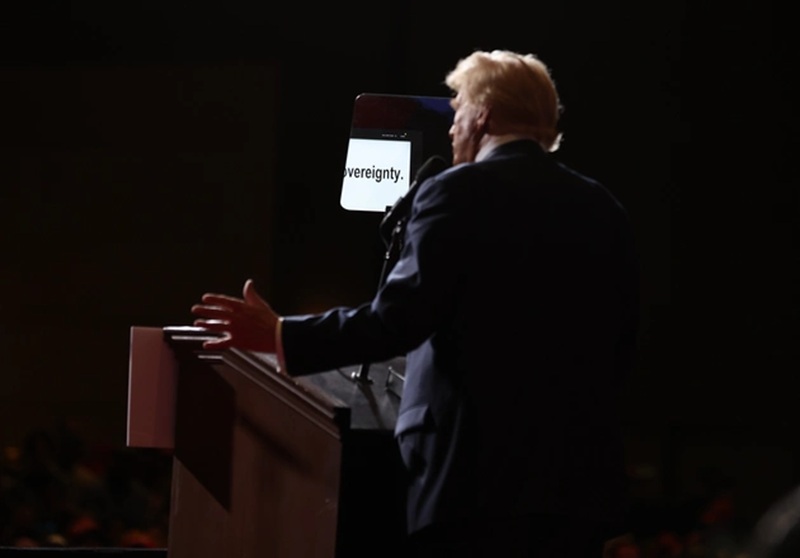
President Donald Trump recently stated that the United States is leading China and other countries by a significant margin in both artificial intelligence and cryptocurrency.
In his remarks, Trump emphasized a clear goal: “We want to stay in front in crypto.”
He made this statement during the Ratepayer Protection Pledge event on July 23, 2026. Part of his broader remarks emphasized “America First” policies and competition with China.
He said,
“Have always said that America’s goal must be to dominate the future and that includes being the number one superpower in artificial intelligence so important and this is I think bigger than the frankly I think it’s bigger than the internet it’s bigger than anything anyone has seen thus far.
“Maybe someday there will be something bigger than this probably will but I think up until this point AI is probably the biggest thing anybody’s ever seen and whoever wins that race is probably going to win period and again we’re leading China and we want to keep it that way.
“We live by the motto America first. That’s what’s made us very strong and we’re leading China and all other countries by a lot in AI and just about every other category. Uh including crypto. We want to stay in front in crypto. They’d love to take that over. So many other things they’d like to take over.”
His comments, which quickly circulated among crypto enthusiasts and market watchers, underscore his administration’s view of digital assets as a strategic national priority rather than a peripheral financial trend.
He warned that failing to maintain leadership could allow China to gain control in these critical technologies.
This position aligns with earlier statements and actions during his second term, including executive orders aimed at strengthening American leadership in digital financial technology and removing barriers to AI innovation.
His administration has also pursued initiatives such as establishing a Strategic Bitcoin Reserve from seized assets and signing legislation to create a regulatory framework for stablecoins.
The timing of these comments comes amid ongoing debates in the US Congress over crypto regulation. While some lawmakers push for clearer rules through bills like the Clarity Act, progress has been slow, drawing criticism from industry participants who argue that regulatory uncertainty hampers American competitiveness.
Earlier this month, President Trump called on the Senate to pass the Digital Asset Market Clarity Act, a significant piece of legislation aimed at bringing regulatory certainty to the cryptocurrency industry in the United States.
In a post on Truth Social, Trump described blockchain-based finance and tokenization as a major financial transformation and warned that countries such as China are working aggressively to dominate the sector.
He argued that clear regulations for the digital asset industry would help ensure the United States remains at the forefront of innovation rather than allowing competitors to gain the upper hand
Supporters of Trump’s stance point to substantial investments flowing into US-based AI and crypto projects, contrasting with China’s restrictions on private crypto activities while advancing its own state-backed digital currency efforts.
For the cryptocurrency market, Trump’s vocal support signals potential policy tailwinds. Bitcoin and other major assets have historically responded positively to pro-crypto signals from high-level officials, though actual legislative outcomes will likely determine longer-term impact.
Observers note that positioning crypto alongside AI as a matter of national security could accelerate institutional adoption and infrastructure development within the United States.
As global competition intensifies, Trump’s message reinforces an “America First” approach to emerging technologies.