DD
MM
YYYY

PAGES

DD
MM
YYYY

spot_img

PAGES

Home Blog Page 2

Okomu Oil Palm Cements Market Leadership with Record 2025 Profits as Revenue Climbs 52% on Strong Volumes and Pricing Power

0

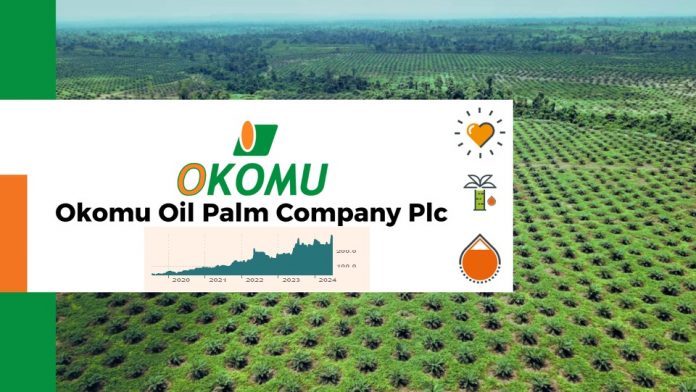
The Okomu Oil Palm Company Plc has delivered another standout performance, posting audited full-year 2025 results that underscore its entrenched position as one of Nigeria’s two largest palm oil producers alongside Presco Plc.

Pretax profit surged 69.26% to N90.6 billion from N53.5 billion in 2024, while post-tax profit rose 45.03% to N57.9 billion. Revenue expanded 52.18% to N198.1 billion from N130.2 billion, fueled by higher sales of palm oil, rubber, and processed products amid firm domestic demand and improved international pricing.

Domestic operations in Nigeria generated N172.6 billion of the total, reflecting Okomu’s deep roots in the local market, while exports contributed N25.5 billion—evidence of the company’s growing global footprint even as it prioritizes supply to Nigerian refiners and manufacturers.

Okomu has maintained its leadership in Nigeria’s palm oil market and broader agricultural sector through decades of disciplined plantation development, operational efficiency, and strategic diversification. Established in 1976 as a federal government pilot project in Edo State, now Nigeria’s leading palm oil-producing region, accounting for roughly 12% of national output, the company was privatized in 1990 and has since scaled to become a benchmark operator.

It controls approximately 19,000 hectares of mature oil palm and over 7,300 hectares of rubber plantations, supported by two high-capacity mills capable of processing more than 80,000 tons of crude palm oil (CPO) annually. In 2025, the company benefited from continued yield improvements, with fresh fruit bunch (FFB) output rising through better extraction rates (around 24%) and third-party purchases from outgrowers, helping it capture a meaningful share of the country’s 1.57 million tons of total palm oil production.

What sets Okomu apart is its vertically integrated model: owning the full value chain from planting to milling and marketing allows it to control quality, reduce intermediary costs, and respond quickly to market shifts.

The company’s long-standing technical partnership with Socfin has brought international best practices in agronomy, while ongoing replanting programmes, such as the hundreds of hectares renewed each year, ensure long-term productivity gains.

Analysts have consistently highlighted Okomu’s superior margins and cash discipline compared with peers, driven by these efficiencies even as raw material costs climbed 30.47% to N29.5 billion (largely from plantation upkeep of N10.9 billion) and employee benefits rose to N31.03 billion amid operational scaling and a 50% staff salary adjustment in prior years.

Sustainability and community engagement have also been central to Okomu’s resilience. As an RSPO member, the company integrates environmental safeguards, while its inclusive smallholder model partners with thousands of nearby farmers to secure additional FFB supply and boost rural livelihoods. Corporate social responsibility spending supports education, skills training, and infrastructure in 29 neighboring communities, reinforcing social license to operate in a sector often challenged by land-use tensions.

These efforts have helped Okomu navigate macroeconomic headwinds—naira volatility, inflation, and high energy costs—better than many peers, turning currency gains (N8.7 billion in realized forex income, 69.53% of other income) into a competitive edge.

On the cost front, the company absorbed increases in raw materials, depreciation (N21.9 billion), finance costs (N4.6 billion), and other expenses (N34.7 billion), offset partly by a N1.7 billion fair value gain on biological assets. Income tax of N32.6 billion left post-tax profit at N57.9 billion.

The balance sheet remains solid: total assets grew to N138.8 billion, led by property, plant and equipment of N61.8 billion, while liabilities rose to N90.04 billion, with trade payables at N14.5 billion. Shareholders’ equity stood at N48.8 billion, with retained earnings of N48.9 billion.

In reward for shareholders, the board approved a final dividend of N15 per 50 kobo share, payable May 26, 2026, to those on record as of April 27, 2026. When combined with interim payouts, the full-year distribution reaches an attractive N55 per share, continuing Okomu’s reputation for generous returns.

Market reaction on the Nigerian Exchange has been subdued in the immediate aftermath, with the stock holding steady at N1,765.00. Yet the longer-term picture tells a different story: year-to-date gains of 61.19%, with more than 19 million shares traded, reflect sustained investor conviction in Okomu’s fundamentals.

In a sector still struggling to meet domestic demand, Okomu’s track record of consistent volume growth, margin expansion, and export diversification positions it as a cornerstone of national agribusiness strategy.


Brent Spot Cargoes Stay Above $124 as Physical Oil Market Signals Ceasefire Has Not Solved Supply Crisis

0

The sharp fall in oil futures following the U.S.-Iran ceasefire has offered financial markets a measure of relief. But the physical crude market is telling a far more troubling story.

While June Brent futures settled at $94.75 per barrel on Wednesday, the spot price for physical Brent cargoes scheduled for delivery within the next 10 to 30 days stood at $124.68, according to S&P Global data. That leaves a striking premium of nearly $30 per barrel over the futures market, a gap that underscores how severely the five-week war has disrupted actual oil flows.

This divergence between paper and physical markets is one of the clearest signals yet that the ceasefire, while positive for sentiment, is not enough to immediately repair the deep logistical damage inflicted on global energy supply chains.

The spot price had already fallen by $19.75 after the two-week ceasefire agreement, suggesting that traders of physical cargoes have acknowledged some reduction in immediate escalation risk. Yet the fact that it remains so far above the June contract points to a market still pricing in sustained tightness in prompt supply.

This is not a routine market dislocation but a reflection of the difference between expectation and reality. Futures prices capture what financial traders believe oil may be worth weeks or months from now. Spot cargoes reflect what refiners, utilities, and large buyers must pay today to secure real barrels moving on real ships.

That distinction is now central to understanding the oil market. As Amrita Sen, founder of Energy Aspects, put it, the physical market reflects “the reality on the ground and the high seas.” Her assessment is blunt: “It’s a complete mess.”

According to Sen, Middle East producers have shut in roughly 13 million barrels per day of production as tanker traffic through the Strait of Hormuz collapsed during the conflict. That is an extraordinary volume by any standard and equivalent to a material share of global daily supply.

Even if the ceasefire holds, restoring that production is not a matter of days. A large part of the problem is maritime. Tankers that would normally be lifting crude from the Gulf have been rerouted, with many vessels now heading toward the United States to load an alternative supply. Repositioning those ships back to the Middle East could take until June, according to Sen.

Oil markets do not normalize the moment a ceasefire is announced. Physical supply chains operate on shipping schedules, insurance clearances, loading slots, and refinery demand cycles. Once disrupted, the system takes weeks or even months to rebalance. That is why the spot market remains under acute pressure even as futures have fallen sharply.

Amena Bakr, an OPEC and Middle East specialist at Kpler, offered an equally sobering assessment, warning that hundreds of millions of barrels have effectively been taken off the market during the war.

Her estimate that it could take as long as five months to restore capacity reinforces the market’s continued backwardation and the steep premium on prompt cargoes.

She told CNBC, “It is contingent on how long this ceasefire lasts” and whether it evolves into a broader peace agreement.

That conditionality is what markets are now pricing. The futures market is betting that the ceasefire reduces the probability of prolonged disruption. The spot market is saying the disruption is already here.

Persistently elevated prompt crude prices will continue to feed into refined products, particularly diesel, jet fuel, and shipping fuels. Europe, already facing high industrial energy costs, remains particularly vulnerable.

Earlier this month, Sen noted that diesel prices in Europe were approaching $200 per barrel equivalent, suggesting that downstream inflationary pressures are still intense even as benchmark futures retreat.

That has direct implications for global inflation, transportation costs, and central bank policy.

A lower June futures price may improve market sentiment, but if physical cargoes remain elevated, businesses and consumers will continue to feel the effects through freight, manufacturing, and pump prices.

The longer-term production outlook also remains constrained. Kuwait Petroleum Corporation has already warned that full restoration of Gulf output could take three to four months.

Chief executive Sheikh Nawaf al-Sabah said: “We have resilient reservoirs that bring out quite a bit of production immediately — within a few days. The bulk of it will come within a few weeks, and then the full production will come within three or four months.”

That timeline broadly aligns with what physical markets are now implying.

Practically, Wednesday’s $124.68 spot reading is the market’s way of saying that geopolitical headlines may have improved faster than the energy system itself. The ceasefire may have stopped the immediate escalation. It has not yet restored the barrels.

Sigenergy Targets $562m Hong Kong IPO as Energy Storage Boom Meets Regulatory Crosswinds

0

Shanghai-based Sigenergy is seeking to raise HK$4.40 billion in Hong Kong, betting investor appetite for clean-energy infrastructure remains strong even as Beijing’s tougher scrutiny of red-chip structures threatens to slow the city’s IPO pipeline and reshape deal-making across Chinese listings.

China’s Sigenergy Technology is pressing ahead with a sizeable Hong Kong listing that will test both investor appetite for the fast-growing energy storage sector and the resilience of the city’s IPO market under tightening mainland regulatory oversight.

The Shanghai-based company is seeking to raise about HK$4.40 billion, or roughly $561.6 million, through the sale of 13.57 million H shares priced at HK$324.20 apiece, according to its filing with the Hong Kong Stock Exchange. Trading is scheduled to begin on April 16 under the stock code 6656.

The offering arrives at a delicate moment for Hong Kong’s capital markets. After a strong start to 2026, the city’s IPO pipeline is now facing fresh uncertainty following Beijing’s heightened scrutiny of so-called red-chip listings, a structure long used by China-linked companies incorporated offshore.

That broader policy backdrop gives Sigenergy’s flotation significance beyond the company itself.

Unlike red-chip issuers registered in jurisdictions such as the Cayman Islands or other offshore financial centers, Sigenergy’s mainland corporate base may make it comparatively less exposed to the current regulatory bottleneck. That could help position the company as one of the deals likely to proceed while other candidates are forced into legal restructuring or listing delays.

Reuters reported last month that Chinese regulators have asked some overseas-incorporated firms to re-domicile back to mainland China before pursuing Hong Kong listings, a process that bankers say could delay deals by at least six months and, in some cases, derail them altogether.

This matters to investors on two fronts. First, regulatory tightening could reduce the near-term supply of new listings, potentially supporting valuations for companies that do make it to market. Second, it introduces execution risk across the IPO pipeline, making structure, domicile, and compliance history more important screening factors than in previous cycles.

In Sigenergy’s case, the core investment thesis rests less on legal structure and more on the global growth story in energy storage.

The company develops smart storage systems, including battery products, inverters, and energy management software for residential and commercial users. That places it squarely in one of the fastest-expanding segments of the clean-energy ecosystem, where demand is being driven by solar adoption, grid instability, peak-load optimization, and electrification trends.

Energy storage has become a strategic market globally as households, factories, and utilities seek to manage intermittent renewable power and rising electricity costs. Investors have increasingly favored companies with vertically integrated offerings that combine hardware with software-driven energy management, an area where Sigenergy appears to be positioning itself.

The company said proceeds will be used to expand production capacity, deepen research and development, and strengthen its sales and service network, signaling a scale-up phase rather than a liquidity event for existing shareholders.

Institutional investors in Hong Kong’s market have recently shown a stronger preference for growth capital raises tied to industrial expansion, particularly in sectors aligned with China’s strategic priorities, such as new energy, semiconductors, and advanced manufacturing.

The presence of CLSA, the international platform of CITIC Securities, among the joint sponsors adds further weight to the transaction, particularly in a market where sponsor quality and execution credibility have become more scrutinized by both regulators and institutional buyers.

More broadly, Sigenergy’s IPO could serve as a barometer for risk appetite toward China’s clean-tech names. A strong book build and healthy aftermarket performance would reinforce the view that sector fundamentals can still attract capital even amid regulatory noise around listing structures.

A weaker debut, by contrast, may suggest that investors are becoming more selective, focusing on profitability visibility, overseas expansion potential, and margin resilience in a highly competitive battery and storage market.

Hong Kong’s IPO market remains active despite the scrutiny. Reuters reported that first-quarter fundraising in 2026 rose sharply year-on-year, underlining that capital remains available, but investors are increasingly discriminating between structurally straightforward deals and those carrying regulatory overhang.

However, while Sigenergy is making a bold move, it appears to be entering the market at a moment when thematic demand for clean energy remains strong, but where the rules of access to capital are changing just as quickly as the technologies the sector is built on.

New York Times Article on Adam Back as Satoshi Nakamoto Creates Renew Wave of Enquiries Who Satoshi Is

0

The New York Times published an article by investigative reporter John Carreyrou detailing a year-long investigation into the identity of Bitcoin’s pseudonymous creator, Satoshi Nakamoto. The piece strongly suggests that Adam Back, a 55-year-old British cryptographer, CEO of Blockstream, and prominent Bitcoin figure, is the most likely candidate.

NYT’s Case for Adam Back as Satoshi

The article builds a circumstantial case based on several overlapping factors:Technical contributions: Back invented Hashcash in 1997, a proof-of-work system that Satoshi explicitly cited in the Bitcoin white paper as inspiration for Bitcoin’s mining mechanism. The NYT argues Back proposed or influenced many core Bitcoin ideas early on e.g., combining proof-of-work with concepts like b-money.

Both were involved in the Cypherpunk movement, which emphasized cryptography for privacy, electronic cash, and resistance to government surveillance. Computer-assisted comparison of Back’s early writings, emails, and posts with Satoshi’s forum posts and emails showed striking similarities in phrasing, style, and even British English patterns.

Back was deeply engaged in electronic cash research from the early 1990s. He was one of the first people to receive an email from Satoshi. The investigation also references Back’s demeanor in an interview described as tense and evasive when asked directly.

A companion takeaways piece summarizes that Back came up with almost every feature of Bitcoin first and that the clues form a compelling trail, though the reporters acknowledge it’s not definitive proof. Back has flatly and repeatedly denied being Satoshi Nakamoto.

In public statements on X shortly after the article’s publication, he said: “i’m not satoshi, but I was early in laser focus on the positive societal implications of cryptography, online privacy and electronic cash. Hence my ~1992 onwards active interest in applied research on ecash, privacy tech on cypherpunks list, which led to hashcash and other ideas.”

He attributed the similarities to coincidences, shared interests in the cypherpunk community, and overlapping technical ideas common in that era. He also noted that proving a negative is difficult and emphasized that he does not know Satoshi’s true identity. Back has denied the claim multiple times in interviews as well, including during the NYT’s reporting process.

Other observers including in crypto media have described the NYT evidence as thin and heavily reliant on circumstantial overlaps and confirmation bias, while noting that Satoshi’s identity has eluded investigators for 17 years despite many prior claims. Satoshi Nakamoto published the Bitcoin white paper in 2008 and was active until around 2011 before disappearing.

The creator’s anonymity has been a defining feature of Bitcoin, helping it evolve as a decentralized project rather than one tied to a single individual. Previous high-profile claims involving Hal Finney, Nick Szabo, or others have been debunked or remain unproven. This NYT story has sparked widespread discussion in crypto communities today, with reactions ranging from skepticism to renewed debate.

However, without new cryptographic proof such as moving coins from Satoshi-era wallets or providing verifiable early metadata, the claim remains unconfirmed—and Back’s denial stands. The mystery continues. Bitcoin’s design and success don’t ultimately depend on knowing who Satoshi was.

US Stock Futures are Surging in Premarket Trading 

0

US stock futures are surging in premarket trading, Dow Jones futures: Up ~1,250–1,300 points, or +2.7%, S&P 500 futures: Up ~177 points, or +2.7%, Nasdaq-100 futures: Up ~845–850 points, or +3.5% and Russell 2000 futures: Up ~3.6–4%.

These levels point to a sharply higher open for the major indices at 9:30 AM ET, assuming no major reversals. ETF proxies like SPY, QQQ, and DIA are also trading up ~2.7–3.5% in premarket. The surge stems from relief over a reported two-week US-Iran ceasefire agreement. President Trump indicated the pause in strikes, tied to the immediate reopening of the Strait of Hormuz to shipping.

This de-escalation eases fears of a broader Middle East conflict disrupting global oil flows. Oil prices are plunging in response (crude down ~17–18%), which benefits equities by lowering input costs for companies and reducing inflation fears. Bond yields are also slipping as risk sentiment improves.

This follows recent volatility tied to the US-Iran tensions that began in late February 2026. Markets had been pricing in some risk premium; today’s move represents a classic risk-on relief rally, with tech and growth stocks outperforming as usual in such environments. Broader premarket movers include gains in sectors sensitive to lower oil and potential reopening of trade routes.

Keep in mind that premarket moves can moderate or shift once regular trading begins, especially if there’s follow-through news on the ceasefire details or other economic data. Oil’s sharp drop and any comments from officials could drive further volatility. Lower oil prices and by extension, jet fuel prices generally act as a significant positive for the airline industry.

Fuel is one of the largest and most volatile operating expenses for airlines, typically accounting for 20-40% of total costs depending on the carrier, route structure, and prevailing oil levels. When crude oil falls sharply — as seen in today’s premarket plunge of ~15-18% following the reported US-Iran ceasefire and anticipated reopening of the Strait of Hormuz — jet fuel prices drop in tandem.

This immediately lowers variable costs per flight. A sustained $10 per barrel decline in crude can translate into hundreds of millions in annual savings for major carriers. For context, during the recent oil spike tied to Middle East tensions where crude briefly exceeded $110-118/bbl and jet fuel more than doubled in some markets, airlines faced massive pressure.

Many revised 2026 fuel expense forecasts upward by ~9-11%, with some European budget carriers seeing potential profit hits of 30%+ from a 10% fuel price rise. Lower fuel costs improve profit margins directly, especially for fuel-intensive long-haul or low-cost carriers. They also reduce the need for aggressive capacity cuts or fare surcharges that were common during the recent high-oil period.

Airline stocks are highly sensitive to oil movements. In today’s premarket, major US carriers like Delta (DAL), United (UAL), and American (AAL) are up 6-12%+, with the sector including Southwest and JetBlue showing strong gains as oil tumbles. This mirrors classic risk-on relief: lower input costs boost expected earnings, while easing broader economic fears supports travel demand.

Historically, airline equities often rally when oil declines, as the cost relief outweighs any secondary effects like slightly weaker energy-sector travel. Many airlines use fuel hedging to lock in prices and protect against spikes. However: US carriers largely scaled back or abandoned hedging programs in recent years. This left them more exposed to the recent surge but means they can now benefit more quickly from falling spot prices without being locked into higher contracted rates.

European and some Asian carriers often maintain higher hedge ratios, which provided some buffer during spikes but can create hedging losses or above-market costs when prices reverse lower. Unhedged or lightly hedged airlines tend to see faster margin expansion in a declining oil environment.

Lower oil generally supports consumer and business spending; cheaper gasoline, lower inflation, which can boost air travel demand. However, if oil falls due to weaker global growth, demand could soften — though today’s ceasefire-driven drop appears more relief than recessionary. Airlines may pass on some savings via lower fares to stimulate volume, or retain them as higher margins.

During high-oil periods, many raised fares or added surcharges; the reverse could now occur, potentially improving load factors. Lower fuel reduces pressure to cut routes, frequencies, or delay fleet modernizations. Fuel-efficient newer aircraft become even more advantageous. Low-cost carriers and those with shorter-haul networks may benefit disproportionately compared to legacy international operators.

Extremely low oil can sometimes signal economic weakness, hurting premium and business travel. Refining margins  can also decouple from crude, affecting jet fuel specifically. Additionally, currency fluctuations matter since jet fuel is dollar-denominated.In the current context, with oil reversing from its recent war-driven highs, this move represents a meaningful tailwind for 2026 earnings.

Overall, falling oil prices tend to be a net boon for airline profitability, stock performance, and operational flexibility — which aligns with the strong premarket moves you’re seeing today. If the ceasefire holds and oil stabilizes lower, expect continued sector momentum, though watch for any volatility around Q1 earnings or summer demand guidance.