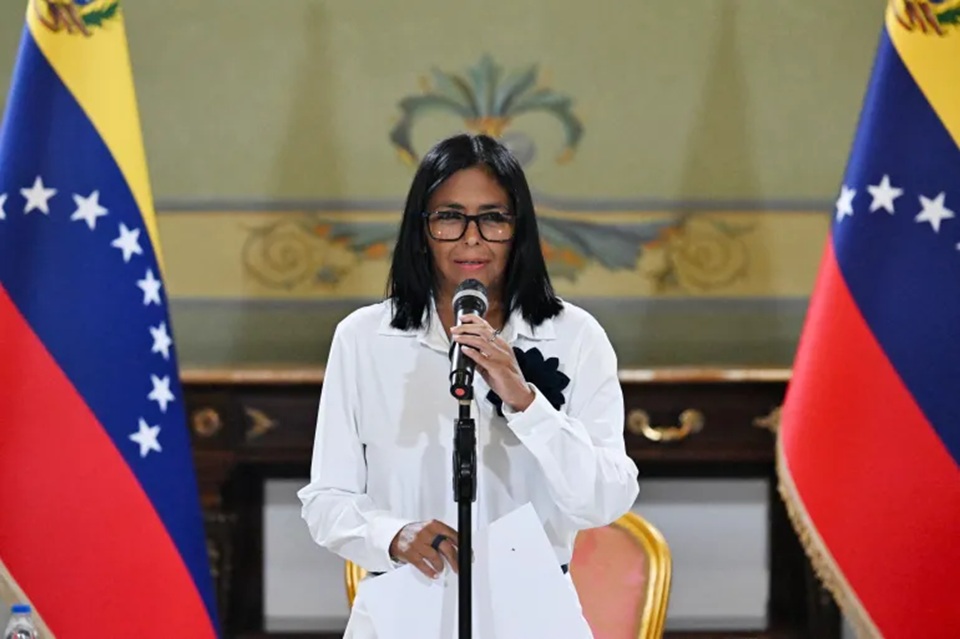
Venezuela’s interim President Delcy Rodriguez said on Saturday that a new 25-year energy agreement with the United States would target crude production of more than 1.5 million barrels per day and generate an estimated $209 billion in revenue for the Venezuelan state, while preserving Caracas’ ownership and sovereignty over its oil resources.
In a late-night address on state television, Rodriguez described the arrangement as a “historic” bilateral project that could help rebuild Venezuela’s oil industry after years of underinvestment, operational problems and sanctions.
“This 25-year bilateral project envisages the development of 17 strategic oilfields with a production target of more than 1.5 million barrels per day,” Rodriguez said on state broadcaster VTV.
“That figure relates solely to the bilateral agreement between Venezuela and the United States.”
The 1.5 million bpd target is significant because Venezuela currently produces about 1.25 million bpd. If achieved, the bilateral project alone would add substantial output to the country’s current production base and represent one of the most ambitious attempts in years to restore Venezuela’s position as a major oil supplier.
Rodriguez said the agreement would initially focus on 17 strategic oilfields, while a wider energy expansion plan would include developing eight additional greenfield blocks. She said the 1.5 million bpd objective was an initial target rather than the full potential of the proposed development programme.
The Venezuelan government estimates the project could generate around $209 billion in state revenue over its 25-year duration, based on an assumed benchmark crude price of $65 a barrel. Rodriguez cautioned that actual revenues would depend on fluctuations in global oil prices.
She said approximately $19 from every barrel produced and sold under the agreement would flow directly to the Venezuelan state. That structure appears aimed at addressing a politically sensitive issue surrounding the deal: whether deeper U.S. involvement in Venezuela’s oil industry would compromise the country’s control over the world’s largest proven crude reserves.
Rodriguez insisted that Venezuela would retain “ownership of and sovereignty” over its natural resources, while using foreign capital, technology and operational expertise to revive an industry that has struggled to attract sufficient investment and maintain production capacity.
Her comments came a day after President Donald Trump announced that the United States had secured majority control of more than 65 billion barrels of Venezuela’s proven oil reserves through a partnership involving private companies. Trump provided few details about the legal and commercial structure of the arrangement but said American companies would play a major role in developing the country’s oil resources.
The apparent difference between Trump’s description of “majority control” and Rodriguez’s insistence on Venezuelan sovereignty is likely to draw close attention as the agreements are formally disclosed. The precise ownership structure, production-sharing terms, investment commitments, and control over oil marketing will be crucial in determining how much authority U.S. companies will actually have.
Venezuela holds the world’s largest proven oil reserves but has produced only a fraction of its potential output. Current production of around 1.25 million bpd remains far below historical levels, constrained by deteriorating infrastructure, limited investment, management problems, and the impact of U.S. sanctions.
The proposed agreement therefore marks a potentially important shift in U.S.-Venezuela energy relations. Greater access to Venezuelan crude could provide Washington with an additional source of heavy oil for refineries configured to process such grades and potentially increase global supply. Trump has also presented the plan as part of a broader effort to help reduce U.S. fuel prices.
For Caracas, the agreement could unlock capital and technology that its oil industry has struggled to secure. Venezuelan officials are expected to sign further agreements next week granting new exploration and production rights under the country’s new energy framework.
Two sources close to the negotiations said Chevron was among the companies expected to conclude talks to transition its Venezuelan joint ventures into the new framework. Other U.S. companies are also expected to participate.
The deal nevertheless faces political and commercial challenges. Dozens of pro-government groups protested in downtown Caracas on Saturday against the U.S. presence in Venezuela, highlighting domestic sensitivities over Washington’s expanded role in the country’s oil sector.
The project’s success will ultimately depend on whether the promised investment can translate into sustained production gains. Raising output to more than 1.5 million bpd will require substantial spending on drilling, infrastructure, power supply, upgrading facilities, and maintenance across oilfields that have suffered years of deterioration.