SpaceX’s first financial results since its June Nasdaq IPO sent a mixed signal to the market. The company delivered impressive growth, but continued to post losses amid an unprecedented level of investment.
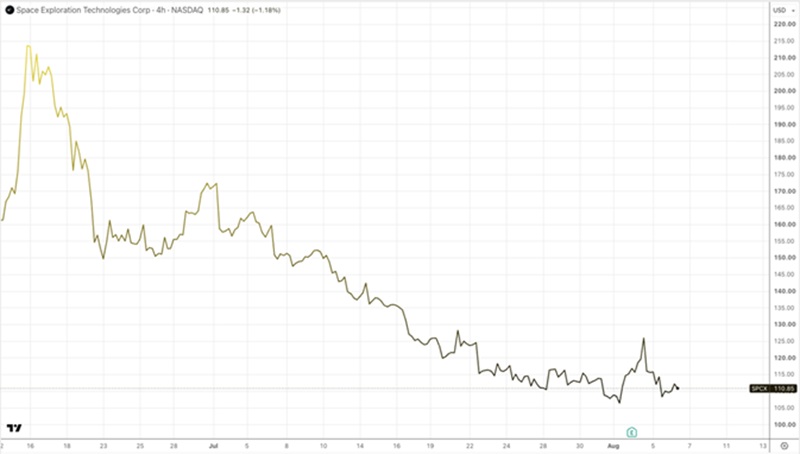
It was the scale of capital expenditures, not the revenue dynamics, that became the main factor putting pressure on the stock. After the report was published, the SpaceX stock chart showed a 10% increase, but those gains were quickly erased.
In the second quarter, SpaceX’s revenue grew by 92% year?on?year, reaching $7.8 billion. However, capital expenditures surged more than sixfold to $18.4 billion, significantly exceeding analysts’ consensus estimate of $11.2 billion. About 80% of these expenses were related to the development of AI infrastructure after the merger of SpaceX with xAI.
The company’s main source of revenue remains unchanged — Starlink satellite internet. Revenue from the telecommunications division grew by 66% to $4.3 billion, and operating profit reached $1.66 billion. In just one quarter, the service attracted a record 1.7 million new users, increasing its subscriber base to 12 million people. At the same time, the average monthly revenue per customer remained at $66, despite the recent price increase.
The aerospace segment looks quite different. Despite 29% revenue growth to $962 million, it ended the quarter with an operating loss of $542 million. SpaceX is directing more and more resources to its own projects, primarily Starlink. While in 2020 about half of Falcon 9 launches were for the company’s satellites, that share has now approached 80%. Commercial customers are already facing a shortage of launch slots, with virtually none available until 2028–2029.
The economic logic behind this strategy is clear. Each additional Starlink satellite launch can generate significantly higher long?term profits for SpaceX than fulfilling a third?party commercial order. Even now, the satellite network accounts for about 60% of the company’s total revenue, while the traditional space business accounts for a smaller share.
The AI segment is expanding just as aggressively. Its revenue grew by 247% to $2.6 billion, although the division remains deeply unprofitable. Most of its revenue comes from renting out computing power. In the quarter, the company secured contracts for computing capacity worth $14.1 billion, but under accounting rules, only $1.6 billion was recognized as revenue.
Elon Musk stated that by the end of the year, SpaceX will have more than 2 GW of computing capacity, compared to the current 1.4 GW, and by the end of next year, this figure could reach 15-20 GW. All new data centers will be built exclusively on the Nvidia Vera Rubin architecture, which the company’s CEO described as the best platform for AI development.
At the same time, SpaceX’s investments are not limited to building computing infrastructure. The company is gradually transforming Starlink from a purely satellite network into a full?fledged mobile operator. SpaceX President Gwynne Shotwell confirmed plans to create ground infrastructure that will support the rollout of its Starlink Mobile service, allowing the company to compete directly with the largest American telecommunications operators. This network will be deployed gradually using existing Starlink facilities, which should help contain additional capital spending.
The next stage in the network’s development will be the introduction of Starlink V3 satellites. The company plans to deploy them into orbit during the 14th Starship test flight. The new generation of satellites will provide gigabit data transfer speeds, but to fully roll out the service, it will be necessary to build a constellation of approximately 1,000 V3 satellites, a target SpaceX expects to reach in the second quarter of next year.
Despite the record revenue, SpaceX’s net loss for the quarter amounted to $541 million. Nevertheless, this was less than half the loss recorded a year earlier. The company ended the quarter with $100 billion in cash and highly liquid assets, and contracted future revenue reached $47.5 billion.
For investors, the main question is not about current profits, but about SpaceX’s ability to turn large?scale investments into sustainable cash flow. So far, the market is cautiously assessing such an aggressive development strategy, but if the company manages to simultaneously scale Starlink, maintain its leadership in space launches, and bring its AI business to self?sufficiency, today’s investments could become the foundation for the next stage of growth in its market capitalization.