DD
MM
YYYY

PAGES

DD
MM
YYYY

spot_img

PAGES

Home Blog Page 2

McKinsey Faces Crossroads at 100: Plans Thousands of Job Cuts amid Market Challenges

0

As McKinsey & Co. celebrated its 100th anniversary in Chicago last October, the festivities projected the image of a consulting powerhouse poised for a new era.

Partners, clients, and high-profile guests — including Rio Tinto chairman Dominic Barton, Visa CEO Ryan McInerney, former U.S. Secretary of State Condoleezza Rice, and Oprah Winfrey — attended the centennial event, which was part gala, part strategic pep talk. On stage, Global Managing Partner Bob Sternfels delivered a rousing message: “We will kick some ass as we start our second century,” he told a cheering audience, promising that the firm’s best days lay ahead.

Behind the scenes, however, the tone was far more sober. McKinsey’s leadership has been quietly communicating a need to tighten the belt, particularly in non-client-facing departments. People familiar with internal discussions told Bloomberg the firm is planning roughly a 10% reduction in headcount across support functions — a move that could affect several thousand employees.

These cuts are expected to be implemented gradually over the next 18 to 24 months, though McKinsey has not provided a public timeline.

The decision reflects a broader strategic recalibration after a decade of rapid expansion followed by several years of flat revenue growth. McKinsey’s employee count ballooned from around 17,000 in 2012 to a peak of 45,000 by 2022, before slipping to approximately 40,000. Meanwhile, firmwide revenue has remained in the $15 billion to $16 billion range over the past five years, a plateau that has prompted internal reassessments.

“Ahead of our second century, we are focused on improving the efficiency and effectiveness of our support functions,” a McKinsey spokesperson said, noting that the firm is responding to rapid changes in technology and client needs, including the impact of artificial intelligence on business operations.

The spokesperson emphasized that the company is continuing to hire consultants — the client-facing core of its business — even as support staff are being trimmed.

Industry analysts note that McKinsey is following patterns seen across consulting firms in recent years. EY, PwC, and Accenture have also cut non-revenue-generating roles while investing in AI and automation to streamline operations. Just last month, McKinsey cut around 200 global technology positions as part of an effort to leverage AI tools internally.

McKinsey is also navigating external pressures. In the U.S., potential cuts in government consulting spending under President Donald Trump have prompted concerns about slower growth. China has encouraged businesses to rely more on domestic consulting firms rather than international giants like McKinsey, while Saudi Arabia has scaled back payments for major government projects, a market that generated roughly $500 million in annual fees for McKinsey during the last decade.

These shifts underline that even consulting behemoths are vulnerable to geopolitical and regulatory currents.

Despite these headwinds, McKinsey projects optimism publicly. Sternfels’ keynote at the centennial gathering framed the moment as an inflection point.

“Are you excited about our mission? Do you feel we have a good shot?” he asked partners, promising that those who embrace the firm’s vision will reap rewards.

The gathering underscored McKinsey’s extensive influence and its network of elite clients spanning governments and multinational corporations, highlighting the firm’s continued centrality to global business strategy.

However, McKinsey still carries reputational baggage. The firm has faced scrutiny in the U.S. over its advisory work for clients in China and Saudi Arabia, while its past involvement with opioid manufacturers forced it to pay hundreds of millions in civil settlements. These episodes continue to weigh on perceptions of the firm, even as Sternfels insisted that the company has “righted our ship.”

The current phase of McKinsey’s evolution is one of contrasts: bold public proclamations of growth and innovation juxtaposed with behind-the-scenes cost-cutting and a careful reassessment of priorities. Support staff reductions are meant to fund the continued expansion of consulting teams, ensuring that client-facing growth is not stymied. Yet, the firm’s ability to sustain its historical dominance may depend on how effectively it navigates a market that is more cost-conscious, technologically disrupted, and politically complex than ever before.

Global Memory Price Shock: Samsung Doubles DDR5 Cost, Triggering Device Price Hikes and Spec Cuts

0

The technology industry is now facing a severe and persistent cost crisis, as Samsung has reportedly doubled the contract price of its DDR5 memory, sending shockwaves across the entire consumer electronics supply chain.

According to reports from industry tracker Jukan on X, and Taiwanese media, Samsung abruptly increased DDR5 contract prices by over 100%, lifting them to nearly $20 per unit from figures around $7 earlier this year. The company justified this aggressive action to “downstream customers” by claiming a severe supply crunch with “no stock” available.

This price escalation is not limited to the newest technology. Contract pricing for 16GB of DDR4 DRAM has also jumped sharply, reaching approximately $18, effectively eliminating the older generation as a temporary, cost-saving alternative for manufacturers. Moreover, volatility is high in the short term, as reports indicate that spot market prices for both DDR4 and DDR5 have surged even faster than contract prices in December, showing “no signs of resting.”

The AI Data Center Pull

The root cause of this memory surge is the overwhelming, insatiable demand from the Artificial Intelligence (AI) sector and massive data center expansions. Memory makers like Samsung, SK Hynix, and Micron are structurally shifting wafer capacity to prioritize higher-margin products such as High Bandwidth Memory (HBM) for AI accelerators and high-capacity DDR5 RDIMM server modules. This strategic reallocation away from commodity, consumer-grade memory creates a supply deficit that analysts predict will persist well into 2026 and potentially beyond.

Industry analysis from TrendForce warns the situation will worsen, projecting that memory prices could rise “sharply again” in Q1 2026, a forecast shared by others like Team Group. This sustained, aggressive pricing environment ensures that inflated DRAM pricing will continue, exerting “significant cost pressure on global end-device manufacturers.”

Memory now accounts for a much larger share of the total component cost (Bill of Materials, or BOM), leaving OEMs with extremely limited room to absorb the increases.

Immediate Impact on Product Planning and Consumer Costs

The rising cost of DRAM is compelling OEMs to adopt a dual strategy of raising consumer prices and actively downgrading specifications to maintain profitability, a phenomenon some are calling “RAMageddon.” TrendForce has already revised its 2026 global production forecasts downward for both smartphones and notebooks, predicting annual declines of around 2% and 2.4%, respectively.

Smartphone and Mobile Market Adjustments

The mobile market, where memory is a key marketing differentiator, will see the most drastic changes. To control costs, manufacturers are expected to reintroduce lower memory tiers, with low-end smartphone base models likely to return to 4GB of RAM in 2026, a configuration that had been largely phased out. Mid-range and even higher-end smartphones may also see tighter memory allocations, slowing the perceived value of upgrades for consumers.

Some brands are reportedly considering the revival of features like expandable storage, such as microSD card slots, as a mechanism to offset the smaller internal memory allocations.

Android vendors targeting the mid-to-low-end—where margins are already thin—will be compelled to raise the launch prices of new models in 2026. Conversely, major players like Apple and Samsung are better positioned to weather the storm due to their scale and higher margins. However, even for Apple, analysts expect memory to “significantly increase” as a share of the iPhone BOM in early 2026, potentially forcing the company to reassess pricing strategies for new devices or reduce price cuts on older models.

PC and Notebook Market Adjustments

PC makers are also preparing for cost shocks, which are already translating into concrete price adjustments. Dell is reportedly planning price increases ranging from 10% to 30% on commercial PCs starting in mid-December, a direct response to rising memory costs. Ultra-thin laptops face the greatest risk, as their designs often rely on soldered memory, which prevents manufacturers from reducing costs by swapping modules.

These models will likely see the earliest and most significant price pressure.

While consumer notebook prices may hold stable for the short term due to existing component inventory, TrendForce warns that medium- and long-term adjustments are unavoidable. More significant volatility is expected to hit the broader PC market by Q2 2026, coinciding with major product lineup refreshes.

Ultimately, the confluence of supply constraints and the AI-driven redirection of manufacturing capacity means that for consumers, the next hardware cycle will be defined by a clear trade-off: higher retail prices for all devices and a general decrease in default memory specifications.

NDIC Begins Liquidation of ASO Savings, Union Homes as CBN Revokes Licenses, Triggers Depositor Payouts

0

The Nigeria Deposit Insurance Corporation (NDIC) has formally commenced the liquidation of ASO Savings and Loans Plc, and Union Homes Savings and Loans Plc, setting in motion the payment of insured deposits to thousands of customers following the withdrawal of the banks’ operating licenses by the Central Bank of Nigeria (CBN).

In a public notice issued on Tuesday, December 16, the NDIC disclosed that the CBN revoked the licenses of the two mortgage banks on December 11, 2025, citing regulatory breaches. The NDIC was subsequently appointed as liquidator under Section 12(2) of the Banks and Other Financial Institutions Act (BOFIA) 2020, activating the statutory process for winding down the institutions and compensating depositors.

The move represents another decisive regulatory intervention by Nigeria’s financial authorities, aimed at protecting depositors, enforcing compliance, and sustaining confidence in the financial system amid persistent stress in parts of the non-bank financial sector.

Automatic payment of insured deposits begins

The NDIC confirmed that it has commenced liquidation proceedings in line with Sections 55(1) and (2) of the NDIC Act 2023 and has begun verifying and paying insured deposits to customers of the failed lenders.

Under Nigeria’s deposit insurance framework, each depositor is entitled to a maximum insured payout of N2 million per institution. The NDIC said payments would be made automatically, using depositors’ Bank Verification Numbers (BVN) to identify alternative bank accounts into which funds will be credited.

“Depositors will be paid their insured deposits up to the maximum amount of N2,000,000 per depositor,” the Corporation said, stressing that affected customers are not required to open new accounts or engage intermediaries for the process.

This automated approach, the NDIC noted, is designed to speed up payouts and reduce the hardship typically associated with bank failures.

Treatment of balances above the insured limit

For depositors whose balances exceed N2 million, the NDIC clarified that only the insured portion will be paid immediately. Any remaining balances will be treated as uninsured deposits and settled later as liquidation dividends.

These subsequent payments will depend on how much the NDIC is able to recover through the sale of the banks’ assets and the recovery of outstanding loans owed to the defunct institutions.

To maximize recoveries, the Corporation said it will aggressively pursue delinquent borrowers and commence the disposal of physical and financial assets belonging to ASO Savings and Union Homes. The timing and size of liquidation dividends will therefore hinge on the success of these recovery efforts.

The NDIC has opened both online and physical channels for depositors and creditors to submit claims and verify their details.

Depositors can submit claims online through the NDIC’s claims portal or appear physically at the nearest branches of the closed banks between December 16 and December 30, 2025. Those opting for physical verification are required to present proof of account ownership, a valid means of identification, their BVN, and details of an alternative bank account.

Creditors of the two institutions have also been invited to submit claims within the same window. However, the NDIC emphasized that creditors will only be considered for payment after all insured and uninsured depositors have been fully settled, in accordance with statutory liquidation priorities.

Payments to staff, shareholders, and other residual claimants will come much later and only if sufficient funds remain after depositors and creditors have been paid.

Regulatory reassurance amid sector scrutiny

In its notice, the NDIC sought to reassure the banking public that the liquidation does not signal a broader systemic problem within Nigeria’s financial sector.

“Banks whose licenses have not been revoked remain safe and sound,” the Corporation said, urging Nigerians to continue their banking activities without fear.

The NDIC added that the action demonstrates its mandate to protect depositors’ funds and uphold confidence in the financial system, even when that requires closing institutions that can no longer meet regulatory standards.

The liquidation comes against a complex backdrop, particularly for ASO Savings and Loans, which had only recently returned to the market’s spotlight.

The Nigerian Exchange (NGX) had lifted a long-standing suspension on trading in ASO Savings’ shares after the company addressed years of post-listing compliance failures, especially its inability to file audited financial statements. When trading resumed, the stock rallied sharply from around 50 kobo per share to above N1.00 in less than a week, making it one of the market’s top performers for two consecutive weeks.

However, the reprieve was short-lived. Trading in the stock was suspended again a few weeks later to allow the company to conclude an ongoing share reconstruction exercise. That process was still underway when the CBN revoked the bank’s license, effectively ending its operations as a regulated mortgage lender.

Union Homes Savings and Loans followed a similar compliance trajectory. With a market capitalization of about N2.95 billion, the company persistently defaulted on post-listing requirements, prompting the NGX to eventually delist its shares after repeated efforts to secure compliance failed.

The collapse of the two institutions is believed to be the consequence of prolonged governance, capital, and reporting weaknesses. The focus now shifts to how quickly the NDIC can complete payouts and asset recoveries in a process that could stretch over several years.

However, the immediate commencement of insured depositor payments provides some relief, reinforcing the role of deposit insurance as a critical safety net in Nigeria’s financial architecture.

Michael Burry’s GameStop Regret: Inside the Trade He Got Right, the Mania He Missed, and the Market Forces He Never Saw Coming

0

Michael Burry’s account of his GameStop investment reads less like a confession and more like an autopsy. In a detailed Substack post published Monday night, the investor best known for anticipating the 2008 housing collapse revisited one of the most scrutinized trades of the past decade: his early bet on GameStop — and his decision to exit months before it became the defining symbol of meme-stock excess.

Burry’s involvement with GameStop began quietly in the summer of 2018, long before retail traders turned the struggling video-game retailer into a cultural and financial phenomenon. At the time, GameStop was broadly written off by Wall Street as a business in terminal decline, squeezed by digital downloads and shifting consumer behavior.

Burry saw a different picture. He believed the stock was deeply undervalued and mispriced relative to its cash flows and balance sheet.

In his post, Burry laid out the logic behind the trade with the precision of someone reconstructing an old model. He pointed to an upcoming console refresh cycle in 2020, historically a boost for GameStop’s sales. He flagged the potential for a buyout, the possible sale of its Spring Mobile unit, and what he described as strong cash generation paired with a sizable cash balance.

That combination, he argued at the time, created room for a “very big and consequential buyback” that could materially re-rate the stock.

Yet the market remained unmoved. After months of stagnation, Burry exited the position in the second quarter of 2019. The lack of price response undermined his confidence. Still, the story did not end there. Within weeks, he was back.

By July 2019, Burry re-entered GameStop, this time more forcefully. One factor had changed: short interest. GameStop had become one of the most heavily shorted stocks in the U.S. market, and Burry viewed that as a fresh catalyst layered on top of his original fundamental thesis. He wrote that he bought the stock “with both hands,” making it one of his larger holdings.

Burry did not rely solely on spreadsheets. He said he visited a GameStop store to test whether his thesis aligned with reality on the ground. The visit raised doubts rather than confidence.

“It did not work,” he wrote. “Even the stuff that was not on sale looked like it should be on sale.”

Still, he stuck with the numbers.

He also took an activist stance, writing directly to GameStop’s board and pushing for changes. That activism led to correspondence with two figures who would later become central to the GameStop saga: Keith Gill, the retail investor later known globally as Roaring Kitty, and Ryan Cohen, the Chewy co-founder who would go on to become GameStop’s chief executive.

Burry disclosed that his second entry into GameStop was at a split-adjusted average price of about 83 cents per share. He accumulated nearly 5% of the company and held the position for more than 16 months. During that period, lending his shares to short sellers generated substantial income. He said the lending rates, often in high double digits, were “lucrative” and formed a significant part of the overall return.

By late 2020, however, Burry’s patience had worn thin. Despite tangible developments — buybacks, board changes, and progress on asset sales — the stock price and short interest showed little response. He wrote that these outcomes, which he considered “home run/slam dunk activist successes,” had “zero impact on price or short interest.” That disconnect convinced him the market was unlikely to reward the thesis.

Burry exited the position by the end of November 2020, selling his shares at an average price of $3.38 — more than four times his entry price. By traditional investment standards, it was a clear win.

What followed reshaped market history. In January 2021, retail traders coordinating on online forums such as r/WallStreetBets launched an unprecedented short squeeze. GameStop shares surged to an intraday high above $120 on January 28, triggering massive losses for hedge funds and turning early retail participants into paper millionaires.

At the peak, Burry estimated that his multi-year investment could theoretically have turned roughly $12 million into $1 billion. But he dismissed that scenario outright.

“That was never a possibility,” he wrote, noting he would have sold long before prices reached those levels.

Even so, Burry did not avoid self-examination. He acknowledged that he could have analyzed the situation better. He believed he understood GameStop’s fundamentals, the short interest, and the trading dynamics. What he underestimated, he said, was how those elements could interact with a mass retail movement untethered from traditional valuation logic.

“I was blinded by what I saw as execution risk,” he wrote.

When GameStop shares jumped after Ryan Cohen disclosed his stake, Burry seized the opportunity to close the trade.

“I had no idea what was coming,” he added. “I had no idea that a Roaring Kitty existed.”

He also said he did not foresee what he described as a “widely distributed gamma squeeze” evolving into what he called “the one and only legal market corner.”

Roughly 50 days after his exit, the company he once characterized as an “ignominious crappy business” became, in his words, the “belle of the ball.”

“The entire world could not take their eyes off her,” Burry wrote. “And neither could I.”

Burry’s reflections extended beyond personal regret. He described the early 2021 meme-stock surge as spectacular, hilarious, and tragic in equal measure. By mid-year, as speculative fervor spread into non-fungible tokens and a wide range of physical assets, his tone darkened. He said he feared retail investors would ultimately be “shredded” and felt compelled to warn them.

That impulse, he explained, was shaped by an older failure: not having been more effective in sounding the alarm ahead of the 2005–2007 housing bubble. Speaking out during the meme-stock era, he suggested, was an attempt to avoid repeating that silence.

Burry also hinted that his GameStop story is not finished. He teased an upcoming post offering a fresh assessment of the company as it exists today. He described it as a “melting ice cube” with some capital-structure optionality, broadly similar to how he viewed it in 2018. The differences are notable: short interest has fallen to about 16%, the financial figures are far larger, and Ryan Cohen now runs the company — “for better or worse,” Burry wrote.

The account stands as a rare, candid look at how a fundamentally sound trade can still miss a once-in-a-generation market event — and how even investors with a reputation for seeing around corners can be overtaken by forces that sit outside conventional financial analysis.

America’s Economic Paradox: Growth Without Jobs

0

Question: How do you see the U.S. market, and what is the new normal from an African perspective?

My Response: The new normal is that the U.S. economic architecture is being redesigned, and what we are witnessing is not a single adjustment but a series of unfolding “new normals” that will play out over the next few years. I saw a similar pattern when Britain exited the European Union. The country cycled through leaders, each searching for a magic wand. None appeared because structural redesigns do not yield instant solutions.

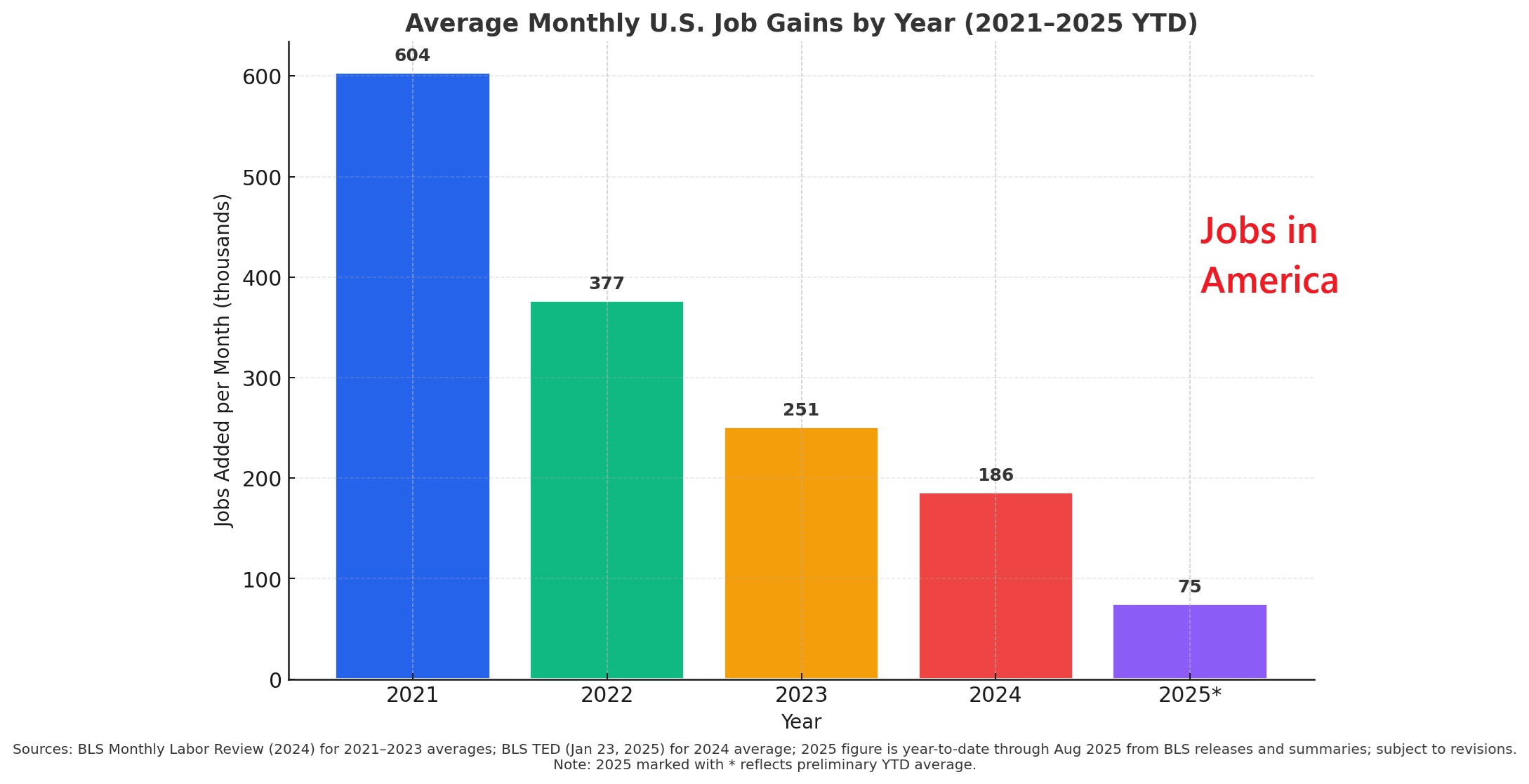
So, what is happening in the United States? America is now experiencing jobless growth. If you track average monthly job creation since 2021, the trajectory is unmistakable: from the exuberant highs of nearly 600,000 jobs per month to fewer than 100,000. Last month, the U.S. added just 64,000 jobs. Yet, unemployment rates remain relatively low, not because the economy is firing on all cylinders, but partly because immigration has slowed, reducing new entrants into the labor force. That demographic slowdown is masking a deeper structural shift.

President Trump understands this reality. Tariffs became one lever to stimulate domestic production. But tariffs alone cannot bridge a fundamental cost gap where a worker in Cambodia earns $10 a day, making relocation to Los Angeles economically unattractive even with a 100% tariff. The Federal Reserve, bound by its dual mandate of employment and price stability, watches this paradox unfold: low unemployment on paper, but slowing job creation beneath the surface.

Meanwhile, Wall Street is euphoric. Equity markets rally, corporate profits rise, and capital flows remain strong. But for the newly graduated American seeking a first job, the experience feels very different. Somewhere between AI-driven productivity gains, corporate efficiency pushes, and shifting demographics lies an unresolved equation.

Many blame AI for the disappearance of entry-level roles. But the truth is more nuanced. The U.S. economy was already losing momentum before AI adoption accelerated following ChatGPT’s launch in late 2022. AI did not create the imbalance; it simply amplified it. And no one has yet figured out how to unwind this paralysis without trade-offs.

From an African perspective, I drop this Igbo proverb: “onye na-amaghi ebe mmiri bidoro mawa ya, agaghi ama ebe o kwusiri” [he who does not know where the rain began to beat him cannot know where it will stop]. Ask an Igbo elder around you to explain that because as Mazi Chinua Achebe noted, proverbs are the palm oil with which words are eaten.

UK Prime Minister Theresa May Resigns as Illusion of “The Rise of Me Only” Ravages