DD
MM
YYYY

PAGES

DD
MM
YYYY

spot_img

PAGES

Home Blog Page 2

Cramer Warns Oracle Could Become the Brake on Big Tech’s AI Spending Spree as Wall Street Loses Patience

0

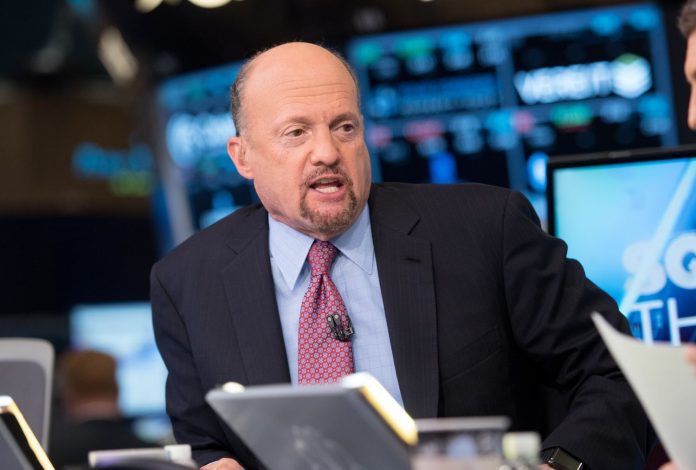
CNBC’s Jim Cramer on Tuesday argued that Oracle may be nearing a financial and market-imposed limit in the artificial intelligence arms race, positioning the software giant as a potential catalyst for a broader slowdown in hyperscalers’ spending.

His comments come as Oracle’s stock and credit profile have become focal points for growing investor unease about whether today’s AI investments can realistically pay for themselves.

Cramer said Oracle’s balance sheet is now under sharper scrutiny after the company committed to an unprecedented expansion of its data center footprint to support AI workloads, particularly for OpenAI. While Oracle has leaned heavily into AI infrastructure as a growth engine, Wall Street’s reaction suggests investors are increasingly concerned about leverage, execution risk, and the long wait before returns materialize.

“Oracle already has a huge amount of debt. Their balance sheet’s not that good,” Cramer said on CNBC. “At some point, they’ll heed the warning of the bond market and slow things down. These data centers cost a fortune and even the best builders stumble. Oracle can’t risk blowing up its balance sheet for Sam Altman.”

Those warnings intensified after Oracle’s recent earnings report, which, like Broadcom’s, showed strong demand for AI services but failed to reassure investors about financing and profitability. Oracle beat earnings expectations but missed on revenue, and management offered limited clarity on how it plans to fund its rapidly expanding AI commitments without further stretching its balance sheet.

Since early September, Oracle’s stock has been under sustained pressure, losing nearly half its value from a peak triggered by optimism over a massive AI backlog. Over just a few trading days last week, the shares fell sharply again, reflecting a broader reassessment of AI-linked infrastructure stocks. Investors who once rewarded aggressive expansion are now questioning whether the pace of spending has outstripped realistic cash flow generation.

The pressure is not confined to equities. Oracle’s growing reliance on debt markets has amplified concerns. The company recently issued $18 billion in bonds, a move that drew intense scrutiny from credit investors. According to Cramer, demand for credit default swaps tied to Oracle surged after the issuance, a signal that bondholders are increasingly hedging against the risk that the company’s leverage could become problematic if AI economics disappoint.

Oracle has also disclosed massive long-term obligations tied to its cloud and data center strategy. As of late November, the company reported hundreds of billions of dollars in lease commitments for data centers and cloud capacity, many stretching 15 to 19 years into the future. That scale of fixed obligation has unsettled investors at a time when pricing, utilization rates, and long-term demand for AI services remain uncertain.

Cramer argued that Oracle’s position makes it the weakest link in what he described as a spending standoff among five major players: Amazon, Microsoft, Google, Meta, and OpenAI, which relies heavily on Oracle as a core infrastructure partner. These companies, he said, are locked in a race to outspend one another, building data centers wherever power and land are available, while trying to prevent rivals from encroaching on their core businesses.

“This reckless, imprudent data center spending has crushed these stocks,” Cramer said, adding that OpenAI’s spending posture is particularly aggressive.

He described the ChatGPT maker as venture-funded and unusually willing to absorb losses in pursuit of scale, committing more than $300 billion over five years to Oracle’s technology alone, with total commitments across partners approaching $1.4 trillion.

In that context, Oracle’s market performance has become a warning sign. Equity investors have punished the stock, while credit markets are demanding higher compensation for risk. Cramer suggested that if Oracle responds by slowing its AI buildout, it could give other hyperscalers political and financial cover to do the same.

“If Oracle pumps the brakes on spending, competitors could follow suit and see their stocks climb,” he said, arguing that restraint could ease fears of runaway capital expenditure and restore confidence in valuations.

He also said a slowdown would force OpenAI to prioritize its ambitions rather than trying to dominate every segment of the AI economy simultaneously.

“This way Oracle stays alive, and OpenAI is forced to choose which businesses it truly wants to target,” Cramer said. “Because he who defends everything defends nothing.”

Oracle’s recent market performance has become emblematic of a broader shift in sentiment for Wall Street. The AI trade is no longer being judged solely on growth narratives and demand projections. Investors are now focused on debt levels, long-term obligations, and the credibility of returns.

Shares of Broadcom, CoreWeave, and Oracle Tank Following Wall Street AI Infrastructure Selloff

0

In a corner of the artificial intelligence market that once seemed immune to doubt, investor sentiment has shifted sharply, exposing growing anxiety about whether the vast sums being poured into AI infrastructure will generate commensurate returns.

Broadcom, CoreWeave, and Oracle — three companies central to the global AI buildout — extended their recent selloff on Monday, deepening losses from last week. The declines have come even as all three firms continue to post strong year-to-date gains, underscoring that the market’s unease is not about the relevance of AI, but about the sustainability of its economics.

The recent weakness reflects a broader reassessment underway on Wall Street. After years of enthusiasm driven by explosive demand for computing power, chips, and data centers, investors are increasingly focused on balance sheets, profit margins, and funding risks. The question now being asked is less about growth and more about how long companies can keep spending at this pace before returns begin to materially justify the investment.

“It definitely requires the ROI to be there to keep funding this AI investment,” Matt Witheiler, head of late-stage growth at Wellington Management, said on CNBC’s “Money Movers” on Monday. He added that, based on what he has seen so far, “that ROI is there.”

Witheiler also outlined the optimistic case still underpinning much of the sector.

“Every single AI company on the planet is saying if you give me more compute I can make more revenue,” he said, a sentiment that has fueled unprecedented capital expenditure across the technology industry.

Yet the market’s reaction to recent earnings suggests that patience may be wearing thin. Both Broadcom and Oracle reported quarterly results last week that beat revenue expectations and reinforced the message that demand for AI-related products and services remains strong. Investors, however, focused less on top-line growth and more on the cost of delivering it.

Oracle’s situation has drawn particular scrutiny. The company has become increasingly reliant on debt markets to finance its aggressive expansion in cloud and data center infrastructure. Management said capital expenditure in the current fiscal year will rise to $50 billion, up from a previous forecast of $35 billion, following new long-term contracts with customers, including Meta and Nvidia.

At the same time, Oracle’s lease obligations have ballooned. As of Nov. 30, the company disclosed $248 billion in lease commitments related to data centers and cloud capacity, with terms stretching between 15 and 19 years. That figure represents a 148% increase from the end of August, highlighting the scale and speed of its expansion. Investors have been left searching for more clarity on how those commitments will be financed and what they mean for future cash flows.

Broadcom’s challenges are rooted less in leverage and more in profitability. Chief executive Hock Tan said AI chip sales are expected to double this quarter from a year earlier to $8.2 billion, driven by demand for both custom AI accelerators and networking semiconductors used in large-scale data centers.

However, producing complete AI server systems requires significant upfront spending. Broadcom’s chief financial officer, Kirsten Spears, cautioned investors that “gross margins will be lower” for certain AI chip systems as the company ramps up production and absorbs higher component costs. That warning reinforced concerns that earnings growth may lag revenue growth in the near term.

The market reaction has been unforgiving. Broadcom shares fell 5.6% on Monday after tumbling 11% on Friday, leaving the stock roughly 18% below the record high it reached just days earlier. Oracle slid another 2.7% on Monday and is now down 17% over the past three trading sessions. The stock has lost about 46% of its value since Sept. 10, when it surged after the company disclosed a massive AI backlog.

Concerns about leverage have further intensified the selloff. Venture capitalist Tomasz Tunguz, founder of Theory Ventures, wrote in a blog post on Monday that Oracle’s recent fundraising has pushed its debt-to-equity ratio to about 500%, a level far above those of its major cloud rivals. He noted that Amazon, Microsoft, Meta, and Google all maintain ratios between 7% and 23%.

CoreWeave, a cloud infrastructure provider built largely around Nvidia’s graphics processing units, is also under pressure. Tunguz pointed out that CoreWeave’s debt-to-equity ratio stands at roughly 120%, making it one of the most highly leveraged players in the AI infrastructure space.

CoreWeave’s stock performance reflects that unease. Shares fell about 8% on Monday after dropping 11% last week, and the company has now lost more than 60% of its value since peaking in June. The decline has occurred even as demand for GPU-powered cloud services remains strong, highlighting how sensitive investors have become to capital intensity and financial risk.

Taken together, the latest market moves suggest the AI trade is entering a more demanding phase. Enthusiasm for the technology itself remains intact, but the tolerance for mounting debt, margin compression, and open-ended spending is fading.

For companies racing to build the backbone of the AI economy, the challenge is no longer just scaling faster than competitors, but proving convincingly that the scale will eventually translate into durable profits.

Thank You For Year 2025 – Ndubuisi Ekekwe

0

As we close the chapter of 2025, I want to thank you for making this feed super-amazing. My prayer for you, your families and your friends, is that 2026 brings abundance in every dimension. Like the baobab tree, may your abundance be vast and unconstrained in health, in wealth, and in wisdom. May the works of your hands be blessed.

This has been my prayer since my early days in secondary school: Oh Lord, as you send your angels to bless men and women, our hands are always lifted up to be noticed, not because we merit anything, but because Your grace has qualified us.  When were done in the Scripture Union, we would affirm: “The next praise will be better, because new songs will be discovered.”

In 2026, you will discover new songs. My name is Ndu-bu-isi-uwa [life is first in all things in the universe] and I pray that you will experience life in abundance. As you reflect on 2025, identify areas for growth and renewal.

Let us enter 2026 with the crisp energy of the harmattan (or winter), unlocking new vistas in our careers, our businesses, and our personal economies.

In our business, the year 2025 has been our best year ever. And in 2026, we will launch a new company that will employ about 100 people in Nigeria, unlocking massive opportunities while fixing critical market frictions. We will share here for those who would like to join in our journey via jobs once our license is out. I look ahead with deep optimism because Nigeria’s greatest companies have not yet been founded, and the promise of what lies ahead remains vast.

From Oriendu Market Ovim to the banking halls of Victoria Island Lagos, those who dream and take actions will always win the future. Take action with a journey into 2026. And make it a journey into abundance.

  • Udo diri unu.
  • Salama alaykum.
  • Alaafia fun yin.
  • Gracias infinita.

I wish everyone who encounters this message an amazing 2026 ahead. You have all made me better, and for that, I am deeply grateful. Thank you for making this feed amazing.

President Trump Sues BBC for $10bn Over Allegedly Malicious Jan. 6 Speech Edit

0

President Donald Trump has escalated his long-running feud with the British Broadcasting Corporation (BBC) by filing a massive $10 billion lawsuit in a U.S. federal court in Miami, Florida.

The suit alleges that the publicly funded British broadcaster defamed him by “intentionally, maliciously, and deceptively doctoring” footage of his January 6, 2021, speech in a 2024 documentary. The complaint targets the BBC, its distribution arm (BBC Studios Distribution Ltd.), and its production unit (BBC Studios Productions Ltd.), accusing them of a “brazen attempt to interfere in and influence the Election’s outcome.”

The lawsuit centers on a segment in the BBC News program “Panorama,” titled Trump: A Second Chance?, which aired in the U.K. in October 2024, just one week before the presidential election. Trump’s legal team, in a 33-page complaint, outlines two main arguments for deceptive editing:

Splicing Disparate Clips: The documentary allegedly stitched together two distinct portions of the hour-long speech that were delivered approximately 55 minutes apart. The edited sequence made it appear that the President told supporters in quick succession: “We’re going to walk down to the Capitol… and I’ll be there with you. And we fight. We fight like hell.” In reality, Trump’s earlier statement about walking to the Capitol was followed by him saying they would “cheer on our brave senators and congressmen and women.” At the same time, the “fight like hell” remark occurred much later and was part of a broader call for political tenacity.

Omission of Peace Call: The lawsuit further claims the BBC deceptively omitted the crucial preceding segment in which Trump urged his followers toward peace, stating: “I know that everyone here will soon be marching over to the Capitol building to peacefully and patriotically make your voices heard.”

The suit argues this omission intentionally gave the “mistaken impression” that Trump had made a direct call for violent action.

Trump is seeking an unprecedented total of $10 billion in damages, requesting $5 billion for defamation and an additional $5 billion for a violation of Florida’s Deceptive and Unfair Trade Practices Act.

Internal BBC Turmoil and Legal Defense

The controversy surrounding the edit sparked a major crisis within the BBC, fueled by a whistleblower report from a former BBC editorial standards adviser, Michael Prescott.

In November, the scandal led to the high-profile resignations of both BBC Director-General Tim Davie and BBC News CEO Deborah Turness, highlighting the severity of the internal concerns over journalistic standards.

While BBC Chairman Samir Shah personally apologized to Trump via email and publicly acknowledged the editing “gave the mistaken impression” of a direct call for violence, the broadcaster has rejected the legal basis for the defamation claim. The BBC maintains it “strongly disagrees there is a basis for a defamation claim” and has vowed to defend the case vigorously.

Legal experts note that Trump, as a public figure, faces a significant challenge in U.S. federal court. To succeed, his team must prove the BBC acted with “actual malice”—meaning they either knowingly published false information or acted with reckless disregard for the truth. Furthermore, the BBC is expected to argue for dismissal, stating the documentary was never aired on U.S. television and was geo-blocked on its main streaming service, the iPlayer, though Trump’s team claims U.S. viewers could have accessed it via the BritBox streaming service or a VPN.

President Trump, who had previously threatened a $1 billion lawsuit, framed the action as essential, telling reporters he was suing the BBC “for putting words in my mouth,” even musing that “they used AI or something.” The current litigation follows his successful multi-million-dollar settlements with CBS News ($16 million) and ABC News ($15 million) over past claims of deceptive editing and defamation.

McKinsey Faces Crossroads at 100: Plans Thousands of Job Cuts amid Market Challenges

0

As McKinsey & Co. celebrated its 100th anniversary in Chicago last October, the festivities projected the image of a consulting powerhouse poised for a new era.

Partners, clients, and high-profile guests — including Rio Tinto chairman Dominic Barton, Visa CEO Ryan McInerney, former U.S. Secretary of State Condoleezza Rice, and Oprah Winfrey — attended the centennial event, which was part gala, part strategic pep talk. On stage, Global Managing Partner Bob Sternfels delivered a rousing message: “We will kick some ass as we start our second century,” he told a cheering audience, promising that the firm’s best days lay ahead.

Behind the scenes, however, the tone was far more sober. McKinsey’s leadership has been quietly communicating a need to tighten the belt, particularly in non-client-facing departments. People familiar with internal discussions told Bloomberg the firm is planning roughly a 10% reduction in headcount across support functions — a move that could affect several thousand employees.

These cuts are expected to be implemented gradually over the next 18 to 24 months, though McKinsey has not provided a public timeline.

The decision reflects a broader strategic recalibration after a decade of rapid expansion followed by several years of flat revenue growth. McKinsey’s employee count ballooned from around 17,000 in 2012 to a peak of 45,000 by 2022, before slipping to approximately 40,000. Meanwhile, firmwide revenue has remained in the $15 billion to $16 billion range over the past five years, a plateau that has prompted internal reassessments.

“Ahead of our second century, we are focused on improving the efficiency and effectiveness of our support functions,” a McKinsey spokesperson said, noting that the firm is responding to rapid changes in technology and client needs, including the impact of artificial intelligence on business operations.

The spokesperson emphasized that the company is continuing to hire consultants — the client-facing core of its business — even as support staff are being trimmed.

Industry analysts note that McKinsey is following patterns seen across consulting firms in recent years. EY, PwC, and Accenture have also cut non-revenue-generating roles while investing in AI and automation to streamline operations. Just last month, McKinsey cut around 200 global technology positions as part of an effort to leverage AI tools internally.

McKinsey is also navigating external pressures. In the U.S., potential cuts in government consulting spending under President Donald Trump have prompted concerns about slower growth. China has encouraged businesses to rely more on domestic consulting firms rather than international giants like McKinsey, while Saudi Arabia has scaled back payments for major government projects, a market that generated roughly $500 million in annual fees for McKinsey during the last decade.

These shifts underline that even consulting behemoths are vulnerable to geopolitical and regulatory currents.

Despite these headwinds, McKinsey projects optimism publicly. Sternfels’ keynote at the centennial gathering framed the moment as an inflection point.

“Are you excited about our mission? Do you feel we have a good shot?” he asked partners, promising that those who embrace the firm’s vision will reap rewards.

The gathering underscored McKinsey’s extensive influence and its network of elite clients spanning governments and multinational corporations, highlighting the firm’s continued centrality to global business strategy.

However, McKinsey still carries reputational baggage. The firm has faced scrutiny in the U.S. over its advisory work for clients in China and Saudi Arabia, while its past involvement with opioid manufacturers forced it to pay hundreds of millions in civil settlements. These episodes continue to weigh on perceptions of the firm, even as Sternfels insisted that the company has “righted our ship.”

The current phase of McKinsey’s evolution is one of contrasts: bold public proclamations of growth and innovation juxtaposed with behind-the-scenes cost-cutting and a careful reassessment of priorities. Support staff reductions are meant to fund the continued expansion of consulting teams, ensuring that client-facing growth is not stymied. Yet, the firm’s ability to sustain its historical dominance may depend on how effectively it navigates a market that is more cost-conscious, technologically disrupted, and politically complex than ever before.