DD
MM
YYYY

PAGES

DD
MM
YYYY

spot_img

PAGES

Home Blog Page 203

How Nvidia’s AI Boom Is Rewiring the Energy Landscape

0

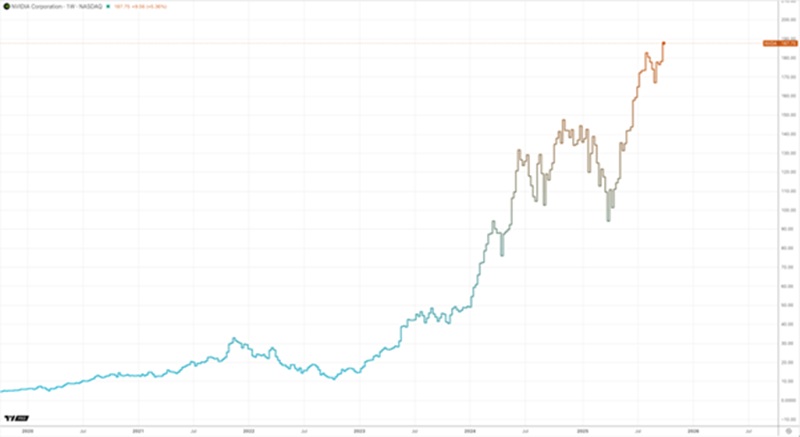
Nvidia is once again driving the American stock market. The chipmaker’s securities have reached a historic high this week, and the company’s capitalization has exceeded $4.5 trillion. The 49% increase since the beginning of the year reflects not only the steady demand for accelerators, but also the avalanche of new deals that increasingly link Nvidia with OpenAI. Investors are also focused on the giant Stargate project – a consortium of data centers worth hundreds of billions of dollars, where the infrastructure will be built on Nvidia GPUs.

According to Jensen Huang, Nvidia products account for about 70% of the cost of new AI data centers. This indicator makes the company an infrastructure monopolist in the new technological cycle. Add to that CoreWeave’s $14.2 billion cloud service deal with Meta and announcements from Google and Microsoft, and it’s clear why Nvidia continues to almost single-handedly lift market indexes and boost ES futures.

OpenAI also remains at the forefront of the AI market, but its business model is yet to achieve financial stability. In the first half of the year, the startup earned $4.3 billion, with operating expenses of $2.5 billion and additional $6.7 billion invested in R&D. By the end of 2025, OpenAI projects $13 billion in revenue and $8.5 billion in expenses, which confirms the company’s ability to maintain a high pace of development, although the long-term return on investment remains uncertain.

The key factor remains the Nvidia deal. Formally, the company announced a $100 billion partnership, but a significant portion of these funds will flow back to Nvidia through rental payments for its accelerators. In fact, OpenAI is becoming not only Nvidia’s largest customer, but also a catalyst for its further market growth. Every new dollar OpenAI or Meta invests in development directly translates into higher demand for Nvidia accelerators.

But accelerators require energy – creating not only new risks but also significant opportunities. It is expected that the increase in electricity consumption by AI centers will lead to a boom in investments in the US nuclear energy industry of approximately $350 billion by 2050. The total capacity of nuclear power plants can grow by 63%, mainly due to small modular reactors (SMRs).
However, there are several limitations to consider here, such as the high cost of construction, the shortage of personnel, and the lack of commercial SMRs in the next ten years. Capacity growth will be limited until 2035, potentially creating an imbalance between the pace of data center construction and available generation. The US authorities have already slowed down the closure of coal-fired power plants in order to maintain the demand for AI data centers.

The existing Nvidia-OpenAI-energy partnership outlines a new framework for global growth. For the US stock market this means a continuation of the AI rally, with Nvidia leading the way – as reflected in the heatmap, where it holds the top spot by market capitalization. But at the same time, the load on the energy infrastructure is growing, which means that nuclear companies and suppliers of generation equipment will gradually take a stronger role.

The current cycle is not only a race of chips, but also a race of resources, capital, energy, and infrastructure. Nvidia is winning here and now, OpenAI is still building scale without guaranteed payback, and the US nuclear industry is getting a chance to be reborn after decades of stagnation. Together, this triad will shape market dynamics for the upcoming years.


Uber Posts Record Trip Volume and Strong Q3 growth, But Shares Slip on Investor Caution

0

Uber Technologies Inc. posted a robust third-quarter performance, reporting its strongest growth since late 2023 and the largest trip volume increase in its history outside the post-COVID rebound, but shares fell about 4% in premarket trading as investors weighed the company’s heavy reliance on one-off accounting gains for its headline profit.

The San Francisco-based ridesharing giant reported revenue of $13.47 billion, beating the $13.28 billion expected by LSEG analysts. Earnings per share came in at $3.11, although it was not immediately clear if that figure was directly comparable to the 68 cents expected by Wall Street.

Revenue rose 20% year-on-year from $11.2 billion, driven by growth across both the mobility and delivery segments. Gross bookings climbed 21% to $49.74 billion, surpassing StreetAccount’s estimate of $48.95 billion.

Uber’s net income nearly tripled to $6.6 billion, compared with $2.6 billion in the same quarter last year. However, a large portion of that profit came from a $4.9 billion tax valuation benefit and a $1.5 billion gain from reevaluations of equity investments. Excluding those one-time items, adjusted EBITDA rose 33% to $2.26 billion, roughly in line with expectations.

“This was our strongest growth since the end of 2023,” CEO Dara Khosrowshahi said in prepared remarks, adding that Uber’s focus on “innovation and affordability” had driven record trip volume and solid gross bookings across both rides and deliveries.

Record Trips and Expanding User Base

The company reported 3.5 billion trips for the quarter, a 22% increase from a year earlier, and said monthly active platform consumers rose 17% to 189 million. The growth reflects Uber’s continued global expansion and consumer shift toward on-demand mobility services despite broader economic uncertainty.

Khosrowshahi told CNBC’s Squawk Box that the company is operating with “blue skies ahead,” though he acknowledged that Uber is keeping an eye on potential headwinds from global economic volatility.

“At this point, the business continues to hit on all cylinders,” he said.

Segment Breakdown

Uber’s mobility segment — its core ride-hailing business — saw gross bookings of $25.11 billion, up 20% from the previous year. Mobility revenue rose to $7.68 billion, slightly above StreetAccount’s forecast of $7.63 billion.

The delivery segment, which includes Uber Eats, posted $23.32 billion in gross bookings, up 25% year over year. Delivery revenue reached $4.48 billion, beating the $4.31 billion projected by analysts.

The company also highlighted strong growth in Uber for Business, its enterprise logistics arm, and in its advertising business, which now reaches millions of users across its app ecosystem.

AI Partnerships and Innovation Push

Khosrowshahi emphasized Uber’s growing use of artificial intelligence to streamline logistics, improve driver dispatching, and enhance customer experiences. He confirmed that the company is collaborating with OpenAI and other large language model developers to build new tools that can optimize operations for drivers and couriers.

He suggested that AI-driven efficiencies will be a key driver of future growth alongside strategic acquisitions and internal innovations.

For the fourth quarter, Uber forecast gross bookings between $52.25 billion and $53.75 billion, ahead of the $52.10 billion expected by analysts. Adjusted EBITDA is projected to range between $2.41 billion and $2.51 billion, compared with StreetAccount’s $2.47 billion consensus.

Despite the upbeat outlook and record performance, investor reaction was muted, with shares down before the bell. Analysts said the pullback likely reflects concerns over the sustainability of Uber’s earnings given the significant one-time gains in the quarter, as well as the broader tech market’s caution amid rising interest rates.

Even so, Uber’s solid operational performance, marked by record bookings, expanding consumer engagement, and a growing AI footprint, suggests the company is well-positioned to sustain momentum into 2025.

Amazon Launches Fastnet, First 320TB Per Second Wholly-Owned Subsea Cable Project, To Boost AI And Cloud Network

0

Amazon has announced plans to build its first wholly-owned subsea fiber-optic cable, a project named Fastnet, connecting Maryland’s Eastern Shore in the United States to County Cork, Ireland.

The landmark initiative marks a major milestone for the company as it continues to diversify beyond its traditional e-commerce roots and deepen its foothold in artificial intelligence and cloud computing — sectors that are rapidly transforming the global economy.

The project, which is expected to become operational by 2028, underscores Amazon’s growing ambition to control the physical infrastructure underpinning its vast data network. Subsea fiber-optic cables are responsible for carrying more than 95% of global internet traffic, including financial transactions, cloud data, streaming, and international communications. They form the invisible foundation of the modern digital world — and increasingly, of the AI revolution.

Amazon Web Services (AWS) Vice President of Core Networking, Matt Rehder, told CNBC that subsea systems are “essential for AWS and for any connectivity internationally across oceans.” He explained that without these cables, companies would have to rely on satellite links, which “can work, but satellite has higher latency, higher costs, and you just can’t get enough capacity or throughput to what our customers and the internet in general need.”

Fastnet will deliver over 320 terabits per second of capacity — the equivalent of streaming 12.5 million HD movies at once — and will play a crucial role in supporting the explosive demand for AI and cloud computing infrastructure. The system will bolster Amazon’s transatlantic connectivity, strengthen network resilience, and reduce latency for AWS users in North America and Europe.

Amazon’s AI Infrastructure Push

The new project comes as Amazon pivots aggressively toward AI, building the backbone needed to sustain its rapidly expanding cloud and machine learning operations. The company has just finalized a $38 billion cloud computing deal with OpenAI, the maker of ChatGPT, which will see OpenAI migrate large portions of its model training and deployment workloads to AWS infrastructure.

The deal marks one of the largest corporate cloud partnerships in history, and highlights Amazon’s ambition to dominate the infrastructure layer of the AI economy — the high-performance computing, storage, and networking capacity that makes advanced AI models possible.

Amazon’s AI ambitions have also led to massive investments in data centers, semiconductors, and energy-intensive facilities across the globe. The company is currently building and leasing new data center complexes in North America, Europe, and Asia, while advancing its in-house chip technology, such as the Trainium and Inferentia processors, to power AI workloads more efficiently.

Fastnet is seen as a critical addition to this infrastructure ecosystem. By owning the subsea route connecting the U.S. and Europe — two of its largest markets — Amazon will gain a competitive edge in terms of speed, cost-efficiency, and security, especially as generative AI applications drive exponential increases in data transfer volumes.

A Shift Beyond E-commerce

The subsea project also underpins Amazon’s ongoing transformation from a retail company to a global technology conglomerate. While e-commerce remains its foundation, Amazon’s fastest-growing revenue engine today is AWS, which provides cloud services to corporations, governments, and startups worldwide.

AI represents a new frontier for Amazon, and one that demands colossal computing and networking capacity. Amazon has previously invested in several undersea cable systems — including JAKO, Bifrost, and Havfrue — but always as part of a consortium with other tech firms. Fastnet marks the first time Amazon is undertaking such a project independently, signaling its desire to control its data pipeline end-to-end, without depending on third-party infrastructure.

Fastnet joins a growing list of private transoceanic cable projects by major technology companies racing to expand AI connectivity. Google operates several of its own systems — including Dunant, Grace Hopper, and Equiano — while Meta and Microsoft have funded new routes between the U.S., Europe, and Africa.

These cables have become strategic assets as AI reshapes the internet economy. The need to train ever-larger models, transmit petabytes of data, and power real-time applications such as virtual assistants and autonomous systems has created unprecedented demand for bandwidth and ultra-low latency.

Amazon’s Fastnet initiative has been described as a defining move in the new AI arms race — a physical manifestation of the competition for data dominance. By 2028, the company’s subsea system is expected to form part of a global network interlinking data centers that host not just retail, but the world’s most powerful AI models.

Gold Holds Near $4,000 as Dollar Rally Pauses; Bitcoin Falls to $100,000 Amid Strong Greenback

0

Gold prices steadied on Tuesday after briefly dipping below the $4,000 mark, buoyed by a temporary pause in the U.S. dollar’s rally and slightly lower Treasury yields.

The precious metal’s recovery came as investors awaited key U.S. economic data that could determine whether the Federal Reserve cuts interest rates again this year. But across the broader market, another major hedge asset — bitcoin — tumbled sharply, as the dollar’s growing strength rippled through the hedges.

Spot gold was down 0.2% at $3,994.47 per ounce as of 1210 GMT, recovering from an earlier 0.9% loss, while U.S. gold futures for December delivery eased 0.2% to $4,004.70 per ounce.

Carlo Alberto De Casa, external analyst at Swissquote Bank, said gold is consolidating around the crucial $4,000 threshold.

“The next few weeks will be crucial for understanding if there’s space for more rally or we see a correction,” he said. “We’re seeing a stronger U.S. dollar and expectations for a cut in December going down. Also, yields are going up and this is affecting gold.”

The dollar index, which measures the greenback against a basket of major currencies, eased slightly after touching a three-month high. Benchmark U.S. 10-year Treasury yields also retreated from Monday’s three-week peak, providing some relief for gold after a round of selling pressure.

The Federal Reserve cut interest rates for the second time this year last week, but Chair Jerome Powell warned that another rate cut in 2025 was “not a foregone conclusion,” a remark that dampened market optimism. According to CME’s FedWatch Tool, traders now see a 65% chance of another rate cut in December — sharply down from over 90% before Powell’s comments.

Gold, which typically thrives in low-interest-rate environments, has faced resistance amid the dollar’s resurgence.

“The initial break below $4,000 triggered a wave of technical selling and unwinding of long positions,” said Fawad Razaqzada, market analyst at City Index and FOREX.com. “But as long as the metal holds above its current support levels, the long-term bullish outlook remains intact.”

Meanwhile, bitcoin — another asset often viewed as a hedge against inflation and currency weakness — fell to around $100,000 on Tuesday, extending a week-long slide that has seen more than $300 billion wiped off its total market capitalization. Analysts say bitcoin’s decline is tied to the same forces weighing on gold: a resurgent U.S. dollar and rising yields.

Analysts say the stronger the dollar gets, the harder it becomes for bitcoin and gold to rally. With the greenback gaining momentum again, risk assets are now facing pressure.

The dollar’s strength could grow further in the coming days, depending on the outcome of a pending Supreme Court ruling on Trump’s tariffs. Economists say if the Court rules the tariffs illegal, it could lead to lower import costs, reduced inflationary pressure, and a stronger U.S. dollar — a development that would likely place even more downward pressure on gold and bitcoin.

Investors are also awaiting key U.S. economic indicators this week, including the ADP private payrolls report and ISM manufacturing and services data, for clearer clues on the Fed’s next moves.

In other precious metals, silver slipped 0.6% to $47.80 per ounce, platinum declined 0.5% to $1,558.25, and palladium fell 2.8% to $1,405.

Analysts say the broader picture remains one of heightened uncertainty. While gold remains near record levels, its short-term momentum appears fragile. With bitcoin sliding and the dollar poised for more strength, markets are entering a phase where traditional and digital hedges alike are being tested against the world’s most dominant currency.

5 Coins Under $5 That Are Stealing Market Attention from Bitcoin (BTC) This Month

0

Bitcoin remains steady above $109,000, while several smaller coins under $5 are garnering significant interest from investors. Money is flowing in, and they could soon surpass Bitcoin’s gains. One that stands out is Little Pepe (LILPEPE). It mixes meme fun with real token rules and proven safety checks.

Little Pepe (LILPEPE): A Strong Pick Under $0.003

Little Pepe continues to build speed after listing on CoinMarketCap and earning a 95% score from the Certik audit. This demonstrates that the project is open and the code is secure. It is currently in the presale stage 13 and has raised over $27 million in 13 rounds. Total supply is 100 billion tokens, split smartly: 26.5% went to presale buyers, 13.5% for staking rewards, and 10% each for liquidity, marketing, and DEX growth. What sets Little Pepe apart from pure gamble meme coins is its mix of uses. It offers DeFi features, high staking returns, and trades with no fees.

This works for long-term holders and day traders who want smooth buys and sells. As the market turns positive again, experts anticipate a price surge once it is listed on major exchanges. At today’s numbers, a move to $0.02 means almost 10x gains. Market forecasts position it among the top 100-150 coins by early 2026, thanks to community support and new exchange partnerships. Currently, it appears to be the best time to buy before the significant rise.

Pepe (PEPE): The Meme King for Fast Cash

Pepe is trading at $0.000007 and jas a market cap of $2.8 billion. The coin is bouncing back as regular investors chase meme plays while Bitcoin holds above $100,000. Pepe stays strong because of the famous frog image and a simple setup—no taxes, run by the community. In bull markets, cash moves from Bitcoin into high-risk assets like meme stocks. If the entire crypto market reaches $10 trillion, PEPE could potentially hit $0.000035 soon, resulting in a profit of up to 220%.

Dogwifhat (WIF): Solana’s Fun Star

Dogwifhat trades near $0.537, with a $537 million market cap and $128 million daily volume. It jumped 7.6% in one day, riding Solana’s DeFi comeback and users leaving Ethereum. The coin started with no big investors—just a dog in a hat and a loyal crowd. Forecasts indicate $1.38 in 2025, with an average of $0.89 as Solana continues to grow. If Solana continues to expand, WIF could become a top meme coin, capturing 1-2% of the trillion-dollar meme space by 2031.

Virtuals Protocol (VIRTUAL): AI in Web3

At $1.86, Virtuals Protocol runs on Base, an Ethereum side chain. Market cap is $1.22 billion, volume $971 million. It rose 32% in a day due to excitement over an AI agent. The platform lets anyone build AI agents without coding. Users earn from games and DeFi. Charts look good—strong momentum and buying near $1.37. Analysts suggest it could reach $4.50 in 2025 or over $30 if AI agents take off.

Plasma (XPL): Better Stablecoin System

Plasma is priced at around $0.299, with a $538 million market cap and $171 million in volume. A small 0.75% drop hides growing trader interest. It is an EVM Layer 1 focused on free stablecoin transfers, secured by Bitcoin, with instant settles. The $800 billion remittance world could adopt it. Features like hidden transactions attract big players like Tether. Price outlook: $3.11 in 2025, $1.37 early 2026 if rules clear up in Europe.

Conclusion: Cheap Altcoins Drive the Next Wave

Bitcoin leads in size, but coins under $5 offer fresh ideas and quick moves. Little Pepe stands out most. It blends meme energy with clear token rules, safety audits, and real staking income. If early 2026 goals are hit, LILPEPE could shift from a meme gamble to a true DeFi player. Early buyers win big and help shape a new kind of useful meme coin. While Bitcoin pauses, these low-priced picks appear to be the cycle’s best bets.

For more information about Little Pepe (LILPEPE) visit the links below:

Website: https://littlepepe.com

Whitepaper: https://littlepepe.com/whitepaper.pdf

Telegram: https://t.me/littlepepetoken

Twitter/X: https://x.com/littlepepetoken

$777k Giveaway: https://littlepepe.com/777k-giveaway/