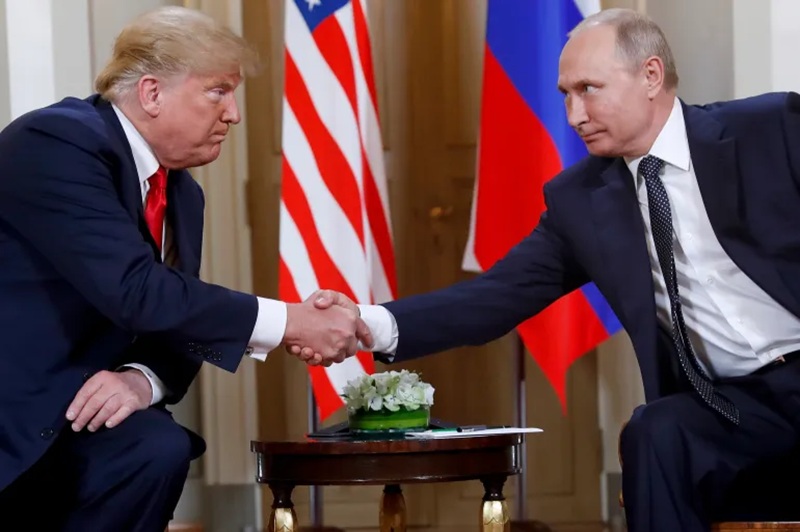
President Donald Trump’s proposed peace plan for the Russia-Ukraine war, unveiled in late November 2025, aims to end the nearly four-year conflict through a U.S.-mediated framework. Initially a 28-point draft leaked to media outlets like Axios and Sky News, it has undergone revisions following negotiations with Ukraine and consultations with Russia.
The plan emphasizes rapid implementation, with Trump setting aggressive deadlines—such as a Thanksgiving 2025 ultimatum for Ukraine’s response—and positioning himself as the chair of a “Peace Council” to enforce compliance.
Critics, including Ukrainian officials and European leaders, have labeled it a capitulation to Russian demands, while supporters argue it provides Ukraine with unprecedented security guarantees in exchange for concessions.
As of December 10, 2025, talks continue amid tensions, with Ukraine presenting a revised counterproposal and Trump publicly pressuring Kyiv to accept terms, claiming Russia holds the “upper hand.” The plan draws partial inspiration from a Russian “non-paper” submitted to the Trump administration in October 2025, incorporating elements like territorial recognition and demilitarization.
Negotiations involve U.S. envoys like Steve Witkoff, Jared Kushner, and Secretary of State Marco Rubio, with meetings in Geneva, Florida, Moscow, and upcoming sessions in Brussels. Despite “meaningful progress” reported in early December, core sticking points—territorial integrity, NATO aspirations, and enforcement—remain unresolved.
Key Elements of the Plan
The original 28-point framework, refined to about 19 points after U.S.-Ukraine talks, includes the following major provisions based on drafts verified by multiple outlets.
Ukraine would recognize Crimea, Donetsk, and Luhansk as “de facto Russian” under U.S. acknowledgment, ceding additional eastern territories currently held by Kyiv beyond Russia’s November 2022 annexations. A ceasefire would follow along revised lines, with troop withdrawals monitored by the Peace Council.
This reverses longstanding U.S. policy on Ukraine’s borders. Ukraine’s armed forces capped at 600,000 troops up from Russia’s initial 100,000 demand but far below current levels. Permanent renunciation of NATO membership, enshrined in Ukraine’s constitution, with a non-aggression pact involving Russia, Ukraine, and Europe.
A Russia-NATO security dialogue and U.S.-Russia working group would address broader tensions. Security guarantees modeled on NATO’s Article 5, a commitment from the U.S. and European allies to treat a “significant, deliberate, and sustained” Russian attack on Ukraine as a threat to the “transatlantic community.”
This could trigger collective responses, including military intervention, though not explicitly obligated. Ukraine seeks firmer, verifiable mechanisms. Access to frozen Russian assets ~$300 billion globally for Ukraine’s rebuilding, but tied to a U.S.-Ukraine Minerals Deal granting American firms preferential rights to lithium, titanium, and graphite reserves valued at $200–500 billion long-term.
This offsets ~$175 billion in prior U.S. aid. Sanctions relief for Russia upon compliance, allowing reintegration into global markets. Full amnesty for Russians accused of war crimes; abolition of discriminatory policies against Russian speakers in Ukraine; potential wartime elections in Ukraine by mid-2026; and de-Nazification assurances.
The Trump-chaired Peace Council imposes sanctions for violations, with immediate ceasefire upon agreement and phased retreats. Implementation is envisioned as swift, with Trump aiming for a deal by early 2026 to redirect U.S. resources domestically.
Zelenskyy hints at wartime elections; Ukraine submits revised plan refusing NATO withdrawal and Donbas troop pullout. Trump criticizes Europe as “weak and decaying” in a Bild interview, urging Zelenskyy to “get his act together.” No breakthrough; next round in Brussels.
Zelenskyy views it “positively” but insists on no territorial cessions without a full ceasefire first, calling reconstruction funding “unfair” without Europe’s full buy-in. Public polls show 69% favoring immediate peace, but constitutional barriers and sovereignty concerns fuel resistance. Kyiv demands a personal Trump-Zelenskyy summit.
Putin calls it a potential “foundation” but criticizes unmet demands like full demilitarization. Kremlin sees it as validation of gains, though some points fall short. Leaders like UK’s Keir Starmer and France’s Emmanuel Macron decry it as undermining EU accession and sovereignty, accelerating plans to seize £100 billion in Russian assets independently.
Pope Leo XIV labeled it “unrealistic and dangerous,” warning of fractured U.S.-Europe ties. Trump allies praise cost savings ~$50 billion/year in aid; critics, including Democrats, accuse it of favoring Putin.
On X, sentiment splits: pro-Trump users hail it as pragmatic, while Ukraine supporters decry it as “surrender.” If adopted, it could stabilize energy markets saving U.S. households $500–$1,000/year but risks emboldening Russia, eroding NATO credibility, and sparking internal Ukrainian unrest.
Failure might lead Trump to cut aid entirely, shifting burden to Europe. This plan represents Trump’s “America First” pivot from open-ended support, but its success hinges on concessions neither side fully accepts.