DD
MM
YYYY

PAGES

DD
MM
YYYY

spot_img

PAGES

Home Blog Page 2145

How to Handle Sensitive Information in Job Applications and Interviews

0

We live in a world where organizations are constantly trying to obtain our personal information for various purposes, which we may or may not be OK with. Portions of the job application and interview process can be nerve-wracking because they involve some of that same information.

Below, we’ve created a guide to help you handle this transitional process. We’ll discover how to protect yourself from bad actors, what to include in a cover letter, when to bring up personal matters—and when not to.

Be Aware of Identity Theft Scams

At some point during the hiring process, you will need to share sensitive identifying information with your employer. This may include your full legal name, mailing address, a government ID such as a driver’s license or passport, your date of birth, and your Social Security number. Once hired, you may need to supply your bank account number for direct deposits of your paycheck.

This information, of course, is the same information that bad actors can use to steal your identity. Because of this, you should take some precautions early on in the application process to make sure you’re interacting with a legitimate business and not a scam artist.

You can protect yourself from scams when applying for jobs online by asking yourself the following questions:

  1. Where am I applying? It’s safest to apply on legitimate job search websites or the company’s official site. Be cautious of links you receive in an email or text message, especially if they are unsolicited. Examine the URL and the webpage itself carefully. Unusual spellings or typos could indicate a fraudulent site.
  2. What do I know about the company? If you’re unfamiliar with the company, do your research. Can you find a physical address? Do they have a website? What does the Better Business Bureau (BBB) have to say about them? Is there any internet chatter about hiring scams?
  3. Who contacted me? If a recruiter reached out to you, do your homework. If it was on LinkedIn, check the company’s page. How long has it been in use? Is all the information filled out? If it was by email, do they have a legitimate company email address (as opposed to Gmail or something similar)?
  4. Is it too soon? Are they asking for sensitive information before they’ve made you an offer?

Put Your Money Where Your Mouth Is

Some job listings include how much you can expect to make per hour or year, but others don’t. You might be anxious to get to the details of your salary but don’t rush it. Wait until you receive an offer or are prompted to comment on your expected salary.

In the latter case, try to be vague and describe a wide bracket. In this way, you retain the ability to negotiate later. You also won’t undercut yourself by proposing a very low salary or cause the hiring manager to move on to another candidate because your expectations are too high.

If It’s Personal, Keep It Concise—Or Don’t Mention It

There are certain things that you don’t have to announce. For example, you don’t have to advertise that you were fired from your last job or that you have a criminal record. If you’re asked about these things, be honest, but keep your answers short and concise. Don’t overshare.

Similarly, you may have a disability for which you will need some accommodation. You might have a career gap due to a personal tragedy or challenge. Or, you may have religious obligations or special circumstances that require flexibility or accommodation.

In any of these cases, consider carefully how much information is necessary. In the workplace, less is often more when it comes to sharing personal details. Communicate enough to explain the situation and request the assistance you need without oversharing.

Finally, keep in mind that you don’t need to talk about anything unrelated to the job during the hiring process. Your employer doesn’t need to know your age, health concerns, hobbies, marital status, religion, sexual orientation, or ethnicity.

Information About Previous Employers

At times, you may be asked about confidential or proprietary information concerning a previous employer. Sharing confidential or legally protected information could have legal ramifications.

Additionally, the interviewer may pose such questions as a test of your integrity. If you’re willing to protect a previous employer’s assets, you can be trusted to protect theirs—and vice versa. If you spill the beans, they will assume you can’t be trusted.

When asked about confidential matters, you can safely respond by confirming your association with the matter and then stating, “But the details are confidential.”

It can also be tempting to speak negatively about previous employers. Resist the urge. Doing so could reflect poorly on your attitude and work ethic.

Key Takeaways

The hiring process can be stressful, but when you think through how to handle your own personal information and that of previous employers, you’ll go into your interview feeling confident. You’ll also make a good impression and be that much closer to landing the job you want.
Hold Tight to These 3 Altcoins Under $1 for 100x Gains This Year

0

Investors are pivoting to low-cost altcoins with high-growth prospects as Bitcoin flirts with the $99,000 mark. Dogecoin (DOGE) and PEPE have stumbled recently, but DTX Exchange’s presale surge to $0.18 is turning heads across the crypto space. This hybrid platform’s fusion of stocks, crypto, and forex under one roof—with blockchain-backed transparency—could reshape how traders approach decentralized markets.

DTX Surges to $0.18 in Bonus Stage

Platforms like DTX, where retail and institutional traders share the same powerful tools, from 1,000x multipliers to copy-trading strategies—all backed by blockchain security—are gaining traction. DTX Exchange is hitting its stride, with tokens now priced at $0.18 in a bonus-stage presale that’s already pulled in $15.1 million. Early investors have watched its value climb 800% since the first stage, driven by demand for its 120,000+ asset offerings and capped supply of 475 million tokens.

What sets DTX apart? Think fractional trading of ETFs, stocks, and forex alongside crypto, all wrapped in enterprise-grade analytics. Its upcoming NFT marketplace for trading licenses and regulatory compliance across 41 jurisdictions further enhances its appeal, attracting both seasoned traders and newcomers. Audits by firms like SolidProof add credibility, while plans for tier-1 exchange listings later this year suggest institutional confidence. For traders tired of meme coin roller coasters, this might just be the best crypto to buy for balancing innovation with stability.

DOGE Dips 6% Amid Market Shifts

Dogecoin’s recent stumble—a 6% slide in 24 hours—hasn’t shaken its die-hard fans. While its price struggles, the coin’s charitable initiatives, like funding clean water projects and sponsoring NASCAR drivers, highlight its grassroots utility. Analysts note that such organic use cases could help it outperform purely speculative tokens in the long run.

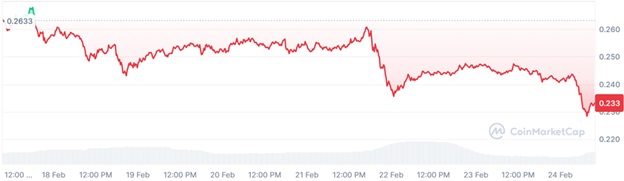
Dogecoin’s resilience amid market volatility continues to spark debate. Priced at $0.23, DOGE is down 34% monthly, but its $34 billion market cap and Elon Musk-fueled Twitter buzz keep it relevant. Rumors of a DOGE-powered X Payments integration and whispers of institutional accumulation hint at a rebound. As crypto analyst @MemeKing42 tweeted: “DOGE dips are buying opportunities—the people’s coin always bounces harder.”

Source: Dogecoin Price, Weekly Chart, CoinMarketCap

Still, Dogecoin’s reliance on social trends leaves it vulnerable. Unlike DTX Exchange’s tech-first approach, DOGE’s lack of staking mechanisms or burn protocols keeps it tethered to hype. Traders are now eyeing its $0.17 support level; a break below could signal deeper cuts, but a hold might spark rallies toward $0.40 by mid-2025.

PEPE Falls 6% in Latest Crypto Slump

PEPE’s 6% nosedive this week underscores the risks of meme coin mania. At $0.0000090, it’s down 40% in a month, with its $3.7 billion market cap clinging to nostalgia rather than utility. Recent listings on Binance Futures and liquidity incentives failed to lift spirits, leaving PEPE stuck near its yearly lows. Despite this, some analysts point to its deflationary tokenomics and upcoming staking features as potential catalysts for a price recovery.

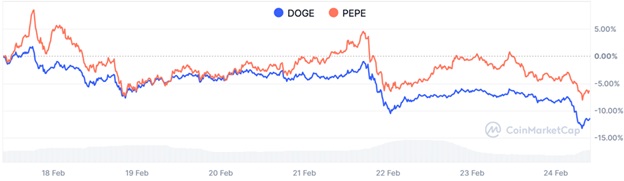
Source: Dogecoin Vs. PEPE Price Comparison, CoinMarketCap

The problem? PEPE lacks DTX Exchange’s roadmap clarity and practical vision. While the frog-themed token dances to meme culture’s tune, platforms blending DeFi with traditional assets are stealing the spotlight with real-world applications. Traders might gamble on PEPE’s volatility for quick gains, but long-term bets are shifting toward projects with actual use cases and sustainable growth potential.

Conclusion

DOGE and PEPE remind all investors that meme magic fades, but hybrids like DTX Exchange could bridge crypto’s wild west with mainstream finance. With presale momentum and a Q2 launch looming, DTX’s blend of security, diversity, and scalability makes it a top crypto to invest in for 2025’s evolving markets. As the crypto landscape matures, platforms like DTX Exchange that offer a seamless blend of traditional and decentralized finance are poised to lead the next wave of innovation.

Curious about DTX Exchange’s presale? Explore below to see why analysts call it this year’s sleeper hit.

Check the DTX Website

Buy Presale

Join Telegram Community

Discover How This Altcoin May Surpass Chainlink in the Upcoming Cycle

0

Chainlink (LINK) has grown steadily this first quarter, and that has drawn investors’ eyes as well as sealed its standing as one of the best performers in the altcoin sector. But a new altcoin called FX Guys ($FXG) has appeared as a potential rival, shocking investors with an outstanding performance. Having raised over $4.3 in an ongoing presale, analysts strongly reveal that FXGuys may surpass Chainlink in the upcoming cycle.

FX Guys has become more popular in the crypto space and social media platforms, as it offers users numerous opportunities to boost their portfolios. FXGuys stands among the leading blockchain trading platforms by featuring a trade-to-earn model and trader funding program alongside a staking mechanism. With a price discount at $0.05 alongside a projected 200% growth upon launch, FX Guys show signs of dominating the market soon.

This article reveals the factors contributing to the growth of FX Guys and why analysts believe it could surpass Chainlink in the upcoming cycle.

>>>JOIN FXGUYS HERE<<<

Chainlink (LINK): Price Surge Sparks Optimism Despite Falling Trading Volume

The price of Chainlink has started to match market performance after persistently falling behind. LINK rose by 8% in a few days according to data from CoinMarketCap. The price increase positioned LINK within the top 10 cryptocurrencies.

The recent market surge increased the market capitalization to approximately $16.4 billion. Despite its rising performance LINK, the prices are not very encouraging due to the low trading activity. The trading volume has decreased by 36% within this short period which raised doubts about the future of LINK and its ranking in the market.

FX Guys ($FXG): Surging Presale and Staking System Set to Disrupt Crypto Markets

Analysts strongly believe that FX Guys will outperform Chainlink in its upcoming market cycle and this is following the impressive presale performance. With over $4.3 million raised in a short time, FX Guys solidified its position as one of the best altcoins for the next bull run. Also, with the swift advancement to stage three and discount offer at $0.05, both new and top traders are assured massive returns in 2025.

Early investors who got in at the beginning have already seen a 66% profit as the price went up from $0.03 to $0.05. Analysts foresee another jump to $0.10 upon launch, giving early adopters a 200% return on investment and confirming its status as one of the best altcoins for the next bull run. This accomplishment can be attributed to its cutting-edge features that can enhance investors’ portfolios.

One of the unique features of FXGuys is the staking system which allows users to stake $FXG tokens and earn  20% of the broker’s trading revenue according to the trading volume. The stakers get double-digit APY, and rewards come from spreads and trading fees, and also trader funding programs.  The model stands out as the best crypto coins to buy now because it provides consistent passive income alongside building  FXGuys’ ecosystem.

FX Guys ($FXG): Empowering Traders with Funding and Crypto Rewards

Due to support from brokerage services, FXGuys creates a fantastic trading environment through its dependable multi-functional trading tools. By adopting widely used blockchain trading platforms such as Match-Trader, cTrader, and  DXtrade along with MT5, FXGuys allows users to work in their preferred context. The flexibility coupled with the strengthened structure of $FXG puts the confidence of the user and provides a stage for consistent results.

The trade-to-earn program awards By distributing $FXG tokens to traders for any market activities through the trade-to-earn program, the platform boosts liquidity and market activity. These tokens can be redeemed for valuable benefits such as lower profit targets and higher drawdown limits, making $FXG the best crypto coin to buy now.  These unique characteristics position FX Guys strongly to surpass LINK in the market phase.

>>>JOIN FXGUYS HERE<<<

Final Thoughts

As FX Guys presale surprised the market with an impressive performance, analysts are confident that it may outperform Chainlink in the next cycle. With the raise of over $4.3 million and a quick climb to stage three, alongside unique features like a no-tax policy, trade-to-earn model, and excellent customer service, this presale token shows signs of dominating the market soon. The FX Guys BETA platform is now available for a free trial, so users can gain early access and also navigate its unique features before the next big leap.


To find out more about FXGuys follow the links below:

Presale | Website | Whitepaper | Socials | Audit


MultiChoice Announces Fresh Price Hike for DStv, GOtv Subscriptions Over Rising Operational Costs

0

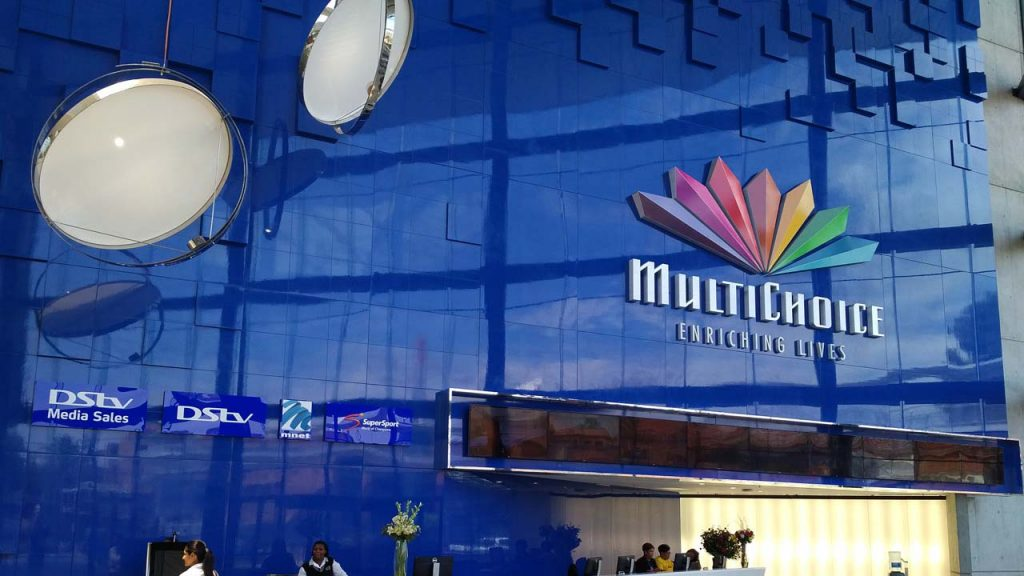
MultiChoice Nigeria, the leading provider of pay-TV services in the country, has announced another significant increase in subscription prices for DStv and GOtv, effective March 1, 2025. The company, in a statement sent to its customers on Monday, cited rising operational costs, inflation, and the depreciating naira as the primary reasons for the latest price hike.

This increase comes less than a year after its last price adjustment, and like in the past, it is expected to face strong resistance from Nigerian consumers.

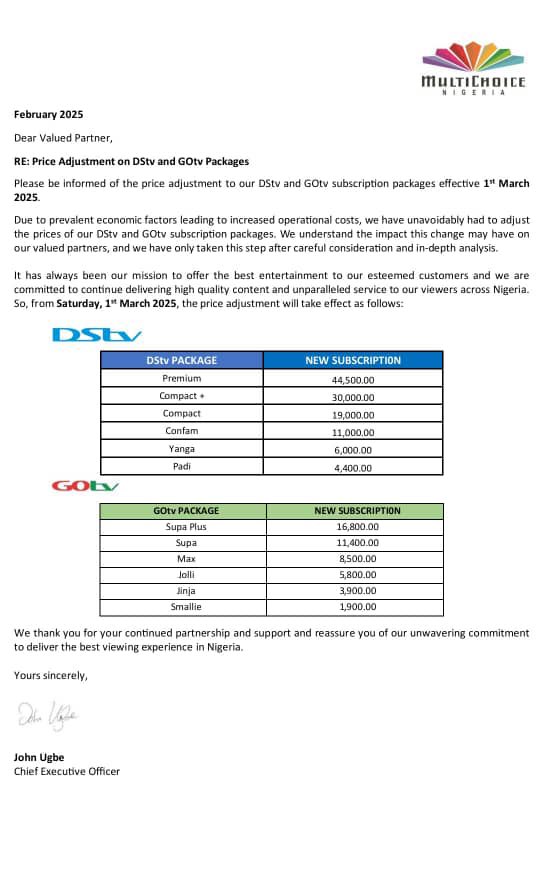
The new pricing structure will affect all DStv and GOtv subscription packages, with some experiencing as much as a 20 percent increase. The DStv Compact bouquet will rise from N15,700 to N19,000, while the Compact Plus package will increase from N25,000 to N30,000. Subscribers on the Premium plan will now pay N44,500 instead of N37,000.

The GOtv Jinja package will now cost N3,900 instead of N3,600, while GOtv Plus will increase from N4,850 to N5,800. The GOtv Max package will rise to N8,500 from N7,700, and the GOtv Supa package will cost N11,400 instead of N10,500. The highest-tier GOtv Supa Plus package will now be N16,800, up from N15,700.

In its statement, MultiChoice said the decision is to boost its service to subscribers.

“Dear Customer, please note that effective 1 March 2025, there will be a price adjustment on all DStv packages. This is to enable us to continue to offer our customers world-class homegrown and international content, delivered through the best technology,” it said.

The company has long argued that its price hikes are necessary to maintain quality programming, pay for satellite maintenance, acquire content rights, and manage increasing operational expenses in Nigeria.

According to MultiChoice, three major factors influenced its latest decision to raise subscription prices:

  1. The depreciating naira: The steady decline in the value of the naira against the US dollar has made it more expensive to acquire foreign content, satellite bandwidth, and broadcast licenses, which are all paid for in dollars.
  2. Inflation and rising costs: Nigeria’s inflation rate, currently at record highs, has significantly increased the cost of doing business, including staff salaries, energy bills, and maintenance expenses.
  3. High costs of content acquisition: Broadcasting rights for English Premier League, UEFA Champions League, and major global entertainment programs continue to increase, forcing MultiChoice to spend more to maintain its exclusive content library.

However, Nigerian consumers have historically resisted price hikes by MultiChoice, arguing that the company abuses its dominance in the pay-TV industry by implementing frequent and unjustified increases.

As expected, the latest increase has ignited anger among subscribers, many of whom are already struggling with economic hardship, high living costs, and stagnant wages. Social media platforms have been flooded with complaints and calls for action against MultiChoice, with some subscribers threatening to boycott the service or switch to cheaper streaming alternatives.

A common complaint among users is that despite the frequent price increases, MultiChoice has not significantly improved service quality. Customers continue to face issues such as signal interruptions during bad weather, poor customer service response, and unresolved subscription payment glitches.

This dissatisfaction has fueled renewed calls for government intervention, with some urging regulators to step in and either regulate pricing or introduce competition to break MultiChoice’s perceived monopoly.

MultiChoice is not new to backlashes emanating from price adjustments. Since 2016, the company has been on and off with Nigerian lawmakers, questioning the frequency and justification of its tariff increases. The lawmakers at one time, proposed the pay-per-view option.

Last year, a Federal High Court in Abuja, ordered the stoppage of MultiChoice’s planned tariff increase. However, the company defended its decision by citing the free-market economy, arguing that it had the right to adjust prices based on market realities.

Given the history of resistance, it is highly likely that the latest price increase will be challenged again—either through court cases, consumer advocacy protests, or fresh legislative hearings. However, the effectiveness of such actions remains uncertain, as MultiChoice has successfully defended past increases by pointing to Nigeria’s deregulated economy and the cost of maintaining premium content.

With each price hike, more Nigerians are exploring alternative entertainment options, including streaming services like Netflix, Amazon Prime, and YouTube, which allow users to watch content on demand. Some are also turning to internet-based IPTV services, many of which provide live TV at a lower cost. Others resort to illegal streaming websites, which, despite being against copyright laws, continue to attract users looking for free content.

Given Nigeria’s economic instability and currency volatility, it is expected that MultiChoice will continue to increase prices in the coming years if the rising consumer dissatisfaction and increasing competition from streaming platforms don’t force the company to rethink its pricing strategy.

Central Bank of Nigeria’s Policy Shift on Virtual Assets: A New Era For Nigeria’s Crypto Market

0

The end of the year 2023 marked a significant moment for Nigeria’s crypto market, following the shift in policy by the Central Bank of Nigeria (CBN), after it lifted a two-year restriction on crypto assets transactions.

Recall that in a circular dated February 5, 2021, the CBN directed all banks to desist from transacting in with entities dealing in cryptocurrency. The apex bank also directed banks to close accounts of persons or entities involved in cryptocurrency transactions within their systems.

Following the recent reversal in policy, the CBN noted that it was spurred by current global trends in crypto transactions, which have shown the need to regulate the activities of virtual asset service providers (VASPs).

The new policy mandated that VASPs would need to be licensed by the Nigerian Securities and Exchange Commission (SEC) to engage in the crypto business. By introducing guidelines for financial service providers working with VASPs, the CBN has signaled a move toward structured regulation. These guidelines are expected to bring much-needed clarity to the digital assets market, addressing concerns related to security, governance, compliance, and oversight. As a result, the formalization of the sector is anticipated to boost investor confidence, reduce the perceived risks of crypto transactions, and foster broader adoption of virtual assets in Nigeria.

Fast forward to 2024, The Nigerian Securities and Exchange Commission (SEC) granted provisional licenses or “Approval-in- Principle” to two cryptocurrency exchanges, Quidax and Busha, as part of its accelerated regulatory incubation program (ARIP). The ARIP was created to onboard firms which had commenced operations prior to the release of the rules on virtual asset service Providers in May 2022.

This means that Quidax and Busha are now part of an ARIP cohort as digital asset exchanges. The cohort also comprises four digital asset offering platforms and one digital asset custodian. The digital asset offering platforms are Trovotech, Wrapped CDC, HousingExhange, and Dream City Capital. The one digital asset custodian is Blockvault Custodian. The SEC outlined the commission’s commitment to fostering innovation while ensuring investor protection and market integrity.

The introduction of these licenses is part of a broader regulatory framework designed to bring order to the previously ambiguous crypto space in Nigeria. It also emphasized that the program aims to balance innovation with necessary regulatory safeguards, creating a secure environment for both investors and industry participants. This move is particularly noteworthy considering the history of regulatory challenges faced by crypto exchanges in Nigeria.

Over time, the structured regulatory approach will help establish standardized operational practices, enhance security protocols, and improve investor protection. This will not only benefit fintech firms operating in the crypto space but also provide them with greater legitimacy and access to financial services, enabling business expansion. Despite previous restrictions, Nigeria’s virtual asset economy has remained resilient, and these new regulations are set to fuel further growth.

Notably, one of the most significant developments following the CBN’s policy shift, is the announcement by the Africa Stablecoin Consortium (ASC) to launch its stablecoin, cNGN, in Q1 2024. ASC has been accepted into the CBN’s regulatory sandbox to conduct a pilot for the stablecoin, which will be pegged 1:1 with the Naira.

Designed to facilitate seamless cross-border transactions, CNGN is well-positioned for accelerated adoption under the new regulatory framework. The CBN’s transition from an outright ban to a nuanced regulatory approach highlights its recognition of the potential benefits of virtual assets. As regulations continue to evolve, their impact on Nigeria’s crypto landscape will be closely watched, with expectations of a more structured, secure, and thriving digital asset ecosystem.