DD
MM
YYYY

PAGES

DD
MM
YYYY

spot_img

PAGES

Home Blog Page 2150

The technologies that power up the online trading industry

0

Online financial trading is a giant industry that depends on modern technologies the most. Without proper computers and software, coupled with a fast internet connection, it is impossible to provide modern financial services. Technologies also enable traders and users to use financial services worldwide, no matter where they are located, and recent trends for AI and automation will only increase our dependence on smart machines. Let’s overview and explain all the crucial technologies that power our modern financial trading industry to gauge their importance.

Trading platforms: the backbone of online trading

To access financial exchanges and buy and sell assets, users need technology that connects them to these exchanges. Such software are trading platforms and several advanced platforms power most modern online trading. The most prominent platforms include MetaTrader 4 &5, cTrader, TradingView, NinjaTrader, and so on. Without knowing how to use modern platforms, the profitability of FX trading online will suffer greatly. This software enables traders worldwide to analyze markets, trade financial exchanges, and stay ahead of the curve. MT4, MT5, and cTrader are used mainly for Forex trading and allow stocks, FX pairs, metals, and indices. TradingView is an online trading platform that supports many different asset classes and comes with a large database of indicators both built-in and published by other users. NinjaTrader is a dedicated trading platform for futures trading which requires different features. These platforms are super popular among traders as they allow custom indicators and automated trading systems or Expert Advisors (EAs). Proprietary trading firms have become popular lately and developers have started working to develop dedicated trading platforms. Popular platforms include DXTrade, TradeLocker, Match-Trader, and so on. This tech supports everything including systems with printable receipt invoice templates.

Algorithmic Trading and AI-Powered Strategies

AI has become an integral part of the modern online trading industry, with many platforms integrating it into their interface and brokers starting to adopt AI for chatbots and automated trading purposes. AI and machine learning algorithms allow traders to enhance execution by automating decision-making based on data patterns. However, AI algorithms are not cheap, and they are mostly deployed by large hedge funds in high-frequency trading (HFT) robots. HFT and AI-driven bots can execute trades at lightning speed which is impossible for human traders. The Algorithmic trading market is growing fast and will reach almost 3.1 billion USD in 2023. Despite being highly accurate and having the potential to rescue human error, algorithms also carry risks like market volatility and system failures. Any bug can seriously impact final trading earnings and this is why algorithms are often deployed by large companies and rarely by retail traders.

APIs and Software Integration in Online Trading

APIs or application programming interfaces enable seamless connectivity between traders, brokers, and liquidity providers or exchanges. Popular APIs facilitate real-time data access and trade execution, which are widely used by developers to connect their Python trading bots with exchange data and make profits. Custom-built software helps traders manage their risks, automate trades, and optimize their strategies. APIs are especially powerful in crypto trading where many AI trading robots are developed using Python. Trading robots later use API calls with top executives to connect their robots with the exchange’s live price data and send trading orders for execution.

Blockchain and Security in Online Trading

Blockchain is a new addition to the trading industry and crypto traders are trying to make profits by speculating on digital currencies. This technology is new and has great potential to enhance trading transparency as it provides immutable transaction records. Cryptographic security and decentralized finance (DeFi) solutions strengthen security and decentralize trading. These innovations prevent fraud, offer unparalleled transparency, ensure safer transactions, and build a trustless financial ecosystem.

Big Data and Analytics

Data analytics enables hedge funds to form predictive models using big data and attain accurate market forecasts. Sentiment analysis tools measure investor behavior and real-time market data feeds enable fast decision-making. Advanced visualization tools also help these funds to interpret trends effectively.

Big data analytics requires serious computing power and is mostly implemented by equity funds, hedge funds, and large financial institutions that have enough financial resources to invest.

The future of trading technology

Quantum computing is the next step in trading technologies. Quantum computers are orders of magnitude faster than traditional computers and neural networks. Machine learning algorithms run on them will analyze big data not only much faster but could possibly produce novel trading strategies and insights which was impossible before. The AI-driven personal assistants will also refine strategy execution while decentralized platforms will continue evolving and will reduce reliance on intermediaries and enhance overall market accessibility.

RXS Crypto Price Prediction: This $0.20 Token is Poised to Push Past $14 Before 2025 Ends

0

Investors are eyeing Rexas Finance (RXS) for its innovative method of tokenizing real-world assets (RWA). With its final presale stage 89.54% filled and over $45.5 million raised, RXS is positioning itself for a strong market debut. At present trading at $0.20, this token has the potential to appreciate massively and surpass $14 before 2025. While many assets are still hard to trade, blockchain technology has improved finance. For instance, Rexas Finance is solving this issue by enabling fractional ownership of high-value assets such as real estate, commodities, and intellectual property. This change drives demand and prepares the market for a massive price rise after the company goes public. The company plans to go public with a stock price of $0.25 on June 19, 2025, which has investors salivating at the prospect of enormous returns.

The Engine Behind RXS: Innovation, Tokenomics, and Security

Despite Rexas Finance’s multiple revenue-generating methods, its core strength lies in developing an ecosystem that facilitates effortless asset tokenization. Any cryptocurrency wishing to attain long-term success must first have value-adding fundamentals and legitimate applications. With the provided blockchain technology, Rexas Finance trades assets with greater transparency and efficiency while eliminating conventional obstacles to entry.

These two components are necessary for security, credibility, and investor trust in Rexas Finance. Rexas Finance has fortified its credibility by completing a CertiK audit, which improves trust in its smart contracts and ecosystem. The platform’s multichain capability guarantees that users from different blockchains will be able to use it, thus broadening the potential audience. The initiative is set to transform the fast-evolving RWA sector by creating a safe marketplace for tokenized assets.

Rexas Finance has earmarked 1 billion RXS tokens with a well-planned tokenomics model to ensure sustained growth. 42.5% of tokens were sold in the presale, while additional allocations support staking rewards, marketing, and liquidity. This balanced distribution model minimizes inflation risks and encourages long-term holding, a key factor in driving value appreciation over time.

Click Here To Buy Rexas Finance (RXS) Presale

Rexas Finance also incorporates an advanced staking system, allowing holders to earn passive income on their investments. This feature further incentivizes long-term holding, reducing sell pressure and stabilizing prices. As more investors recognize the advantages of RWA tokenization, the demand for RXS is expected to rise, potentially driving its price well beyond initial projections.

Market Demand and Whale Accumulation Fuel Price Predictions

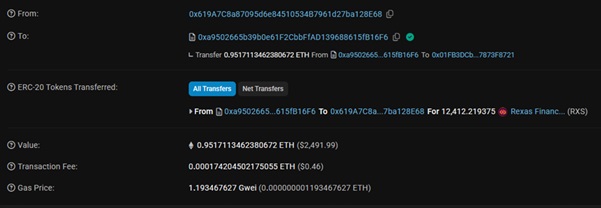
Institutional and retail interest in RWA tokenization is growing rapidly. By offering a transparent and liquid marketplace for traditionally illiquid assets, Rexas Finance stands out in an evolving landscape. Whale activity has increased significantly, with large investors accumulating RXS tokens in anticipation of post-listing growth. For example, an investor acquires over 12,000 RXS for $2,491. If demand continues to rise at this pace, supply constraints could drive the price higher than initial projections.

Source: Etherscan

Recent market data reveals that high-net-worth investors have been steadily acquiring RXS tokens, signaling confidence in its long-term potential. This pattern is often a precursor to significant price rallies, as institutional support enhances credibility and liquidity. As the broader crypto market recovers and adoption accelerates, RXS could see even greater momentum.

The increasing integration of RWAs into blockchain-based financial ecosystems provides another catalyst for growth. Institutional investors are seeking exposure to tokenized assets, and Rexas Finance is positioning itself as a leader in this sector. Analysts forecast that if market conditions remain favorable, RXS could break past $14 before the end of 2025, delivering substantial returns for early adopters.

Final Call: The Presale Countdown and the $1 Million Jackpot

As Rexas Finance enters its final presale stage, investor enthusiasm is reaching new heights. With only 10.46% of tokens remaining, demand continues to surge. The $1 million giveaway further amplifies interest, allowing participants to win $50,000 USD each while securing RXS at its lowest price. This marketing initiative has helped drive presale success, increasing visibility and attracting a global investor base. Apart from the giveaway, Rexas Finance has been successful due to its community-driven approach. Stakeholders are participating in conversations and providing valuable information, which helps the project’s ecosystem expand. This self-fueling growth enhances the investors’ confidence and guarantees a strong network effect after the launch.

Regulatory clarity surrounding tokenized assets is also improving, with more jurisdictions recognizing the legitimacy of RWAs. As compliance frameworks evolve, platforms like Rexas Finance that offer transparency and security will likely attract even greater institutional interest. This trend further demonstrates RXS’s value as a high-growth, in-demand asset for the future.

Conclusion

Rexas Finance (RXS) is gaining traction in the cryptocurrency sphere as it makes strides in transforming asset tokenization and gaining considerable investor interest. Rexas Finance progresses with nearly 90% of its presale already sold, and the current launch price of $0.25 is enticing investors looking to take a position before the price escalates. If adoption and demand continue on this trajectory, surpassing $14 by 2025 could be well within reach.


For more information about Rexas Finance (RXS) visit the links below:

Website: https://rexas.com

Win $1 Million Giveaway: https://bit.ly/Rexas1M

Whitepaper: https://rexas.com/rexas-whitepaper.pdf

Twitter/X: https://x.com/rexasfinance

Telegram: https://t.me/rexasfinance

Adam by Tyms, A Great AI Agent for Accounting, Is Introduced to Pastor Bakare

0

At Tekedia Capital, we congratulate our portfolio company, Tyms, for the progress it has made. It is leading the innovation race in the accounting technology space. Well done Chineye Ochem MBA, ACA, CFE  and Ibrahim Adepoju for executing the playbook.

Here, the Team introduced Adam by Tyms to the wonderful people of Citadel Global Community Church (CGCC) , Pastor Tunde Bakare and the whole community.

What is Adam by Tyms? “Adam by Tyms is an AI Accounting Agent that helps you with your manual Accounting tasks. As a business owner or an Accountant that manages multiple businesses, you can simply share your bank statements (in whatever format) with Adam, and instruct Adam to upload, categorise and post the transactions for you. This will be done for you in minutes, and you can go ahead to ask Adam by Tyms to generate your income statement. As an AI Agent, Adam by Tyms has been built to interact with Tyms and other existing Accounting software. ”

Learn more about the fastest growing accounting software in Africa here

Winter can Slash Electric Vehicles’ Range Drastically

0

Winter weather can really hit electric cars hard when it comes to range—sometimes cutting it by 20% to 40%, depending on the conditions and how you use the vehicle. Cold temps mess with battery chemistry, slowing down the reactions that generate power, and then you’ve got extra energy drain from heating the cabin and defrosting windows.

Studies—like one from AAA a few years back—found that at 20°F (-6°C) with the heater on, range can drop by over a third compared to 75°F (24°C). Real-world data backs this up: Tesla Model 3 owners in Norway reported losing 20-25% in subzero weather, and that’s with a pretty efficient heat pump.

It’s not just the cold itself. Snow and slush increase rolling resistance, and if you’re stuck in traffic or blasting the heat full-on, the battery takes an even bigger hit. Preconditioning helps—warming the battery and cabin while plugged in—but once you’re on the road, you’re at winter’s mercy. Newer EVs, like the latest Teslas or the Rivian R1T, have better thermal management, but it’s still a universal Achilles’ heel for the tech.

Gas cars lose efficiency too—think 10-20% from cold starts and idling—but they’ve got waste heat from the engine to lean on, so it’s less brutal. EVs? No such luck. That’s why range anxiety spikes in places like Minnesota or Scandinavia in January. What’s your angle here dealing with this yourself or just curious how it plays out?

Lithium-ion batteries—the workhorse of EVs—have been getting steady upgrades. Energy densities climbed from about 250 Wh/kg in 2020 to 300-350 Wh/kg in commercial cells today, thanks to tweaks like higher nickel content in cathodes (e.g., NMC 811—nickel-manganese-cobalt in an 8:1:1 ratio) and silicon-rich anodes over graphite. Tesla’s 4680 cells, rolling out since 2023, pack more punch—around 20% better range per charge—and cut production costs with a tables design. Cold weather still bites, but better thermal management—like heat pumps and smarter insulation—keeps losses closer to 15-20% now instead of 40% in older models.

Solid-state batteries are the big hype. They swap liquid electrolytes for solid ones (ceramics or polymers), promising 400-500 Wh/kg—think 600-800 miles of range—and faster charging (10-80% in 15 minutes). Toyota’s got a prototype slated for 2027 with a sulfide-based electrolyte, while QuantumScape’s version, backed by VW, hit headlines in 2024 with lab tests showing 80% capacity retention after 800 cycles. Cold performance? Potentially better—less ionic resistance—but they’re not road-ready yet. Cost and scaling are the bottlenecks; don’t expect them in your garage before 2030.

Then there’s lithium-sulfur (Li-S). It’s lighter, cheaper, and theoretically hits 500-600 Wh/kg, blowing lithium-ion away. A 2024 breakthrough from Monash University stabilized the sulfur cathode with a polymer binder, pushing cycle life past 200—still short of lithium-ion’s 1,000+, but progress. Winter resilience isn’t fully tested, but the high energy could offset losses. It’s years out, though—commercial bets are thin.

On the fast-charging front, CATL’s Shenxing Plus battery, launched in 2024, does 1 km of range per second of charge (600 km in 10 minutes) via a lithium phosphate tweak. It’s in Chinese EVs now, and cold-weather charging dips less—maybe 25% slower at 0°C versus 50% for older packs. Pair that with 800V architectures (Porsche Taycan, Hyundai Ioniq 5), and charging infrastructure’s catching up—350 kW stations are more common in Europe and the U.S. by 2025.

Sodium-ion’s the dark horse. No rare metals, dirt cheap, and decent at 160-200 Wh/kg—half of lithium-ion but enough for city cars. CATL’s version powers budget EVs in China since mid-2024, and it laughs at cold weather: minimal capacity loss below freezing, unlike lithium’s sulkiness. Range tops out at 250-300 miles, so it’s niche, but it’s a lifeline for affordability.

Recycling and sustainability are advancing too. Redwood Materials is pulling 95% of lithium, cobalt, and nickel from old packs in 2025, feeding it back into new cells. It’s not a performance boost, but it cuts reliance on mining, which matters as EV demand spikes—global sales hit 18 million in 2024, per IEA.

Winter-specific fixes? Beyond heat pumps, some startups—like Michigan’s Our Next Energy (ONE)—are testing dual-chemistry packs: lithium-ion for power, paired with a high-capacity cell that resists cold better. Their Gemini prototype in 2024 claimed 600 miles total, with only 10% winter loss. It’s not mass-market yet, but it’s a glimpse of tailored solutions.

Bybit Recovers $1.46B Hack Loss Through Loans, Whale Deposits And Ethereum Purchases

1

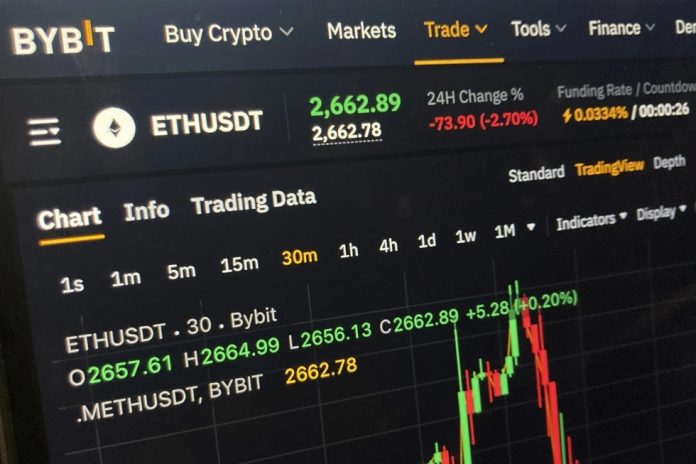
Bybit, a major cryptocurrency exchange, has reportedly recovered its $1.46 billion loss from a recent hack, through a combination of loans, whale deposits, and Ethereum (ETH) purchases, according to Lookonchain data.

This is coming after the company launched a recovery bounty program with rewards of up to 10% of stolen funds. Bybit called on the brightest minds in cybersecurity and crypto analytics to join the global hunt for the perpetrators of crypto’s largest heist in history. With a reward of 10% of the amount recovered, the contributors stand to share a bounty of potentially up to 140 million USD in value in the scenario of a full recovery.

The CEO revealed that since the hack, the exchange experienced the greatest number of withdraws that it has ever seen. He disclosed that they had a total number of more than 350k withdrawal requests, and so far, around 2100 withdrawal requests left to be processed. Overall 99. 994% of withdrawals were disclosed to have been completed.

Moving forward, on February 24, Lookonchain reported that Bybit received a substantial. 157,660 ETH (approximately $437.8 million) from a single address, likely through over-the-counter (OTC) transactions. Additionally, another 109,033 ETH ($304.1 million) came from an entity that purchased ETH from both centralized and decentralized exchanges.

Whales and institutions provided over $127 million in ETH as loans, with:

  • Bitget contributing 40,000 ETH ($106 million)
  • MEXC sending 12,653 stETH ($33.9 million)

Further contributions included:

  • 22,609 ETH ($61.9 million) from an OTC buyer.
  • 20,000 ETH ($53.7 million) from an unknown entity.
  • 10,000 ETH ($28 million) each from Mirana Ventures and a possible Fenbushi Capital-linked address.
  • Smaller amounts from users linked to “@yuchao” (2,499 ETH) and DWF Labs (2,200 ETH).

Acknowledging the support received towards the recovery of the hacked funds, Bybit wrote,

“Within 24 hours of the event, we were overwhelmed with support from some of the best people and organizations in the industry, and we do not take it for granted. We have shared a dark moment in crypto history, and we’ve proven we are better than the malicious actors. We want to officially reward our community who lent us their expertise, experience, and support through the Recovery Bounty Program, and our efforts to make this difficult lesson a valuable one do not stop here. Bybit is determined to rise above the setback and fundamentally transform our security infrastructure, improve liquidity, and be a steadfast partner to our friends in the crypto community”.

On Monday 24, 2025, Bybit CEO Ben Zhou announced on X that Bybit has already fully closed the ETH gap, noting that a new audited POR report will be published very soon to show that the crypto exchange is again Back to 100% 1:1 on client assets through Merkle tree.

Possible Links to Phemex Hack and Lazarus Group

Blockchain investigator ZachXBT identified on-chain connections between the Bybit hack and the recent Phemex breach. The attackers merged stolen funds from both incidents using the same addresses, a strategy previously employed by North Korea-backed Lazarus Group in multiple hacks.

On the other hand, some reports have suggested that the perpetrators could be North Korean state hackers, the Lazarus Group, who have been blamed for previous large-scale heists, including the $615m theft from the blockchain project Ronin Group in 2022.

Bybit took a decisive step by reportedly purchasing $742 million worth of ETH to restore its referes making it one of the largest post-hack recoveries in crypto history. This move has had a significant impact on Ethereum’s market price, contributing to a 6% recovery from the previous week’s decline.

Notably, the rapid response by Bybit has been praised as a strong example of crisis management, though some analysts note that relying on loans means the exchange still has debts to settle, raising questions about long-term financial health.