DD
MM
YYYY

PAGES

DD
MM
YYYY

spot_img

PAGES

Home Blog Page 2154

DOGE Price $0.40 Bounce-Back Is Coming, 1Fuel (OFT) On Track For 10x Post Presale, WIF Days Look Done?

0

Dogecoin is preparing for a strong comeback, with analysts expecting a bounce to $0.40. At the same time 1Fuel (OFT) is rising, as the post presale potential projects a 10x surge. Some are even wondering whether WIF’s best days are behind it now that investor interest is shifting.

Let’s explore why DOGE is set for a rebound, how 1Fuel is capturing attention, and what this could mean for the market.

Dogecoin (DOGE): Eyeing the $0.40 Mark

Dogecoin has been battling resistance levels while trading at $0.2420 and analysts say DOGE is ready to bounce to $0.40. Whale accumulation is a major factor in this DOGECOIN PRICE PREDICTION as large holders grow their positions while markets condition stabilize. Dogecoin’s use as a payment method also continues to be a key element driving its potential rally. Meme coins often don’t see much real world adoption, but DOGE has kept its spot as one of the most widely accepted cryptos for transactions.

A wildcard, however, is the Elon Musk factor, which tends to ride Dogecoin news alongside Musk’s public endorsements, and a positive nod could spur more retail buying. Additionally, DOGE can also benefit from anticipated market cycles because historically, DOGE thrives in a bull market and Bitcoin’s halving event is on the horizon, which could see DOGE rally alongside larger cryptos. According to technical analysts, $0.30 is a critical breakout level, which if DOGE passes means an imminent push to $0.40+ is likely. While DOGECOIN PRICE PREDICTION is speculative, its history of explosive moves make this rally conceivable.

1Fuel (OFT): 10x Growth Expected Post-Presale

Unlike DOGE, which is almost entirely based on hype, 1Fuel is building a cross-chain transaction network, which makes it a DeFi infrastructure play rather than a meme coin. The presale for the token has already proven successful, having raised over $2 million and offers a structured rewards system with up to 40% additional tokens for early investors. The massive market potential has attracted analysts who believe that 1Fuel has achieved up to 10x gains, as its cross chain liquidity solutions approach one of the biggest problems currently plaguing crypto: fast and easy asset transfers across blockchains.

Strong investor interest in 1Fuel, which usually translates to early adoption success, has been another indicator of presale demand which in turn has been a strong indicator of post launch performance. The project’s long term staking rewards provide a clear advantage over traditional meme tokens. As opposed to Dogecoin which is based on external hype, 1Fuel has a clear way for investors to generate passive income, making it a more favorable option to gain steady returns. As interest in the presale grows, investors are betting that 1Fuel’s DeFi solutions will put it on top of the pile once it goes live.

WIF Struggles to Keep Up

Dogecoin and 1Fuel are seeing momentum, but dogwifhat (WIF) is in decline. WIF trades around $0.6663 but comes with low volume and lacks a strong use case, rendering it difficult to keep long term interest. While the branding and community driven marketing did make the meme coin initially famous, that momentum has dried up. Whereas Dogecoin already has a dedicated following, WIF still hasn’t achieved sustainable value. Its future is uncertain without significant new adoption or major developments.

Conclusion

Dogecoin’s turnaround seems likely, while 1Fuel’s 10x potential is becoming increasingly difficult to ignore. It is already attracting investors who are keen to get early positions before the presale closes. Meme coins will always be a thing and have their place, but investors are heading toward projects that offer both speculation and true utility. Join the 1Fuel presale now and take advantage before the next big price jump.


For more information about the 1Fuel presale, visit the links below:

Website: https://1fuel.io/
Telegram:
https://t.me/Portal_1Fuel

Twitter / X – https://x.com/1Fuel_

40% of Kenyan SMEs Embrace Financial Technology in Operations

0

Kenya’s digital payments landscape is experiencing rapid growth, driven by increasing demand for digital transactions and growing recognition among SMEs.

A recent Visa survey reveals a positive trend evident in the high satisfaction rate (69%) among SMEs already accepting digital payments, who particularly value reduced fraud risk and increased transparency.https://www.tekedia.com/40-of-kenyan-sme…and-transparency/

This surge in digital payment reflects a growing awareness among Kenyan SMEs of the vulnerabilities inherent in traditional financial practices. While cash remains a convenient means of transactions due to simplicity and wide acceptance, the reliance on cash transactions exposes businesses to risks ranging from theft and misplacement to intricate fraud schemes.

In contrast, financial technology platforms offer a robust shield, providing a digital trail that enhances accountability and reduces the potential for illicit activities. The shift towards digital solutions is further evident in the survey, as 40% of SMEs already utilize financial technology, and the significant majority (68%) planning to invest in new digital payment technologies.

Nearly one in four (24%) cash-only SMEs plan to acquire POS systems, and 52% of cash-only SMEs intend to invest in new payment technology overall. This, combined with the 61% of existing digital payment users who plan to invest further, particularly in card payments (45%), points to significant future expansion.

Drivers of Fintech Adoption in Kenyan SMEs

Enhanced Security

Cybersecurity threats and financial fraud remain significant concerns for SMEs. Fintech solutions provide advanced security features such as encryption, multi-factor authentication, and real-time fraud detection, ensuring that businesses can conduct transactions safely.

Transparency in Transactions

Fintech platforms offer real-time tracking, digital payment records, and automated accounting solutions that reduce human errors and fraud. This transparency helps businesses maintain accurate financial records and fosters trust with stakeholders, including customers and investors.

Access to Digital Payments

With the rise of mobile money platforms like M-Pesa, SMEs are moving away from cash transactions. Digital payments not only reduce the risks associated with handling cash but also streamline financial operations, making business transactions more efficient.

Ease of Access to Credit

Traditional banking systems often have strict lending criteria that exclude many SMEs. Fintech companies provide alternative credit scoring models that assess businesses based on transaction history and cash flow, making it easier for SMEs to access credit.

Digital Payments Driving SMEs Growth in Kenya

Digital payments are crucial for SMEs digitalization, offering numerous advantages for Kenya’s businesses. These include increased revenue through access to a wider, increasingly cashless customer base; improved customer satisfaction due to faster, more convenient payment options; and reduced operational risks by minimizing cash handling and associated risks. Furthermore, digital transaction records provide valuable data that can facilitate access to financing, empowering growth!

Kenyan SMEs are already acknowledging the strategic importance of digital payments, with 77% of digitally enabled SMEs agreeing that adoption will drive growth. This is further underscored by the strong demand for secure B2B solutions (71%) and guidance on best practices (69%) among SMEs already accepting digital payments. Encouraging further investment by showcasing success stories and tangible ROl is crucial.

Moreover, digital payments are a gateway to broader financial inclusion, representing a crucial first step into the formal financial system for the unbanked, enabling access to services like remittances and government assistance. Transaction accounts increase the likelihood of utilizing other financial services, such as savings, credit, and insurance, empowering individuals and businesses. This is especially relevant considering that only 40% of SMEs currently utilize financial technology, highlighting the need for broader digital inclusion.

Finally, digital payments are a powerful engine for economic growth. Research reveals that transitioning from cash to digital payments can generate annual GDP gains of 1% to 2%. Globally, increased payment card usage (debit, credit, and prepaid) added $245 billion to real GDP between 2015 and 2019, across 70 countries and territories studied, each 1% increase in card usage correlated with an average annual increase of approximately $67 billion in consumption. In addition, a mere 5% increase in digital payments per year for five consecutive years could reduce the informal economy by 11-13% and boost tax revenue.

Nigeria’s Pension Industry Reaches Historic N22.51tn Milestone Amidst Policy Reforms

0

Nigeria’s pension industry recorded a remarkable surge in 2024, with total pension assets climbing to an unprecedented N22.51 trillion, marking an impressive 22.65% year-on-year increase from N18.36 trillion in 2023.

This growth, as revealed by the National Pension Commission (PenCom) in its unaudited pension fund portfolio report, is believed to be a reflection of the changing investment climate and also an evolving regulatory framework that continues to shape the industry’s trajectory.

The expansion was accompanied by a steady rise in Retirement Savings Account (RSA) registrations, which reached 10.58 million by the end of December 2024. This 3.84% growth, adding 390,899 new enrollees within the year, signals increasing participation in the Contributory Pension Scheme (CPS) amid rising awareness and regulatory enforcement.

Fixed Income Reigns Supreme

A deep dive into the pension industry’s portfolio composition reveals a strong inclination toward fixed-income investments, which accounted for 83.72% of total pension assets, amounting to N18.85 trillion. The preference for fixed-income securities, particularly federal government instruments, is largely attributed to their tax-exempt status and low-risk appeal.

Among the standout components of this asset class, federal government securities dominated with a staggering N14.11 trillion, representing 62.70% of the total pension fund. State government securities, however, remained a marginal allocation at N250.86 billion, a modest 1.11% share. Corporate debt securities held their ground with N2.25 trillion, making up nearly 10% of the portfolio.

However, not all fixed-income instruments witnessed gains. Commercial paper investments saw a dramatic slump, plummeting 38.67% from N262.79 billion in 2023 to N161.16 billion in 2024. The decline followed PenCom’s October 2024 suspension of commercial paper investments due to regulatory uncertainties for non-bank capital market operators. This restriction was eventually lifted after the Securities and Exchange Commission (SEC) intervened to provide clarity on investment guidelines.

Equities and Alternative Investments Gain Traction

Equities remained a growing asset class within the pension industry’s investment mix, with total equity holdings valued at N2.66 trillion, representing 11.81% of total pension assets. Domestic ordinary shares accounted for the bulk of this at N2.24 trillion, while foreign equities stood at N267.99 billion. Notably, private equity investments, though relatively small, reached N147.86 billion, highlighting a strategic shift toward diversified, high-return opportunities.

Beyond traditional asset classes, pension fund administrators explored alternative investments, channeling funds into infrastructure, real estate, and mutual funds to diversify risk. Infrastructure funds grew to N214.33 billion, while real estate investments reached N283.62 billion, reinforcing the industry’s commitment to broadening its asset base.

Fund II Maintains Lead in Pension Asset Allocation

When broken down by fund type, Fund II continued to dominate with N9.24 trillion, representing 41.02% of total pension assets. Fund II serves as the default allocation for contributors under 49 years, allowing exposure to equities, infrastructure, and other long-term, higher-risk investments. Fund III followed with N5.92 trillion, while Fund V had the smallest allocation at N731.4 million.

Meanwhile, the Retiree Fund (Fund VI), which adopts a more conservative investment approach focusing on capital preservation, stood at N10.48 billion.

Regulatory Reforms and Industry Leadership Changes

The pension industry’s expansion in 2024 coincided with significant policy shifts and leadership changes within PenCom. Notably, the commission reinstated investments in commercial paper after addressing concerns regarding the involvement of non-bank capital market operators.

Additionally, a major regulatory change will take effect on February 1, 2025, requiring the mandatory use of Bank Verification Numbers (BVN) for RSA registration and data recapture. This policy aims to enhance the security and integrity of the pension database, reducing fraud and identity duplication within the system.

Further shaping the industry’s landscape was the appointment of Omolola Oloworaran as acting Director-General of PenCom in 2024. Although she assumed office without Senate confirmation, Oloworaran has pledged to sustain the industry’s growth trajectory, expand CPS membership, and enhance pension coverage across the country.

With regulatory reforms taking shape and investment strategies evolving, the sector appears set for further expansion. However, sustaining this growth, which observers say depends on PenCom’s ability to balance risk and ensure compliance, is one of the biggest challenges facing the sector.

Risk and Success – Peter Thiel on Elon Musk (video)

0

Napoleon Bonaparte: “Impossible is the word found only in a fool’s dictionary”. Elon Musk does not pay a lot of attention to “risks”, and that mindset has made him multi-pioneers in many domains of markets and industries. And that brings my question: how is the awareness of risk influencing our ability to take action on things?

Risk, failure and modelling failure as a subset of success could be vectors which separate these category-king empire builders from the rest of us.

Credit: Aspen/Peter Thiel

Solana’s Price Faces Resistance at $200—Is It Time to Rotate Into DTX Exchange?

0

Solana has been on a rollercoaster, recently testing the crucial $200 resistance level. Despite its impressive run, SOL seems to be struggling to break past this psychological barrier, leaving traders wondering how long the token’s price troubles will last.

Meet DTX Exchange, a rising star in crypto that blends DeFi and TradFi into one powerful trading platform. Could moving to DTX be the smarter move, or will SOL finally break through? Let’s dive in and find out!

Solana Price Stuck at $200 – Will SOL Break Out or Break Down?

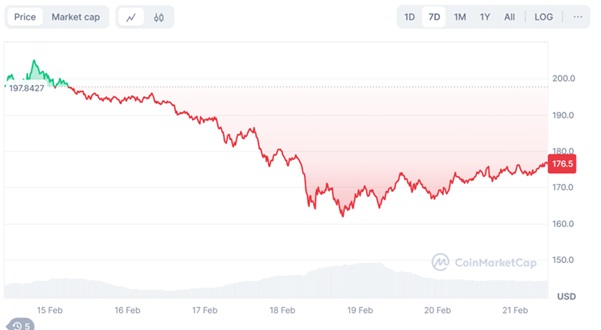
The Solana price has struggled around $200 recently. SOL fell to $167 after repeated efforts to break through this resistance. This price threshold has become a psychological barrier, with buyers straining to break through. Although positive earlier in the month, the new drop raises questions about whether the Solana price can continue rising or if a more significant correction is imminent.

Technical signs indicate $200 as key resistance. A breakthrough might spark a rally to $210 or higher. Analysts say failure to hold above $189 might bring the SOL price down to $183, perhaps causing further slumps. Market sentiment is mixed, with short-term profit-taking driving selling. Solana needs more bulls to recover positive momentum and break $200.

Source: CoinMarketCap

The Solana price remains a hot topic in crypto as traders closely monitor its potential recovery. Interest remains, as shown by the 24-hour trading volume of $89.94 billion, creating the conditions for a pump if market conditions improve.

However, pessimistic investors believe SOL might remain in this consolidation phase for the next few weeks, leading investors to consider alternatives like DTX.

DTX Exchange Gains Momentum – A Smarter Play as Solana Price Stalls at $200?

As the Solana price struggles to break past $200, investors are asking a crucial question: Is it time to explore new opportunities? Although SOL remains a strong contender, traders looking for profitable opportunities should consider DTX Exchange, an emerging platform with groundbreaking features. Its rapidly expanding user base and unique multi-asset trading model offer a fresh frontier for those seeking the next big thing.

Unlike Solana’s single-layer focus, DTX Exchange provides access to crypto, forex, equities, and CFDs, a game-changer in a market often divided by asset type.

The testnet already clocked 200,000+ transactions per second (TPS), demonstrating its ability to handle large-scale demand. Additionally, with over 700,000 holders and over $14.9 million raised in its presale, DTX is rapidly gaining traction among investors.

A key reason DTX stands out is its upcoming ETF trading feature, allowing users to trade tokenized ETFs even in jurisdictions with heavy restrictions. This feature is a step toward bridging traditional finance with DeFi, allowing traders to engage with institutional-grade assets. This is just like early DeFi projects, where innovation led to exponential returns for those who got in early.

The DTX token will give holders access to tokenized assets representing real-world commodities and financial instruments. This means investors will gain access to tangible and capital-intensive markets, bringing a level of diversification that few blockchain trading projects offer.

Notably, the live exchange is set to launch in Q2 2025. Early adopters have a prime opportunity to position themselves before the mainstream catches on.

While Solana battles resistance, DTX Exchange is quietly laying the foundation for the future of multi-asset trading. Will you be ahead of the curve or wait until the masses catch up?

Conclusion

As the Solana price faces resistance at $200, DTX Exchange emerges as a profitable alternative. Its cutting-edge features, real-world asset access, and booming user base have positioned DTX for growth. While SOL struggles to break out, savvy investors may find more significant opportunities in DTX’s multi-asset trading ecosystem. To learn more about this project, check out the links below:

Visit Website

Buy Presale

Join Community