DD
MM
YYYY

PAGES

DD
MM
YYYY

spot_img

PAGES

Home Blog Page 2181

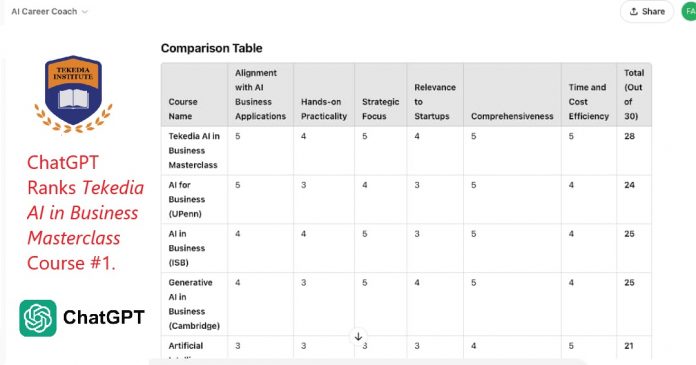
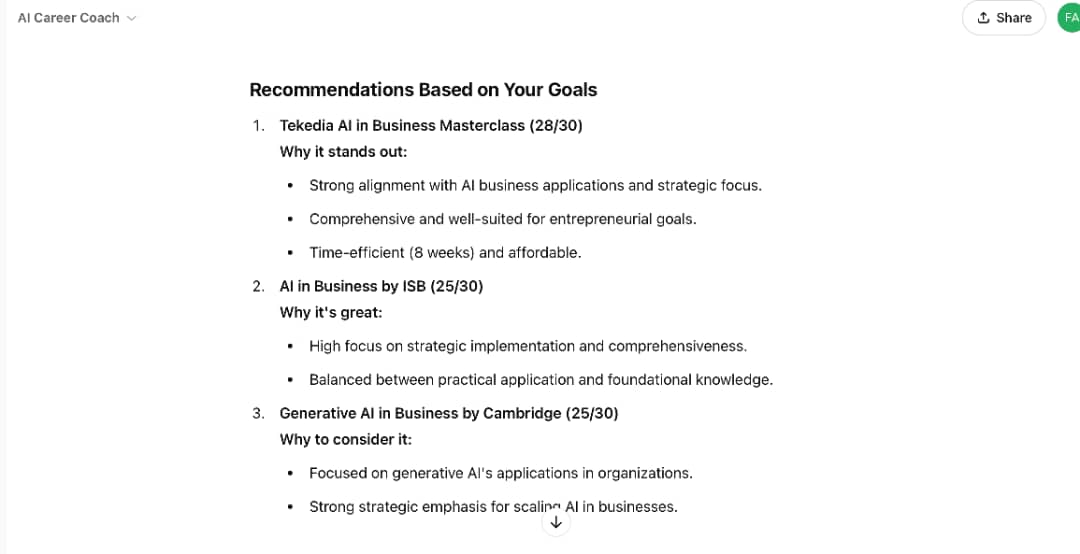
ChatGPT Ranks Tekedia AI in Business Masterclass Program #1

0

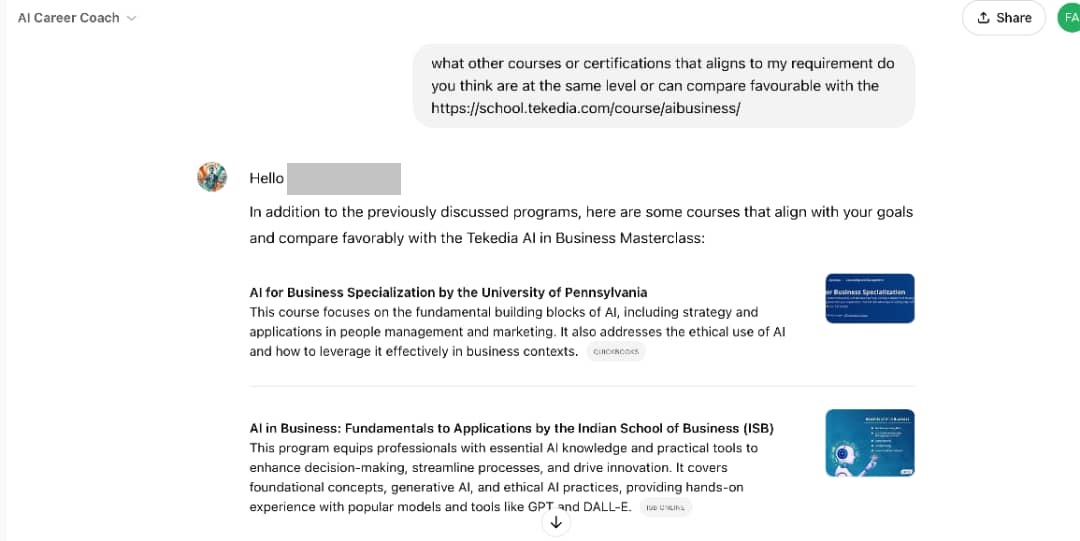
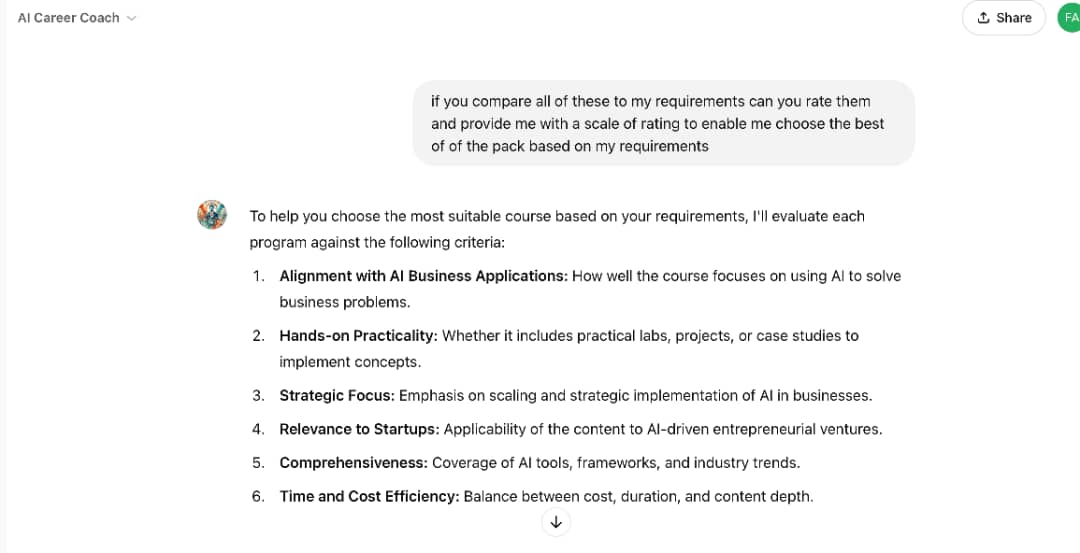
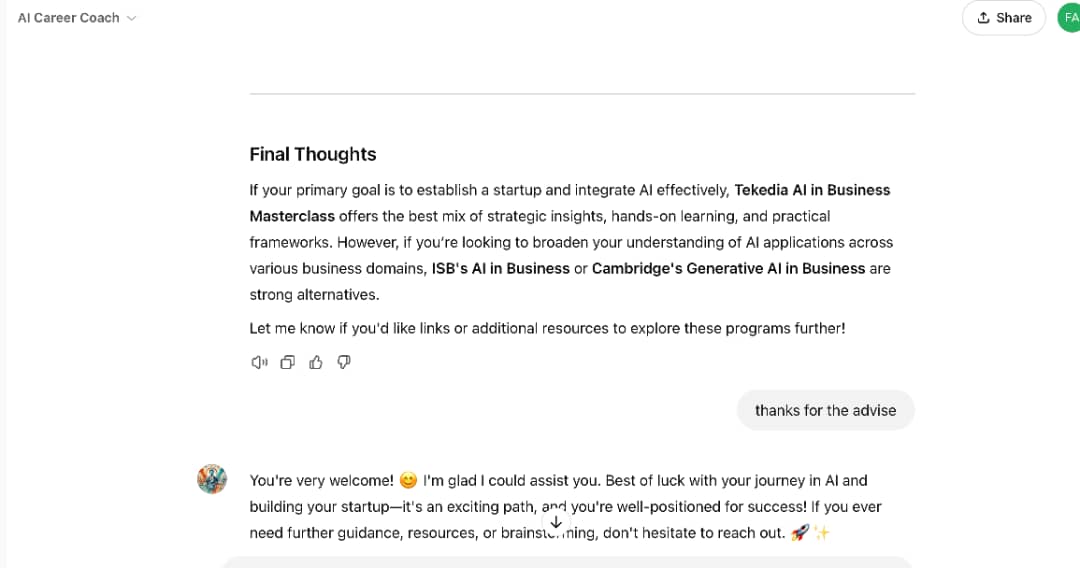
Good People, we have a small win today. A Learner from New Zealand reached out that ChatGPT ranked our Tekedia AI in Business Masterclass program the #1, ahead of programs developed by Cambridge, MIT and other peerless institutions. Sure, no one is comparing our unaccredited program, powered exclusively by the knowledge base of business executives, with iconic global knowledge institutions. But I will celebrate this win because it takes the killing of one leopard to be called a killer of leopards!

Tekedia Institute graduates more learners on business in Africa than any university in the continent, and we have the most diverse study body, by geography, than any university in continental Africa. That ChatGPT has recognized the quality of our program design is something we celebrate.

Our Tekedia AI in Business Masterclass program is refreshing and amazing because we do not just teach AI, we also bring the reason for AI, connecting it to mathematics and natural philosophy, and by the time you are done, you will be ready for the opportunities of the business of AI. By next week, we will add more modules to ensure you have core things you need to thrive in 2025 and beyond.

Take a look at Tekedia AI in Business Masterclass and see why ChatGPT likes it…click here https://school.tekedia.com/course/aibusiness/ 

( the ChatGPT chat below)

Winning the GenAI Monetization Game for Consumers

0

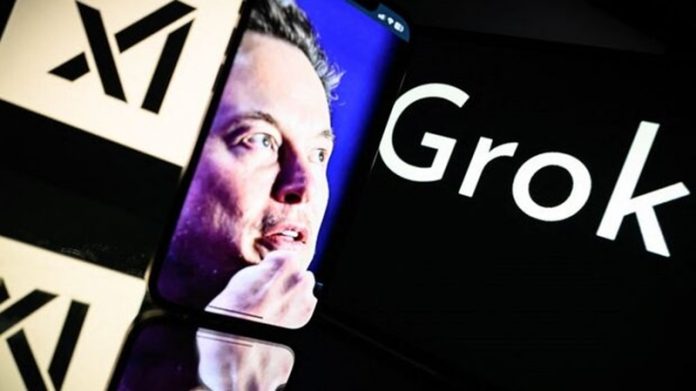
I am a Google One subscriber, and I have been using Google Gemini.  I am subscribed to Microsoft 365 and they have added their AI, Copilot, generously on top of it. Then there is Twitter which I pay to have access to space to write therein. Now, they want to bundle Grok 3, a partner AI system in the empire of Elon Musk, for Premium+ Twitter users

“Just hours after Elon Musk’s artificial intelligence company, xAI, unveiled its latest AI model, Grok 3, the social media platform X (formerly Twitter) has significantly increased the price of its Premium+ subscription plan, which grants users access to the latest AI model. The monthly price of Premium+ in the U.S. has now jumped to $50, while the yearly subscription fee has surged to $350.”

What is going on here? How sustainable is the pricing playbook we’re seeing in these tech ecosystems. Right now, I am not sure I will pay for a generative AI subscription solely for it. Rather, it has to be an add-on to something valuable.

And that brings how this generative AI monetization game is going to play out. With Microsoft powering my Office (Word, Excel, etc) solutions, a decent Copilot will do, and with that I do not need to look for an AI system to pay for. Yes, a sub-par Copilot within the Office ecosystem will do for me. A standalone AI chatbot like ChatGPT may not get my attention provided Copilot is just good enough. So, bundling wins this game for me.

That brings me to Twitter and xAL. Elon Musk understands that many people will not subscribe for whatever Grok 3 offers alone. But by baking it into Twitter, he has a chance since many people already pay for Twitter for non-AI related reasons.

This is the reason this AI opportunity may be gone before we think it is just starting, and the reason I challenge those in Africa with zero native platforms to re-examine their playbooks. Besides the technology, do you have something to co-bundle that AI with? Since fintechs have the most users in the continent, the path to AI penetration may actually go through fintech companies in Africa understanding that traditional banks will play safe.

Comment on Feed

Comment 1: The AI products will need hosts, and existing digital platforms already have some big advantage in that regard. Again, how many AI products would be enough for individual consumers? AI investments may never deliver big returns as standalone, but it’s something all major platforms must incorporate, just to remain competitive. The ones building AI-as-a-Service might be left to carry the empty can, after OpenAI and DeepSeek have scrambled off what is left.

Big investment, small returns. It’s what will define AI Era in the finance universe.

Comment 2: I think the market will segment into a
1)consumer ( Ai bundled with something else) ,
2)enterprise ( Custom AI models) &
3) power ( AI for deep research or analytics)
user categories; pricing models would evolve accordingly.
Imo , stand alone AI are for power users and for many businesses, i think ai agents would be the game changer long term.

X Hikes Premium+ Subscription Price to $50 Following Grok 3 Release

X Hikes Premium+ Subscription Price to $50 Following Grok 3 Release

0

Just hours after Elon Musk’s artificial intelligence company, xAI, unveiled its latest AI model, Grok 3, the social media platform X (formerly Twitter) has significantly increased the price of its Premium+ subscription plan, which grants users access to the latest AI model.

The monthly price of Premium+ in the U.S. has now jumped to $50, while the yearly subscription fee has surged to $350.

This marks the second major price increase in just a few months. In December 2024, X raised the Premium+ price from $16 to $22 per month, and now, in what appears to be a move to capitalize on the AI hype surrounding Grok 3, the cost has more than doubled again.

However, the pricing appears to be inconsistent across different parts of X’s platform. While the official support page states that Premium+ costs $50 per month, users attempting to subscribe have reported seeing different prices at different stages of the checkout process. Some have encountered a $48.40 per month charge, while others have seen a $40 per month charge, creating confusion about the exact cost.

SuperGrok Plan Introduced for Additional Features

Adding to the complexity, xAI has introduced a separate “SuperGrok” subscription plan within the Grok app, which will house some of Grok 3’s advanced features. While Premium+ subscribers will still get access to certain Grok 3 functionalities, such as “deep search” and “reasoning,” other features will be exclusive to SuperGrok users. The pricing for SuperGrok has not yet been disclosed, but it suggests that xAI is attempting to create a tiered pricing structure for different levels of AI access.

The timing of the price hike suggests that X and xAI are doubling down on AI as a revenue driver, banking on the growing interest in generative AI tools. Musk has aggressively expanded xAI since its founding in 2023, positioning Grok AI models as direct competitors to OpenAI’s ChatGPT and Google’s Gemini. The latest Grok 3 model has been touted as a major leap forward, with significant improvements in math, coding, and reasoning abilities.

Musk had previously teased Grok 3 at the World Governments Summit in Dubai, describing it as “scary smart” and highlighting its powerful reasoning abilities. He went as far as suggesting that Grok 3 might be the last AI model to surpass its own capabilities, hinting at the rapid advancements in AI self-improvement.

“This might be the last time that an AI is better than Grok,” Musk said.

He further revealed that the model was trained on a large amount of synthetic data, allowing it to reflect upon its mistakes and achieve greater logical consistency—an ability that has been a major challenge for AI systems.

Early testing results from Chatbot Arena, a crowdsourced AI ranking platform, reportedly placed an early version of Grok 3 ahead of competing AI models, though xAI has not provided independent verification of these claims.

While Musk is betting that users will be willing to pay a premium for access to advanced AI capabilities, the pricing inconsistencies and steep cost increases could deter some potential subscribers. For a platform already struggling with user retention and ad revenue losses, Musk’s AI-powered push could either revitalize X’s business model or alienate users unwilling to pay the higher fees.

Elon Musk’s xAI Unveils Grok 3, Claims It Outperforms OpenAI and DeepSeek

0

Elon Musk’s artificial intelligence startup, xAI, has introduced its latest AI model, Grok 3, which it claims surpasses offerings from OpenAI and China’s DeepSeek in early standardized tests on math, science, and coding.

The launch underscores Musk’s ambitions to challenge leading AI players amid an escalating race for dominance in the generative AI space.

At a demonstration streamed on his social media platform, X (formerly Twitter), Musk described Grok 3 as a massive leap forward compared to its predecessor.

“We’re very excited to present Grok 3, which is, we think, an order of magnitude more capable than Grok 2 in a very short period of time,” Musk said.

In addition to unveiling Grok 3, the xAI team also announced “Deep Search,” a next-generation AI-powered search engine, signaling the company’s push into the broader AI ecosystem.

The rollout of Grok 3 will begin immediately for premium X subscribers, while a separate subscription plan will be available for those who wish to access the model through a dedicated web and app platform, xAI confirmed.

Musk had previously teased Grok 3 at the World Governments Summit in Dubai, describing it as “scary smart” and highlighting its powerful reasoning abilities. He went as far as suggesting that Grok 3 might be the last AI model to surpass its own capabilities, hinting at the rapid advancements in AI self-improvement.

“This might be the last time that an AI is better than Grok,” Musk said.

He further revealed that the model was trained on a large amount of synthetic data, allowing it to reflect upon its mistakes and achieve greater logical consistency—an ability that has been a major challenge for AI systems.

Early testing results from Chatbot Arena, a crowdsourced AI ranking platform, reportedly placed an early version of Grok 3 ahead of competing AI models, though xAI has not provided independent verification of these claims.

While unveiling the product, Musk acknowledged that the model remains a work in progress but assured rapid improvements in the coming months.

“We should emphasize that this is kind of a beta, meaning that you should expect some imperfections at first, but we will improve it rapidly, almost every day,” Musk said.

He also confirmed that voice assistance capabilities would be introduced at a later stage.

Grok 3 Enters an Intensely Competitive AI Market

The launch of Grok 3 positions xAI as a serious challenger in the highly competitive AI space, which is currently dominated by OpenAI, Google DeepMind, and Anthropic.

Musk, who co-founded OpenAI in 2015, has since split from the company’s leadership over disagreements regarding its direction. His criticism has only grown louder, particularly after OpenAI transitioned from a nonprofit to a for-profit entity.1

In a recent high-profile move, Musk and a group of investors offered $97.4 billion to acquire OpenAI’s nonprofit parent company, an offer that OpenAI rejected. The feud between Musk and OpenAI CEO Sam Altman has further fueled speculation about Musk’s ambitions to create a direct OpenAI competitor through xAI.

OpenAI, for its part, continues to push forward with its own advancements. Last week, Altman provided a major update on the company’s roadmap for its next-generation AI models, revealing that GPT-4.5, codenamed “Orion,” will be the final model before OpenAI moves towards a more unified AI experience with GPT-5.

Meanwhile, Chinese startup DeepSeek recently shocked the AI industry by unveiling an open-source model that it claims can rival OpenAI’s o1 model, despite being trained using less powerful, more energy-efficient chips.

DeepSeek’s rise comes against the backdrop of U.S. sanctions that have restricted access to cutting-edge Nvidia AI chips in China. Despite this, DeepSeek has demonstrated that AI breakthroughs are possible without access to the latest Western hardware, which has broadened the competitive landscape.

xAI Expands Its Computing Power to Train Grok 3

To maintain its edge, xAI has significantly expanded its AI training infrastructure. The company had previously announced a Colossus supercomputer, powered by 100,000 Nvidia GPUs. On Tuesday, it revealed that it had doubled the size of its GPU cluster to train Grok 3, cementing its position as one of the most hardware-rich AI companies in the world.

While xAI’s massive computing power gives it an advantage, DeepSeek’s ability to achieve competitive results with lower-end hardware has led some experts to question whether brute-force GPU scaling is the most effective long-term AI strategy.

Some AI experts who spoke to CNBC praised DeepSeek for proving that efficiency can rival raw power, while others remain skeptical about whether its cost-saving methods can truly compete with well-funded giants like OpenAI and xAI in the long run.

Will Grok 3 Give Musk the Edge in AI?

Despite Musk’s ambitious claims about Grok 3’s superiority, xAI still has several hurdles to overcome.

First, xAI lacks the ecosystem reach of OpenAI and Google, whose models are deeply integrated into widely used consumer and enterprise applications. Microsoft, OpenAI’s biggest backer, has embedded GPT models into products like Windows, Office 365, and Azure, giving it a massive distribution advantage.

Second, OpenAI continues to lead in fine-tuning AI models for real-world applications, particularly in business and creative industries. While xAI markets itself as developing AI with a “truth-seeking” approach, it’s not clear how Grok 3 will be adopted by businesses and everyday users.

Elon Musk’s artificial intelligence startup, xAI, has unveiled its Grok 3 chatbot, calling it an “order of magnitude more capable” than its predecessor and the “smartest AI on Earth.” Its features will be rolled out to premium users of X — who now face higher prices — from Tuesday. Musk claims that in early testing, Grok 3 outperformed a model from China’s DeepSeek, as well as OpenAI, which is looking to fend off a takeover bid from Musk.

Huawei’s Trifold Smartphone Launches Globally as Company Aims for Int’l Market Comeback, Marking Victory Over US Sanctions

0
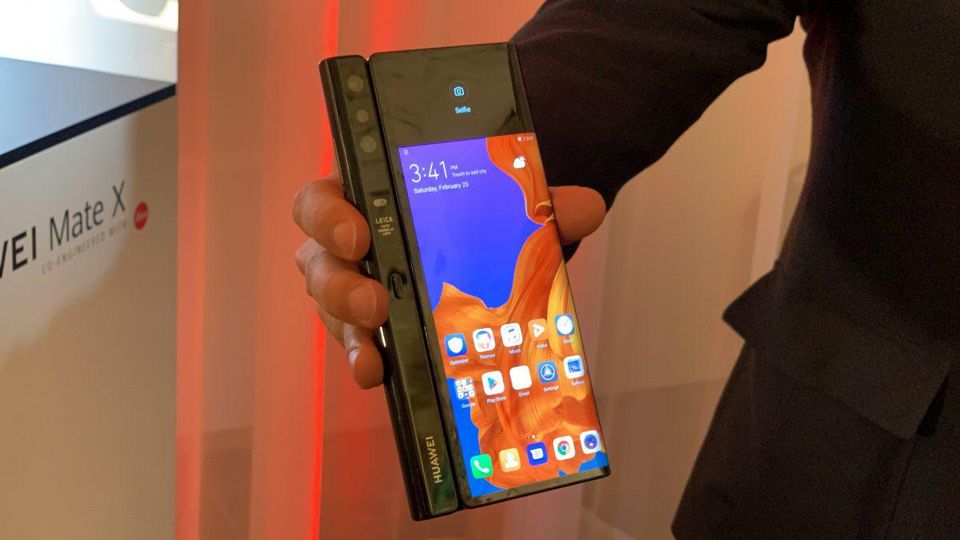
Huawei Mate X

Huawei has officially launched its highly anticipated Mate XT, the world’s first trifold smartphone, outside of China—a move that signals not just an expansion strategy, but a major step toward reclaiming its position in the global market after years of being crippled by U.S. sanctions.

The Mate XT, which was first released in China last year, comes with a hefty price tag of 3,499 euros ($3,660). Huawei has yet to specify the exact countries where the device will be sold, but it has advised consumers to look out for local announcements.

Unlike conventional foldable devices that only fold once, the Mate XT’s two folding points allow it to transform into single, double, or triple screens, making it a significant innovation in the smartphone industry. But beyond its hardware, the global launch of the Mate XT is also seen as a bold statement—Huawei has survived and adapted despite Washington’s efforts to cripple its technological advancements.

Huawei’s International Launch: A Sign It Has Beaten U.S. Sanctions

For the past five years, Huawei has been locked in a battle with the United States, which imposed sanctions aimed at cutting off the company from critical semiconductor technology, software, and global supply chains. The restrictions were part of Washington’s broader efforts to curb China’s technological rise and prevent Huawei from gaining dominance in 5G networks and advanced chip production.

While these sanctions initially led to Huawei’s market collapse outside China, its latest international expansion suggests that it has successfully found workarounds to keep producing cutting-edge smartphones. Huawei is proving that it has adapted to the restrictions, rebuilt its supply chain, and developed its own technological alternatives—effectively outmaneuvering U.S. sanctions.

Despite being cut off from Google’s Android operating system, Huawei has forged ahead with its own software ecosystem, HarmonyOS, and found ways to develop advanced chips for its smartphones—shocking industry analysts who believed the company would never recover.

Huawei’s troubles began in May 2019, when former U.S. President Donald Trump blacklisted the company, adding it to the Entity List—a U.S. Department of Commerce trade restriction that prohibits American firms from doing business with Huawei.

This devastating blow cut Huawei off from its most crucial suppliers, including Google, which provided Huawei’s smartphones with the Android operating system and access to the Play Store. It also severed ties with Qualcomm, which supplied key semiconductor chips for Huawei’s devices, and TSMC (Taiwan Semiconductor Manufacturing Company), the world’s leading chip manufacturer, which was producing Huawei’s Kirin processors.

Without these suppliers, Huawei’s smartphone business collapsed overnight. Global shipments plunged by more than 80%, and its once-dominant position in markets like Europe, Latin America, and Southeast Asia disintegrated.

The situation worsened in 2020, when the U.S. tightened restrictions, banning foreign companies from using American technology to supply chips to Huawei. This move effectively cut Huawei off from TSMC, forcing the company to halt production of its flagship Kirin chips.

With no access to high-end processors and a crippled supply chain, Huawei’s smartphone market share outside China shrank to just 0.3%, according to IDC (International Data Corporation).

How Huawei Fought Back, Developing Its Own Operating System and Chips

Rather than accept defeat, Huawei took radical steps to rebuild itself. The company made two key strategic moves that changed its fortunes: launching HarmonyOS as a replacement for Android and mastering semiconductor technology.

With no access to Google’s Android OS, Huawei was forced to create its own operating system, HarmonyOS. Initially launched in 2019, HarmonyOS was Huawei’s answer to being locked out of the global smartphone software ecosystem.

While it lacked Google apps—such as YouTube, Gmail, and Google Maps—Huawei invested heavily in building its own app store, the AppGallery, and developing partnerships with alternative app developers. By 2023, HarmonyOS had over 600 million users, making it the third-largest mobile operating system after Android and iOS.

Perhaps the most shocking part of Huawei’s comeback was its ability to develop an advanced 7nm chip, despite U.S. sanctions blocking access to cutting-edge semiconductor manufacturing. In August 2023, Huawei released the Mate 60 Pro, powered by a Kirin 9000s chip, developed by China’s SMIC (Semiconductor Manufacturing International Corporation). The chip demonstrated that Huawei had made major breakthroughs in semiconductor production—despite efforts by the U.S. to prevent China from accessing such technology.

This technological leap was seen as a symbolic victory, proving that Huawei was no longer dependent on U.S. technology to build high-end smartphone.

Huawei’s Mate XT Marks A Bold Step Back Into the Global Market

With the launch of the Mate XT, Huawei is not just showcasing its hardware innovation—it is making a political and economic statement. The company is signaling to the world that it has successfully overcome U.S. sanctions and can now compete again on the global stage.

However, there are still challenges. The biggest hurdle for Huawei’s global expansion remains the lack of Google services. Without access to Google Play, Gmail, and other critical apps, Huawei’s international appeal remains limited.

Neil Shah, a partner at Counterpoint Research, highlighted this issue, saying that the lack of Google still poses a major problem for the mainstream international market.

“Lack of Google still is a ‘gaping hole’ for mainstream international market especially those who will pay top dollar for a tri-fold hardware but which want to run Netflix or Google’s Play Store or the latest cutting edge GenAI Google Gemini features,” Neil Shah told CNBC.

This remains a key disadvantage compared to rivals like Apple and Samsung, which dominate the high-end smartphone segment.

Despite this, Huawei is betting that its high-end, premium devices—such as the Mate XT—will appeal to wealthy consumers who prioritize unique design and exclusivity over software compatibility.

Francisco Jeronimo, an analyst at IDC, told CNBC that Huawei sees the trifold device as a unique value proposition. Because of its high price, the company is targeting wealthy individuals who are more interested in showing off their wealth rather than having the absolute best user experience.

If Huawei can sell even half a million units of the Mate XT, it could generate nearly $1.5 billion in revenue—helping to fuel further expansion.

Can Huawei Win Back the Global Market?

While the Mate XT’s launch marks an impressive milestone, Huawei still faces long-term challenges in winning back international consumers. The lack of Google services remains a major roadblock, U.S. restrictions continue to evolve, and the company’s success will depend on whether HarmonyOS can attract more international developers and apps.

Nevertheless, the launch of the Mate XT proves that Huawei is no longer a company in retreat. Despite U.S. sanctions, the company has survived, innovated, and is once again making a global impact.

If Huawei can continue its comeback and regain a foothold in international markets, it would mark one of the greatest corporate turnarounds in modern tech history—proving that even the world’s most powerful sanctions could not stop China’s leading technology giant.