
DD
MM
YYYY

PAGES

DD
MM
YYYY

spot_img

PAGES

Home Blog Page 2243

Dissecting Taaooma’s Digital Trajectory

0

Taaooma’s journey on YouTube presents a fascinating case study in the dynamics of digital influence, where the interplay between video production and public search interest reveals critical insights about her growth, peak, and current trajectory.

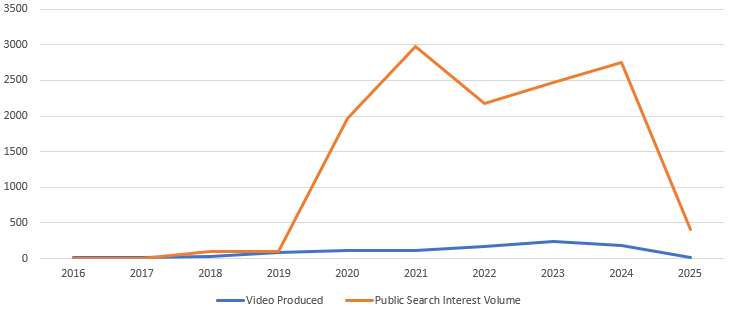
A striking observation is the disparity between the number of videos Taaooma produces and the public’s search interest in her content. Despite a steady output of videos, search interest has seen dramatic fluctuations, suggesting that demand has often outpaced supply. This raises an important question: is she fully leveraging her popularity, or does an untapped opportunity remain?

Exhibit 1: Video Production Versus Public Search Interest
Source: Taaooma, 2016-2025; Google Trends, 2016-2025; Infoprations Analysis, 2025

The pivotal moment in her career came in 2020 when both video production and search interest saw a remarkable surge. This year marked a breakthrough, possibly fueled by viral content, increased visibility, or favourable shifts in platform algorithms. It was a transformative phase, catapulting her from a niche comedian to a widely recognized digital star.

By 2021, Taaooma reached the zenith of public interest. The peak could be attributed to a viral skit, a strategic change in content approach, or heightened marketing efforts. With growing demand, she increased her video production, demonstrating an awareness of her rising popularity. However, this also poses a thought-provoking question—was this the optimal moment to scale content even further and fully capitalize on the momentum?

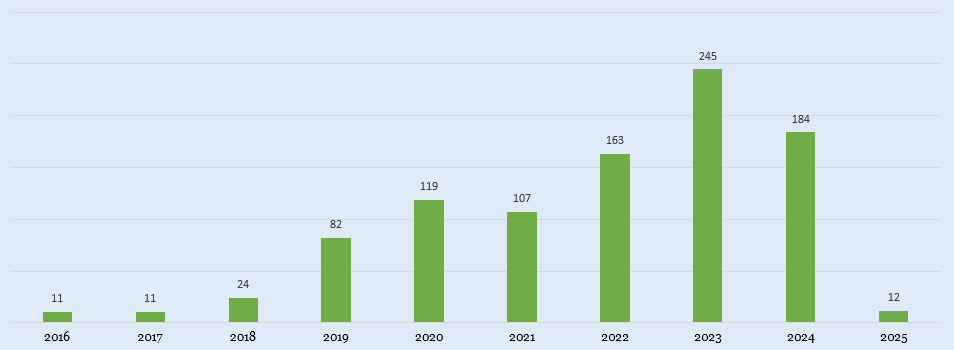
Exhibit 2: Video produced per year
Source: Taaooma, 2016-2025; Google Trends, 2016-2025; Infoprations Analysis, 2025

From 2022 onwards, a gradual decline in public search interest became apparent, even as video production remained stable. Several factors might explain this shift: market saturation, evolving audience tastes, the rise of new competitors, or even subtle changes in YouTube’s recommendation system. Despite this downward trend, Taaooma’s consistency in producing content underscores her dedication to her craft, reflecting resilience in an unpredictable digital landscape.

A closer look at her journey from the beginning provides a deeper context. Between 2016 and 2019, both video production and public search interest were minimal (see Exhibit 1). These formative years were likely spent honing her style, understanding audience engagement, and establishing a foundation for future success. Then came 2020, the turning point where search interest skyrocketed, accompanied by a modest increase in video uploads. This indicated a growing demand for her content, possibly spurred by heightened online activity during national events or strategic amplification of her brand.

In 2021, search interest hit an all-time high. This surge could have stemmed from a specific viral moment, a new approach to storytelling, or strong social media distribution. Recognizing this demand, she maintained a consistent stream of content, responding to audience enthusiasm. Yet, the subsequent years, (2022 to 2024), witnessed a decline in interest, hinting at a potential disconnect between audience expectations and content evolution. Our analyst points out that while her production levels remained steady, audience engagement softened, possibly due to a need for content reinvention or changing digital consumption habits.

Looking ahead, several strategic considerations come into play. The disparity between audience demand and content supply suggests that increasing video output could be beneficial. A more frequent release schedule, combined with strategic collaborations or episodic storytelling, might help reignite engagement. Moreover, adapting to changing audience preferences is crucial. Exploring new formats, refreshing characters, or integrating interactive elements could sustain interest and keep her content fresh.

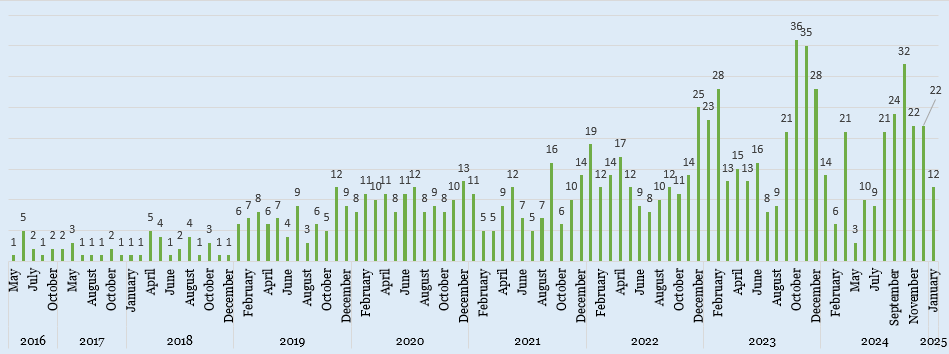
Exhibit 3: Video produced by month and year
Source: Taaooma, 2016-2025; Google Trends, 2016-2025; Infoprations Analysis, 2025

The competitive landscape also cannot be ignored. With the comedy skit niche becoming increasingly crowded, differentiation is essential. Experimenting with niche storytelling, cross-platform engagement, or blending humour with educational content might provide a new edge. Additionally, given YouTube’s ever-changing algorithm, visibility strategies must be refined. A focus on SEO-driven content, optimized timing, and stronger cross-platform distribution could improve content reach and discoverability.

Beyond YouTube, brand diversification presents another avenue for sustaining relevance. Expanding into merchandise, and forging high-profile collaborations could elevate Taaooma’s influence beyond the digital space. The key is to create a brand ecosystem that extends beyond one platform, ensuring resilience against fluctuating trends and algorithms.

Taaooma’s journey establishes the challenges of digital fame. Going viral is one thing, staying relevant is another. The unpredictable nature of digital content demands constant reinvention, and the coming years will determine whether she will reclaim dominance or shift towards a new creative path. Her trajectory serves as both inspiration and a cautionary tale for content creators. Our analyst notes that success isn’t just about riding a wave, but about learning how to create the waves yourself.


Amazon Increases AI Investments by 35% in 2025, as Tech Giants Ramps up AI Spending

0

Amazon, an American multinational technology company engaged in e-commerce and cloud computing, has announced plans to increase its investments in Artificial Intelligence  (AI) this year.

The tech giant disclosed plans to raise its capital expenditure to an estimated $105.2 billion in 2025, marking a 35% rise from the $78 billion spent in 2024. The bulk of this investment will be channeled into artificial intelligence (Al) capabilities within its cloud division, Amazon Web Services (AWS), according to CEO Andy Jassy.

During the company’s fourth-quarter earnings call, Jassy highlighted that the $26.3 billion spent in Q4 2024 signals a strong annual spending trend for 2025.

“We spent $26.3 billion in Cape in Q4, and I think that is reasonably representative of what you expect an annualized capex rate in 202. The vast majority of that capex spend is on AI for AWS”, he said on a call with investors.

Jassy tried to reassure investors on the call that the jump in spending would be worthwhile, calling it a “once-in-a-lifetime type of business opportunity.”

“I think that both our business, our customers, and shareholders will be happy, medium to long-term, that we’re pursuing the capital opportunity and the business opportunity in Al. We also have capex, that we’re spending this year in our stores business, really with an aim towards trying to continue to improve the delivery speed and our cost to serve”, he said.

The CEO further dismissed assumptions that decreasing Al’s costs would lead to reduced technology investments, comparing Al’s adoption to past tech revolutions like the internet and cloud computing.

Amazon has been investing in data centers, networking gear, and hardware to meet the vast demand for generative AI. This investment represents Amazon’s vision for collaborative technology that assists employees and improves safety and sustainability while expediting delivery speed.

Last year September, the tech giant announced the launch of several AI innovations that power users’ shopping and delivery experience. The company rolled out Vision-Assisted Package Retrieval (VAPR), an AI-powered solution that automatically identifies the right packages for drivers at each shop, which will be rolled out in 1,000 electric vans by Rivian in early 2025. VAPR projects green and red lights on packages at each stop, removing the need for drivers to manually sort them in the back of their vans.

Also, Amazon announced the roll-out of AI-powered shopping tools in its app. With this, shoppers can save time and energy shopping for products with Amazon’s new Al Shopping guides available in the Amazon Shopping app and mobile website. They help reduce the time customers spend researching before they buy by proactively consolidating key information they need with Amazon’s wide selection, making it easier to find the right product for their needs.

Amazon’s increase in AI spending this year comes as other tech companies are also spending big on AI. Recall that Google parent Alphabet said it expects to invest about $75 billion in capital expenditures this year. Last month, Microsoft said it planned to spend $80 billion in fiscal 2025 on the buildout of data centers to support AI workloads. Meta said it will spend as much as $65 billion on capital expenditures as it works to construct more data centers and computing infrastructure.

Just like the internet, AI is seen as the next big wave of technological transformation. With AI poised to reshape industries, big tech companies are showing no signs of slowing down investments. Instead, these companies are accelerating their investments, each vying for dominance in the next phase of AI-driven innovation.

IT Unemployment Rate Rises to 5.7% As AI’s Impact on Labor Market Grows

0

The rapid expansion of artificial intelligence (AI) is reshaping the tech labor market, leading to an increase in unemployment among information technology (IT) workers.

According to WSJ, the latest report from consulting firm Janco Associates, based on U.S. Department of Labor data, reveals a sharp rise in IT unemployment from 3.9% in December to 5.7% in January, well above the overall jobless rate of 4%.

The number of unemployed IT professionals rose from 98,000 in December to 152,000 in January, underscoring how automation and AI-driven transformations are affecting the workforce. This comes at a time when the broader U.S. job market remains resilient but slowing, with the economy adding 143,000 jobs last month, a lower pace compared to the previous two months.

The rise in IT joblessness is being driven in part by the increasing adoption of AI-powered automation, which is eliminating traditional roles within the industry. Many jobs that involve routine tasks—such as reporting, clerical administration, and even software development—are being streamlined or outright replaced by AI, reducing the need for human employees.

“Jobs are being eliminated within the IT function which are routine and mundane, such as reporting, clerical administration,” said Victor Janulaitis, CEO of Janco Associates. “As they start looking at AI, they’re also looking at reducing the number of programmers, systems designers, hoping that AI is going to be able to provide them some value and have a good rate of return.”

Tech companies, particularly Big Tech giants like Amazon, Microsoft, Meta, and Alphabet, are spending billions of dollars on AI-driven infrastructure, but this investment has not yet translated into increased hiring for IT workers. Instead, cost-cutting measures are being prioritized, and many firms are relying on AI-driven “cost avoidance”—a strategy where automation takes over tasks traditionally done by humans, eliminating the need to expand IT teams.

Tech Layoffs and Budget Cuts Compound Job Losses

January’s tech job losses were also compounded by corporate budget cuts, as companies began implementing cost-reduction strategies planned during last year’s fiscal cycle. Some of these reductions were based on economic uncertainties from 2023, leading companies to adjust their spending in anticipation of a challenging business environment in 2024.

Among the notable layoffs: Meta announced that it would cut 5% of its workforce through performance-based layoffs in the U.S. Workday, a major enterprise software provider, said it would cut 8.5% of its workforce as part of a broader restructuring effort.

However, there are still some areas within tech that continue to see hiring activity. Cloud security company Netskope, for example, is expanding its workforce in areas such as data engineering, data analytics, and cloud operations. Mike Anderson, Netskope’s chief digital and information officer, noted that his company is “making investments to drive productivity across the business.”

White-Collar Unemployment at Its Highest Since 2020

Beyond the IT sector, white-collar job losses are becoming a broader trend. According to Cory Stahle, an economist at the hiring website Indeed, job postings for knowledge-based positions have stagnated, while demand for in-person, skilled labor roles remains high.

“What we’ve really seen, especially in the last year or so, is a bifurcation in opportunities, where white-collar knowledge worker type jobs have had far less employer demand than jobs that are more in-person, skilled labor jobs,” Stahle said.

New job postings for software development roles on Indeed declined by 8.5% in January compared to a year earlier. However, Stahle pointed out that the trend may be stabilizing after the drastic tech-sector layoffs of 2023.

The Future of IT Jobs in an AI-Driven Economy

The ongoing wave of AI automation presents both opportunities and risks for the IT job market. While AI investments are driving unprecedented growth in certain areas, they are also eliminating jobs at a rapid pace. The current trend suggests that companies will continue to prioritize automation over workforce expansion, particularly in roles where AI can replace human labor efficiently.

However, emerging fields within AI and cybersecurity could offer new job opportunities for displaced workers. Companies investing in AI infrastructure, cloud security, and data engineering will require skilled professionals to manage, train, and oversee these systems.

Despite these possibilities, the immediate impact of AI on employment is more displacement than job creation, raising concerns about long-term job security in the tech industry.

Utility-Focused Tokens Like XRP and Rexas Finance (RXS) Shine Brighter Than Shiba Inu and Pepe Coin in 2025

0

In the constantly changing cryptocurrency environment, utility-oriented tokens are establishing themselves. Although meme coins such as Shiba Inu and Pepe Coin can raise enthusiasm through virality, in 2025, utility tokens such as XRP and Rexas Finance (RXS) present more realistic and practical value. Tokens that aim to resolve issues in the real world are more advantageous in terms of long-term appreciation. The growth of blockchain technology has increased market activity for blockchain projects, which focus on asset tokenization and practical application integration.

Why Utility-Focused Tokens Are Gaining Momentum in 2025

There is a growing interest in tokenizing real-world applications with blockchain technology going mainstream. Unlike meme coins, which are hype-driven and community-based, utility tokens such as XRP and Rexas Finance (RXS) have actual value in DeFi and asset tokenization. These tokens also appeal to investors who value stability and growth because of their cross-border payment functionality (XRP) and the ability to offer fractional ownership of real-world assets (RXS). There is a precise prediction that utility tokens will dominate the market in 2025 as blockchain technology becomes further entrenched within society.

Rexas Finance (RXS): The Future of Real-World Asset Tokenization

Rexas Finance demonstrates a transformation in the possession, exchange, and investment of real-world assets – property, artwork or commodities. It allows users to tokenize ownership and freely trade property on the blockchain, which significantly increases accessibility to investment beyond institutional investors. This evolution permits investors to purchase pieces of expensive assets, thereby increasing the value and diversification of investment portfolios. Furthermore, Rexas Finance allows users to actively buy, sell actively, and trade tokenized properties and other valuable assets, creating endless investment possibilities.

Click Here To Buy Rexas Finance (RXS) Presale

The platform’s focus on practical usage gives it an advantage over other projects, such as Shiba Inu or Pepe Coin, which are only hype-driven. Rexas Finance is not just a speculative venture based on tokens but also focuses on providing value to investors through a more secure form of investing in tokenized assets.

A presale phase of Rexas Finance is also a significant driver of its expansion. By Stave 12 of the presale, almost 88.30% of the token supply available had been sold, attracting more than $44 million of the targeted $56 million. This shows high demand, translating to confidence in the platform’s marketplace. The pre-sale structure gives initial investors a significantly lower token price of $0.20, which will be listed at $0.25. With a Certik audit and an active giveaway of $1 million, Rexas Finance is poised to establish itself in this space and capitalize on the growth opportunities available after 2025.

XRP’s Role in Financial Systems vs. Meme Coins in 2025

XRP is essential in the financial ecosystem as it seeks to innovate cross-border transactions. The token is more practical than meme coins such as Shiba Inu and Pepe Coin. These meme coins are often based on social media trends. The token functions to make cross-border transactions faster, cheaper, and more secure. XRP’s concern with value makes it a safer bet for investors targeting long-term growth. As traditional banks and payment processors transition towards blockchain technology, the demand for and value of XRP is anticipated to grow steadily, rendering XRP a reliable alternative to speculative meme coins by 2025.

How Rexas Finance’s Tokenomics Enhances Its Long-Term Value

Rexas Finance has a unique tokenomics structure, which will significantly fuel its growth potential in the long run. There is a maximum limit of 1 billion RXS tokens, of which 42.5% is allocated for the presale phase. These investors are provided with significant chances to access the platform’s potential. This executed presale structure allows everyone to participate during the initial stages of the project, thus enhancing chances of making money throughout the project’s lifecycle. Moreover, 22.5% of the tokens are kept in a staking pool, which motivates holders to stake them to earn rewards. This staking feature is crucial for the liquidity and value of the tokens because it encourages investors to hold onto their tokens, thus decreasing the selling pressure on the market. Additionally, Rexas Finance ensures that 10% of tokens are saved for a treasury, guaranteeing financial stability and funds for future developments and expansions of the ecosystem.

Additionally, Rexas Finance is empowered by the open nature of blockchain technology, which makes the transactions involving the RXS tokens fully traceable and verifiable. This degree of transparency fosters trust from users and investors alike, making Rexas Finance a credible and safe platform. Because of its tokenomics complemented by real-world assets, Rexas Finance appears poised for long-term growth, making it one of the strongest contenders in 2025 and beyond.

Conclusion

To sum up, meme-centric coins like Shiba Inu and Pepe Coin will likely continue attracting attention due to speculation. However, XRP and Rexas Finance (RXS) genuinely provide value and potential for sustained growth. Rexas Finance’s focus on tokenizing real-world assets and strong tokenomics makes it a powerful contender in the blockchain ecosystem. As the market develops in 2025, utility tokens will be in the limelight, and Rexas Finance seems promising enough for investors who wish to gain value and stability in their investments.


For more information about Rexas Finance (RXS) visit the links below:

Website: https://rexas.com

Win $1 Million Giveaway: https://bit.ly/Rexas1M

Whitepaper: https://rexas.com/rexas-whitepaper.pdf

Twitter/X: https://x.com/rexasfinance

Telegram: https://t.me/rexasfinance

Africa Startups Kick Off 2025 With Nearly $300M in Funding

0

The year 2025 has started on a high note for Africa’s startup ecosystem, with January marking a significant milestone in Venture funding.

According to a report by Africa: The Big Deal, African startups collectively raised $289 million through deals exceeding $100,000, excluding exits. This impressive figure represents a 3.5x increase compared to January 2024, when startups secured just $85 million.

The significant funding recorded, also makes January 2025 the second-best January in recent history, trailing only the record-breaking month of January 2022, which occurred during the peak of the funding surge.

Surge in Equity Funding

Africa’s financial Equity landscape experienced a significant transformation in January 2025, with a notable surge in equity funding attracting investors from across the globe. A staggering 90% of the total funding in January came from Equity investments, amounting to $262 million, which is a 4.4x increase from January 2024. This makes it the second-strongest January for equity fundraising since at least 2019.

In total, 40 deals of $100,000 or more were recorded, fewer than in 2022, 2023, and 2024. However, on a positive note, 26 of these deals exceeded $1 million, surpassing the 21 deals recorded in January 2024. This also makes it the second-best January in terms of the number of $1 million+ deals since at least 2019.

Major Deals Driving the Momentum

A significant portion of the funding was concentrated in just four large deals, which collectively accounted for nearly 60% of the total funds raised. These deals came from startups within the Big Four African markets (Nigeria, South Africa, Egypt, and Kenya), though three of them focused on expansion into new regions within and beyond Africa.

The standout deals of the month included:

PowerGen (Energy) – $50M+: Raised to develop a scalable platform for distributed renewable energy solutions across Africa.

LemFi (Fintech) – $53M: Secured funding to support its expansion into Asia and Europe, strengthening its global footprint in cross-border payments.

Naked (Insurtech) – $38M (Series B): Aimed at automating and broadening its product offerings, leveraging Al-driven insurance solutions.

Enko Education (Edtech) – $24M: Raised capital to continue expanding its network of African schools, improving access to quality education.

Could Africa’s Latest Funding Surge Produce a New Unicorn?

Recall that last year the African continent recorded a significant milestone after it produced two unicorns (Moniepoint and Tymebank). With a whopping $289 million already raised in January 2025, African startups have no doubt begun the year on a strong footing. The scale of investment suggests that the continent may likely witness the rise of another unicorn valued at $1 billion or more.

Historically, African unicorns such as Flutterwave, Chipper Cash, and MNT-Halan emerged after securing large funding rounds and demonstrating rapid growth in high-potential markets. If we look at the current funding trends, some of the startups that secured significant funding last month could be on a similar path.

Startups like LemFi and Naked are already on growth trajectories that could push them toward the $1 billion valuation mark, especially if they continue expanding into new markets successfully. The combination of increased investor confidence, market expansion strategies, and strong sector growth makes it likely that at least one of these startups or another high-growth company could hit unicorn status in the near future.

A Promising Start for 2025

The remarkable growth in startup funding at the beginning of 2025 reflects a renewed investor confidence in Africa’s innovation ecosystem. Despite global economic uncertainties, the continent continues to attract substantial capital, particularly in sectors such as fintech, energy, insurtech, and education.

If this momentum persists, 2025 could shape up to be one of the most exciting years for Africa’s startup landscape. With strong early indicators, all eyes will be on how the funding trajectory evolves in the coming months and whether Africa’s startups can sustain this impressive growth throughout the year.